Custom Rap Song Guide: Hire, DIY or AI in 2026
You're three texts deep about Saturday, and the group chat still wants something sharper than a playlist. A custom rap song can name the person, the bad night, and the joke only your people know, then hand the room a line to shout back.
Hiring a writer, writing it yourself, or starting from a generator all get you a verse. They don't get you the same control, the same rights, or the same chance of a roast that stays funny once it leaves the room. Treat the song as a creative job and a safety job at the same time.
Why a Custom Rap Song Lands Harder Than a Generic One
The best man grabs the mic, and one line about the groom's disastrous karaoke night gets the whole room screaming. That is the pull of a custom rap song. A name, a shared night, and a joke only this crowd knows do the work a stock chorus never will.
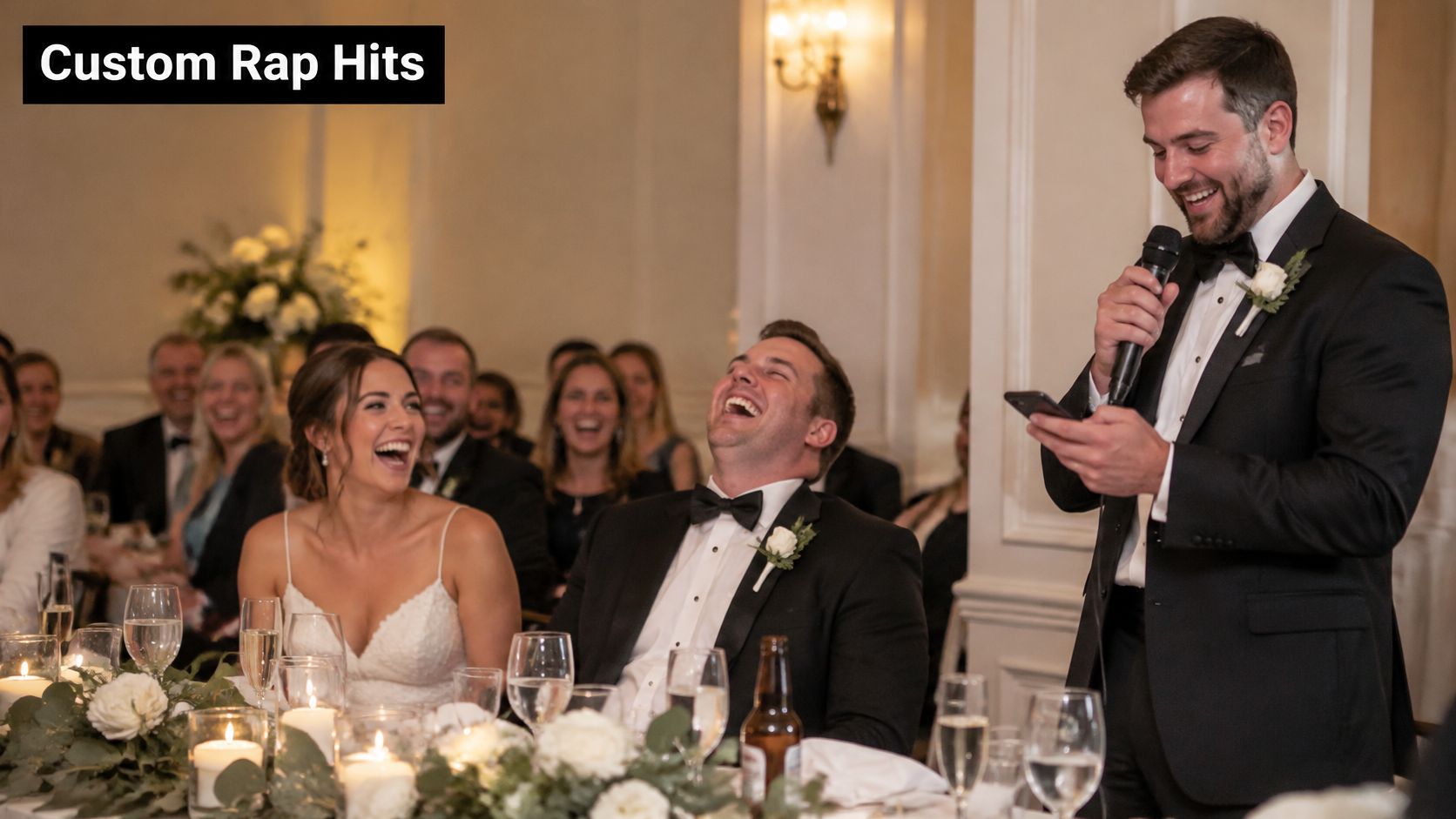 A groom and bride laughing during a wedding speech delivered by a best man holding a microphone.
Rap lived first at block parties and in clubs. Once a personal verse could be recorded, it could travel past the people who were in the room. On December 1, 1979, the Sugarhill Gang's "Rapper's Delight" entered the UK Official Singles Chart at number 38. The Official Charts account calls it the first rap record in the UK Top 40, and the first rap record to enter a Top 40 chart anywhere. Two weeks later it sat at number 3. Boasts, jokes, and spoken storytelling had become a song people would pay to hear again.
Three routes sit in front of you.
- Hire a writer when the verse has to hold up on a release.
- Write it yourself when a birthday toast is personal and the clock is yours.
- Use an AI lyric generator when a stream segment needs a draft before the show.
Pick the route, write a brief that holds up, and you'll know what you can safely post.
Choosing Between Hiring, DIY and AI Routes
The route decides the wait, the control, and how much rights work you owe yourself. Start with the comparison, then match it to the job.
| Route | Best for | Typical turnaround | Control | Main risk | Typical cost |
|---|---|---|---|---|---|
| Hire a rap writer or artist | Release-quality verse with real craft | Days to weeks | Shared after briefing | Long wait and rights terms to read | A written quote that includes clearance |
| Write it yourself | Personal songs and budget-free projects | Hours to days | Full | Flow can plateau without feedback | Time only |
| AI lyric generator | Roasts, party bits and fast drafts | Seconds to minutes | Medium: style, savagery and edits | Generic lines and authorship gaps unless rewritten | The generator's free or paid cap |
Hiring fits a verse you plan to release or license. You hand over the persona, the jokes, and the line you won't cross, then you wait. Days to weeks is normal. You give up some of the wording, so read the contract before you pay. Who owns the lyrics, who can post them, and whether a sample or a copied hook is already cleared should be on the invoice, not a surprise after the file arrives. Compare quotes on the full bill, clearance included. There is no honest single rate for this work.
Writing it yourself fits the toast, the group chat, and any project where the budget is zero. You keep every line. The cost is hours, sometimes a couple of days, not a fee. The failure mode is a flow that flattens because nobody else heard it. Send one verse to a friend who will tell you where they stumbled.
A generator fits the party bit and the stream segment, where speed matters more than a perfect multisyllabic chain. You set the style and how hard the roast goes, then you edit. Raw output goes generic fast, and a prompt by itself is a thin claim if you later want to register or license the song. Rewrite the hook and at least a verse in your own words.
Purpose picks the row. A group-chat roast, a party bit, or a live segment wants the fast column. A song you will release or license wants a human writer, or a heavy rewrite, plus a clearance pass before anyone uploads it.
AI help is already ordinary in music work. In 2025, 87% of 1,241 music makers surveyed worldwide said they used AI somewhere in their workflow, according to LANDR's global artist survey, as reported by Digital Music News. Using a draft tool isn't a shortcut you have to hide. Skipping the rewrite is the shortcut that gets you a flat verse and a messy rights story.
If the words are yours and you still need a beat under them, try ElevenLabs AI music tools from Visual Sandbox while you lock the lyric. Decide the purpose first. That choice sets how much safety and paperwork the song needs.
Write a Brief That Keeps the Roast Funny and Safe
A sharp brief saves the verse. Write it before you rhyme anything.
Target. A real friend who has agreed to be roasted, a fictional character, or a public figure you parody with care. A private person who never said yes is a different job, and a worse one.
Relationship. Coworker, cousin, rival in the group chat, or the groom. One sentence.
Inside jokes. Three to five details only this audience will catch. The karaoke key change. The lost Uber. The haircut. Skip addresses, workplaces, and anything that identifies someone who isn't in on it.
Style. West Coast, old school boom bap, trap, battle rap, drill, emo rap, or UK grime. Each one carries its own pocket and vocabulary. Pick one so the bars don't switch accents mid-verse.
Savagery. Set it before the first punchline, from playful to vicious, so the room knows the ceiling.
Then write the no-go list and stick to it.
- Protected-class insults. Race, gender, disability, religion, and sexuality are not punchlines.
- Sexual humiliation. Especially anything the person didn't offer as a joke.
- Fabricated crimes. Don't invent arrests, theft, or abuse for a laugh.
- Private details. No home address, workplace, phone number, or medical fact.
- Threats. Even jokey ones read differently once a clip spreads.
If the target wouldn't laugh at a private playback, cut the line. A joke about behavior can stay. A joke about identity should go.
A 2025 survey of 1,525 musicians found authenticity was a leading worry for 58% and copyright for 55%, in reporting gathered by MusicWave. Those numbers don't measure harassment. They do show how fast trust drops when a track feels fake or lifted. Custom diss tracks get shared in public, not kept in a headphones session. For a friend roast that stays in bounds, this guide to roasting your best friend is a useful companion to the no-go list.
Share private by default. Get a yes before you post. If a punchline feels risky, rewrite it so the hit lands on a choice the person made, not on who they are.
Paste this and fill the blanks. "Roast Sam, my cousin, who agreed. Jokes: karaoke in the wrong key, lost the Uber, bowl cut before the wedding. Style: boom bap. Savagery: playful. No threats, no private details, no jokes about identity."
How to Build the Song from Brief to Final Verse
Say a best man wants to roast the groom at the reception. He has one golden detail, a karaoke song butchered in front of the whole office, and a room full of relatives. Build in order, because each step keeps that detail funny, sayable, and safe enough to play out loud.
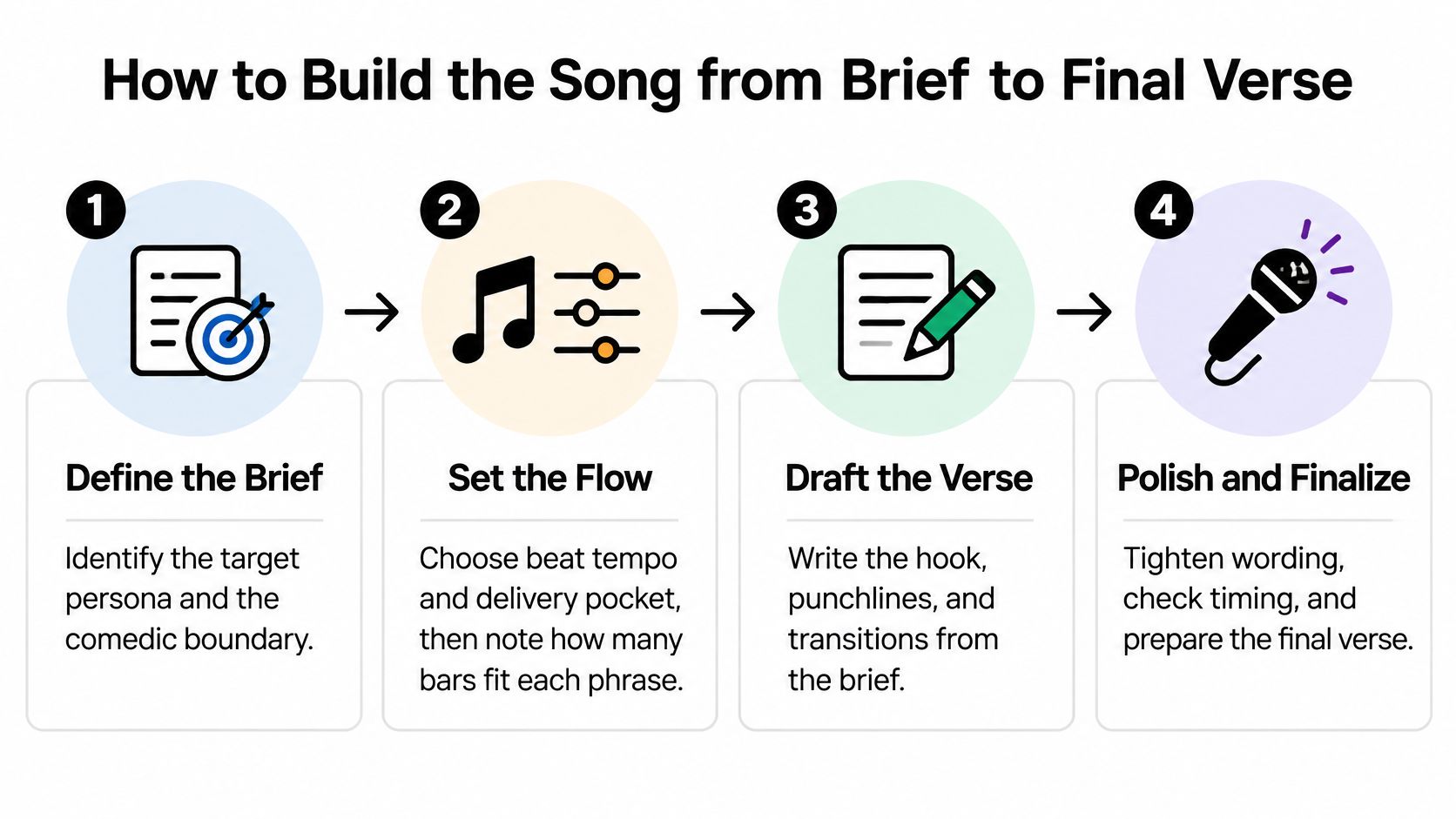 A four-step infographic illustrating the process of building a song, from briefing to final recording.
- Lock the persona and the ceiling. Name who is talking and what the roast will not touch. A verse without a boundary drifts into the no-go list by bar 12.
- Pick the pocket. Choose a tempo and count how many syllables a bar can hold before you gasp. Trap pockets want fewer words than a slow boom bap loop.
- Draft the hook on one idea. Keep it under four lines, with one phrase the room can shout. If the premise changes every line, nobody remembers it. A plain walk through song structure basics for remixers helps you see where that hook sits against the verses before you add extra parts.
- Write 8 to 16 bars. One idea per bar, and at least one personal reference in each verse. A bar that could fit any groom is a bar you have not finished.
- Audit the line. Check syllable count, where the stress falls, the end rhyme, any internal rhyme, and whether the punchline is clear on one hearing.
- Score every bar from 0 to 2. Use four marks: rhythmic fit, phonetic rhyme, semantic specificity, and whether you can perform it cleanly. Reject a draft that averages below 1.5, or that has more than two awkward stress mismatches per 16 bars.
- Keep the best mix, not the densest rhyme. Generate a few variants, then save the one with personal references, a cadence you can say, and a hook you still remember an hour later.
- Record a rough take. Read the verse aloud at the speed of the beat. Your tongue will find the stress problems your eyes skipped.
Rap lines rarely need one fixed syllable count. They lean on regular, complex stress, and on denser internal, link, and bridge rhymes than non-rap lyrics. Corpus work hosted by the University of Waterloo found negative links between critical reception and the share of four-syllable rhymes (or² = 0.16, p = 0.002) and longer rhymes (or² = 0.19, p = 0.001). Cleaner rhyme units often land better than a pile of syllables you cannot say.
Where the hook sits in the song
A hook, two short verses, and a return to the hook is enough for a toast or a short clip. If you want the bar counts and the order laid out, this rap song structure breakdown is the map. Add a bridge only after the hook works on its own.
The karaoke premise gives the song a spine. The hook is four words the wedding can yell. Verse one names the song he picked and the key he missed. Verse two names who filmed it. That is a custom rap song people can repeat, and the jokes stay on choices the groom made in public.
Once the scored draft exists, hear it against a simple loop before you polish. A rough vocal over a metronome or a spare beat shows late rhymes faster than another silent read.
You now hold a scored draft and a rough recording. The next pass is for the bars that still stumble.
Fix Weak Bars, Stiff Flow and Forgettable Hooks
Most drafts fail in the same few ways. Match the symptom, then change one thing.
| Symptom | Likely cause | Fix |
|---|---|---|
| Lines feel flat | Punchline is generic, with no name or detail | Swap in one specific detail from the brief |
| Verse trips over the beat | Too many syllables for the pocket | Cut words so the stresses land on the beat |
| Rhymes sound forced | Chasing multisyllabic rhyme density | Use shorter, cleaner end rhymes |
| Hook is forgettable | Central premise changes every line | Repeat one central idea and one sticky phrase |
| Roast reads as mean, not funny | Insult has no setup | Add a setup line before the hit |
| Awkward stresses pile up | More than two mismatches per 16 bars | Rewrite those bars with stress on the beat |
| Hook sounds like a known song | Recognizable hook borrowed from another track | Rewrite from scratch and run a similarity check |
Fix the cheapest problem first. Swapping one detail takes a minute. Rebuilding a hook means a new variant, so don't start there unless the hook is the actual failure.
Hear the stumble
Play the beat and speak the verse over it. Mark every place your mouth trips. Those marks are the stress problems. If a line needs three sentences of explanation before anyone laughs, cut the bar. Don't decorate it.
Forced rhymes are usually the density chase. You reached for a four-syllable match and the sentence stopped sounding like speech. Shorter end rhymes, said cleanly, beat a clever chain you can't perform.
A verse about a rival's bad haircut stays flat if it only says the hair was bad. Name the cut and the reason it was a mistake. "He booked the bowl cut the week of the photos, then blamed the barber" gives the room a picture. "His hair is tragic" gives them nothing to repeat.
Fix the hook first. A strong hook can carry a weaker verse. A great verse cannot rescue a hook nobody remembers.
Run the table top to bottom on one draft only. Stacking five fixes in one pass hides which change helped.
Clear Rights and Prove Your Contribution Before Release
Say your roast lands. The clip makes the group chat rounds, someone reposts it, and by Monday the video is gone. A borrowed hook or a flagged beat can pull down a funny verse as fast as a serious one, so treat rights as a checkpoint before you post.
Start a source log
List every borrowed lyric, melody, or sound. Mark each item as original writing, a sample of existing audio, or an interpolation that recreates part of an older composition. The U.S. Copyright Office draws that line clearly. An interpolation can still touch the copyright in the underlying musical work. A sample may involve both the sound recording and the composition.
Before anyone hears the public version, write down the source work, what you borrowed, the rights holders, whether you have permission, the credits, the splits, and any royalty duty. Do that record before you plan the release, not after a claim arrives.
Three myths that get people burned
"I re-recorded the melody, so it's mine." A new performance of someone else's tune is still their tune. Re-recording doesn't wipe the composition.
"It's just a roast, and the hook is obvious." A recognizable chorus inside a joke is still a recognizable chorus. Get a license, or write a new hook and run a similarity check on it.
"It's comedy, and I'm not selling it, so it's fair use." Fair use is case by case. It weighs the purpose, the nature of the source, how much you took, and the effect on the market for the original. Humor is not a free pass. Neither is a $0 price tag.
The practical pass stays short. Write original punchlines. Don't imitate a specific artist's voice. Review every chorus for a lift you can sing along to from memory. License whatever protected piece you keep, and save the prompt, the revisions, and the clearance notes.
What you can actually claim
Prompts alone generally do not establish authorship. U.S. Copyright Office guidance requires human authorship for protection, which means coverage lands on lyrics you rewrote, a performance you recorded, and genuine human selection, arrangement, or editing. AI help doesn't make the song useless. It also doesn't make raw output yours because you typed one sentence.
On our side, we don't claim any rights in the lyrics the tool writes for you. That settles the relationship with us. It doesn't register the song with the government, and it doesn't clear a hook you borrowed. For the filing steps after you've done the human work, see how to copyright lyrics to a song. A plain overview of intellectual property on AmaJova is a useful second read if splits and ownership language still feel fuzzy.
Do this before you upload:
- Rewrite by hand. The hook, and at least one full verse, in your own wording.
- Keep dated drafts. Prompt, first output, your edits, and the final text.
- Record a human performance. Your take, or a performer you hired.
- Disclose the assist. Wherever a platform or a contract asks whether AI was used.
- Drop lookalike lines. If a bar sounds like a famous rapper's record, replace it.
That file won't make a weak joke funnier. It will make a strong one much harder to knock offline.
Pick Your Route and Write the First Draft
Choose one row and start today. Hire when the verse has to survive a release. Write it yourself when the song is personal and the only spend is time. Use a generator when you need a roast or a party bit before the room fills up.
Write one paragraph: the target, the relationship, three to five inside jokes, the style, the savagery, and the no-go list. That paragraph is the whole brief.
On DissTrack AI, step 2 is where you pick style tags and how savage the diss should be. Generate a few variants, edit lines in the app, or regenerate until a bar hits, then export the lyrics as text. Be straight about the file you get. Output is lyrics text right now, and audio generation isn't available yet. Record the verses yourself, or book a performer, before you post anything.
Your task is small. Pick one target, write one brief, and build the first hook before the day ends. Then score that hook on the 0 to 2 scale so you know whether it is ready or just loud.
DissTrack AI writes personalized roast lyrics from a name, a relationship, and the jokes only your crowd knows, with style tags and a savagery setting you control. You can edit the bars, regenerate until one lands, and export the text for a toast, a stream, or a track you record yourself. When you're ready to turn that brief into a first draft, open DissTrack AI and build the hook before the group chat picks the playlist.