How to Write Drill Rap Lyrics That Actually Hit
You've got the beat loaded, the 808 is sliding under a sparse drum pattern, and the blank page is daring you to sound dangerous. The first impulse is usually to name a rival, stack threats, and borrow the coldest phrase from the last drill track you heard. That's also the fastest way to write a verse that feels borrowed, legally risky, and flat on the mic.
Strong drill rap lyrics don't depend on menace alone. They need a pocket, a point of view, compressed storytelling, and enough technical control to make every pause feel intentional. The best writers can study Chief Keef, Pop Smoke, or Central Cee without copying their surface details. They take the underlying mechanics, then put their own terrain, pressure, losses, ambition, and humor inside the frame.
What Makes Drill Rap Lyrics Sound Like Drill
You sit down with four bars in mind. Before writing the first threat, ask a better question: what can the listener hear immediately? Drill grew from Chicago's South Side in the early 2010s, with histories tracing the first explicit use of the term to Pac-Man's “It's a Drill” from the 2010 to 2012 period. Chief Keef and peers including Lil Durk, Fredo Santana, SD, and Lil Reese helped push the style into broader mainstream attention in 2012, as documented in this history of drill music.
The sound gives the lyric its pressure. Sliding 808s create tension under short, declarative phrases. Sparse snares and syncopated hi-hats leave room for the vocal to lurch, stop, and restart. Sustained notes can bend through portamento, while ad-libs such as “skrr” or “blam” punctuate the bar rather than decorate it.
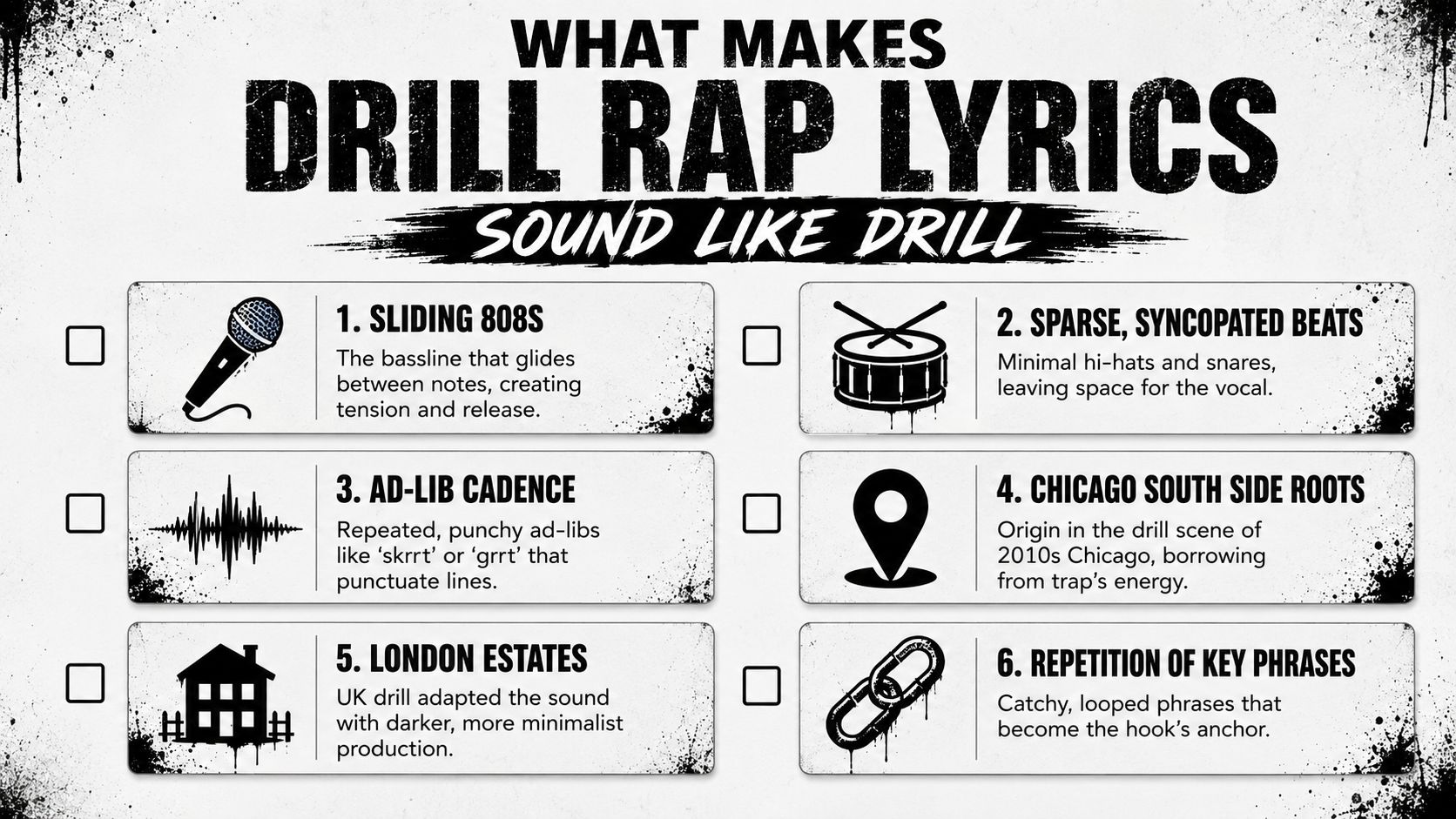 An infographic titled What Makes Drill Rap Lyrics Sound Like Drill listing six defining characteristics.
The vocabulary has a job
Territorial markers, opposition cues, local slang, and street-coded imagery can establish a world quickly. They shouldn't become costume jewelry. If you don't know a phrase, postcode, or conflict from lived experience, forcing it into a verse makes the performance sound like an imitation and may attach real people to claims you can't support.
A Chicago drill verse often feels more direct and diaristic, while UK drill tends to favor darker space, clipped phrasing, and coded references shaped by London estates. Brooklyn drill commonly leans into sliding bass, forceful repetition, and a more booming vocal attack. Trap usually gives the rapper more melodic room and a fuller low-end bed, while grime's rhythmic snap and MC tradition create a different relationship with the beat.
Mic test: If the bar only sounds “drill” because it contains a weapon reference or an ad-lib, the writing hasn't done enough work.
Try a compressed image instead: “Cold stairwell, phone light, rain on the landing.” It carries location and tension without pretending to document a crime. Repetition then turns a phrase into a hook anchor, the same way a short Chief Keef-era chant or a Pop Smoke-style call can make a sparse track feel crowded with attitude.
Mastering Drill Cadence and Delivery
Cadence is the physical architecture of a drill verse. Start with the beat, count four beats per bar, and listen for where the 808 bends. Your voice doesn't have to mirror the bass, but it should react to it. A held vowel can ride the slide, while a clipped consonant can strike against the snare.
Three useful cadence modes
Sliding cadence stretches a stressed vowel across the bass movement.
“Cold in the ends, let the low note bend.”
Hold “cold” and “bend” long enough to hear the pitch travel. Keep the rest compact. The danger is overholding every line, which removes contrast.
Double-time cadence uses rapid syllables around the off-beats. Think of it as a burst, not a permanent setting:
“Quick with the step, but I'm calm when I'm stressed.”
The exact syllable count can change with the beat. What matters is the stress pattern. Let lighter syllables move quickly, then plant “step,” “calm,” or “stressed” where the snare gives the line weight.
Stop-start cadence creates menace through absence:
“No call. No text. Still moved. Skrr.”
The pauses become part of the bar. Leave enough air for the ad-lib, then return with a word that changes the emotional temperature.
| Cadence | Tempo feel | Stress pattern | Best for |
|---|---|---|---|
| Sliding | Broad and heavy | Held vowels on bass movement | Melodic hooks and ominous statements |
| Double-time | Urgent and compressed | Rapid syllables with hard landing words | Escalation and technical display |
| Stop-start | Broken and tense | Sudden silence before emphasis | Threat-free suspense and ad-lib impact |
A practical rehearsal loop
Take one safe, original line, such as “Late train, grey sky, still I came through.” Recite it slowly with a sustained “late.” Repeat it in double-time, then break it into three clipped units. Record all three versions and compare which stress lands cleanly on beat 1 or the “and” of 2.
Use breath control instead of shouting. A dry, low delivery with controlled vocal fry often creates more authority than forcing rasp into every syllable. If your throat tightens, back off. Drill's intensity comes from timing, not vocal damage.
Rhyme Schemes, Punchlines, and Wordplay
A drill verse can sound simple while carrying dense internal mechanics. Begin with a couplet, then add pressure inside the line. For example:
“Rain on the train, still I came through the grey.”
“Rain,” “train,” and “came” share a family of sounds, while “grey” closes the thought. The rhyme doesn't need to be perfect. Slant matches often fit drill better because they preserve conversational grit.
Build the punchline in layers
Start with a believable setup. Add a concrete image. End with a reversal that changes what the listener thought the line meant.
- Setup: “They said I'd stay in the same lane.”
- Image: “Now the whole route knows the name.”
- Reversal: “I changed the map, not the face.”
The final line doesn't accuse a real person or describe a real act, but it still delivers a turn. That distinction matters. Implication can create pressure without turning the song into an identifiable allegation.
Internal rhymes raise density without making the verse sound academic. Try a stack built around the “ay” sound:
“Same day, grey rain, made way, no praise.”
Four linked sounds make the bar move, but the writer still needs a clear idea. Rhyme density can't rescue a weak sentence.
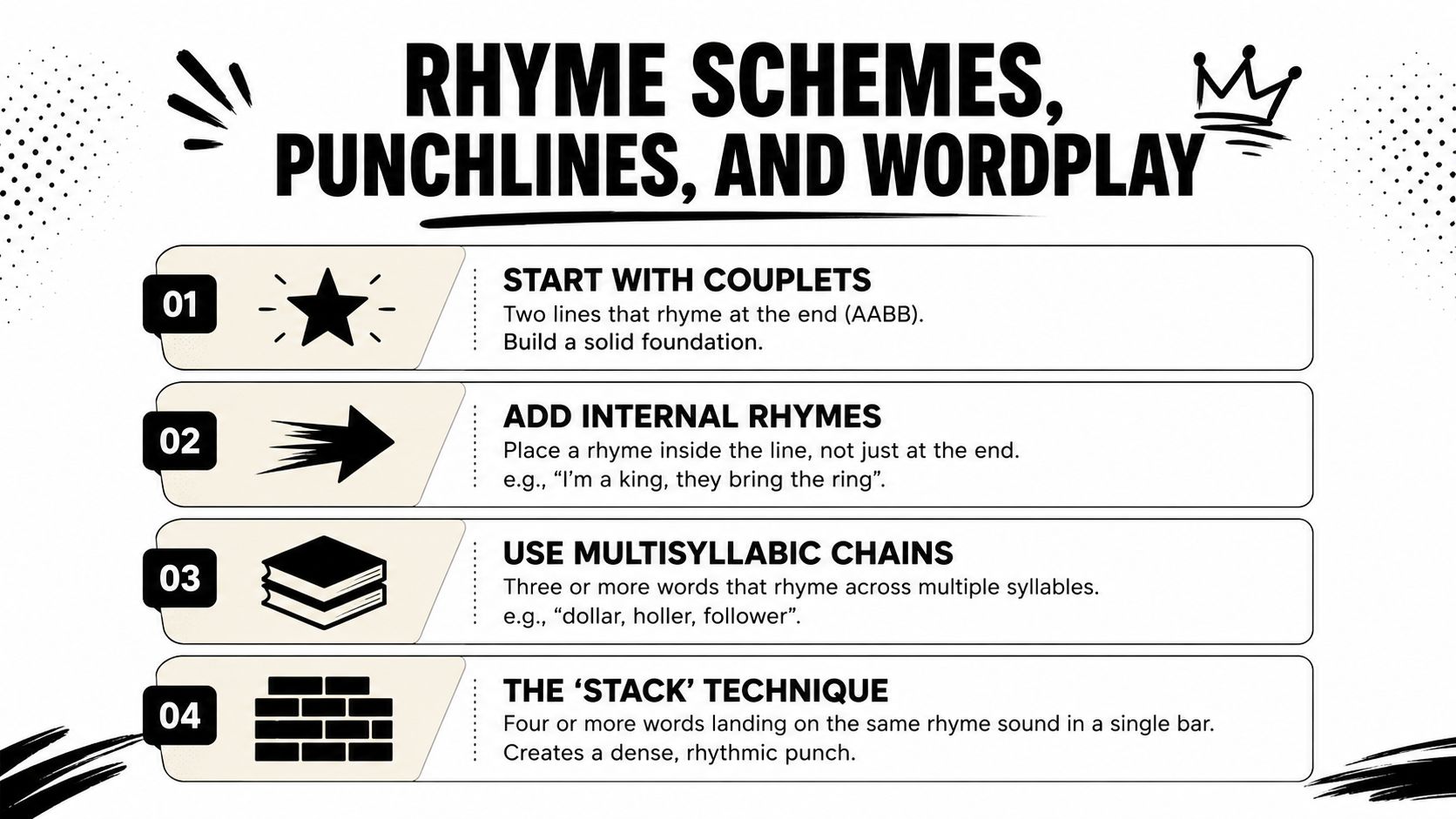 An infographic titled Rhyme Schemes, Punchlines, and Wordplay explaining four techniques for writing better rap lyrics.
Homophones and double meanings work best when the listener can catch both readings at performance speed. A phrase such as “I keep my circle tight, no loose ends” can refer to discipline, relationships, or narrative closure. It doesn't need a named target to feel pointed.
For a deeper breakdown of setups, reversals, and spoken impact, use this punchline writing guide alongside the performance exercise below.
Before recording, read every bar aloud. Cut any filler word that exists only to complete a rhyme. Check three things: does the line earn its place, does the punchline land on a stressed beat, and can you say it clearly at speed?
Themes and Storytelling in Drill Bars
The strongest drill writing usually has a world behind the posture. A qualitative analysis of 90 UK drill, grime, and related rap songs identified recurring themes including social issues, community conditions, crime involvement, status, adversity, social support, police, and escape in this thematic analysis of UK rap lyrics. That range matters because drill isn't only a catalogue of threats. It can function as compressed narrative data, but listeners and analysts need local slang and social context before treating a line as a literal confession.
Four angles that give a verse a spine
Terrain anchors the listener in place. Use a street texture, building detail, route, or weather cue rather than a random postcode.
“Same stairwell, new shoes, old rain on the rail.”
Opposition works through contrast. Instead of naming somebody, expose the gap between their public image and your private assessment.
“Big talk online, small voice when the room goes still.”
Come-up shows movement without turning into a shopping list. Progress feels more convincing when it has friction.
“Missed calls, night shifts, now the same doors let me in.”
Loss earns vulnerability through a specific object or routine. Avoid generic grief slogans.
“Your cup stays by the sink, nobody moves it.”
Time markers can bind the angles together. “Last winter,” “day one,” or “before the first upload” gives the verse sequence without requiring a full plot. Choose the angle that belongs to your actual experience, then change identifying details where necessary. A fictionalized narrative can still be emotionally honest, while a pasted-on street persona usually reads as borrowed.
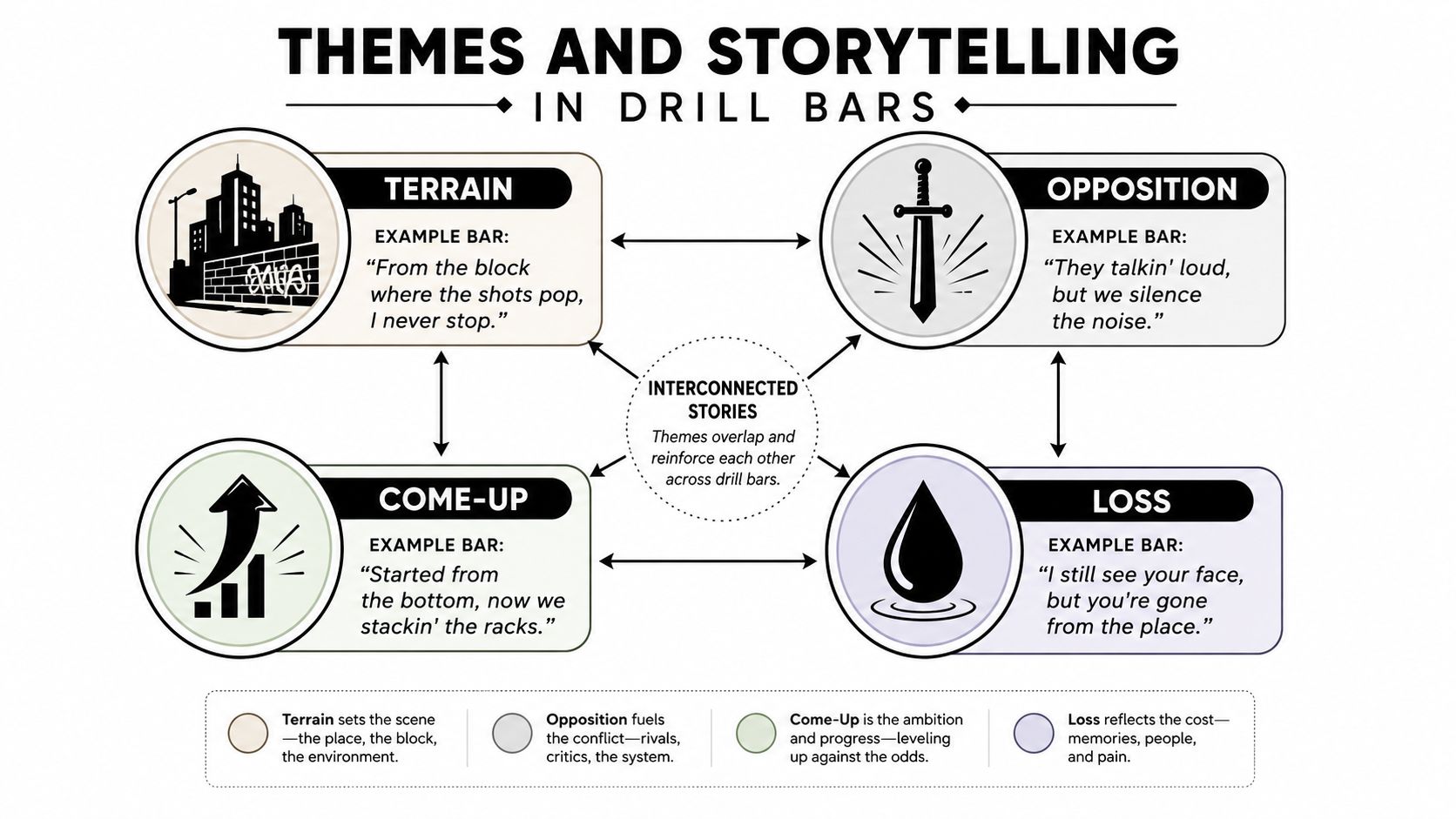 A diagram illustrating four key themes in drill rap lyrics including terrain, opposition, come-up, and loss.
Structuring a Drill Verse From Hook to Outro
A reliable arrangement gives aggression somewhere to go. One practical template uses a 4-bar hook, two 8-bar verses, a doubled hook, and a 4-bar outro carrying the producer tag or final image. Treat that as a frame, not a prison.
| Bars | Section | Function | Example move |
|---|---|---|---|
| 1 to 4 | Hook | Establish the repeatable idea | Short phrase, clear vowel, strong ad-lib |
| 5 to 12 | Verse A | Set the scene and build pressure | Terrain, routine, first contrast |
| 13 to 20 | Verse B | Switch cadence and raise the stakes | Double-time burst, sharper reversal |
| 21 to 24 | Hook | Confirm the central phrase | Add a harmony or doubled ad-lib |
| 25 to 28 | Outro | Leave an afterimage | Strip the words back, let the tag breathe |
Place ad-libs at the end of a four-bar thought or behind the snare on beat two. Don't fill every gap. Silence makes the return hit harder. A cadence change around the second half of the verse can reset the listener's ear, especially when the first passage used held notes and the next uses clipped double-time.
A sixteen-bar working scaffold
Write the hook first:
“Same cold road, but I'm not the same.”
Then assign each verse bar a job:
- Establish the location
- Add a sensory detail
- Introduce the pressure
- Land the first punchline
- Explain the response
- Add an internal rhyme stack
- Pause for an ad-lib
- Close the first movement
- Switch cadence
- Bring in the time marker
- Show the cost
- Reverse the opponent's claim
- Compress the central message
- Repeat the key vowel
- Leave one vulnerable image
- Return to the hook idea
Mirror the rhyme family between the two halves, but don't repeat the same sentence shape. The result should feel built rather than improvised. For more arrangement ideas, pair this scaffold with song-structure guidance, and use these hook-writing tips from SupaBird when the chorus feels like a verse with louder drums.
Legal and Ethical Lines You Should Not Cross
A hard bar can create artistic tension without becoming evidence, an allegation, or a direct instruction. The risk is real because courts have increasingly considered rap lyrics in criminal proceedings. Research cited in 2025 reported that UK Court of Appeal cases involving drill or rap lyric evidence rose from 20 cases between 2005 and 2018 to 33 cases from 2019 to early 2025, a more than threefold increase in annual rate, as discussed in reporting on restrictions around rap lyrics in court.
That legal attention doesn't prove that lyrics cause violence. A 2020 study of London drill lyrics found that sentiment stayed predominantly negative, yet never crossed a neutral absolute sentiment threshold of zero, and the researchers found no meaningful relationship between drill music and three forms of police-recorded violent-crime data in London. The study also reported that lyrics did not become steadily more negative over time, with relative sentiment reaching a low at the corpus's beginning and local maxima reaching 14.67% on 1 August 2016 in the measured analysis (read the empirical study). A separate version of that research likewise concluded that it found no publicly available empirical evidence that drill language incites violent crime (review the UK drill violence analysis).
Three risks deserve separate checks
- Lyrics as evidence: A fictional verse may be read as a factual admission when prosecutors isolate lines from performance context. Avoid specific threats, confessions, dates, vehicles, addresses, or descriptions that identify a real event.
- Defamation: Naming a real, non-public person and accusing them of a crime can create serious exposure. Change names, locations, relationships, and identifying details, and don't use a disclaimer as a substitute for responsible writing.
- Uncleared material: A beat, melody, vocal chop, or sample can trigger a copyright dispute if you don't have permission. Confirm the producer's terms before releasing the track.
Ethics adds a second filter. Don't turn a real victim's pain into a prop, don't glamorize a specific act, and don't use coded references to inflame an active conflict. Keep the danger in the atmosphere, then include a line that names the harm or consequence so the verse doesn't read as incitement.
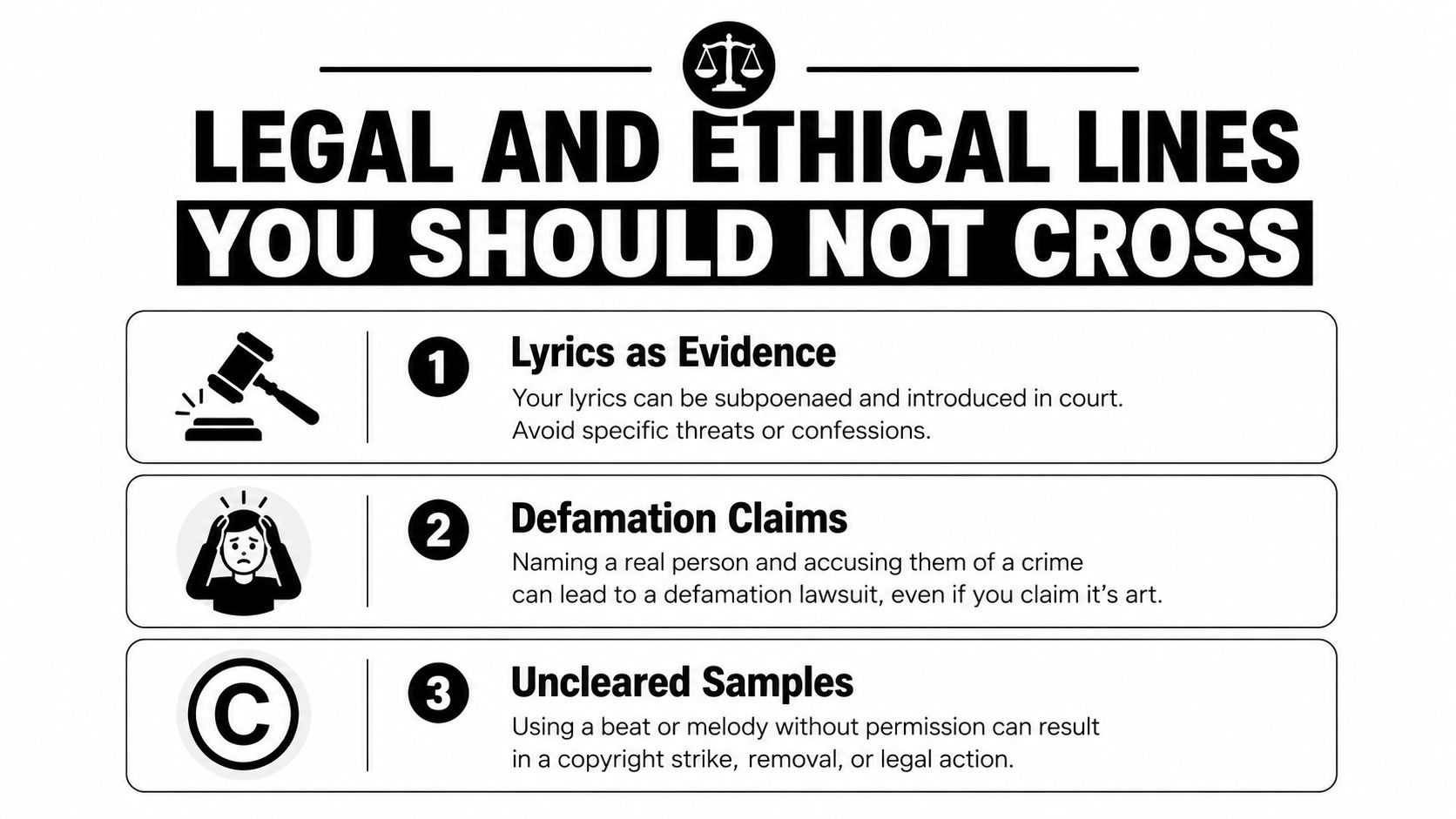 An infographic detailing three important legal and ethical boundaries to consider when writing rap music lyrics.
Using DissTrack AI to Generate Drill Verses Faster
AI can help you escape the blank page, but it shouldn't decide what is true, identifiable, or safe to publish. DissTrack AI lets you select a drill-oriented style, set a tone, provide a subject, and generate structured material that you can rewrite in your own voice. Treat the output as a rough session partner, not a finished statement.
Prompt recipe for a sixteen-bar diss verse
Use a prompt with clear boundaries:
Style tag: UK drill. Mood: menacing but melodic. Subject: fictional rival called Northside Nate. Beef intensity: 6 out of 10. Write a sixteen-bar verse with a sliding cadence, short declarative sentences, internal rhymes, and a stop-start switch after bar eight. Use fictional locations only. No real people, threats, criminal accusations, or instructions for violence. Make the final bar a nonviolent reversal.
This tells the generator what to perform and what to avoid. “Menacing” should describe the delivery and tension, not a literal plan. If the first output sounds too generic, ask for stronger sensory details, tighter internal rhyme, and fewer ad-libs rather than increasing aggression.
Prompt recipe for a hook and verse
Style tag: Brooklyn drill. Mood: dark, melodic, controlled. Subject: turning public doubt into momentum. Beef intensity: 3 out of 10. Write a four-bar hook and sixteen-bar verse. Use a sliding double-time flow, with held vowels in the hook and rapid off-beat syllables in the second half of the verse. Build around the rhyme family “late, page, change, made.” Keep the story fictional and avoid named individuals, threats, confessions, and real addresses. Include one loss image and end with a forward-looking line.
The editing pass is where the artist appears. Read the generation over the actual track, mark the weakest bar, and regenerate only that function. Replace generic punchlines with a detail from your own life, lock the main rhyme family, then test the breath points against a metronome.
A useful workflow looks like this:
- Generate variations: Keep the subject and cadence fixed while changing the imagery.
- Cut soft bars: Remove lines that repeat an idea without escalating it.
- Protect your identity: Don't paste private information or real conflict into a prompt. These AI and identity protection tips are useful before you share personal material with any creative system.
- Fact-check names: If a model produces a real person's name, replace it or verify that the lyric doesn't make a false accusation.
- Perform the edit: The page can hide awkward consonants. Your mouth won't.
Try style combinations such as UK drill with grime, Brooklyn drill with a soul-derived vocal texture, or Chicago drill with lo-fi atmosphere. Use a songwriting app workflow when you need to capture revisions away from the studio, but keep the final decisions human.
The best generated drill rap lyrics still need your cadence, your restraint, and your lived perspective. A tool can offer variations quickly. It can't take responsibility for the name you print, the story you imply, or the harm a careless bar may cause.
DissTrack AI gives you drill-focused style options, customizable tone, structured verse variations, and editable hooks for turning a rough idea into performable bars without losing control of the rewrite. Try DissTrack AI with a fictional subject, a clear cadence brief, and a safety check before you record.