Emo Blink 182: A Guide to Their Best Songs
What if the question isn't whether Blink-182 is emo, but which songs made people start hearing them that way in the first place? That's the useful question, because Blink-182 didn't wake up one day and become an emo band. They stayed a pop-punk band, but a chunk of their catalog drifted close enough to emo's emotional vocabulary that the label stuck for good.
For readers typing emo Blink 182, that distinction matters. Casual 2000s-era emo usually means songs that sound more vulnerable, more confessional, and a little less joking than standard pop-punk. Pop-punk still gives you speed, bounce, and punchline energy, while emo leans harder on loneliness, regret, and emotional directness. Blink-182 lives in the overlap, which is why the debate never really dies.
The fairest way to think about them is as a sliding scale. A lot of their songs sit firmly in pop-punk, some sit on the edge, and a few lean so hard into bruised mood that listeners reach for the emo tag instinctively. That's the lens I'm using here, accurate enough to be useful, flexible enough to explain the songs people mean.
Why Call Blink 182 Emo in the First Place
Blink-182 gets labeled emo because part of their catalog moved into darker emotional territory without losing the bright, melodic engine that made them pop-punk in the first place. The shift became impossible to miss on the 2003 self-titled album, which put more weight on sadness, tension, and self-examination while still sounding like Blink-182. That is a big reason the band's emo reputation stuck so hard. The change was public, obvious, and heard far beyond the usual underground audience.
Emo in everyday fan language
In everyday fan language, emo usually means more than a strict genre label. It can describe a mood, a lyrical stance, or even a wider cultural vibe. A song that sounds wounded, intimate, or self-questioning often gets tagged as emo even when the band still belongs to pop-punk.
Blink-182 fits that messy middle well. Songs like “I Miss You” and “Feeling This” show why listeners heard a more emotional side and started reaching for the emo label. That label feels partly earned, but it is too broad if you try to use it for the band's whole career.
Why pop-punk and emo get mixed up
The confusion comes from overlap, not from people hearing things wrong. Both styles can use fast drums, guitar-driven hooks, and choruses built for shouting along. The difference often sits in emotional emphasis, not in the instruments themselves.
Practical rule: if a Blink-182 song sounds like it wants you to jump and laugh, it usually sits closer to pop-punk. If it sounds like it wants to stay in the room after the joke lands, it moves toward emo.
That is the working lens here. Blink-182 is best understood as pop-punk with a few unmistakably emo-adjacent peaks, especially in their darker, more confessional material.
The Band's Journey From Pranksters to Heartbreakers
How did Blink-182 go from crude jokes and fast guitars to songs that sound openly bruised? The answer is not a clean break. Their emo reputation came from a slow shift in tone, where the band kept its pop-punk speed but started writing with more emotional weight and less distance.
Blink-182's early identity was built on speed, jokes, and teenage mischief, which is exactly why the later turn felt so noticeable. By the time the 1999 album Enema of the State hit the mainstream, the band had already become one of the biggest rock acts of their era, which gave them room to stretch without vanishing from view. Their rise is laid out in the band history on Blink-182 band overview.
From comedy first to confession later
Their first big phase leaned on the classic pop-punk mix, bright hooks, bratty humor, and clean momentum. Fans loved that version because it was easy to shout along with and easy to recognize. Then the emotional vocabulary deepened, and the band stopped sounding like they were only performing adolescence.
The self-titled era is where that shift became hard to ignore. The music got heavier in mood, the lyrics got more vulnerable, and the band let silence, tension, and regret sit next to the usual bluntness. That combination did not erase their old personality. It complicated it, the way a familiar joke sounds different after the room gets quiet.
Personal life changes bled into the writing
The darker tone did not happen in a vacuum. Breakup tension, addiction, maturity, and mental health struggles all pushed the songs toward a more confessional center. That is why the change feels personal instead of cosmetic. You can hear the band reckoning with themselves, not just trying on a new subgenre for fun.
That emotional growth is also why later listeners return to the self-titled era as a bridge record. It still sounds like Blink-182, but it sounds like Blink-182 after the jokes stop being enough. If you want to understand why fans argue about emo Blink 182, this is the biography you need, not just the discography.
A useful comparison helps here. The song's harmony can do part of the work, which is why readers who want a clearer chord progression basics reference often hear how a few chord choices change the mood even before the lyric lands. That musical shift also explains why conversations about AI and emotional music creation keep coming up, because the emotional effect is never just about one element by itself.
The arc in one sentence
They started as pranksters, became stars, then wrote like people who had something to lose. That is the setup for the emo conversation.
What Actually Makes a Blink 182 Song Sound Emo
The easiest way to hear the shift is to listen for the details that change the emotional weight. Blink-182's song “Emo” is documented at 123 BPM, in E major, with a 2:51 runtime and 4/4 time, which puts it in a mid-fast pop-punk zone rather than true down-tempo ballad territory (song details). Even there, the title feels half-joking and half-self-aware, which is very Blink-182.
The cues that move a song toward emo
The songs that people call emo usually add minor-key color, more atmosphere, and a heavier emotional focus. “I Miss You” is the obvious example because its gothic mood, sparse tension, and intimate delivery make it feel colder and more exposed than the band's joke-heavy material. “Down” works differently, but it still leans into slow-burn sadness rather than straight-up rush.
The lyric side matters just as much. Emo-leaning Blink-182 songs often use first-person vulnerability, loss, regret, and emotional self-inquiry. Instead of just acting out adolescence, they sound like they're processing it.
A useful outside comparison helps here. If you want a broader breakdown of how chord movement shapes mood, the primer on chord progression basics is a good companion read, because the harmonic side of this conversation is simpler than people assume.
What keeps them from fully leaving pop-punk
Even at their most emotional, Blink-182 usually keeps the I–IV–V-based progressions, power chords, palm-muted rhythmic picking, and punchy attack that define pop-punk's drive. Technical breakdowns of their writing point to exactly that combination, simple harmonic structure plus percussive guitar work, which helps explain why their songs stay accessible even when the mood turns serious (technical analysis).
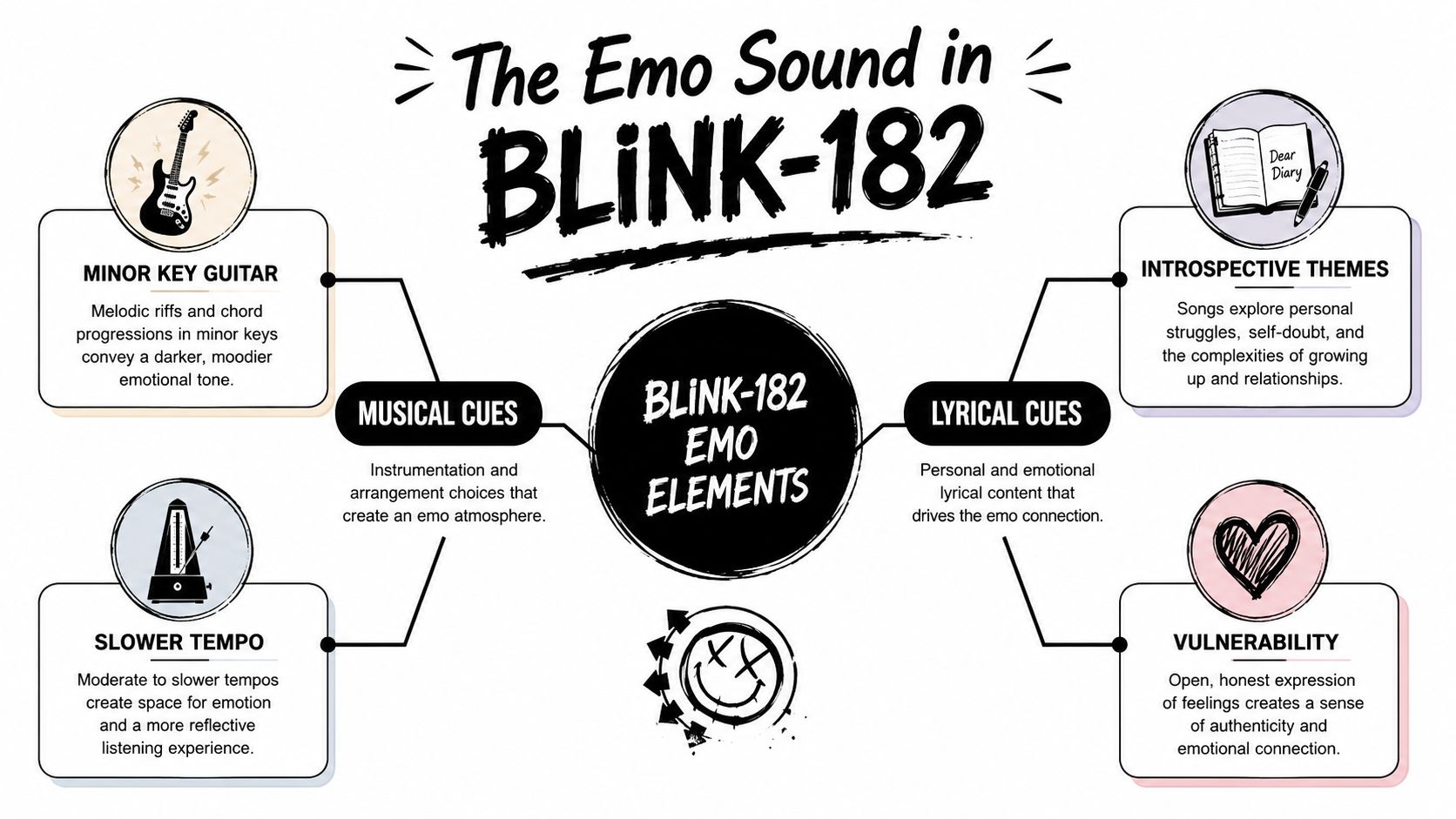 An infographic diagram explaining the emo musical and lyrical elements found in the band Blink-182's sound.
Useful shortcut: Blink-182 sounds most emo when the guitars stay simple but the emotional framing gets heavier. The music doesn't need to get harmonically complicated for the feeling to change.
If you're curious about how machines might imitate that kind of emotional contrast, the discussion of AI and emotional music creation is a helpful rabbit hole. It's a reminder that the “emo” effect often comes from arrangement choices, not just lyrics.
The Self-Titled Album as the Emotional Turning Point
Why do so many listeners point to Blink-182's 2003 self-titled album when they talk about the band going emo? Because this is the record where the emotional center moves forward and the jokes stop carrying the whole song. The band keeps its pop-punk skeleton in place, but the mood grows darker, the lyrics feel more exposed, and the performances sound less like a prank and more like a bruise. Tracks like “Feeling This” and “I Miss You” became reference points for that shift, since they sound haunted, intimate, and far more interested in emotional tension than in being purely funny (album details)).
Self-Titled Album Emo Highlights
| Track | Emotional Tone | Why It Reads as Emo |
|---|---|---|
| I Miss You | Haunted, lonely, intimate | The mood is vulnerable and stripped of the usual prankster edge |
| Feeling This | Restless, tense, romantic | It mixes urgency with emotional friction instead of simple humor |
| Down | Heavy, drifting, sad | The pacing and atmosphere make it feel slower and more wounded |
| Emo | Self-aware, ironic, anxious | The title itself shows how the band played with the label |
Why this record changed the conversation
The shift mattered because it happened inside a band that was already enormous. Blink-182's broader commercial reach helps explain why the emotional turn was so visible. The band has sold 50 million albums worldwide and 15.3 million in the United States, and Enema of the State sold over 15 million copies worldwide while making them one of the era's biggest international rock acts (band overview). When a band that widely recognized gets more vulnerable, the change does not stay subtle.
That scale is part of why the emo label stuck. A smaller band can sound intense and still remain a cult favorite. Blink-182 did it in the mainstream, so the darker tone had nowhere to hide. The emotional shift became easy to hear because it arrived in songs that were already reaching huge audiences.
Why fans still return to it
A recent retrospective on the album keeps landing on the same point. The record widened Blink-182's emotional range and gave listeners a more vulnerable version of the band to hold onto (retrospective). That is why this era still anchors the band's emo reputation two decades later. The impact goes beyond a single track. The entire album shifted the emotional center closer to the foreground.
Pop-Punk vs Emo and Why the Argument Even Exists
A lot of listeners push back on the emo label because Blink-182 still sounds, at heart, like a pop-punk band. Independent music coverage describes them that way first, while also noting that some listeners mistakenly file them under emo (genre coverage). That's not a trivial distinction. It's the reason the debate keeps resurfacing.
The pop-punk case
The pop-punk argument is easy to make. Blink-182 built their identity on speed, hooks, bratty humor, and a tone that usually wants to move forward instead of wallow. Even their emotional songs rarely abandon the genre's bounce completely. They'd rather turn sadness into a chorus than sit in it for six minutes.
That's why older fans often resist the emo tag. To them, calling Blink-182 emo can sound like flattening the band's personality into one mood.
The emo-adjacent case
The emo side of the argument is more specific. Blink-182 wrote songs that sounded more vulnerable than their peers, and their self-titled era made that shift especially visible. Listeners who came up through emo playlists, reunion-night nostalgia, or later online scenes often heard those songs as emotionally central, not just stylistic side notes.
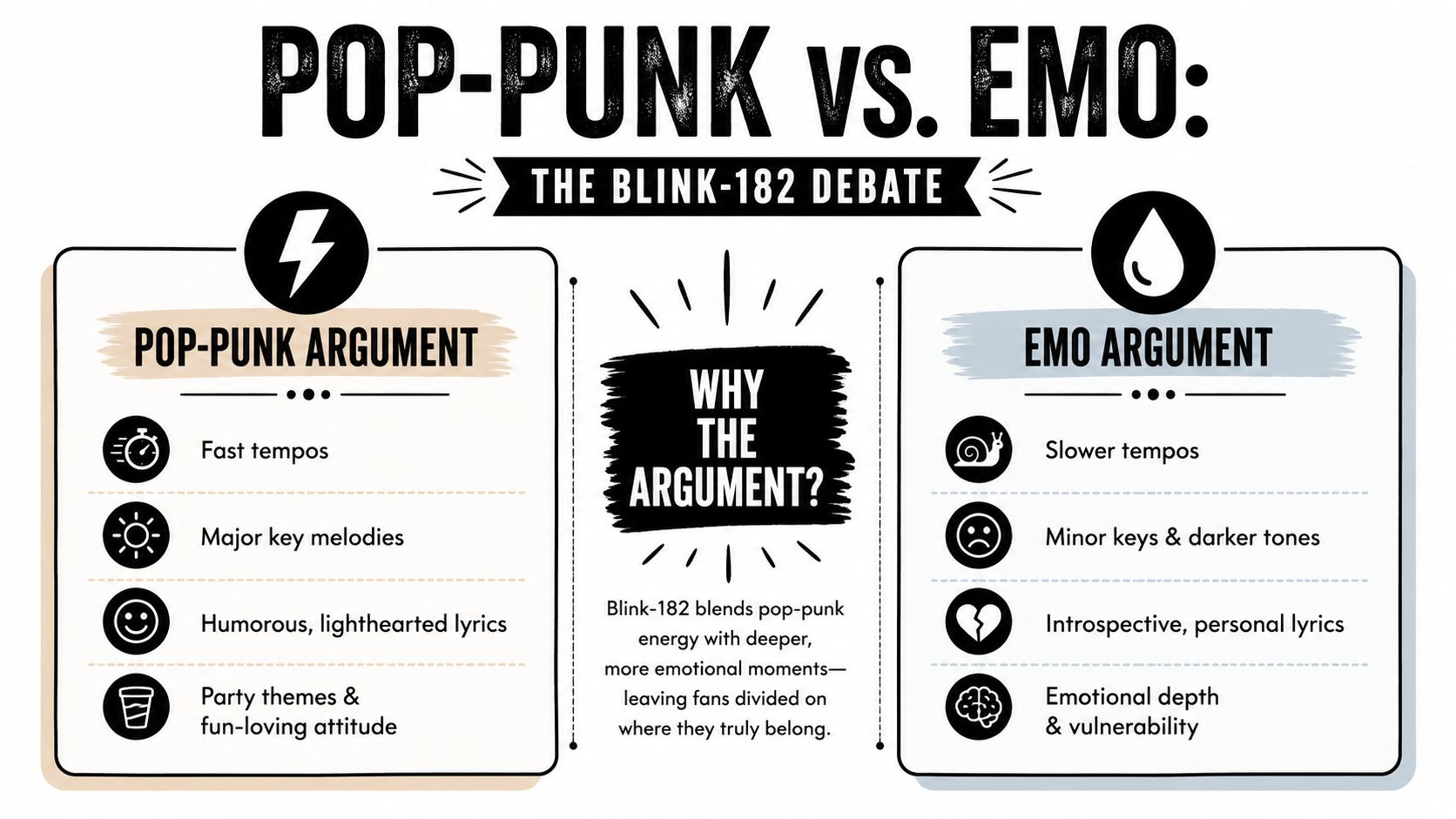 A comparative infographic titled Pop-Punk vs Emo explaining the debate surrounding the band Blink-182's musical style.
The cleanest conclusion is the least dramatic one. Blink-182 sits at the emotional edge of pop-punk, and the emo label fits best when you apply it to specific songs and eras instead of the whole catalog. That's more accurate, and it explains the disagreement better than a simple yes or no.
How Blink 182 Shaped Emo Pop and What Came After
Blink-182's emo value isn't just about how the band sounded. It's also about what later scenes borrowed from them. Their mix of melody, vulnerability, and easy-to-chant hooks helped set the template for a lot of emo-pop that came after, especially the version of the genre that wanted to be both catchy and bruised. Recent scene coverage keeps showing how their songs remain staples in nostalgia-driven settings like Emo Nite, where blink-182 sits comfortably beside My Chemical Romance, Fall Out Boy, Paramore, Dashboard Confessional, and other scene favorites (Emo Nite coverage).
The afterlife of the sound
You can hear Blink-182's influence in the way later emo-pop acts balance contrast. Fast verses drop into emotional choruses. Jokes sit next to confession. Hooks stay huge even when the lyrics get fragile. That formula didn't belong to Blink-182 alone, but they helped make it normal enough to spread.
The band also became part of the broader visual and social memory of the era. Emo scholarship and fan culture now treat them as one of the key bridges between mainstream pop-punk and the emotional language that later scenes recycled, remixed, and memed.
Why the internet keeps reviving them
The internet loves a band that can be reduced to a vibe but still rewards close listening. Blink-182 fits that perfectly. Their songs work at parties, in nostalgia playlists, and in fan arguments, which is why they keep circulating in new contexts.
That video culture matters because it keeps reframing the same songs for new ears. A track that once felt like a mainstream rock single can later read like a gateway into emo aesthetics, especially when a new generation discovers it through clips, edits, or scene playlists.
Your Starter Pack and How to Write in the Style
If you want the shortest path into emo Blink 182, start with the songs that show both sides of the band. Open with “I Miss You”, then “Feeling This,” then “Down,” and then loop back to “Emo” for the meta joke. After that, spend time with the self-titled album as a whole, because that's where the emotional arc makes the most sense together.
A smart listening order
- Start with “I Miss You”: It's the clearest example of the band's darker, more vulnerable side.
- Move to “Feeling This”: It shows how emotional tension can still feel huge and catchy.
- Add “Down”: The pacing and atmosphere make the sadness easier to hear.
- Finish with “Emo”: It's the band winking at the label while still living inside it.
- Then play the 2003 self-titled album front to back: That's the best single snapshot of the era.
If you want to write in a similar style, the trick is balance. Keep the chords simple, let the vocal melody carry the ache, and use specific emotional images instead of vague gloom. A good guide to writing memorable lyrics can help with that part, especially if you're trying to make the lines feel personal instead of generic.
Practical rule: emo-leaning Blink-182 writing works best when the line feels honest enough to hurt a little, but still sharp enough to sing with a crowd.
How to borrow the mood without copying the band
For production, use minor-key shapes, a steady backbeat, and a chorus that feels bigger than the verse. For lyrics, lean into relationship fallout, self-doubt, and the weird mix of humor and humiliation that Blink-182 handled so well. If you want the emotional charge to hit harder, the bridge or pre-chorus should feel like the pressure valve opening.
A useful technical companion is the explainer on what a pre-chorus does, because Blink-182-style songs often depend on that lift. If you're writing diss tracks, the same mood can work there too. The vulnerability becomes self-aware drama, the roast lands harder because it sounds like the narrator cares too much.
Quick Answers to the Questions Readers Ask Next
Is Blink-182 officially emo? The cleaner answer is no, because pop-punk still describes the band better overall. The emo label fits certain songs and a specific stretch of their career, but it works more like a sliding scale than a permanent tag.
Which Blink-182 album feels the most emo? The 2003 self-titled album makes the strongest case because it widens the band's emotional range and puts songs like “I Miss You” at the center of how listeners remember that era.
Why do people call them emo at all? Their darker material sounds more exposed and confessional than their early prank-heavy work. Those songs helped make emotional pop-punk feel normal in the mainstream, even if the band never stopped sounding like Blink-182.
Did Blink-182 influence later emo-pop? Yes. Their mix of melody, tension, and vulnerability shows up in later emo-pop, and the band's influence still hangs around in nostalgic scene listening habits and reunion-era playlists.
If you want to compare that kind of emotional framing with another song form, a clear explanation of what a cover version of a song is helps show how styles get reshaped as they move between scenes.