
Emo Rap Explained: Sound, Artists and How to Write It
Emo rap is a hip-hop style that fuses trap beats and rap cadence with emo's confessional, melodic lyrics.
Say you're staring at a message someone read but didn't answer. You don't want a victory anthem. You want a song that sounds embarrassed about caring, furious about being ignored, and catchy enough to sing while pretending neither thing bothers you.
That's the useful way into emo rap. Not as a requirement to own a distorted guitar or write the bleakest line imaginable, but as a way of turning private discomfort into something other people can sing. The drums can hit hard. The narrator doesn't have to pretend they're bulletproof.
Emo Rap at a Glance in One Table
Think of a rapper singing their diary over a trap beat, like a group chat with a hard drum kit. The message is personal, the delivery slips between speech and melody, and the beat leaves enough room to hear the hesitation.
Listen for the relationship between those parts rather than a single production trick. A sad sentence isn't enough, and neither is a guitar loop dropped onto otherwise unrelated vocals.
Core traits of emo rap
| Trait | Typical Choice | Why It Matters |
|---|---|---|
| Drums | Trap 808s with a half-time feel | Gives a heavy, slow pocket |
| Harmony | Sustained minor-key chords | Carries the melancholy |
| Guitar | Distorted or sampled guitar | Links the sound to emo and punk |
| Vocals | Sung and half-sung rap | Makes the confession audible |
| Lyrics | First-person heartbreak, isolation, self-doubt | Creates the bond with listeners |
| Finish | Saturated, blown-out low end | Signals rawness over polish |
Listen to the person before the preset
Start with vocal delivery, the melodic hook, and the emotional first-person frame. Is the performer explaining an experience from inside it, or merely describing something sad? Does the refrain feel like a thought they can't stop repeating?
A useful listening exercise is to ignore the backing briefly. If the vocal sounds like someone arguing with their own memory, you're hearing an important part of the approach. Bring the beat back, and notice whether the arrangement supports that exposed feeling or buries it.
Practical rule: Judge the combination of traits, not the presence of a guitar or the darkness of a lyric.
There's no single tempo or drum pattern that settles the classification. A track that hits most rows will often read as emo rap, while sad lyrics over a conventional boom bap arrangement may be better described as sad rap. That's a listening shorthand, not a customs checkpoint.
Use the table without turning it into a test
The finish row is especially easy to overread. Rawness can help, but a polished mix doesn't automatically erase emotional vulnerability. Likewise, a producer can use synths instead of guitar and still make room for the same confessional performance.
Pull up a few tracks you already know and run them through the table. Mark what you hear rather than what the cover art promises. You'll learn more from comparing the vocal and arrangement than from arguing over whether a performer's hoodie is sufficiently distressed.
Where Emo Rap Came From
Start with a bedroom, a laptop, and an upload button. A performer records a hook that sounds too bruised for a triumphant rap single and too rhythmically loose for a conventional rock song. Someone elsewhere hears it online, sends a message, and contributes a verse.
That's a useful scene to hold in mind, not a claim about a single founding session. Emo rap grew through connections between people who didn't need to live near each other or wait for permission to release music.
Before the label, there was confession
The NPR feature carried by KCSM places the convergence of hip-hop, emo, punk, and internet-based SoundCloud scenes in the mid-2010s, and describes a lineage that includes Tupac, Kid Cudi, and the Geto Boys, alongside the modern community around GothBoiClique, Lil Peep, Lil Tracy, and Wicca Phase Springs Eternal.
Those names don't represent interchangeable sounds. They help explain why the neat version of the story, rock sadness suddenly arriving to rescue emotionally unavailable rap, doesn't hold up. Introspection already belonged to hip-hop.
The newer combination gave that introspection a different musical setting. Rap cadences could sit beside a melodic hook; guitar textures could share space with trap drums. A performer didn't have to choose between sounding wounded and sounding rhythmically forceful.
The community's development is easier to understand as a network than a birthplace.
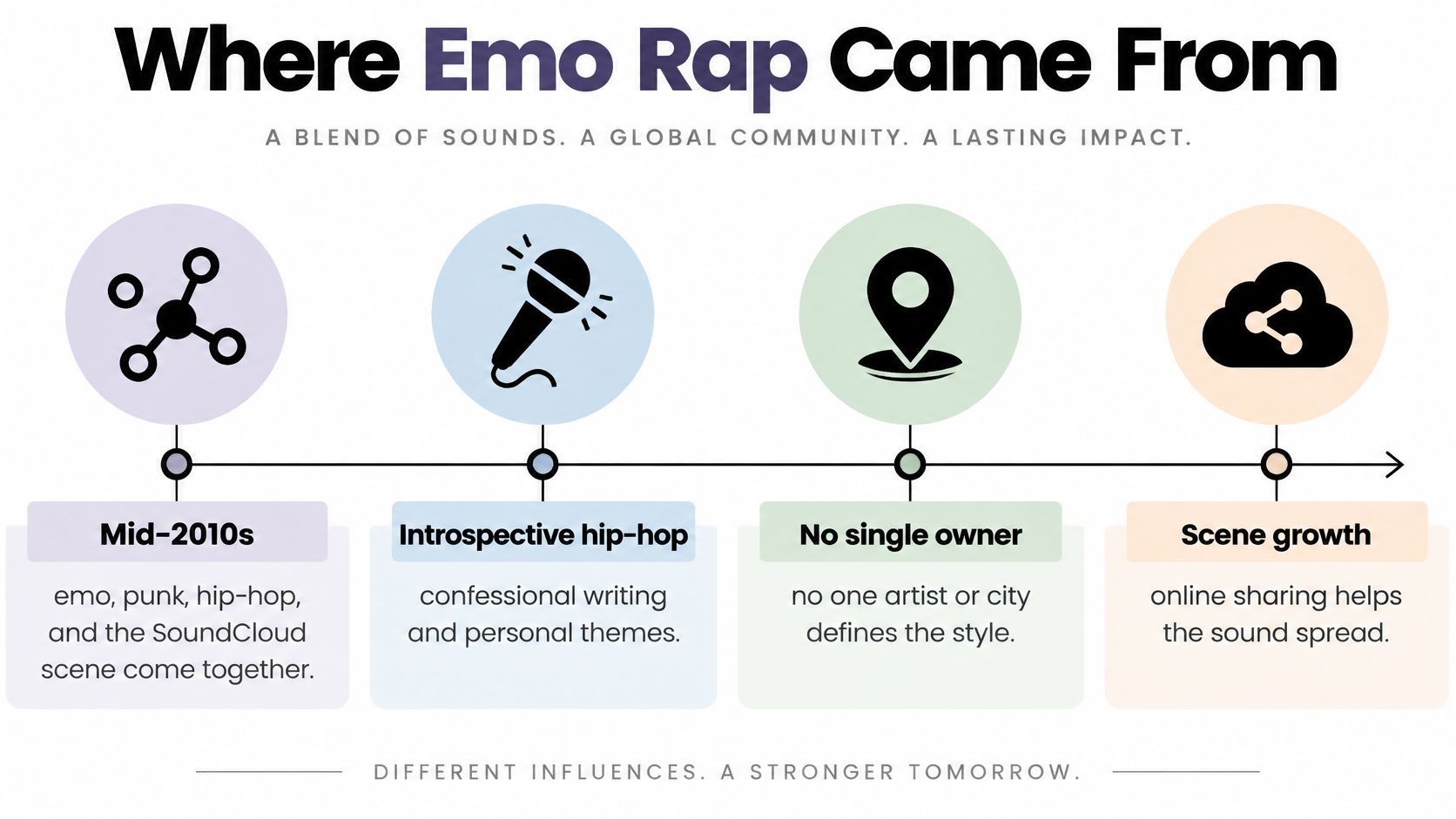 An infographic titled Where Emo Rap Came From explaining its origins, themes, and global community development.
From the upload page to a wider audience
SoundCloud mattered because artists could distribute songs directly without traditional label access. Geographically scattered musicians could hear one another, collaborate, and develop a recognizable aesthetic without assembling in the same local venue.
Think of the difference between waiting for a hometown gatekeeper and sending a song directly to listeners who already understand its mood. The latter lets an unusual hybrid find its people before anyone agrees what to call it.
The listening surge was substantial: Spotify data reported by NBC News showed emo rap listening grew 292% in 2018 compared with 2017, after accelerating in late 2017. That shift marks the point where an online scene became difficult for the broader music business to overlook.
For writers, there's also a useful connection to older forms of mourning and remembrance. The elegiac verse examples from Lumi Humanizer offer a way to think about absence through concrete objects, remembered gestures, and things left unsaid, without treating poetry as a claimed historical source for the genre.
The origin matters because no artist or city owns the entire method. A network assembled this sound from overlapping traditions. Writers elsewhere can contribute their own details instead of borrowing someone else's bedroom, accent, and heartbreak wholesale.
Key Artists and Their Breakout Numbers
Juice WRLD's 2018 single Lucid Dreams reached No. 2 on the Billboard Hot 100, while his debut Goodbye & Good Riddance peaked at No. 15 on the Billboard 200, according to the chart history summarized in Wikipedia's emo rap overview.
That pairing matters. A memorable single can introduce an artist, but an album gives listeners somewhere to stay. Here, a confessional approach worked both as an immediate hook and as a longer emotional setting.
Breakout releases and chart results
| Artist | Breakout Release | Chart Result |
|---|---|---|
| Juice WRLD | Lucid Dreams (2018) | No. 2 Billboard Hot 100 |
| Juice WRLD | Goodbye & Good Riddance | No. 15 Billboard 200 |
| XXXTentacion | 17 (2017) | No. 2 Billboard 200, debut |
| Lil Peep | Come Over When You're Sober, Pt. 1 | No. 38 Billboard chart |
These results show different releases reaching established commercial channels, not a leaderboard of artistic importance. The same overview identifies emo rap as Spotify's fastest-growing genre in its breakthrough period. The useful takeaway is that intimate online music and mainstream reach weren't opposites.
Hear the differences behind the category
Use Lil Peep as a listening reference for the seam between a melodic confession and a rock-oriented texture. Pay attention to how you experience the hook: does it sound performed outward to a crowd, or repeated inward until a crowd can join?
With Juice WRLD, study the balance between emotional complication and melodic clarity. A useful writing exercise is to notice how a refrain can remain easy to remember even when the feeling underneath it isn't tidy.
For XXXTentacion, listen for contrasts in intensity. Don't treat aggression as an instruction to shout throughout a song. An exposed passage can feel more exposed when the surrounding performance has somewhere harsher to go.
These are listening prompts, not complete definitions of the artists. You're choosing a reference for a particular craft problem, not reducing a catalog to a mood sticker.
Build a reference shelf, not an imitation kit
Lil Tracy and Wicca Phase Springs Eternal also belong in the listening conversation. Leaving them out of a chart table doesn't make them peripheral to understanding the scene. Commercial measurements explain audience scale, not every artistic connection.
The durability of the biggest records is visible beyond their initial chart runs: Spotify reported that Lucid Dreams had surpassed 2.5 billion streams by May 20, 2024.
Choose references by the problem you're trying to solve:
- Heartbreak: Listen to Lil Peep for the relationship between melody and a bruised atmosphere.
- Intensity: Use XXXTentacion to consider contrast rather than constant maximum volume.
- Melodic recall: Study Juice WRLD when your verse has feeling but the hook won't stick.
Take notes on arrangement and delivery. Don't borrow signature wording or try to reproduce a performer's identity. The point is to understand a decision well enough to make your own.
How Emo Rap Is Built in the Studio
Open your digital audio workstation and mute everything except the vocal and the main loop. If the emotional idea disappears without a mountain of effects, fix the arrangement before adding more distortion.
Spotify's music-intelligence analysis describes connected sides of this sound: distorted, blown-out low end and spacious, wallowy trap beats that foreground melody and feeling. You can work between those poles rather than choosing either pristine softness or total sonic wreckage.
A modest home setup is enough to audition those decisions.
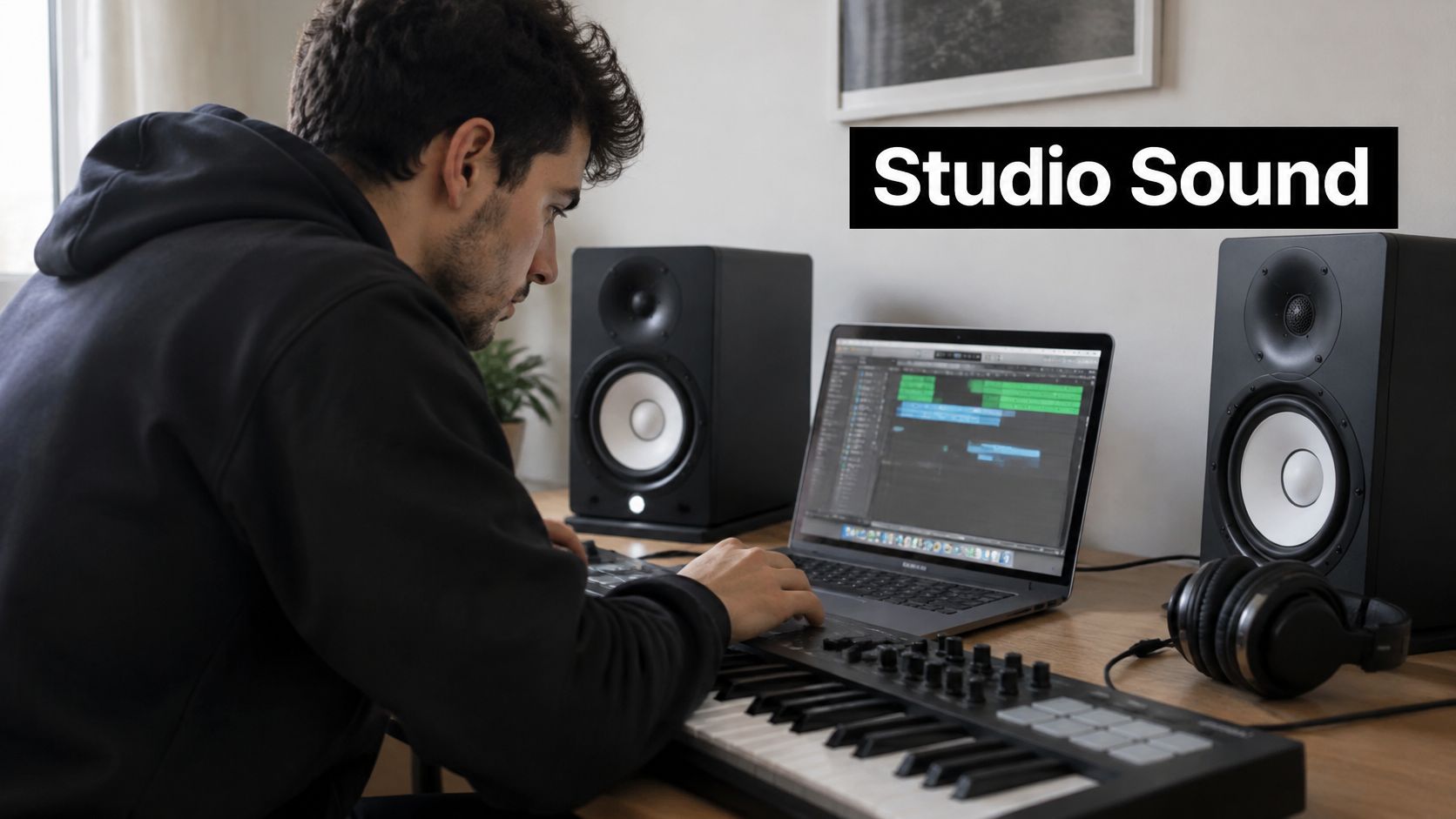 A young music producer working on a digital music production project in a home recording studio environment.
Build room around the confession
Begin with an 808-centered drum pattern that feels unhurried. Place the kick and snare so the vocalist can finish a thought, then add hi-hats without filling every available gap. A busy subdivision can add nervous energy, but it shouldn't turn a delicate phrase into an obstacle course.
Lay sustained minor-key chords underneath. Keep the voicing simple enough that a sung line can supply movement; the guide to chord progression basics is useful if you're choosing harmonies by trial and error.
Then audition a guitar or alternative-rock texture. A distorted part may add friction, while a sampled phrase can establish a repeating emotional backdrop. If you use a sample, make sure you have the necessary permission before releasing it.
Change the texture deliberately
Use saturation or controlled clipping on the bass when you want roughness, but compare it against the clean signal at a similar listening level. Louder can seem more exciting even when it's merely louder.
- Clean versus clipped 808: Choose whether the low end should support the vocal or push against it.
- Minor loop versus brighter keys: Check whether the harmony deepens the words or usefully contradicts them.
- Single take versus doubled vocal: Keep intimacy for a close confession; add doubles where a line needs pressure.
For a visual listening break, play the embedded video and focus on the space around the vocal rather than looking for a preset to copy.
Don't distort everything merely to prove you can. Leave consonants intelligible and preserve a contrast between restrained verses and more insistent hooks.
Try the same confessional verse over a clean keyboard-led arrangement and then a saturated bass-led version. Keep whichever makes the words feel more believable, even if it's the less spectacular mix.
Writing Emo Rap Lyrics Without Losing the Edge
Say your draft begins with a missed call and ends with the narrator declaring that suffering makes them special. The first image gives the listener something recognizable. The conclusion asks them to admire the damage.
You don't need that trade. Emotional intensity isn't the same thing as glamorizing crisis, and dark humor doesn't require treating self-destruction as a credential.
Heavy themes aren't entry requirements
Academic discussion of emo rap includes sadness, depression, drug use, addiction, adolescence, reputation, violence, and death, as described in this Kent State academic analysis. Those are recurring subjects, not a checklist a writer must complete.
The wider rap context matters too: a content analysis of 125 high-ranking U.S. rap songs found anxiety references in 28% and depression references in 22%, as summarized in Unlocking the Lyrics. That sample concerns popular rap, not emo rap alone.
You can write about insecurity without making a diagnosis. You can describe isolation without claiming that nobody will ever help. A narrator who admits they're hurt has already taken a creative risk.
Three lyric modes and when to use them
| Lyric Mode | What It Sounds Like | Safe Use |
|---|---|---|
| First-person disclosure | I stopped answering her texts | Honest heartbreak told through your own lens |
| Battle persona | You left me as the bad guy in your story | Roast energy aimed at a fictional or playful target |
| Literal harm | Lines that romanticize self-harm or suicide | Avoid; reframe toward recovery or clearly fictional conflict |
Keep the feeling, change the implication
First-person disclosure works best when it distinguishes an experience from a verdict. I felt disposable after you left describes a feeling. It doesn't require the song to declare that the narrator is disposable.
A battle persona can exaggerate the social situation instead of escalating the danger. Make the unreliable friend a terrible customer-service department. Make the style-copying rival your unpaid tribute act. There's plenty of room for bite without threats.
Write the wound honestly. Don't make the wound the prize.
A recovery perspective doesn't need to sound like an inspirational poster. A narrator can still be annoyed, embarrassed, or stuck while choosing to leave the party, call a friend, or stop rereading the messages. Those small actions give the character somewhere to go.
Clearly fictional conflict can also create distance, but fiction isn't a reason to make harmful behavior aspirational. For this kind of roast writing, keep heartbreak, betrayal, and insecurity; cut threats, suicide imagery, and claims that suffering makes someone glamorous. You're preserving the emotional voltage, not draining it.
How to Write an Emo Rap Verse Step by Step
Say your friend Sam always promises to join the gaming session, then disappears while posting elsewhere. You've got a recognizable behavior, a little disappointment, and a target who can plausibly laugh. That's more useful than opening with a generic claim that Sam is fake.
Build the verse around the moment you noticed the contradiction. Concrete detail → internal reaction → melodic refrain → reversal gives the performance an emotional progression instead of a pile of insults.
Draft from the smallest true detail
-
Pick a specific detail. Use the ready-up screen you watched while Sam posted a snack photo, rather than a broad accusation about loyalty. Specifics make the scene legible; the common slip is adding unrelated complaints until nobody knows what the song is about.
-
Write the internal reaction in a small, honest line, such as I kept your place like you were coming back. It admits investment without requiring a grand tragedy; the mistake is making a missed game sound like the collapse of civilization.
-
Build a short melodic refrain, then repeat it with a slight change: Still waiting in the lobby / You're busy being offline, followed later by Done waiting in the lobby / You can queue up next time. Repetition gives the listener something to sing, while the changed ending shows movement; a wordy hook is the usual trap.
-
Turn the wound into a jab: Sam, your snack got a photo, but we couldn't get a sign. The joke grows out of the same incident, so it doesn't cancel the feeling; avoid bolting on a harsher insult that belongs to a different song.
-
Check the flow aloud. Sing the refrain, rap the connecting lines, and mark where you naturally inhale. If you have to rush the setup to reach the joke, cut words rather than treating breathlessness as proof of skill.
The visual reminder keeps the drafting process anchored to the detail.
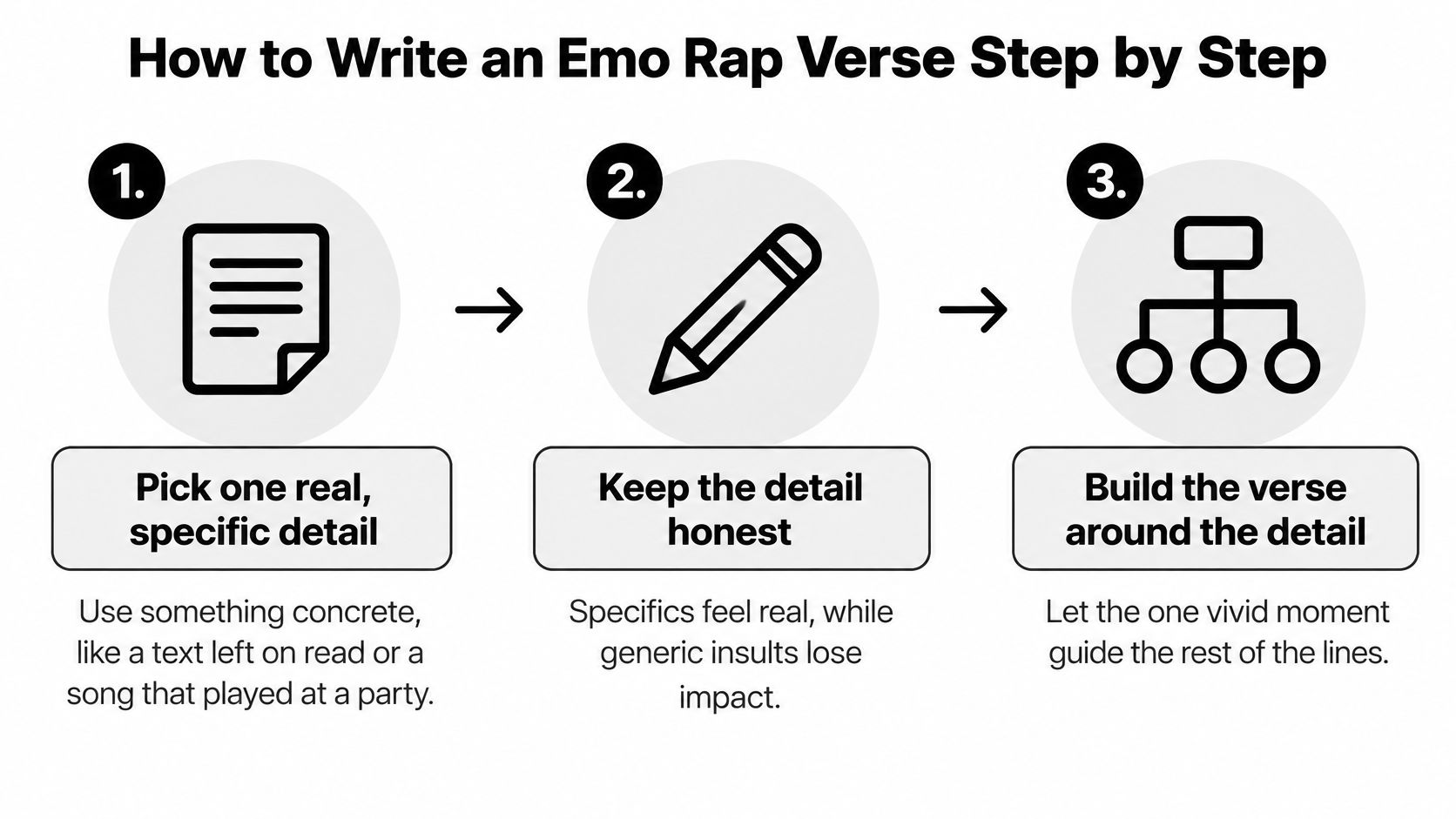 A three-step infographic on how to write an emo rap verse using specific and honest details.
Edit the sentence before polishing the rhyme
Read the draft without a beat. If the sentence doesn't make sense in speech, a rhyme probably won't rescue it. The guide to making rap lyrics can help with phrasing when the idea is clear but the line keeps tripping over itself.
Keep the strongest noun and verb in each line. Replace a vague complaint about being abandoned with the actual thing you did while waiting: saved a seat, left a controller connected, checked the door.
Finally, remove the adjectives from the punchline. If it still lands, you've probably built the joke on a relationship or contradiction rather than a decorative insult. If it falls apart, return to the incident and find what's funny about it.
Adapting Emo Rap for Roasts and Diss Tracks
A friend who ghosts the group chat doesn't need the same treatment as a fictional rival who copies every outfit. Choose the emotional angle before choosing how harsh to sound.
The Genre AI emo rap overview describes a fusion of confessional voice and trap production. For roast writing, treat that combination as a flexible approach: the narrator cares about what happened, even while trying to score a laugh.
Match the bite to the relationship
Gentle roast works through affectionate disappointment. For the absent friend, try a premise like I saved you a seat; your typing bubble came instead. The joke is about a familiar habit, not a secret vulnerability.
A medium diss can expose the insecurity behind imitation. If a fictional rival copies your style, let the narrator admit they noticed before landing the jab: I changed my look to find myself; you asked me for the receipt. The sting comes from the contradiction.
Heavy diss needs precision rather than menace. For a fictional betrayal, a line like You called it loyalty until loyalty asked you to stay puts pressure on conduct. You don't need to threaten the target or enlist their private life.
Before sharing: If the target can't recognize the joke without feeling exposed, choose another detail.
Keep your own accent and social world
Don't replace your normal vocabulary with American references just because you're writing emo rap. Use regional slang you speak, a familiar hangout, or the local pop and hip-hop textures that make sense to you.
If you normally move between languages, let phrasing follow that habit rather than inserting words as decoration. Check that the rhyme, stress, and emotional turn still make sense aloud. A literal translation may preserve the information while losing the joke.
For a sharper reversal, the guide to writing punchlines can help you connect setup and payoff without abandoning the narrator's perspective.
The same approach can fit a party performance, streamer short, or meme-page verse, but public reach changes the stakes. A joke that works among friends may become humiliating when strangers pile on.
Use a final target check:
- Protect privacy: Leave out private messages, identifying details, and personal disclosures.
- Remove threats: Make the consequence a punchline, not intimidation.
- Aim at behavior: Roast ghosting, copying, or empty promises, not identity.
- Check the audience: Share only where the target can reasonably enjoy the bit.
Pure cruelty makes the emotional setup feel like an excuse. A pointed joke works better when listeners understand both why the narrator cares and why the target deserves this particular jab.
Write Your First Emo Rap Roast Verse Today
Write a roast for a friend who already enjoys being roasted. Choose a harmless, familiar habit: arriving after everyone has ordered, claiming to know every song, or sending voice notes longer than the story deserves.
Keep the first draft private. You're testing whether the joke works, not inviting an audience to help you decide whether it should have been written.
A notebook is enough to get the premise out of your head and onto a page you can edit.
 A young man with messy hair sitting at a wooden kitchen table writing in a spiral notebook.
Make the assignment small enough to finish
Choose gentle, medium, or heavy, then write the friend's name, your relationship, and an inside joke at the top of the page. Keep only information they'd be comfortable hearing in the intended setting.
Suppose your friend always claims they're almost there while you're already splitting the bill. Begin with the empty chair, admit you kept checking the entrance, give the waiting a singable refrain, then turn the late arrival into the joke. Don't add unrelated ammunition just because you've thought of it.
You don't need a finished beat to find out whether that idea works. Read it in rhythm, sing the refrain softly, and listen for the point where a sentence becomes difficult to deliver.
Give the draft a pass-or-fail test
- Does it name a real detail? The listener should be able to picture the chair, message, outfit, or other harmless incident.
- Does the refrain repeat cleanly? You should be able to sing it again without renegotiating the wording.
- Does the reversal land? The ending should change how the listener hears the setup, not merely add an insult.
If an answer is no, edit the relevant line and test again. If they're all yes, check the friend's comfort with the joke and decide whether it belongs in a private chat, a party performance, or nowhere public.
At DissTrack AI, we support Emo Rap, Drill, UK Grime, and more, with different flows, vocabulary, and attack patterns. You can use the target, relationship, inside jokes, and savagery level to generate lyric variations, then edit in the app, regenerate, or export the lyrics as text. Output is currently lyrics text only; audio generation isn't available yet.
Keep the final choice yours. If a generated line sounds clever but doesn't sound like something you'd say to that friend, rewrite it. Publish or share only after the verse passes the writing checks and the human one.
Bring a harmless inside joke and a little wounded pride to DissTrack AI, choose Emo Rap, and turn them into personalized roast lyrics. Edit the variations until the hook sounds like you and the punchline makes your friend laugh, then export the text for your own performance.