
Foot and Meter in Poetry: A Practical Guide for Poets And
The worst advice about meter is that it belongs to dusty classrooms, dead poets, and people who still iron their scarves. If you write poems, hooks, or battle bars, foot and meter in poetry is not decorative trivia, it's the hidden rigging that helps a line swing, snap, breathe, and land.
A lot of modern writers think they've escaped meter because they don't write strict sonnets. They haven't. They've just stopped naming the pattern they're already using, which is how people end up with lines that feel flat when they should hit like a clean uppercut.
The practical question isn't whether meter still matters. It's how to hear it, name it, bend it, and use it on purpose. That's especially true in rap and spoken word, where breath control, punchline placement, and multisyllabic rhyme schemes live or die by stress.
If you've ever wanted a faster way to hear why one line slaps and another drifts, this is the map: what feet are, how meter works, how to scan a line, which patterns show up most, how rappers warp them, and how to practice until your ear catches up with your pen. If you're building content around verse and rhythm, even something as visual as anime video templates for viral growth can help you think about timing, motion, and emphasis in a new way.
Why Meter Still Matters in 2026
Meter didn't retire just because poetry got looser and rap got louder. It went underground, where it now does the important work, shaping the lift of a hook, the pause before a punchline, and the tension in a breath you almost didn't notice. English poetic meter is still built from recurring feet, and line length is still measured in feet, from monometer through octameter. University-style teaching materials keep pentameter as the most common English line length, with monometer rare and hexameter uncommon, which tells you something simple. The old system hasn't vanished, it's just wearing better shoes. foot-based scansion overview
That matters because writers don't only need rhyme. They need control. A line can be technically correct and still land like a wet sock if the stresses are scattered in the wrong places, while a well-placed stress can make even a plain phrase sound inevitable.
The hidden job meter is doing
Meter gives you a way to hear where a line leans. In English, that means the pattern of stressed and unstressed syllables is measurable, not mystical, and the shape changes when you change the foot pattern. That's why a performer can make the same words sound calm, jagged, comic, or threatening just by shifting cadence.
Practical rule: if the ear keeps remembering one word in a line, that word is probably carrying stress for a reason.
A lot of modern free verse and spoken-word work still uses meter strategically, even when it refuses to look formal on the page. That's the part many beginner guides skip. They define meter, then act surprised when a contemporary poem or a rap verse doesn't sit neatly in one box.
If you learn to hear the grid underneath the performance, you get a better map for breath, emphasis, and timing. That's the whole game. Meter isn't a rulebook, it's a toolkit for making rhythm do emotional work.
What Foot and Meter Actually Mean
A foot is the smallest repeating rhythmic unit in a line of poetry. It resembles a single heartbeat, one pulse you can feel before you start counting the whole song. Meter is the larger pattern those beats make across the line, like the full groove that tells the listener where the downbeat lives.
The cleanest way to keep them separate is this, feet are the bricks, meter is the building. A line can be classified by both the kind of foot it uses and how many of those feet repeat. That's why iambic pentameter means five iambic feet in a row, not just a vague “poetic vibe.”
The two first shapes to hear
An iamb goes unstressed, stressed, often heard as da-DUM. A trochee flips that to stressed, unstressed, often heard as DUM-da. If iambs feel like a step forward, trochees feel like a drop or stumble.
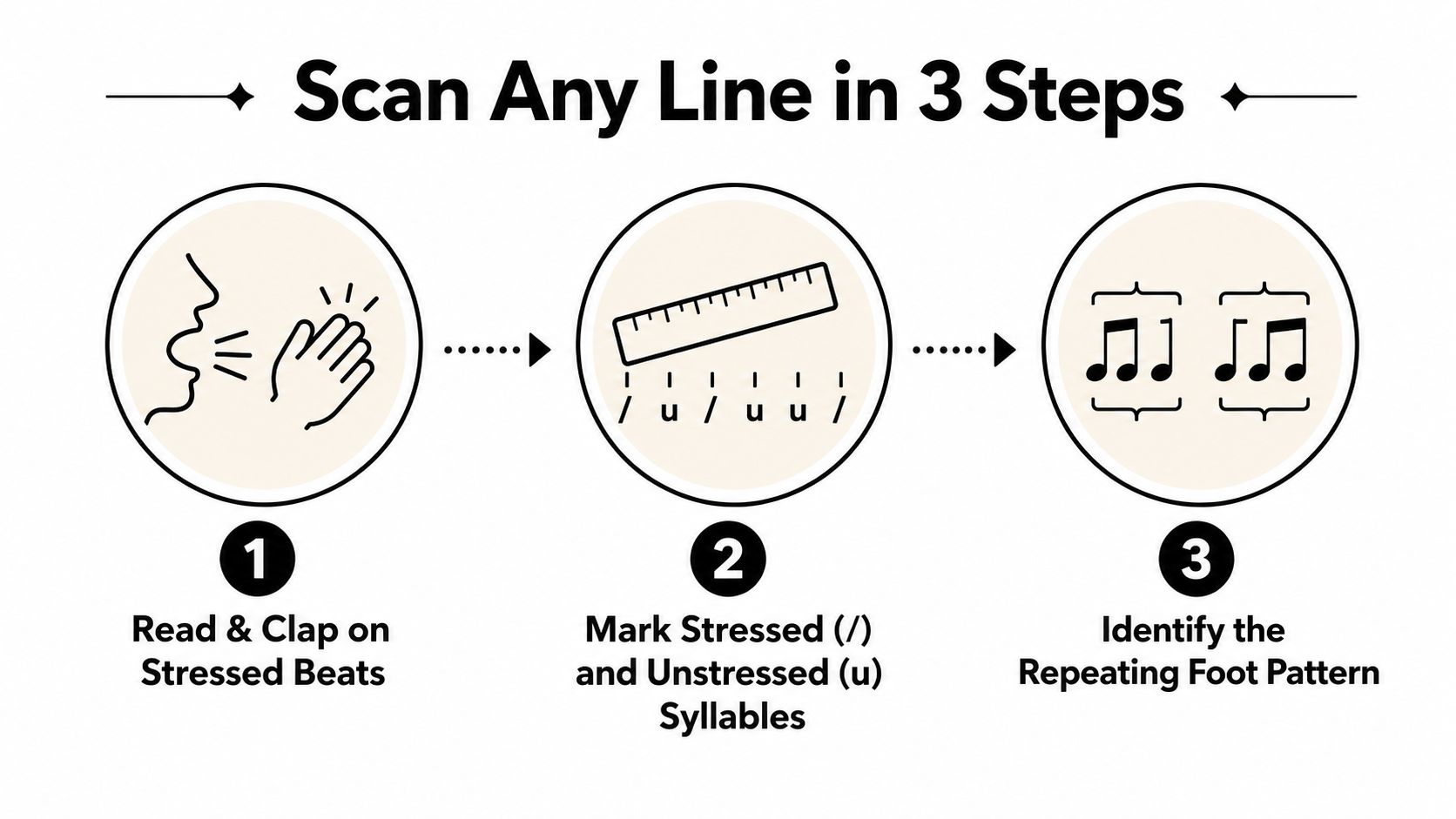 A three-step instructional graphic showing how to scan a line of poetry using meter and rhythm.
The meter part comes from the Greek metron, meaning “to measure,” which is a pretty direct clue that poets have always treated rhythm like something you can count, not just admire. Classical Greek and Latin verse also use feet, but they organize them by long and short syllables instead of stress, so the foot is a cross-tradition unit, not an English-only gimmick. If you want a handy refresher on pronunciation choices while scanning, browse the pronunciation lexicon before you start arguing with your own syllables.
The line-length ladder
The standard labels are easy once you stop overthinking them.
- Monometer, one foot
- Dimeter, two feet
- Trimeter, three feet
- Tetrameter, four feet
- Pentameter, five feet
- Hexameter, six feet
- Heptameter, seven feet
- Octameter, eight feet
The word choice tells you the line's size. The foot choice tells you the line's movement. That's the whole machine in two parts.
How to Scan a Line in Three Steps
Scansion gets less intimidating when you stop treating it like a test and start treating it like audio editing. The first move is to read the line out loud and clap the words that naturally feel heavier. Don't clap where the poet wants you to clap. Clap where your mouth leans.
Take Shakespeare's line, “Shall I compare thee to a summer's day?” Read it once, then again with the stress marks in mind. The classic scansion is Shall I / comPARE / thee TO / a SUM / mer's DAY, which gives you a clean picture of iambic pentameter. The line isn't just “pretty,” it's built on a repeatable beat pattern that carries the thought forward.
Mark, then name, then count
Step two is to mark the syllables. A stressed syllable gets /, and an unstressed syllable gets u. Once you do that, the line stops being fog and starts looking like structure.
Step three is to name the foot that repeats most often and count how many times it appears. If the foot is iambic and it shows up five times, you've got pentameter. If the line keeps bending away from that pattern, you've got a variation worth noticing instead of a mistake to panic over.
Quick diagnostic: if two syllables feel equally strong, read the line in context and choose the stress that matches the sentence's meaning, not the one that looks neat on paper.
Function words like the, a, and of usually stay light. That's why beginners get stuck trying to force every syllable into equal weight. English doesn't work that way, and pretending it does only makes the scan worse.
Try this five-line practice snippet aloud, then mark it yourself:
The rain came late
and knocked the gate
My tired shoes
refused the muse
I went home slow
If you want more practice with stress, rhyme, and bar-level patterning, the guide on rap rhyme patterns pairs well with this exercise because rhyme placement starts making more sense once you can hear the beat beneath it.
The Five Feet You Will Meet Everywhere
Most students learn meter by memorizing names. That works until the line starts moving, then the names evaporate and you're left with a confused face and a pencil. It's easier to hear the pattern if you attach each foot to a sound and a use case.
The five common feet
Iamb, unstressed then stressed, like da-DUM. The Greek root links back to the idea of a “launch” or “step,” which fits the feeling of rising emphasis. Shakespeare leans on it constantly, and a line like “Shall I compare thee” makes the pattern almost sing itself.
Trochee, stressed then unstressed, like DUM-da. The word comes from Greek and is often taught as the “running” foot because it feels more front-loaded. Nursery-rhyme energy and some rap cadences love it, because the stress lands fast and hard.
Anapest, unstressed, unstressed, stressed, like da-da-DUM. Lord Byron's famous gallop is the textbook vibe here, and the motion feels like a sprint that ends in a punch.
Dactyl, stressed, unstressed, unstressed, like DUM-da-da. Tennyson's most quoted examples make this foot feel sweeping, almost cinematic, because the stress opens the phrase and the rest trails behind it.
Spondee, stressed, stressed, like DUM-DUM. This one is the hammer. It's not always a full line foot in normal English speech, but when it appears, it hits like a doubled emphasis.
Two substitutions that show up all the time
A pyrrhus gives you two unstressed syllables in a row, which can soften the line and make room for the next beat. A feminine ending adds an extra unstressed syllable at the end of a line, so the motion doesn't stop cleanly. Both are common in real verse, and both remind you that meter is a live system, not a prison sentence.
If you can hear an iamb as a lift and a trochee as a drop, you're already ahead of most beginners. The point isn't to become a meter cop. The point is to hear what kind of energy the line is carrying before you decide how to perform it.
How Rappers Use Meter on Purpose
Rap doesn't escape meter. It weaponizes it. The bar is still a counted line, and even when the surface sounds chaotic, the performer is usually deciding exactly where the stress should land so the rhyme snaps in the right place.
Pusha T is a great example of this kind of control. In his cocaine-and-commerce wordplay, multisyllabic rhyme often lands with near-metronomic confidence, so the stressed syllables arrive like a series of locked doors opening at the same key. That's why the bars feel surgical instead of random. The meter creates the runway for the rhyme to take off.
Why stress placement matters on the mic
Eminem often does the opposite effect. He packs in dense internal rhyme and throws in spondaic hits when he wants comedy, menace, or brute force. Those doubled stresses can turn a line into a verbal body shot, especially when the delivery snaps the consonants cleanly.
Kendrick Lamar is another useful study because he'll shift feet mid-bar to mirror tone. A line can move from smooth to jagged in a single breath, and the meter change helps the emotional shift register on first listen. That's not a trick. That's composition.
If you want to see how rhyme density and stress work together in modern bars, the breakdown on multisyllabic rhymes pairs naturally with this idea, because long rhyme chains only feel effortless when the beats underneath them are controlled.
The ear hears stress before it hears theory.
That's why punchlines land harder when the key word sits on a stressed syllable. Beat switches, triplet flows, and breathy pauses all change the meter's surface, but they're still variations of the same basic logic. The rapper isn't escaping structure. They're bending it with timing.
Three Meter Traps That Trip Up Beginners
The first trap is thinking free verse has no meter. Free verse often has flexible meter, hidden meter, or meter that changes by design. The poet isn't ignoring rhythm, they're choosing when to make it visible and when to blur it.
The second trap is confusing meter with rhyme. Two lines can rhyme and still have completely different feet. Two other lines can share the same meter and not rhyme at all. Those are separate tools, and once you stop collapsing them into one category, your reading gets much sharper.
 An infographic titled Three Meter Traps showing pros and cons for beginner traders using technical market levels.
The dialect trap is real
The third trap is assuming one way of speaking is the universal way of scanning. It isn't. The same poem can scan differently depending on pronunciation, stress patterns, or whether you're working in English accentual-syllabic verse or the quantitative systems of Greek and Latin. That's why a line that looks tidy on the page can sound different in another mouth.
A simple test helps.
- Free verse test: is the rhythm varying on purpose, or did the writer just not hear it?
- Rhyme test: do the rhymes sit on stressed syllables, or are they only visually similar?
- Tradition test: am I scanning this in the right language system for the poem I'm reading?
For a useful comparison point, the glossary at Poets.org on meter is a solid reminder that English meter and classical quantitative meter don't operate the same way.
The cleanest lesson here is confidence. You don't need to force every poem into a box. You need to know which box, if any, the poem is playing with.
Three Drills to Internalize Meter This Week
The fastest way to get meter into your body is to stop only reading about it. Take fifteen minutes and make your ear do the reps. That's how rhythm stops feeling like homework and starts feeling like instinct.
Clap, swap, rewrite
Clap-and-count: pick a song you already know and clap on the downbeats while you read the lyric or hear the line. Then write the pattern down and ask whether it leans iambic, trochaic, or anapestic. Success looks like being able to hear the repeat before you label it.
Swap-the-foot: take one line of your own, identify the dominant foot, then rewrite it in a different foot type. If the original line was smooth, make it jagged. If it was punchy, make it glide. The point is to feel how the emotion changes when the stress pattern changes.
Eight-bar rewrite: write eight bars on a topic you care about, then mark every stressed syllable. If your punchline sits on a weak syllable, move it. If the breath runs out before the bar ends, trim the line. Clear stress placement helps more than cleverness when the mic is live.
A simple workflow helps too, especially if your brain gets noisy while drafting. How to write with fewer distractions is useful if you want a calmer way to stay inside the rhythm long enough to hear what's happening.
 Screenshot from https://aidisstrackgenerator.com
If you want a second listening lab, the beginner guide on how to freestyle rap for beginners can help you practice meter in motion instead of only on the page. You'll hear quickly that freestyle is less about saying anything and more about staying inside a rhythm long enough to think clearly.
Putting It All Together on the Mic
Meter stops being an abstract school term the moment you hear it as performance control. A writer who knows where the stress lands can manage breath, place a punchline exactly where the audience expects the hit, and decide when to break the pattern for surprise. That's true in a sonnet, a verse, or a battle round.
Before you deliver a line, ask five questions. Is the dominant foot clear. Do the stressed syllables carry the key words. Where does the line breathe. Where does it accelerate. Does the meter serve the emotion, or is it fighting it.
A clean scan won't make a weak line brilliant, but it will show you why the line is weak. A messy scan won't ruin a great idea, but it will bury the moment you wanted people to feel. That's why serious performers still care about foot and meter in poetry, even when the page looks casual.
2026 audiences reward writers who can bend form on purpose. Meter gives you the shared vocabulary for that bending, whether you're writing a classroom poem, a stage piece, or a bar meant to land in a crowded room with bass shaking the floor.
If you want a faster way to generate bars, experiment with cadence, and hear different rhythmic patterns without staring at a blank page, visit DissTrack AI. It's built for writers who want lyrical structure they can perform, so you can test meter, punchline placement, and flow ideas without losing the thread.