
German Underground Rap: Origins, Sound, and Scene Guide
People keep telling you German underground rap is a basement hobby, a side street, a coded language for a small crew of men in hoodies. That picture falls apart the moment you look at who's listening, where they're listening, and how the music travels through Germany's cities and regions. German underground rap isn't a curiosity on the edge of the map. It's a crowded, regional, and surprisingly broad culture that has learned how to sound local without staying small.
If you only know the genre by rumor, start with the crowd. A market study estimates 4,082,392 listeners in Germany, with 52.5% female and 47.5% male, and an average age of 32.6. The audience is concentrated in Nordrhein-Westfalen, Niedersachsen, and Bayern, which tells you this isn't a Berlin-only story either. It reads less like a niche and more like a real national market with different streets, accents, and entry points. The scene's social range matters because it changes how people hear the music, from first-generation listeners in local crews to casual fans who encounter tracks through friends, clubs, and regional playlists. Discover how viral music scenes spread on social platforms
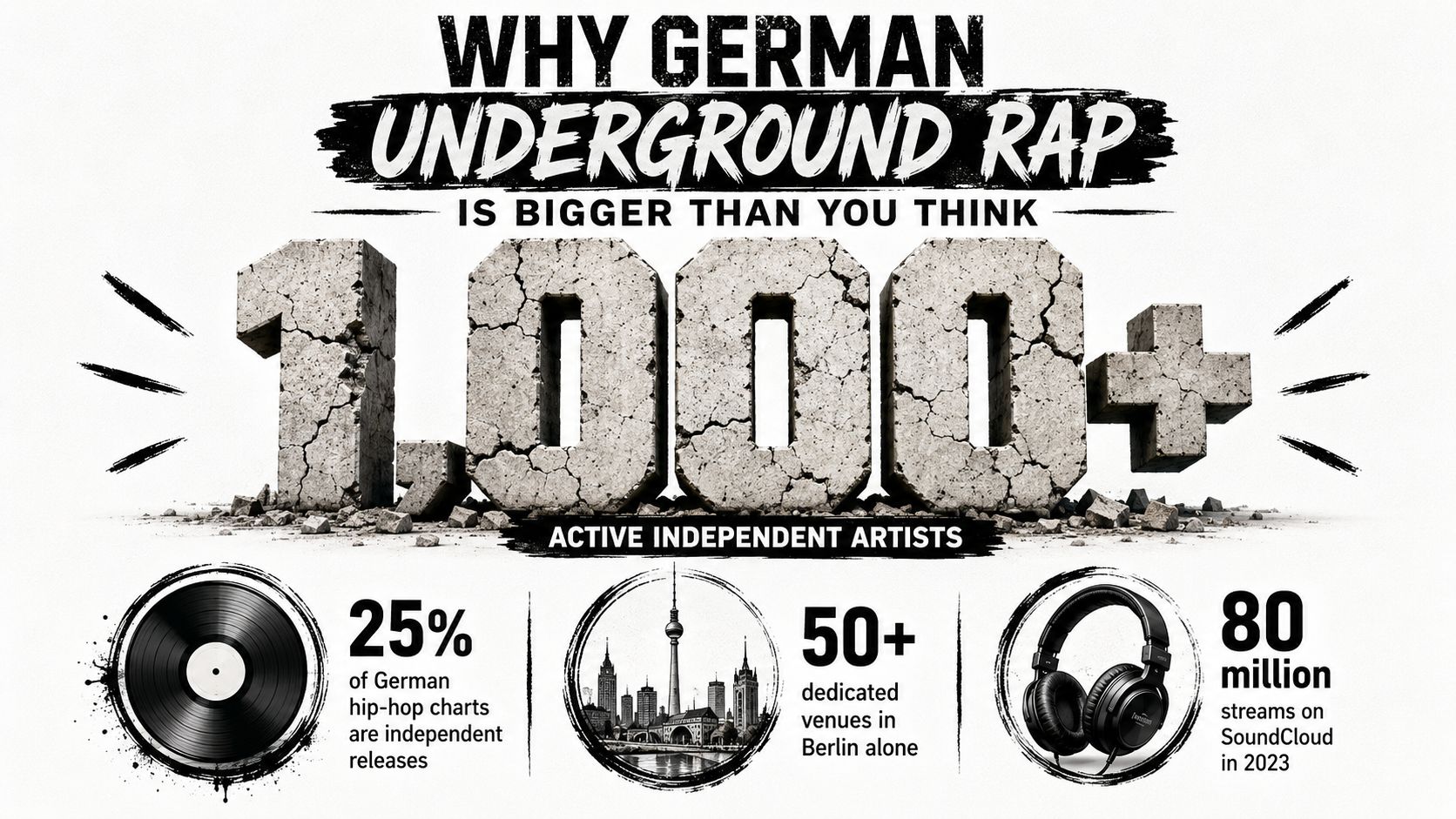 An infographic showing statistics about the thriving German underground rap music scene and independent artists.
That scale also changes the way you should think about credibility. In underground rap, being “underground” doesn't mean invisible. It usually means the music moves through independent channels first, then spreads outward through scene trust, local reputation, and repetition. For marketers, artists, and producers, that's the key lesson. This is not a tiny subculture waiting to be discovered, it's a living market that rewards people who understand its codes.
Why German Underground Rap Is Bigger Than You Think
The lazy version of the story says underground rap belongs to a few loud voices, a few smoky rooms, and a few recycled stereotypes. Germany doesn't fit that template. The numbers point to a scene that's multi-million-listener deep, with a gender balance that undercuts the old “male youth enclave” cliché, and a geographic spread that reaches beyond the capital. The center of gravity shifts depending on the city, but the audience itself is plainly larger than the mythology around it. Rascasse's market overview of German underground hip-hop
The most important thing about that audience mix is what it implies. A fan base that's nearly evenly split by gender and spread across major states doesn't behave like a novelty scene. It behaves like a culture with repeat listeners, local scenes, and a steady memory for artists who stay consistent. If you're trying to understand why a track can feel like a private code in one room and a regional anthem in another, this is part of the answer.
The scene lives in regions, not just playlists
Nordrhein-Westfalen, Niedersachsen, and Bayern show up as the strongest regions by reach, which makes the map feel bigger than any one city. That matters because underground rap in Germany often travels through regional pride, dialect color, and neighborhood references before it ever becomes a national talking point. A listener in NRW doesn't hear the same thing as a listener in Bavaria, even when the beat is similar.
Practical rule: if you want to understand the scene, stop treating it like one monolith. Follow the regions, then notice how the regions talk back to each other.
The audience profile also explains why artists can sound raw without sounding amateur. A large and varied base can sustain records that are dense, local, and uncompromising. That gives underground artists room to be specific instead of broad. It's one reason the genre keeps attracting listeners who want identity, not just background music.
The old advice says underground means small. German underground rap proves the opposite. It's underground in method, not in reach.
From Imported Beats to a Homegrown Movement
The early German rap story starts with import culture. In the 1990s, gangsta rap took shape in Germany first as an underground phenomenon and then as a subcultural force, according to a Cambridge study on the scene's development. The mid-1990s market was still tilted toward outside influence, with roughly a 70% import to 30% domestic ratio in German hip-hop, which shows how dependent the ecosystem once was on borrowed references and outside records. Cambridge's case study on German gangsta rap
That opening phase matters because it tells you what the scene had to overcome. Early German rap wasn't born fully formed. It had to learn how to localize imported forms, then build the infrastructure to circulate them. Independent labels, production circles, and regional distribution became the machinery that turned imitation into ownership. You can hear that shift in the way German artists moved from echoing American models to shaping their own street language, their own persona types, and their own version of credibility.
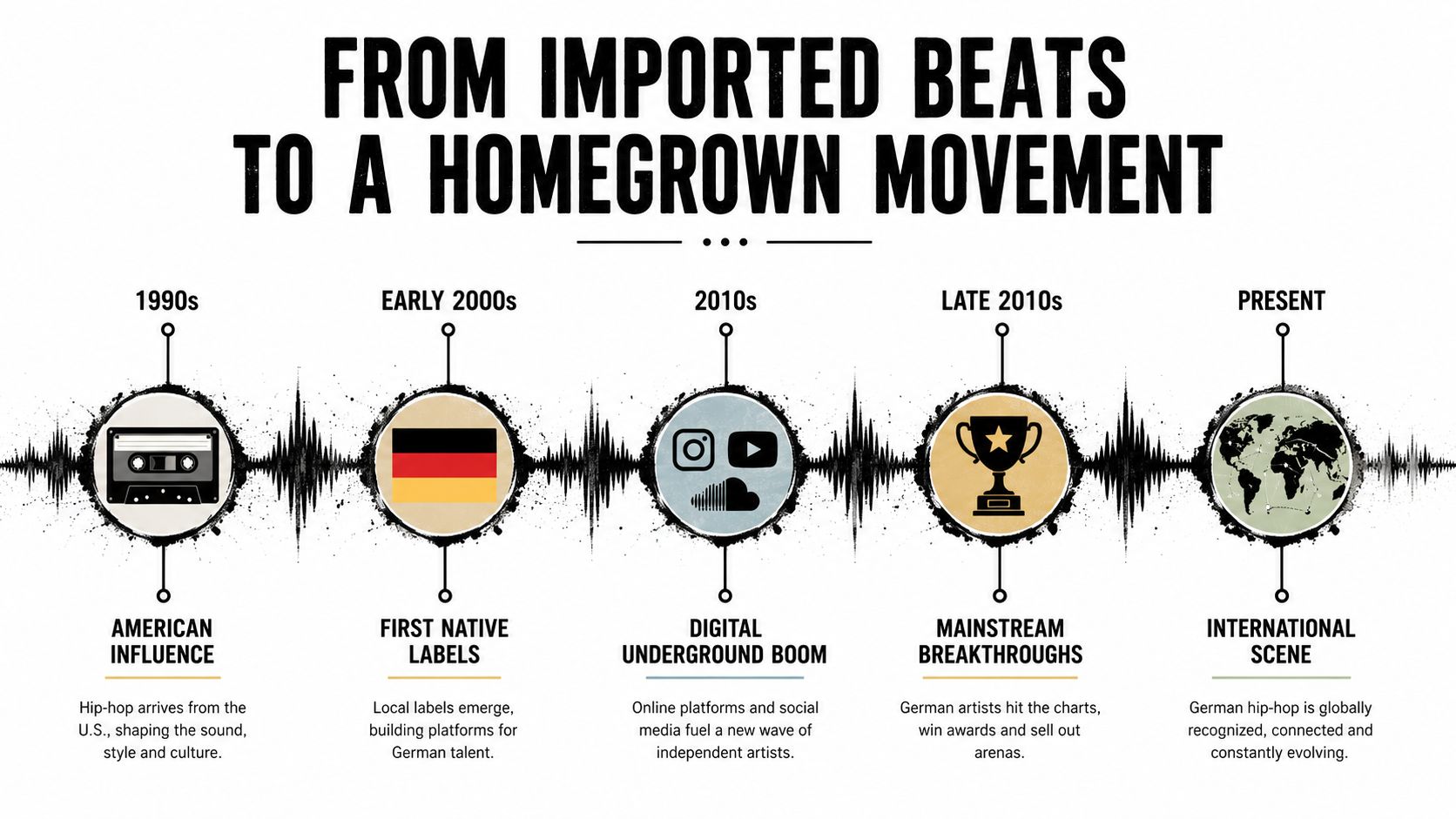 A timeline graphic showing the evolution of German hip-hop from American influence to international mainstream recognition.
Sido's early gold run marked a break
One of the clearest milestones in that transition is Sido. The Cambridge study notes that his label and production ecosystem sold more than 100,000 copies of his gangsta rap album, earning gold status in the German charts. That's not just a commercial footnote. It shows how an artist rooted in underground culture could move enough units to prove that domestic rap wasn't borrowing the room anymore, it was filling it.
The break wasn't about sales. It was about confidence. When artists and labels see that a local German-language project can reach gold, the whole scene changes its expectations. Smaller crews, regional acts, and independent producers start treating domestic rap as a serious center of gravity instead of an imitation lane.
That's why the genre's history feels like a relay race, not a miracle. Imports set the tempo, local crews learned the rules, and then German artists started building systems that could survive without outside permission. A scene that once leaned on foreign records became one that could certify its own relevance in German charts.
For a broader comparison of how regional rap cultures localize global styles, this look at Egyptian rap music helps make the pattern easier to see. Different cities, different languages, same basic struggle, take a borrowed form and make it feel native.
The Sonic and Lyrical DNA of the Scene
The first thing you hear in German underground rap is texture. The tracks often sound like they were built in rooms where the walls held onto dust, tape hiss, and memory. The genre's DIY profile is part of that, because artists often release through independent labels, self-releases, digital platforms, cassettes, or small-run CDs. The sound tends to favor dense multisyllabic wordplay, sample-based or dusty-loop production, and either rapid-fire delivery or hypnotic cadences. Music Metrics Vault's genre profile
That combination makes the voice and the beat feel inseparable. The rapper isn't just riding the music, he's compressing language into it. Dense rhyme schemes become a performance metric, not a decorative flourish. If the verse is full of internal turns, clipped stresses, and stacked endings, that's not a style add-on. It's the core craft.
Why the words hit harder than the polish
Underground credibility often comes from compression. Artists pack meaning into short phrases, tangled rhymes, and hard consonants that sound built to survive small rooms and loud speakers. That's why the delivery can feel almost architectural. The verse has load-bearing walls, not just decoration.
The production matches that discipline. Sample-based loops and rough textures give the rapper something to push against. You hear the dust, then you hear the articulation cutting through it. The contrast matters because it keeps the listener focused on density rather than gloss.
Listen for this: when the beat is sparse and the rhyme scheme is crowded, the rapper is asking you to pay attention to every stressed syllable.
The mainstream beat grammar changed the backdrop
Contemporary German-language rap often leans on two dominant beat architectures, trap and dembow. A University of Innsbruck study found that 24 of 25 German-language rap songs examined from the Austrian number-one charts between 2018 and 2019 used one of those two rhythmic hook types. The trap pattern relies on heavy TR-808 bass and kicks, slow tempo, sparse harmonic movement, fast hi-hat clusters or triplets, and auto-tuned vocals. Dembow, by contrast, pushes emphasis toward the fourth sixteenth note and creates tension by disrupting the regular 2-and-4 backbeat. University of Innsbruck research on German-language rap rhythms
For listeners, that means groove placement is the whole game. For producers, micro-timing isn't a fine detail, it's the hook. A beat can feel forward-driving because the percussion lands with precision, or because it deliberately leans off-center and keeps the body slightly unsettled. The underground side of the scene still cares about raw texture, but it lives inside a wider rhythmic grammar that now shapes what gets repeated, remembered, and rewound.
If you want the technical side of that craft, learn the basics of making rap beats and then listen back to German records with a producer's ear. The difference between “hard” and “forgettable” is often the drum pocket.
Key Artists, Labels, and Regional Hubs
Berlin gets the headlines, but the city only explains part of the story. The map runs through basements, rehearsal rooms, and small labels that know how to move music without flattening it. Berlin's appeal is obvious. Its neighborhoods are layered, multilingual, and visibly rough around the edges, which fits a rap culture built on friction and atmosphere. But NRW carries a different energy, more industrial, more grounded, and often more focused on battle-ready writing and scene loyalty.
The artists matter because they embody different parts of the ecosystem. Sido stands for the moment underground energy became commercially undeniable. Kollegah represents persona-heavy lyricism and the kind of virtuosity that turns technical skill into brand identity. The Cambridge study's focus on persona types is useful here because it shows that German gangsta rap doesn't just reward flow, it rewards the construction of a character strong enough to hold a whole catalog. Cambridge's study of persona and virtuosity
Labels and crews keep the scene alive
Independent labels are the quiet infrastructure. They handle small runs, digital distribution, and the kind of patient artist development that major-label cycles often skip. That matters in a scene where credibility can come from staying close to the audience and keeping the release process visibly human. The underground doesn't just reward talent. It rewards people who know how to move records while protecting the texture that made them matter in the first place.
Berlin, in practice, often feels like a patchwork of micro-scenes. A basement show in one district can sound polished and abstract, while another room a few stops away might favor grimy drums and raw dispatches from the street. NRW tends to sharpen the regional contrast, with artists often sounding more direct and insistent, as if they're spitting across a factory floor rather than into a club booth.
Here's the useful pattern to remember:
- Berlin: scene density, cross-cultural traffic, and a strong visual identity.
- NRW: industrial weight, hard edges, and a reputation for lyrical seriousness.
- Independent labels: the glue that keeps releases local before they become national.
- Crew networks: the trust system that decides who gets heard first.
The small labels, the producers, and the local DJs do more than distribute music. They define the standard. In a genre where the audience can smell fake posturing fast, those middle-layer actors matter as much as the headliners.
How to Discover Current Underground Acts
Algorithms will hand you whatever already looks popular. Underground discovery in German rap works the opposite way. Start with places where scene trust is visible, independent label catalogs, local radio slots, small venue flyers, and producer pages where credits point backward and sideways. The artists worth finding usually move in clusters, not alone. One guest verse leads to a remix, a remix leads to a support slot, and the support slot leads to a room full of people who already know the hook.
Follow the credits, not just the singles
Track producer names. Track featured artists. Track mastering engineers and cover designers if you're serious about finding the scene before it surfaces. The underground is often organized through relationships rather than algorithms, so the smallest names on a release page can be the most useful signposts.
Language barriers can scare off non-German speakers, but they don't block everything. Dense rhyme, rhythm, and vocal tone still carry identity even when every line doesn't land semantically. Listen for repetition, stress patterns, and the way a performer stretches or compresses a beat. That's often enough to tell whether the room is responding to skill, not just to hype.
Field note: if a track keeps showing up through the same producers, DJ sets, and tiny local venues, it's probably worth more attention than the playlist that surfaced it once.
For practical digging, independent hip-hop media, small club calendars, and social pages tied to local shows usually beat broad recommendation feeds. You'll also hear more in live settings. Underground artists often reveal their best timing, breath control, and crowd command in rooms that don't forgive sloppy delivery.
The smartest move is to treat discovery like crate-digging. Follow one act, then follow the people around that act, then follow the rooms where they play. That's how the scene stays legible.
Emulating the Style in Writing, Flow, and Production
To write convincingly in this lane, start with language density. German rap rewards internal rhyme, compound stress, and phrasing that locks tightly to the beat. Don't pad bars with filler just to sound aggressive. Tighten the line until every syllable earns its place, then test how it sounds when spoken faster, slower, or with a different accent on the bar's final word. Browse an Aicut German tutorial for a related creative workflow
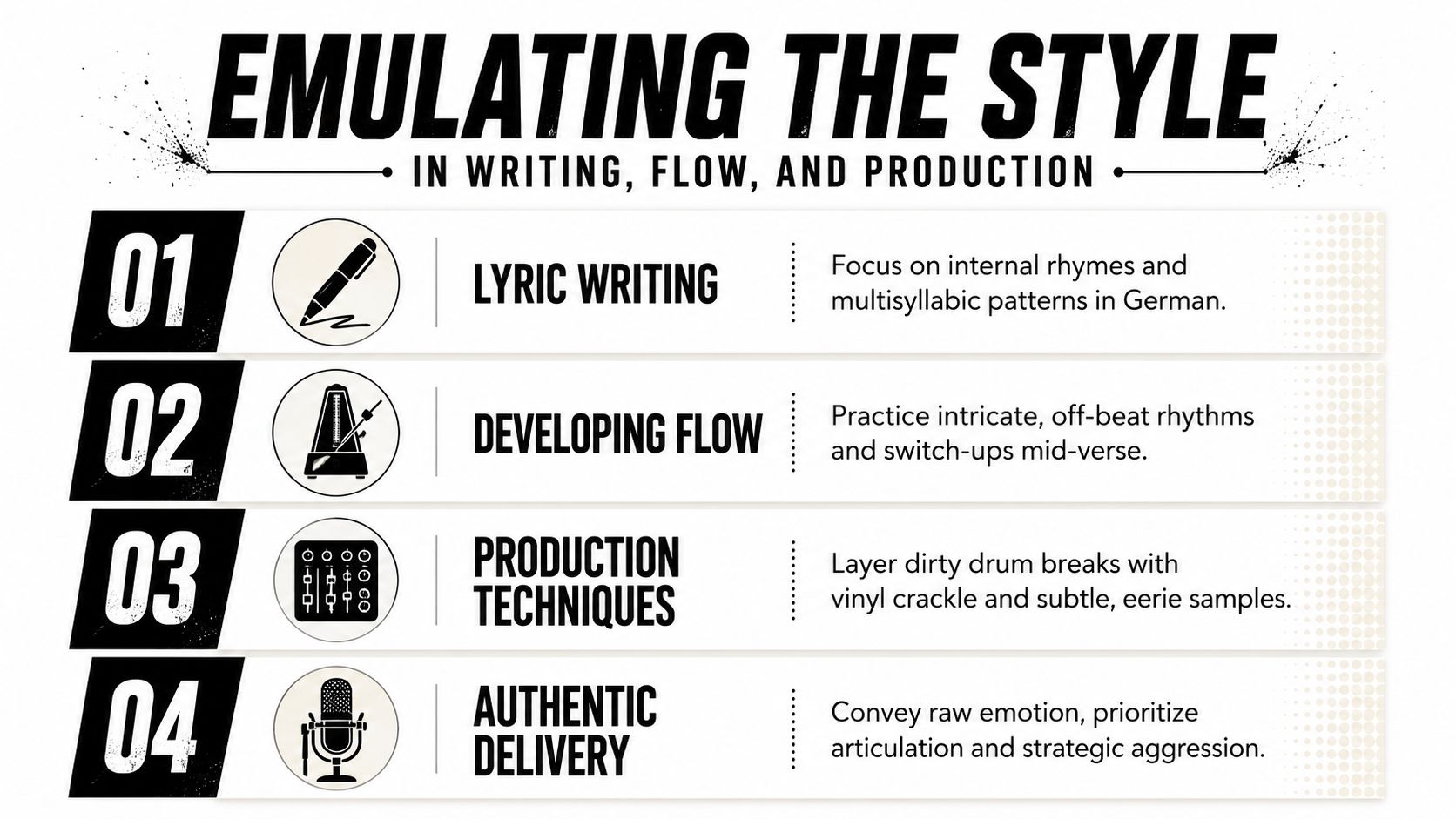 A four-step guide on emulating German underground rap style through writing, flow, and production techniques.
Write for compression, not decoration
Build a verse around one pressure point, a personal image, a local reference, or a conflict you can keep turning over. Then stack rhyme around it without flattening the line. If you're not fluent in German, study how native rappers use compound nouns and clipped syntax to make bars feel denser than they look on the page. That density is part of the genre's authority.
Let the flow answer the beat
Practice switching between rapid-fire delivery and more hypnotic pockets. The point isn't just speed. It's control. A strong underground verse can sit slightly ahead of the beat, then sink back into it, then snap forward again without losing clarity. Record yourself against simple loops first, because overly busy production can hide weak breath control.
Build beats that leave room for the voice
Keep the drum programming grimy and intentional. Sample fragments, dusty loops, vinyl crackle, and subtle noise can all work, but only if the vocal lane stays open. The recent German-language rhythm research makes the bigger point clear, groove placement drives retention, so the micro-timing of hats, kicks, and hook accents matters as much as sound selection. The University of Innsbruck rhythm study backs up what producers already feel in the room, the beat has to move the body before the hook can stick.
A simple reference routine helps:
- Study one verse for rhyme density.
- Study one beat for pocket and percussion placement.
- Study one live performance for breath control.
- Rewrite your own bar until the stress pattern feels inevitable.
Don't copy the attitude and call it authenticity. The scene hears through that instantly.
Building Your Place in the Scene Through Collaboration and Promotion
In German underground rap, collaboration is the fast lane to legitimacy because it shows you know the people, not just the aesthetics. A guest verse on a compilation, a producer swap, a shared live bill, those moves signal that someone inside the network already trusts you. Promotion works best when it looks like participation. The artists who last usually show up in rooms, on records, and in conversations before they ever try to sell themselves as a brand.
The live circuit still matters because it proves the record can survive outside the screen. Small venues, local DJs, and scene-specific social pages often move faster than broad paid campaigns. The audience is sharp enough to tell when someone is parachuting in, so the strongest promotion feels like a continuation of the music, not a layer pasted on top of it.
Credibility rule: if your rollout doesn't match the culture around the song, the culture will ignore the rollout.
AI tools can help at the edges, especially for brainstorming hooks, testing rhyme clusters, or escaping writer's block. They work best as a rough starting point, not as a substitute for lived scene knowledge. If you're building around German underground rap, the advantage comes from listening closely, collaborating openly, and letting the local codes shape the final version.
DissTrack AI fits this world because it's built for writers who care about rhyme schemes, wordplay, and sharp, performance-ready lines. If you're studying underground rap's density and want a fast way to brainstorm battle bars, hooks, or roast concepts, visit DissTrack AI and turn that pressure into usable lyrics.