Grime Music Explained from Sound to Style
Most beginner advice tells you to learn grime music by memorizing a list of names and dates first. That's backwards, and it's why people end up calling any fast British rap grime. Start with your ears instead. If you can't hear the tempo, the eight-bar loop and the space left for another MC to jump in, the history is just trivia.
Grime rewards listeners who treat it as a live performance system, not a playlist category. A DJ loops a cold, brittle beat. An MC lands a punchline inside a tiny window. The crowd shouts for a reload, the beat rewinds, and someone else grabs the mic. Once you hear that handoff happening, the whole genre clicks, from pirate radio to chart albums to your own first verse.
How to Hear Grime Music Instantly
Grime music is a Black British electronic MC style that took shape in early 2000s East London for clashes, reloads and rapid talk rather than sung choruses. You don't need a family tree to spot it. You need four sound checks you can run in the first thirty seconds of any track.
Run them in order. If a track passes most of them, you're probably listening to grime. If it passes none, a London accent alone doesn't change that.
The Four Sound Checks
The tempo should feel like it's slightly chasing the MC. That's deliberate. A Goldsmiths analysis of grime's production grammar%20Wot%20Do%20U%20Call%20It_%20Doof%20Doof_AAM.pdf) places tracks typically around 135 to 145 BPM, with flows designed around roughly 16 to 18.5 beats per five seconds and deliberate rests to prevent syllabic overcrowding. In plain terms, the MC is cramming clear words into a fast-moving frame, then leaving tiny gaps so you can understand the insult.
- Tempo check: Nod along. If your head is moving at a jog rather than a stroll or a sprint, you're in the right zone.
- Loop check: Count the pattern. Does the beat reset in short, predictable blocks an MC could memorize?
- Snare check: Is there a sharp crack cutting through, keeping every syllable accountable?
- Bass check: Does the bass buzz and jab in front of the mix instead of humming warmly underneath it?
| Element | Typical setting | What it does for the MC |
|---|---|---|
| Tempo | 135-145 BPM | Packs rapid phrases at about 16-18.5 beats per five seconds |
| Loop | Repeated eight bars | Leaves entry points for punchlines, reloads and handoffs |
| Snare | Prominent transient | Keeps syllables audible at speed |
| Kick and bass | Clear separation | Stops the low end swallowing the voice |
| Bass tone | Square-wave or shell-down | Gives the brittle, forward grime weight |
Think of the beat as a small boxing ring. The MC gets eight bars to land a combination, duck out, and let the next person in. A long, wandering verse with no exits breaks the whole design, because nobody can tag in, answer back, or demand the best line again.
Neighbors That Cause Confusion
UK garage is smoother and more swung, built for dancing and sung hooks more than verbal combat. Jungle runs faster and breakbeat-driven, so the drums chop and tumble instead of holding a steady ring. Drill usually sits slower and darker, with sliding bass and a heavier, brooding pocket.
That contrast helps if you're comparing British and American traditions too, since the laid-back bounce described in this guide to West Coast rap style solves the opposite problem. West Coast production often gives an MC room to lean back. Grime gives an MC a stopwatch and dares them to stay intelligible.
If you can't point to where the next MC would enter, slow down and listen again before you label the track.
Play a track now and tick off tempo, eight bars, snare and square bass one by one. Don't use the label until your ears pass the test. That habit will make every artist and era that follows much easier to place.
East London and the First Breakthrough
Grime didn't arrive with a press release. Around the turn of the millennium, East London MCs pulled pieces from UK garage, jungle, dancehall and hip-hop into something sparer, colder and more confrontational. Garage supplied club rhythms, jungle brought sound system pressure, dancehall shaped the flow and bass weight, and hip-hop sharpened the MC phrasing.
The scene underneath was cheap and local by necessity. Pirate radio on rooftops, raves, record shops, bedroom production and small-scale distribution did the work major labels normally do. If your bars worked live in front of peers who'd happily take the mic off you, you had a career starting point.
This timeline shows those influences converging before the mainstream noticed.
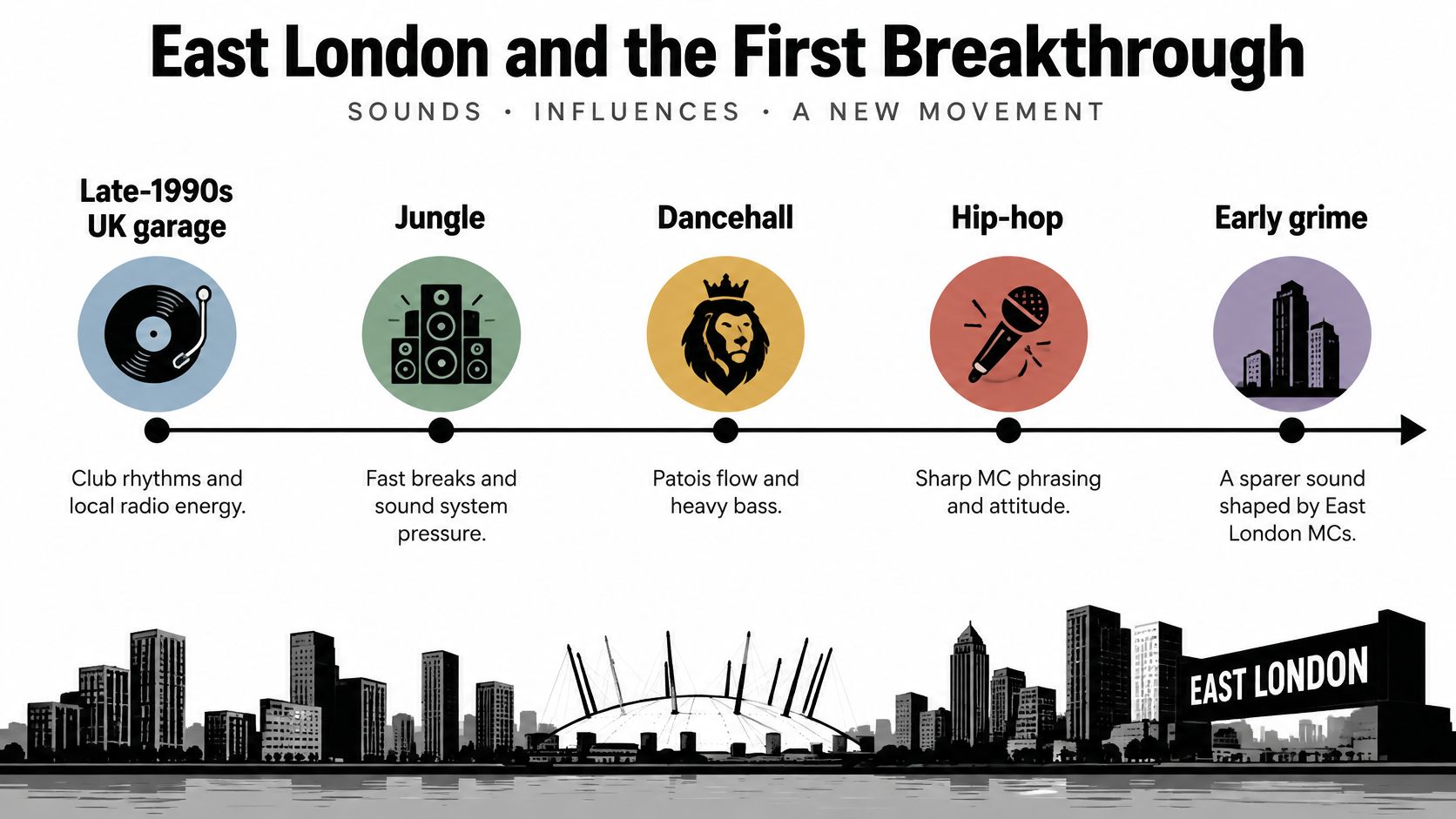 A timeline graphic showing influences on East London grime music, including garage, jungle, dancehall, and hip-hop.
The 2003 Hinge
The breakthrough record was Dizzee Rascal's Boy in da Corner. A Chapman University sociology account of grime's emergence describes the 2003 release as widely recognized as the first grime album, winning the 2003 Mercury Prize and making Dizzee Rascal the first artist associated with grime to receive it. The same account notes it achieved gold status in its first year, with subsequent reporting placing worldwide sales above 250,000 copies.
Those facts matter because the album didn't sand down the sound to win. Sparse electronics, rapid flows, local slang and a clash format reached critics and buyers who'd never tuned into a pirate station. Grime proved it could survive outside the room where it was born.
Artists built followings through low-cost, decentralized media before major-label recognition arrived.
A Small Cast With Clear Jobs
You don't need a discography yet, just a few roles. Wiley was the producer-MC architect, shaping icy beats other MCs could spar over. Kano and Jme widened what the writing could do, bringing sharper storytelling and a drier, more conversational wit. Skepta later carried that underground attitude back toward the charts without pretending the pirate era never happened.
- Wiley: Listen for the blueprint in the beats.
- Kano: Listen for narrative packed into tight bars.
- Jme: Listen for clarity and deadpan control.
- Skepta: Listen for clash confidence at arena scale.
By 2003 the sound was proven, but proof isn't the same as market dominance. The explosion in streams, sales and ticket demand came much later, and it arrived all at once.
The Year Grime Hit the Charts
If 2003 proved grime could win a prize, 2017 proved it could move a market. BBC reporting of British Phonographic Industry figures shows grime streams climbing from 86 million in 2016 to 206 million in 2017, a jump of roughly 140% in a single year. That's the chart equivalent of an MC wheeling up the same bar four times because the crowd keeps demanding it.
The same analysis put grime's album-equivalent sales up 93% year over year, while the overall UK recorded-music market managed 6%. Grime lapped the industry it was selling into.
This graphic puts the streaming jump in one glance.
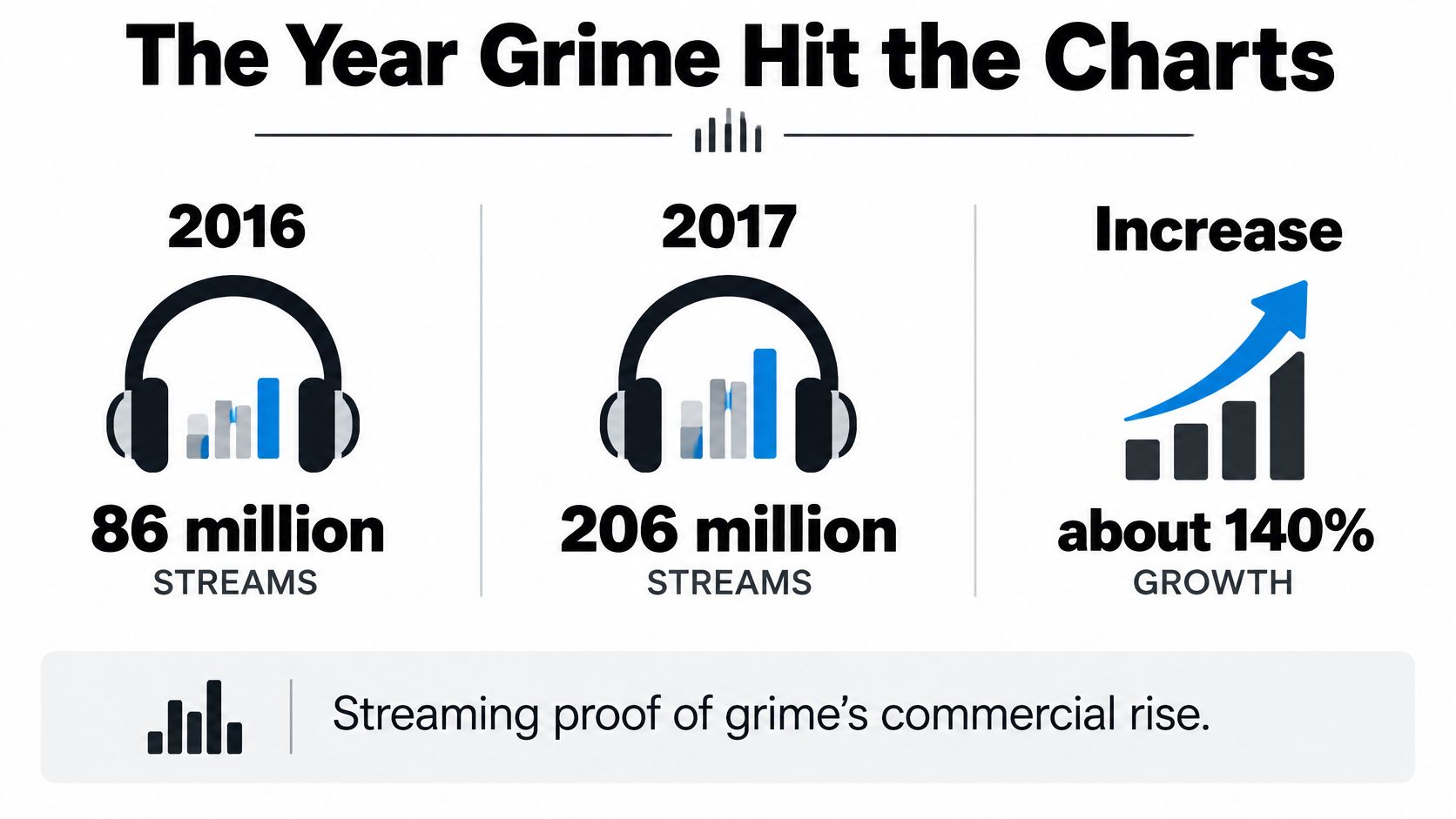 An infographic showing the 140 percent increase in grime music streams from 2016 to 2017.
Reading the Numbers Properly
| Measure | Figure | Compared with |
|---|---|---|
| Streams | 86 million in 2016 to 206 million in 2017 | About 140 percent in one year |
| Album-equivalent sales | Up 93 percent year over year | UK recorded music up 6 percent |
| Streaming plays | Up 138 percent | Same 2016-2017 window |
| Digital album sales | Up 51 percent | Same window |
| Physical album sales | Up 109 percent | Same window |
| CD demand | Physical copies kept moving | Gang Signs and Prayer and Konnichiwa |
| Fan awareness | Reached general music fans | Listeners well beyond the core scene |
| UK Albums Chart | Gang Signs and Prayer at number one in 2017 | First pure grime album to do so |
Physical sales more than doubling in a streaming year matters. Stormzy's Gang Signs & Prayer and Skepta's Konnichiwa moved real CDs, which means fans treated grime albums as events worth owning, shelf space and all.
People were buying objects.
Awareness followed the money. Grime reached general music fans well outside its home turf, and grime events kept multiplying on national ticketing platforms. Streams count individual plays, though. The fuller picture is a genre whose live engine, the clash, the eight-bar handoff, the reload, was suddenly pulling crowds that had never stood anywhere near a pirate-radio postcode.
The Caveat Behind the Victory Lap
National reach still left gaps on the map. Birmingham, Manchester, Sheffield and Nottingham all matter as grime locations, but plenty of towns lack the recurring venues, clashes and radio slots where an MC earns peer credibility bar by bar. A track travels digitally overnight. A room full of rivals who test your new material every week cannot be downloaded.
By 2017 no new listener had to treat grime as a rumor from London. It was a chart genre with a number one album, physical sales and a live audience that kept showing up.
Records That Show the Range
Treat these five listening posts as assignments, not a hall of fame. Each record teaches one thing the others don't. In the first minute of each, listen for the bass tone, how soon the first punchline lands, and whether the voice rides the snare or fights it.
Start with a producer's eye view of the working setup behind this kind of record.
 A young man wearing a black hoodie and beanie working on a laptop near vinyl records.
Five Records, Five Jobs
Dizzee Rascal, Boy in da Corner. This is the early document, a teenage MC over cold square-wave beats before grime had a chart playbook. Notice how little decoration the production needs. The voice does the decorating, usually at alarming speed.
Wiley's early beats and Eskimo-lineage riddims show the producer's side of the bargain. These patterns are short, icy and deliberately unfinished sounding, because they're built for MCs to jump on, not to admire from a distance. If a riddim feels like it's waiting for someone, that's the point.
Kano is your writer's example. Storytelling and internal rhyme sit inside the same eight-bar pressure that clash MCs use for insults, which proves the form can carry memory and character, not only challenges. Listen for sentences that twist without losing the beat.
- First minute test for Kano: Can you follow the story while the flow accelerates?
- First minute test for Wiley: Can you hear where you'd enter if someone handed you the mic?
- First minute test for Dizzee: Does the bass feel brittle and forward rather than warm?
Skepta, Konnichiwa brings the clash attitude into a full album campaign years later. The delivery is blunt and self-assured, and the tracks still sound like they could be interrupted by a reload at any moment. That's the pirate room surviving inside a polished release.
Stormzy, Gang Signs & Prayer shows the widest emotional range here. Gospel-scale hooks and reflective moments sit next to straight MC authority, so the album argues that grime can hold faith, family and ambition without softening its stance. Listen for how his voice stays commanding even when the arrangement opens up.
Watch this performance clip after you've heard at least one studio track, and compare how the crowd changes the pacing.
One Edge Case Worth Remembering
A regional or international MC changes accent, slang and venue reality even when the BPM stays put. Copying a London voice isn't the same as building a local scene, and the strongest non-London grime sounds like its own streets, not a costume.
Short on time? Take one Dizzee album cut, one Wiley-style riddim and one Stormzy single. Twenty minutes, three eras, and you'll hear the genre's skeleton and its growth in one sitting.
Lyric Themes Past the Tough Talk
The laziest reading of grime says the lyrics are only violence and criminal boasts. Refuse it. That shortcut flattens a neighborhood diary into a headline, and it makes you a worse listener and a duller writer.
An academic analysis of grime, drill and related UK rap lyrics identified seven recurring themes, local social issues, crime, status, coping with adversity, social support, policing and escape, with references to social problems in the local area and community appearing in more than half of the songs studied. Read that list again. Only one of the seven is crime.
What the Bars Are Actually Documenting
Status and clash talk are real, and grime would be boring without them. But so are rent pressure, police attention, loyal friends, dead-end options and the wish to get out. An MC shouting about their block at high speed is often doing social documentation with better rhythm than a council report.
Context changes how a hard line lands, too. A reload moment in a rave, a pirate-radio clash, a social-media freestyle and a commercial single each ask you to hear the same aggressive bar differently. In a clash, exaggeration is the sport. On a reflective album track, the same voice might be confessing.
Four things can share one verse, so separate them before you judge it.
- Persona: The larger, louder character an MC performs.
- Competitive exaggeration: A boast inflated because an opponent is standing right there.
- Fictional storytelling: A scene invented to make a point, like a short film in bars.
- Lived experience: The detail that sounds too specific and unglamorous to be decoration.
A Four Check Writing Filter
Steal this filter when you write your own bars, especially if you're studying how the best rap punchlines and metaphors stay sharp without getting lazy. It keeps the bite and drops the harm.
- Name a place or pressure. A street, a job, a landlord, a deadline. Specific beats generic menace every time.
- Aim at choices, not identities. Mock a rival's weak flow, bad timing or borrowed slang, never a protected identity.
- Mark what's staged. Signal the clash frame so playful rivalry reads as performance, not a real threat.
- Leave one human line. One honest detail makes the tough talk believable instead of cartoonish.
Brutal delivery is a rhythm choice, not a requirement to threaten anyone.
That distinction is liberating for creators. You can keep the velocity, the wordplay and the winner-takes-the-mic energy while choosing fictional rivalry or social commentary as your fuel. The beat doesn't care. It just wants bars that fit and a voice that means them.
Build a Grime Riddim and Verse Tonight
You can build a working grime loop and a performable verse in one evening if you keep the target small. Forget a full song. You're building an eight-bar ring and a set of bars that survive inside it.
Eight bars is the point, not a limitation. An MC steps into a short loop the way a boxer steps into a ring: bounded space, repeat running, and a clean doorway for the next person to enter. A sprawling beat with verses, choruses and a bridge gives nobody a way in.
This overview shows the order before you open your software.
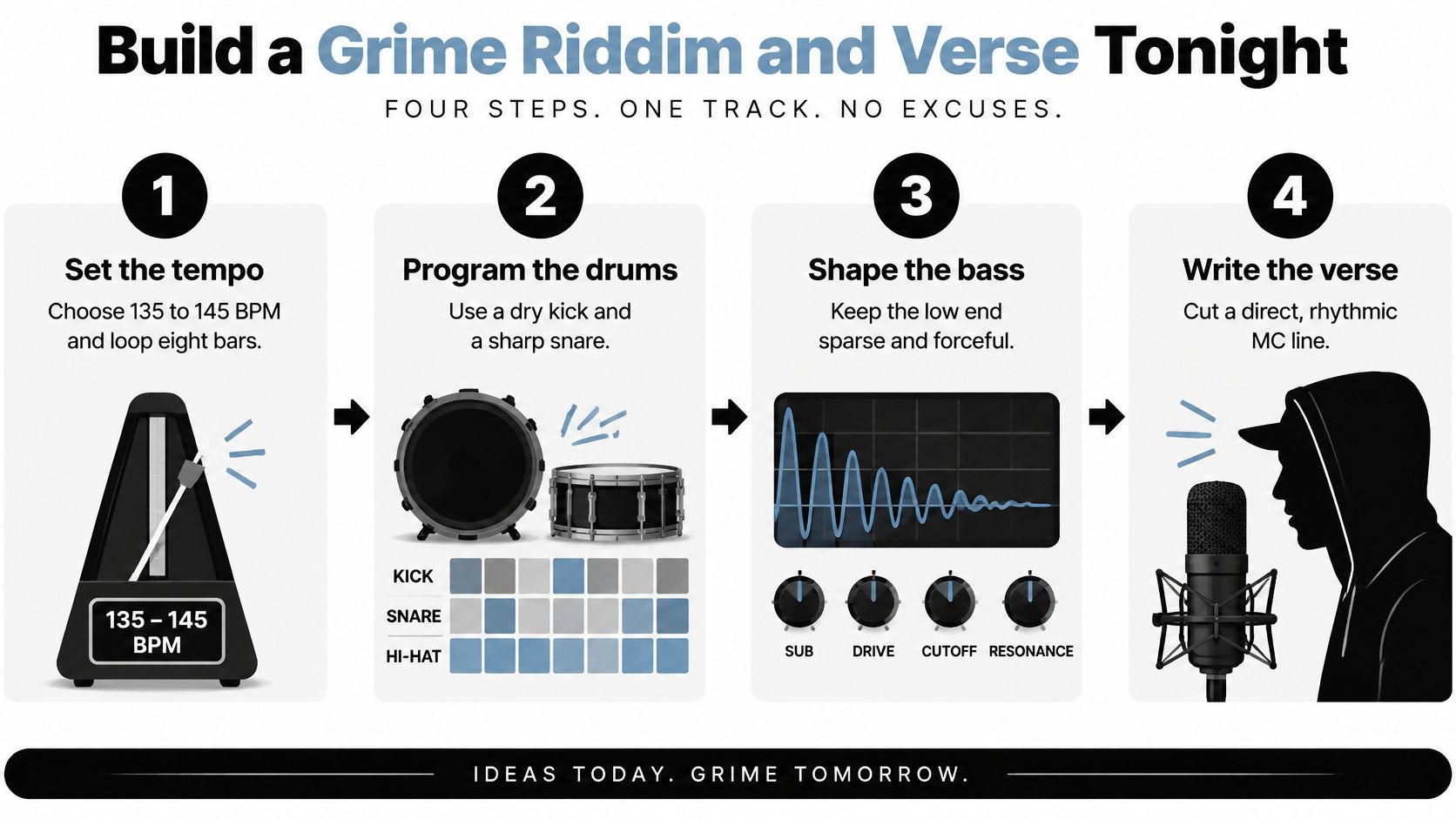 A four-step infographic guide on how to produce a grime music riddim and write a verse.
The Seven Step Build
- Set the tempo and loop. Put your project between 135 and 145 BPM and loop eight bars, not a verse-chorus song form.
- Program dry, separate drums. Use a dry kick and a sharp snare, and keep kick and bass out of each other's space so the voice has room.
- Shape a jabbing bass. Design a square-wave or shell-down hit that repeats with small variations, giving the MC a target to aim at.
- Leave a reload point. Add a one-beat gap or short fill where a DJ can rewind or another MC can enter cleanly.
- Write short lines to the cell. Draft four to eight lines that fit the loop, cutting a word anywhere the snare disappears under your voice.
- Write a second angle. Add alternate punchlines for the same riddim so a clash can change direction without a new beat.
- Test it out loud. Rap over the loop and mark any tongue-twister that only works on paper. Paper never runs out of breath. You will.
This modular approach has a history behind it. A Goldsmiths study of pirate radio broadcasts from 2001 to 2005%20Let%20us%20know%20you%E2%80%99re%20locked'_AAM.pdf) shows pirate radio functioned as a live compositional environment for improvisation, fresh-lyric testing, MC rotation and audience feedback. Sets were workshops. Riddims had to survive MCs swapping mid-stream, so grime favors adaptable sections over fixed studio arrangements, and your eight-bar cell inherits that design.
If you want the technical side to become a longer study path alongside your own practice and this guide on how to make rap beats, structured production training such as studying music technology with OCAD can deepen the mixing and sequencing skills this loop only introduces. Keep tonight's goal narrow regardless. One riddim, one verse, recorded.
The 20 Minute Drill
Pick a rival who's in on the joke, one shared place and one fair-game detail only your circle would recognize. Set a timer, loop your riddim near the middle of the tempo range, and write one status boast and one reply as if you'd just been handed the mic. Record both takes on your phone.
Keep the take where every word survives a phone speaker and the snare still punches through. Throw out any line that stereotypes a community or turns a playful clash into a real threat, no matter how clever it sounded while typing.
Three failure modes account for most first attempts.
- Too many syllables: If you can't breathe, the listener can't follow. Cut, don't speed up.
- Sub bass masking the voice: Warm low end feels powerful solo and buries an MC in a mix.
- A long pop structure: Sixteen bars with no reload point leaves nobody a way in.
When writer's block hits mid-drill, a generator can supply raw angles to edit rather than a finished identity. DissTrack AI's supported styles include Drill, Emo Rap, UK Grime, and more, each with different flows, vocabulary, and attack patterns, and its second step lets you pick rap style tags and choose how savage the diss should be. Each track is generated in 30 seconds, which suits the drill's spirit. Generate fast, then do the work yourself: cut lines until they fit your eight bars and your voice, because the tool hands you angles, not a persona.
You've got the sound checks, the eight-bar ring and a 20 minute drill, so put them to work with DissTrack AI, where you can pick UK Grime style tags, set how savage the diss should be, and get structured verses in 30 seconds. Bring your rival who's in on the joke, your shared place and your fair-game detail, generate a few hard angles, then cut them until every word survives your riddim at full speed.