UK Grime Rap Explained: Origins, Sound and Key Artists
Stop copying the most popular advice about UK Grime Rap. Speeding up your flow, borrowing a few London words and shouting louder won't make a bar sound like grime. You'll just sound like someone doing an impression.
Grime isn't a costume. It's a specific sound, a specific structure and a way of talking about a specific place. Learn those three things and the genre suddenly makes sense, whether you're listening, producing or trying to write your own bars.
What UK Grime Is and Why It Still Matters
Think of UK Grime Rap as a family tree with attitude. The roots sit in club music and sound system culture. The branches reach toward rap. Grime took the energy from below and the voice from above, then grew into something that doesn't neatly belong to either parent.
That matters because newcomers often file grime under generic British rap. Rap is part of the story, but grime's MC led vocals, sparse backing tracks and club ready pressure give it a different job. The MC isn't floating over a finished song. The MC is sparring with the beat in real time.
The Three Pillars to Listen For
- The sound: Fast, lean and bass heavy, with space left deliberately empty.
- The bars: Short, competitive bursts built for impact, reply and reload moments.
- The place: Streets, estates, cities and postcodes that act like evidence, not decoration.
Miss the third pillar and you'll misunderstand the first two. A grime lyric often works because listeners know where the speaker claims to stand. Place tells you who's being represented, who's being challenged and why the brag should be believed.
Grime sounds local even when it travels. That local detail is not a limitation. It is the credential.
That's also why grime still matters to writers. It teaches economy. You can't hide behind a lush backing track or a long storytelling verse if the beat keeps opening holes under your voice. Your entrance, punchline and exit have to land cleanly.
Producers learn a different lesson. Restraint can feel heavier than density. One cold synth line and a sub that hits your ribs can do more than a crowded arrangement that's fighting the vocal.
Fans get something else again, a record of British youth culture that didn't wait for permission. You can hear that lineage celebrated visually too, in collections of prints celebrating iconic rappers that treat MCs as cultural figures worth putting on a wall, not just names on a playlist.
If you came here for history, start with East London. If you came for craft, pay close attention to tempo and phrasing. If you came to write, keep place and context in your hand the whole time. Those aren't separate interests. In grime, they explain each other.
How East London Built the Grime Sound
Grime didn't emerge from a polished launch or one defining London sound. In early-2000s East London, bedrooms, youth clubs and pirate radio rooftops formed a network where MCs tested their skills live. Every set was an audition: hesitate, and another voice could take the mic.
The sound drew on UK garage, jungle, drum and bass, sound system culture and US hip hop, a mix described in Bass Culture's history of grime's East London emergence. Those influences gave grime its musical ingredients, but the postcode gave them meaning. Local references could tell listeners who was speaking, where they came from and which community stood behind their words.
The early chart story shows how far that local sound could travel. More Fire Crew's “Oi!” peaked at No. 7 on the UK Singles Chart in 2002. Dizzee Rascal released Boy in da Corner in 2003, and the album won the Mercury Prize in 2004. These were separate steps in grime's growing public recognition, not a single overnight leap.
The infographic below traces the influences and history behind the sound.
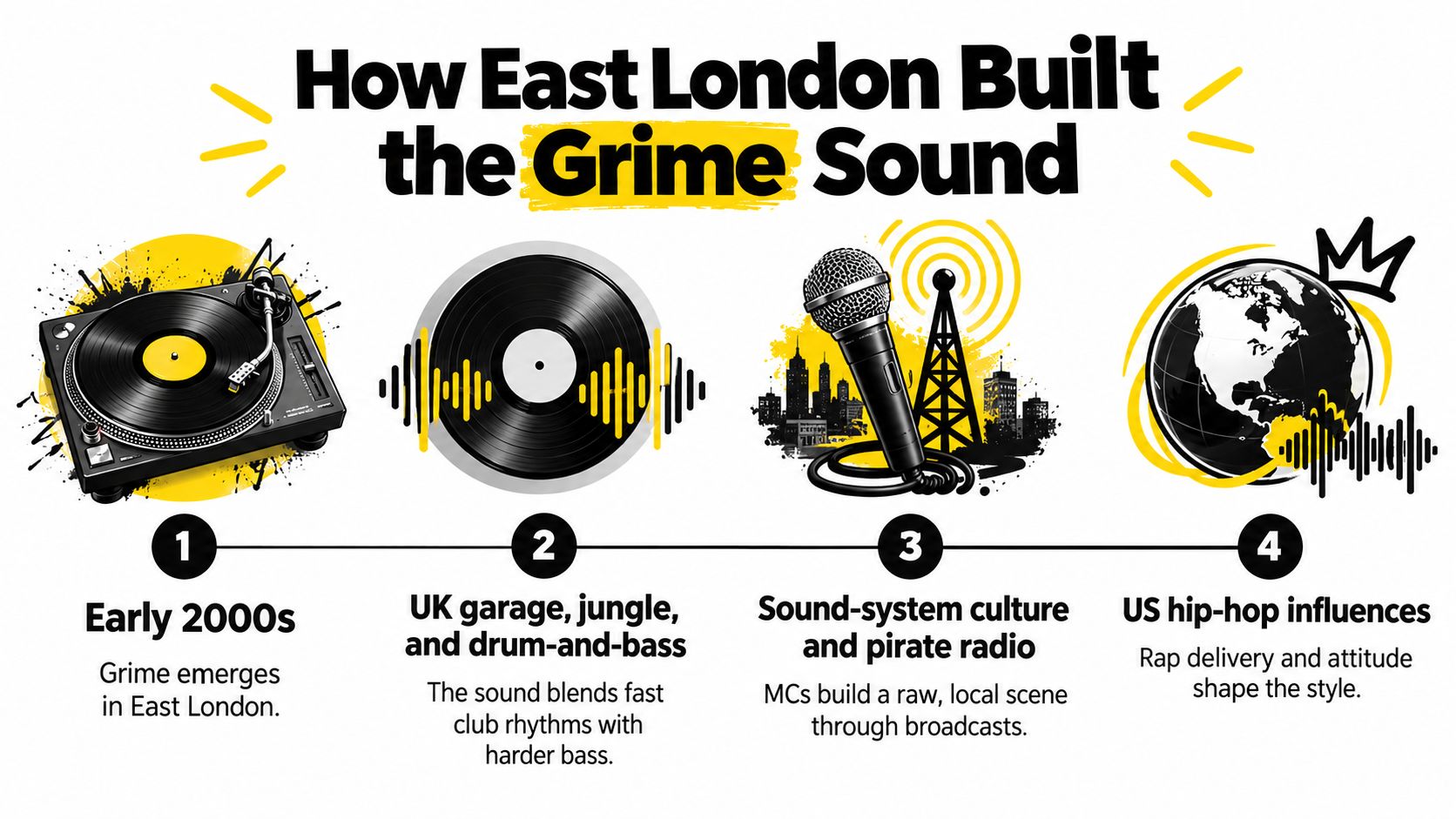 An infographic titled How East London Built the Grime Sound explaining its history and musical influences.
Pirate Radio Was the Training Ground
Pirate radio did more than broadcast tracks. It put MCs under pressure. DJs mixed live, performers passed the mic, and listeners formed an instant verdict. A weak eight bars had no second take; the moment belonged to the room.
That setting shaped delivery. Voices had to cut through rough audio and crowded spaces, so MCs learned to project, repeat key phrases and make their name, area and stance clear in seconds. The mic was a test of presence as much as rhyme.
Clubs and informal recording spaces kept the music close to the people making it. References to a street or estate weren't scenery added for effect. They came from shared experience, which gave a boast or challenge its local weight. Authenticity rested on context and community, not aggression alone.
The Names That Defined the Template
Wiley helped shape the production and MC blueprint that others developed. Dizzee Rascal showed how grime could take album form, while Skepta, part of a later generation, carried its confidence and directness to a wider audience.
Each name points to a different contribution. Wiley suggests invention, Dizzee album craft, and Skepta renewal and reach. Follow those roles and the history becomes easier to hear.
Listen for function, not just fame. Ask what each artist changed in production, delivery or audience, and the scene's development comes into focus.
Formal recognition came after the culture had already built its own identity. The MOBO Awards formally acknowledged grime as a genre in 2015, and iTunes added grime as a category in 2016. Those dates mark institutions catching up with a scene East London's young people had been building for years; they aren't grime's starting point.
The template grew from local conditions: fast beats left space for the voice, MCs competed in short bursts, and a postcode could carry the force of a signature. The sound could travel, but its credibility still came from the places and communities that shaped it.
From Pirate Radio to National Charts
A scene can be culturally loud long before it's commercially visible. Grime spent years in that gap. Insiders knew the names, the stations and the clashes. Much of Britain still heard only a rumor.
The 2010s closed that gap. The clearest way to see the shift is to put the audience, streaming, live and album figures in one place, because PRS for Music's report on BPI figures reported by the BBC and related audience research records UK grime streams rising from 86 million in 2016 to 206 million in 2017, grime events listed through Ticketmaster reportedly quadrupling between 2010 and 2017, 73 percent of Britons in a study of 2,000 respondents being aware of grime while 40 percent had listened to it, and grime album sales growing 93 percent in one reported year compared with 6 percent for the overall UK music market. That's not a niche bubbling. That's national breakout.
This visual summary shows that movement from specialist scene to mainstream visibility.
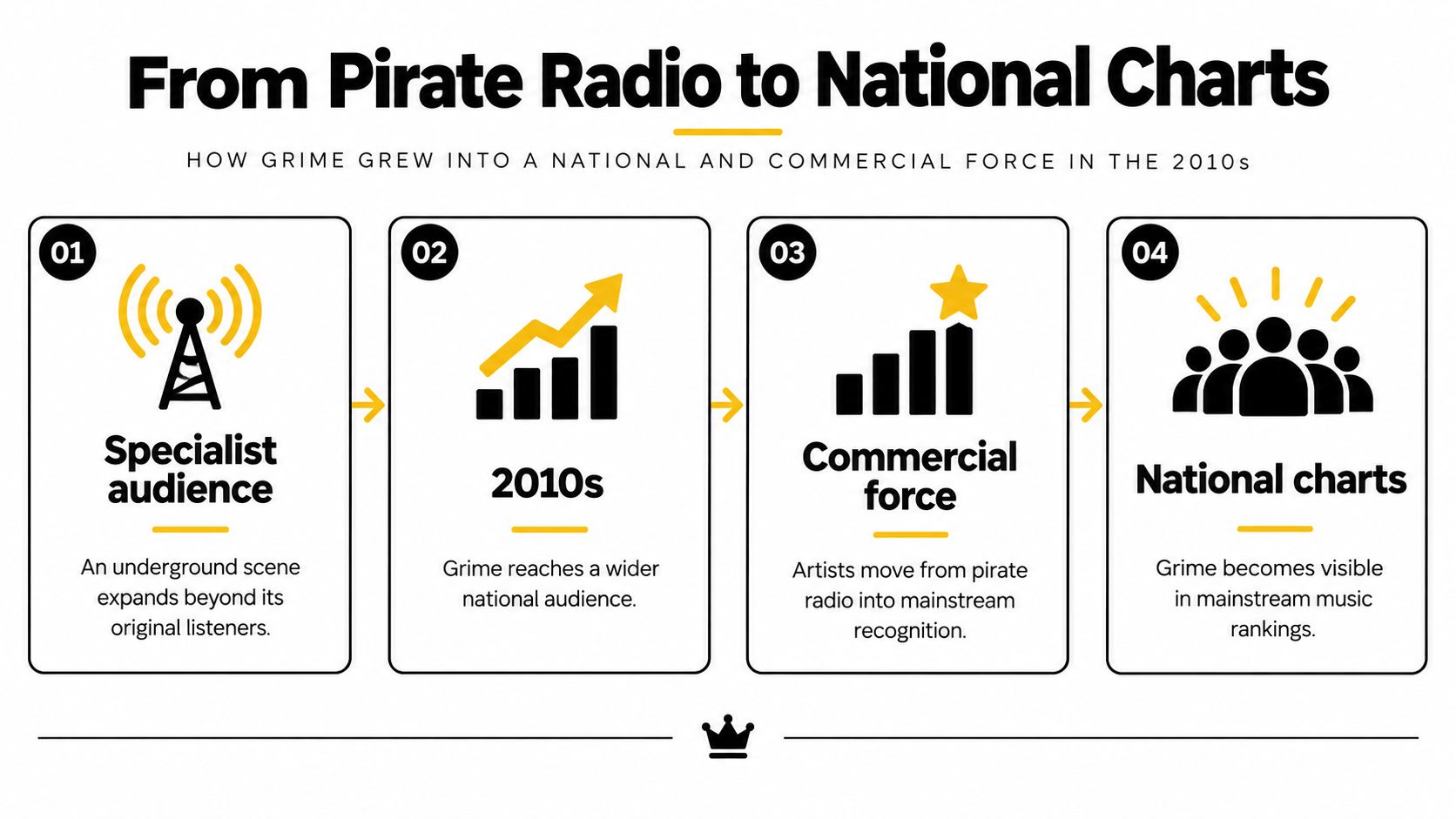 A four-step infographic showing the evolution of UK Grime from pirate radio to national charts.
Streaming Removed the Gatekeepers
Pirate radio had always rewarded immediacy. Streaming rewarded it at national scale. A listener no longer needed to live near a station, know a DJ or catch a set at the right hour.
That route mattered because streaming platforms were used by half of listeners as at least one route to the music. Background listening widened the funnel too. Another report in that same body of research found people hearing grime actively or passively while it played around them, which turns casual exposure into familiarity.
Don't confuse familiarity with fandom. They're different steps. Awareness means someone recognizes the label. Listening means they've spent time with the sound. Buying albums and attending events mean money and effort follow.
Grime eventually cleared all three steps. That is why the live growth matters as much as the streams. Screens can inflate curiosity, but people still have to leave home, buy tickets and stand in a room.
The video below gives you a performance context for that shift, and it's worth watching how crowd energy changes the meaning of short, punchy bars.
Commercial growth didn't erase the underground logic. It amplified it. The reload, the clash and the local shout out still made sense because audiences had learned the codes. Grime didn't become national by becoming vague. It became national while keeping details that once belonged to a few London postcodes.
Rhythm, Bass and Production Limits That Shaped Grime
Now step onto the grid. Grime feels frantic, but its structure is surprisingly tidy. Once you can count it, you can hear where an MC is playing safe and where they're deliberately leaning against the beat.
The core specification is documented in academic analysis of grime meter, cycle length, frequency profile and tempo, which places grime in 4/4 with repeated 8 or 16 bar cycles, typical tempos around 136 to 140 BPM, a quarter note lasting about 429 milliseconds at 140 BPM, an 8 bar phrase lasting about 13.7 seconds and a 16 bar phrase lasting about 27.4 seconds. Those numbers aren't trivia. They tell a writer exactly how much room each idea gets.
Grime Timing at 140 BPM
| Musical Unit | Approximate Duration at 140 BPM |
|---|---|
| Quarter note beat | About 429 milliseconds |
| 8 bar phrase in 4/4 | About 13.7 seconds |
| 16 bar phrase in 4/4 | About 27.4 seconds |
Count four beats per bar. An 8 bar section gives you a short speech, not a novel. That is why grime writing favors compressed claims, sharp images and endpoints the crowd can catch on first hearing.
A 16 bar section doubles the space, but it doesn't remove the pressure. You still need internal turns so listeners don't feel the loop dragging. Change your rhyme placement, pause before a punchline or enter off the expected beat.
Practical rule: Write to the phrase boundary first. Fancy internal rhymes won't save a verse that spills awkwardly over the place where listeners expect release.
Fast Grid and Heavy Pocket Can Coexist
Here's where readers often get confused. A track can run at a fast tempo while feeling spacious. Producers use half time bass or drum interpretations, so a bass phrase may articulate roughly every two beats while the underlying grid stays quick.
That creates weight under dense vocals. The MC can sprint. The low end walks like it owns the pavement.
Don't assume every syllable should land on a kick. Grime MCs cluster syllables, leave gaps and strike accents between obvious points. The pocket comes from contrast, not from gluing every word to the drums.
If you're building the backing track yourself, a practical guide to making rap beats can help you separate tempo, drum placement and bass movement before you start adding decoration. For grime, that separation is essential. Decoration is usually the first thing to remove.
Cheap Tools and the MC Tool Idea
Early grime production grew from constraint, as Clash's account of grime's resurgence and production history describes accessible PC software and, in some cases, PlayStation music production software, with tracks recorded to MiniDisc and transferred directly for vinyl cutting. Limited tools pushed producers toward economical choices. They kept what hit and cut what merely filled space.
That history explains the synthetic timbres, abrupt drops and off kilter rhythms. The sound wasn't sparse because producers lacked imagination. It was sparse because every element had to justify itself on limited equipment and in a live mix.
The 140 BPM norm also helped DJs mix records and backing tracks consistently across pirate radio sets. A backing track could function as an MC tool, leaving perceptual and rhythmic room for whoever grabbed the mic. Think of it as a boxing ring. The canvas and ropes matter, but they're built so the fighters can move.
For writers, that means your lines must survive exposure. Use clear punchline endpoints. Vary bar density. Leave an occasional rest before a drop so the next entrance feels like an event.
Regional Scenes Beyond London
London built grime, but London doesn't own every version of it. Treating UK Grime Rap as one accent, one slang dictionary and one map is the fastest way to write something hollow.
Scenes developed across major UK cities. Artists outside the capital often work with weaker infrastructure, fewer suitable venues, limited mentoring and lower industry visibility. The talent pipeline and the opportunity pipeline aren't the same thing.
Liverpool makes that gap concrete, because Liverpool music city research on regional rap participation notes that UK rap and hip hop represented 22% of the UK singles market in 2023, yet Liverpool rappers struggled to share in grime and drill's mainstream trajectory, with Hazey's 2022 chart success standing out as an exception, while related Manchester research identifies a rap gap shaped by licensing, noise complaints, gentrification and venue policies. National demand doesn't automatically create local access.
What Changes When the City Changes
- Accent: Vowel sounds change rhyme options and the percussive feel of a line.
- Slang: Local words signal belonging, but borrowed terms can sound forced.
- Venues: Available rooms shape set length, crowd behavior and promoter risk.
- Networks: Mentors, studios and local media decide who gets heard repeatedly.
Birmingham, Nottingham, Glasgow and Cardiff each bring different speech patterns and venue ecosystems to the same broad grime framework. The tempo may stay familiar. The mouth delivering the bars shouldn't be treated as interchangeable.
Manchester's rap gap shows why infrastructure belongs in a music discussion. If licensing decisions and venue policies make Black rap and grime events harder to stage, artists lose the live feedback that sharpened the original London scene. A city can have MCs and still lack a reliable stage.
A postcode is not a rhyme filler. It is a claim about where you learned to speak, perform and be judged.
This is the contrarian point many explainers miss. Internet distribution made grime internationally accessible, but global reach didn't flatten its identity. Listeners still prize the sense that a voice comes from somewhere real and specific.
For writers, region-aware choices beat generic UK flavor. Don't sprinkle Multicultural London English over a verse supposedly rooted in Liverpool or Glasgow. Research the local dialect, or write from your own place instead of renting someone else's.
Authenticity doesn't mean only Londoners can make grime. It means every scene should sound like itself. The genre grows when regional artists bend the framework around their own streets, rather than polishing away the differences that make them worth hearing.
How Grime Lyrics Work and How to Choose Your Angle
Grime lyrics get misread when every aggressive line is treated as a literal threat. They also get misread when every line is dismissed as harmless theater. The truth depends on context, and good listeners learn to ask which mode they're hearing.
A useful evidence check comes from qualitative research analyzing 90 UK grime, drill and rap songs, which found recurring themes of local community issues, adversity, social support, policing, poverty, exploitation and escape, with local social issues appearing in more than half of the songs and almost one third referencing a specific geographic location, most commonly London. That tells you place and social conditions aren't side topics. They're central material.
Bravado Versus Testimony
Competitive bravado is performance combat. The MC claims superior skill, status or nerve, often through exaggeration. Its nearest sporting cousin is trash talk before a match. The point is dominance inside the contest.
Autobiographical testimony works differently. The MC reports conditions they've lived with or witnessed, such as poverty, policing or blocked escape routes. Details function as receipts. A named estate or street can say, I know this because I was there.
Confusing these modes leads to bad writing. If you copy testimony you haven't lived, you risk caricature. If you treat testimony as simple aggression, you miss the social record inside the song.
Grime's language also carries multiple inheritances, including Jamaican sound system culture, hip hop, R and B, working class British experience and Multicultural London English. That mix is why slang alone can't authenticate a verse. Vocabulary without lived context is just seasoning with no meal underneath.
Choose the Angle Before the Insult
- Playful battle: Skill based, funny and safest for friends or fictional rivals.
- Fictional persona: Lets you exaggerate without pretending the story is yours.
- Local pride: Turns place into celebration rather than threat.
- Social commentary: Aims at conditions or institutions, and needs specific observation.
- Personal roast: Uses known details about a target, so consent and relationship matter.
Each angle changes your vocabulary and risk. Playful battle can rely on flow and wit. Social commentary needs credible detail. A personal roast lands because the audience recognizes the target, not because you've turned the volume to maximum.
Structure helps every angle. Studying common rap rhyme patterns shows how end rhymes, internal rhymes and repeated sounds can hold a fast verse together without forcing every line into the same shape. In grime, variation also creates breath points before a punchline lands.
Ask what the bar is doing before asking how hard it sounds. Proving skill, telling truth and mocking a friend are three different jobs.
DissTrack AI fits at the drafting stage for writers who want options. Users can choose UK Grime among its style tags, tune the level of savagery and receive structured verses with multiple variations that stay private until they choose to publish. Treat generated material as raw clay. You'll still need to check regional references, remove borrowed experiences that aren't yours and reshape lines to your own voice.
The most convincing angle is usually the one you can defend without pretending. If your strength is humor, battle playfully. If your strength is observation, write about your own streets. If your strength is character work, build a persona and signal that it's fiction.
Putting Grime Into Your Own Bars
Start with one angle and one place. Don't write a general UK verse and decorate it later. Decide whether you're battling, boasting, testifying or roasting, then let that decision control your details.
Draft in 8 bar blocks first. Read each block aloud at a fast tempo and mark where you run out of breath. Shorten the line, move the rhyme earlier or leave a rest. Space isn't failure. In grime, space is where the drop gets its power.
Check every punchline endpoint. If the listener can't tell where the joke or claim lands, the bar needs surgery. Reading guidance on how to write punchlines can help you tighten setup and payoff before you worry about extra internal rhymes.
Then test a draft against a sparse grime feel. Remove any slang you wouldn't naturally say. Replace borrowed hardship with an experience you can claim, or switch to a clearly fictional persona.
For a concrete first attempt, use a free plan to generate one roast verse, select the UK Grime style, set a moderate level of savagery and compare the variations. Edit the best lines until the accent, references and rhythm sound like you. That's the work. Respect the scene, trust the structure and make every bar earn its seconds.
Ready to turn that 8 bar idea into a full grime style roast? DissTrack AI lets you choose the UK Grime style tag, tune the savagery and generate structured verse variations you can edit to your own voice and place. Start with one free roast, keep what's sharp, rewrite what isn't yours and perform the version that sounds unmistakably like you.