
UK Grime Drill Explained: Tempo, Flow and Hybrid Tips
The most popular shortcut for sorting UK grime from UK drill is to check the tempo. It sounds sensible until you put both styles near the same fast London pulse and realise the number alone tells you very little. A 140-BPM beat can carry a sharp grime clash or the uneasy roll of drill, depending on what the bass, drums and MC do with it.
Listen past the tag on the beat. The pocket lives in the bass movement, the snare and hi-hat placement, and the way the voice spends its syllables. Once you hear those choices, “UK grime drill” stops sounding like one blurred genre label and becomes a useful listening and writing question.
Why UK Grime and Drill Keep Getting Confused
You load a 140-BPM backing track, see “UK” in the file name, and assume the verse will tell you whether it's grime or drill. That shortcut fails because the styles share plenty of surface features: a fast electronic pulse, bass in the foreground, space for an MC, and a beat that doesn't need a wall of sounds to make its point.
Playlists and beat menus often blur them for the same reason. A dark melody doesn't automatically make a beat drill, just as a fast tempo doesn't automatically make it grime. The useful clues sit in the details you can hear and feel when the loop starts moving.
Think of grime as a packed club where the MC has to cut through the room, throw a line, and leave space for the crowd to answer. Drill feels more like a walk down a narrow corner, with the ground shifting under the bass and the snare refusing to land like a comfortable march. That's an analogy, not a rule, but it helps you notice the contrast before you reach for a genre tag.
Four checks for the first listen
- Pulse and bar length: Hear the beat in 4/4, then notice whether the writing and arrangement lean on familiar repeating cycles or a more unsettled two-bar feel.
- Bass movement: Is the low end holding a firm foundation, or does it slide around like a second melody?
- Snare and hats: Do the accents feel direct and even, or do they create a lurch that makes the loop tilt?
- Vocal phrasing: Does the MC fire clipped, consonant-heavy bursts through the space, or shift syllable density to ride the beat's changing accents?
Producer's ear test: Mute the melody and listen to bass, kick, snare and hats. If the groove still tells you how the MC should move, you're hearing the arrangement rather than just the mood.
Those checks will help you brief a producer, write a 16, or pick a style tag without calling every dark UK rap backing track grime. The beat's label can be a clue, but your ears get the final say.
How London Built Grime Then Drill
Grime and drill came from different London scenes, even when their tempos sit close together. Grime grew through pirate radio and club networks shaped by UK garage, jungle, dancehall and other Black British music traditions. Its MCs competed for attention in live sets, where clashes, reloads and quick exchanges made timing part of the performance.
That setting shaped the sound. A grime beat could leave plenty of room, like a clear gap in a crowded radio mix, so an MC could drive a punchline through the speakers and catch a crowd's response. Its slang and identity were local, while its musical roots reached across London's clubs and underground broadcasts.
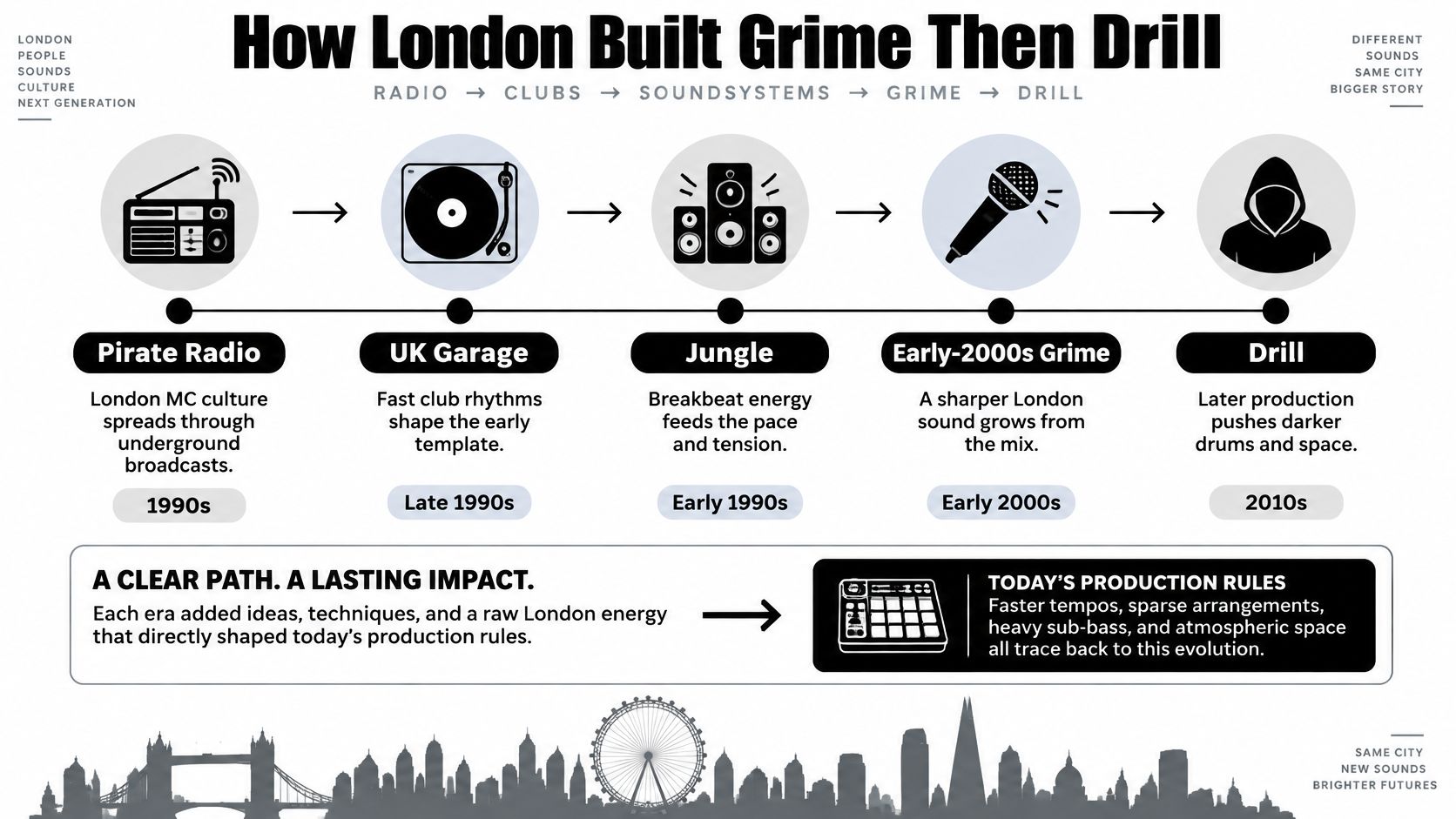 An infographic timeline showing the evolution of London music from Pirate Radio through Grime to Drill.
From underground sets to a wider audience
Dizzee Rascal's Boy in da Corner brought grime to a broader audience after its 2003 release, then won that year's Mercury Prize. The album's recognition carried a sound built in local networks beyond London without erasing its roots (Long Live Vinyl's account of grime's rise).
Grime reached another commercial peak around 2016–2017. Skepta's Konnichiwa won the 2016 Mercury Prize, and Kano's Made in the Manor was nominated. Streaming, online video and social platforms helped artists reach audiences beyond the traditional gatekeepers. Long Live Vinyl reported that grime received about 1 billion streams per week by 2017, alongside a 109% year-on-year rise in physical album sales (coverage of grime's commercial shift).
UK drill emerged in the 2010s, adapting Chicago drill to London's own setting. Its early spread relied heavily on online video, while grime's foundations were closely tied to pirate-radio sets and live MC exchanges. Those different routes shaped more than audience reach: grime puts the MC's performance at the centre, while drill often builds tension through a darker musical atmosphere.
Tempo Bass and the Beat Grid
Grime and drill can occupy a similar fast-tempo neighbourhood, but that's where the easy comparison stops. Think of the tempo as the road speed and the groove as the way the car handles the corners. Two beats can move at similar speeds while making the MC sit in completely different places.
For grime, start with a 4/4 frame around 136–140 BPM, often arranged in repeating 8- or 16-bar cycles. Bass and sub-bass carry much of the weight, while relatively sparse drums leave room for the MC. Drops and sudden changes in texture can sharpen the performance tension. At 140 BPM, one 16-bar section lasts roughly 27.4 seconds, a useful timing estimate when planning a verse (research on grime's production and rhythm).
Drill can share that broad pulse while using a different machine underneath. Common UK drill tempos are described around 138–151 BPM, with sliding 808s, hard kicks, dark melodic material and hi-hats often grouped in a 3+3+2 pattern. Snares can emphasise the fourth beat in alternating two-bar patterns, giving the loop a lurch instead of a straight walk (UK drill rhythm and production overview).
Grime pocket versus drill pocket
| Element | UK grime | UK drill |
|---|---|---|
| Tempo | Around 136–140 BPM | Commonly around 138–151 BPM |
| Bar framework | Often repeating 8- or 16-bar cycles | A two-bar pattern can shape the groove |
| Bass | Bassline and sub-bass provide a strong foundation | Sliding 808s add pitch movement in the low end |
| Drums | Sparse, aggressive programming leaves room for the MC | Hard kicks and shifting accents create a lurching feel |
| Hi-hats | Syncopation supports clipped, fast phrasing | Figures often group in a 3+3+2 pattern |
| Snare feel | A direct, performance-friendly grid | Emphasis can lean on beat four in alternating two-bar patterns |
The production choices create the difference. A sliding 808 makes the low end move in pitch, so the bass feels melodic instead of fixed. A displaced snare changes where the listener expects the vocal to settle, giving the pocket urgency.
If you're sorting a music library or comparing tempos across loops, a BPM tool for music library management can help organise tracks by speed. For a beat-building refresher before you start arranging drums and bass, see this guide to making a backing track. A tempo match is a starting point, not a style verdict.
Where the Vocal Pocket Actually Sits
Flow isn't a speed setting. It's a seat in the beat: the MC chooses how many syllables to fit, where to stress them, and which gaps to leave open.
In grime, a steady fast pulse can carry double-time energy. Consonant-heavy phrases and syncopated bursts give the verse bite, but phrase economy keeps it from turning into a blur. Imagine an MC riding an electric rail: they can accelerate across a line, then leave a clean gap for a reload, a drop or another voice.
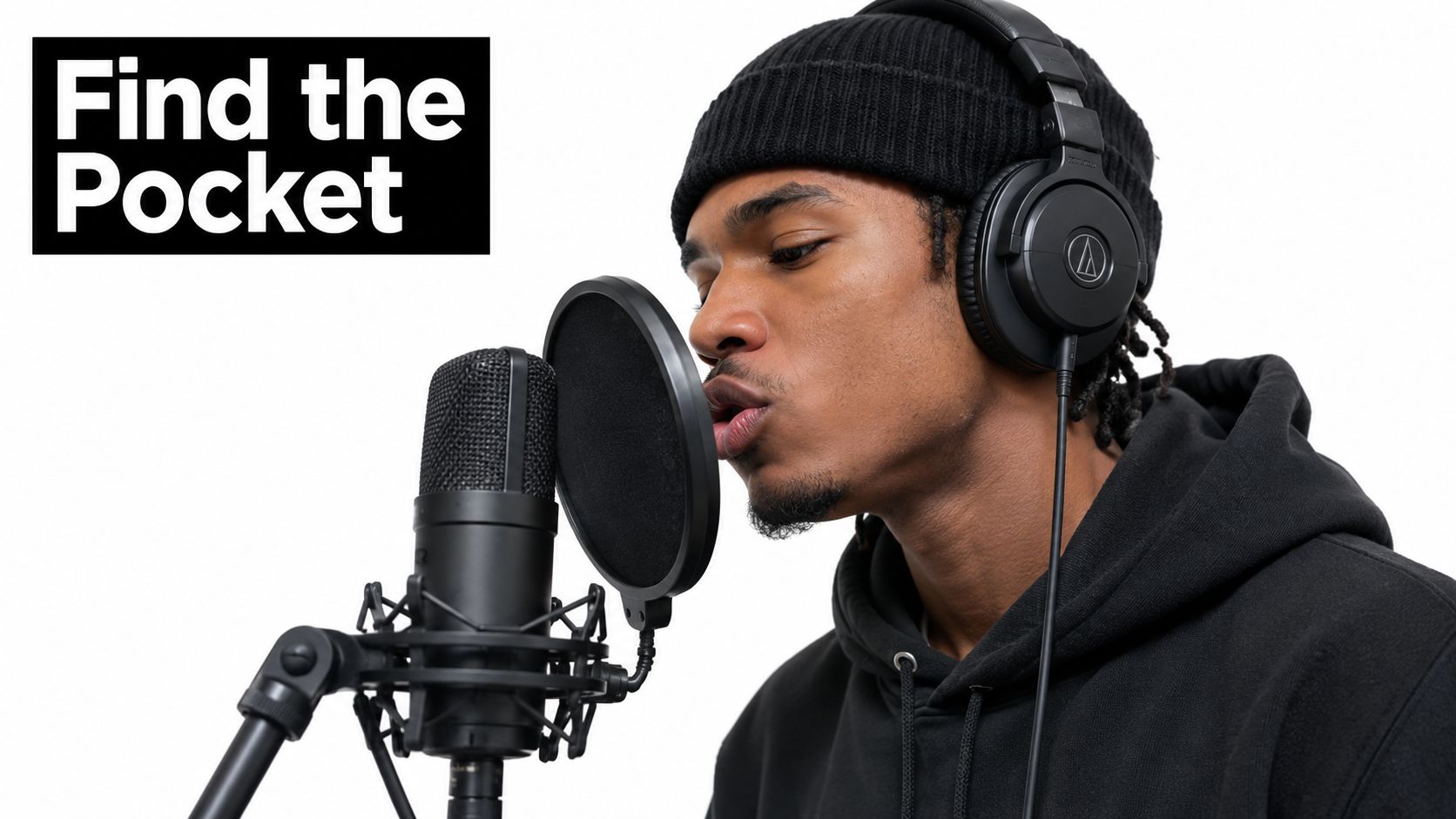 A young man wearing a black beanie and headphones recording rap vocals into a studio microphone.
Drill asks you to shape the line around a more unsettled seat. Map a phrase across a two-bar unit, change the syllable count from bar to bar, and give the important words room to meet the kick or snare. If every line marches with four equally stressed beats, the vocal can flatten out the groove you built.
Same joke, different pocket
Take one harmless premise: your friend arrived late to the studio and missed the first take. The idea stays the same, but the delivery changes.
Grime cadence: “You rolled in late, mate, missed the whole first take / Door swings wide, but the mic's on break.” The consonants snap forward, and the rhyme lands neatly while leaving space for a response.
Drill cadence: “Walked in… beat's gone / Late again… mic's on.” Let the stress words fall on the kick or snare, then let the gaps do some of the work. It's not about cramming the same number of syllables into every slot.
End-rhyme addiction is a common trap. A neat rhyme at the end of every bar doesn't make a verse sit well if the punch words miss the drum accents. To revise, clap the snare while you rap the line. Move the key word onto the snare, shorten the lead-in if needed, and let the remaining syllables breathe.
For more ways to vary line endings and internal rhymes without losing the rhythm, explore these rap rhyme patterns. The pocket should still feel clear when you strip the line down to its stresses.
Lyrics Rivalry and the Violence Myth
A verse can sound menacing without describing a real threat. Cold delivery, local references and aggressive boasts are part of the performance toolkit, like a minor-key chord or a snare that lands hard. Rivalry and exaggeration build tension; a credible, specific threat aimed at an identifiable person carries a different meaning.
That distinction matters because UK drill has also been treated as a policing issue. In 2012, Newham Council's Operation New Hampshire reportedly led to 76 drill videos being removed from YouTube over concerns about gang recruitment. In 2015, the Metropolitan Police's Operation Domain treated some videos alleged to incite violence as intelligence material, as described in research on UK drill's history and criminalisation. These actions record institutional responses. They do not, by themselves, show that the music caused violence.
Separate the image from the evidence
Researchers examined 549 UK drill songs released between December 2013 and November 2018, alongside Metropolitan Police data on homicide, robbery of personal property and violence with injury. Their analysis found no causal link between drill lyrics and those forms of violent crime. That finding does not make every lyric harmless or settle the meaning of a particular line. It does show why violent imagery alone cannot establish that a song caused a crime.
For writers, the practical test is the target and the intent. Fictional beef, stylised boasts and atmospheric menace can create a character or a clash. Naming a real person and directing a credible, specific threat at them can read as something intended beyond the track.
Criticism works better when it separates sound from evidence. Listeners can examine a lyric's conventions and the tension in its delivery without treating a whole genre as criminal. Judge the line in context, and don't mistake a performed persona for proof of real-world action.
How to Build a Grime-Drill Hybrid
The trap is that grime and drill can share a similar tempo, yet still feel completely different. Build the hybrid around one style's rhythmic logic, then borrow a single feature from the other. Otherwise, sliding bass, shifting snares and competing accents can crowd the same pocket.
Start with a grime framework and add a drill-style sliding 808. Keep the vocal delivery clipped and the drums open, so the bass can bend between notes without swallowing the MC. Or use drill's shifting two-bar rhythm, then leave a grime-style gap for a vocal handoff or response. The borrowed detail should colour the groove, not redraw its whole map.
 Screenshot from https://aidisstrackgenerator.com
Choose how you'll draft the verse
You can write from a blank bar, study a reference track's arrangement, or use a style-tagged generator to spark a first draft. Writing by hand suits a clear idea for the pocket: you can place each stress against the drum accents. A reference can show how an artist uses space, but keep their distinctive lines and persona out of your own verse.
If the page is empty, DissTrack AI can generate editable verse variations from a name, relationship, inside jokes and tags such as UK Grime or Drill. You can also adjust how sharp the roast should be. Treat the output like a rough vocal take: keep phrases that sit on your beat, rewrite the awkward ones, and make the final choices yourself.
A hybrid can carry character without relying on menace. A 2025 ethnographic study of UK drill and grime communities describes perceived benefits such as mental-health support, creativity and community connection, while arguing that criminalisation can harm Black and White British young people. The study also found that, across its corpus of 549 songs by 105 London drill artists, more negative lyrical sentiment did not bring more YouTube engagement; songs with more positive sentiment received roughly twice as many views (the study's account of drill and grime communities and its analysis of lyrics and engagement). Wit, vivid detail and an unexpected punchline can give a verse bite without making threat its only tool.
Turn the Difference into a Finished Verse
Make the next session small enough to finish. Choose one 16 at about 140 BPM, then decide whether the snare stays on a straight grime grid or takes drill's off-balance two-bar snap. Write eight bars first, putting the punch words where the kick or snare gives them weight.
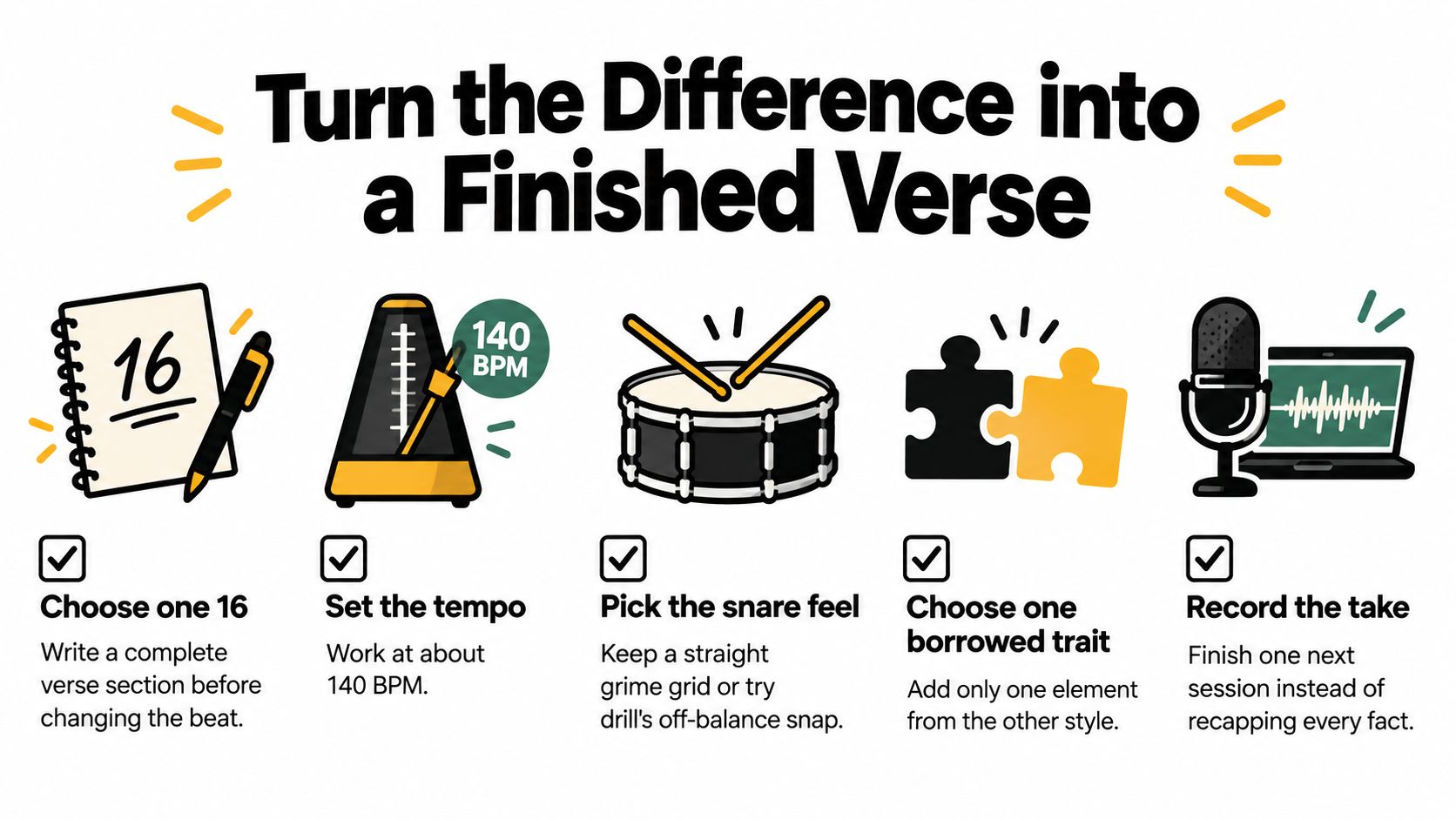 A five-step guide for turning musical differences into a finished verse, illustrated with icons and instructions.
Before recording, run a quick check: choose one bass movement, settle on one hat feel, and keep one stress pattern consistent enough for the listener to follow. Then remove any line that could sound like a real threat rather than a roast or fictional clash. That edit doesn't weaken the writing; it makes your intention clearer.
For another drill-focused writing prompt, try this guide to a drill rap lyrics generator. You can also open DissTrack AI, enter a willing friend's name and a harmless inside joke, then generate one pass tagged UK Grime and another tagged Drill. Edit the stronger pocket by hand so the verse matches the grid you chose. Generations stay private until you publish them, and free, Pro and Creator plans have different limits for extra variations and commercial use.
Listen back after one loop. If someone can name the pocket from the bass, drum accents and vocal stresses, your blend is doing its job.
Open DissTrack AI to try UK Grime and Drill style tags with a friendly inside joke, then edit the generated verses until their stresses lock to your beat. Keep the lines that sound like you, and leave actual threats out of the session.