
How to Write Grime Lyrics: A 16-Bar Verse Guide
You've got a beat looping in your headphones, six bars in your notes app that looked enormous when you typed them, and a nagging suspicion that the whole thing collapses the moment you say it out loud. That gap between how a line looks and how it lands is where most grime writing dies. Not at the idea stage. At the point where the words meet the tempo. Learning how to write grime lyrics is mostly learning to write for a clock you can hear.
The 16-Bar Blueprint and Step-by-Step Draft
A verse can have sharp ideas and still feel shapeless if every bar does the same job. Give the listener a clear route: introduce the subject, build the details, turn the idea, then close with a phrase that sticks.
Grime writing sits on a fast, regular rhythmic grid. The genre emerged in East London in the early 2000s, drawing on UK garage, jungle, dancehall and hip-hop. Its defining tempo is generally around 140 beats per minute, as the encyclopedia entry on grime music explains. That pace rewards short rhythmic cells and clear stresses. Long sentences crowded with clauses can blur before the next snare.
Why the 8-bar unit is the building block
Pirate-radio sets shaped the form. Several MCs shared one backing track and took short runs of bars before passing the microphone, so a compact run became a natural size for one idea. A 16-bar verse can work as two contrasting 8-bar sections, rather than one long paragraph with a breath in the middle. At bar 9, change something: the angle, pace, register or target.
Direct address suits the form. You can speak to the opponent, the crowd or the beat itself, giving the verse a clear point of contact.
The bar map
Use this frame for a first draft.
| Bars | Job | What to write |
|---|---|---|
| 1-2 | Setup | Name the subject or boast in plain words |
| 3-6 | Development | Add one concrete detail: a place, routine or habit |
| 7-8 | Reversal | Deliver the punchline, insult or twist |
| 9-14 | Escalation | Raise the stakes with a second detail and a harder claim |
| 15-16 | Close | Return to the opening phrase so the verse ends on a hook |
Two bars state the subject. Six earn it. Two turn it. That completes one thought; the second eight bars can push the idea further. Try drafting the same verse twice, with the punchline at bars 7-8 in one version and bars 15-16 in the other. Compare which placement makes the ending feel earned rather than delayed.
Seven steps from loop to recorded check
1. Loop 16 bars and count out loud. Sixteen bars at this tempo runs about 27 seconds. Count four beats per bar over the loop, then check that the shape feels manageable before adding words. If you are building the backing track yourself, this walkthrough on making a backing track covers tempo and arrangement.
2. Write one observed sentence, not a theme. “Betrayal” is a theme. “You left my hoodie on the radiator and took the charger” gives you an image to work with. Start with a detail you can describe plainly, then decide what it says about the subject.
3. Draft bars 1 to 6 in phrases of four to eight syllables. Speak each phrase against the beat before typing the next. If a line keeps spilling past its pocket, simplify the wording instead of trying to cram it in later.
4. Write the reversal last. Bars 7 and 8 depend on what the setup has promised. Draft the twist after the first six bars, then adjust the setup so the punchline has something to turn. Without that groundwork, the ending can sound like an insult dropped into the wrong verse.
5. Mark stresses and breath points by hand. Capitalise the stressed syllables and mark where you breathe. Place the main stresses where the beat gives them room. A technically neat line can still feel stiff if its natural emphasis keeps falling in the wrong place.
6. Escalate in bars 9 to 14, then close on a return. Add a new detail in the second half instead of repeating the first claim at higher volume. Bring back the opening phrase at the end, with a changed meaning or sharper edge.
7. Record it and listen against the beat. Check whether the words sit cleanly around the kick and snare. Cut syllables that crowd them, then listen again for the line's meaning and punch. A bar that fits the grid but hides its point still needs work.
Watch the counting and drafting in practice before you start your own:
Where drafts fall apart
A polished sentence can fail as a bar. Writers sometimes build a long line first, then force it into the rhythm syllable by syllable. It may fit on paper and still sit awkwardly in the groove. Shape the thought around the beat from the start.
Test the frame first: state your subject in two bars. If you can't, sharpen the setup before working on the punchline.
If the opening takes too long to explain itself, the later bars have to carry unnecessary weight. Make the subject clear early, then let the details and reversal do their work.
Flow and Delivery That Stay Audible
You wrote a line that made you laugh at the kitchen table, recorded it on your phone, played it back, and heard a smear of consonants where the joke used to be. That isn't a performance problem. It's a writing problem that only shows up once the words are moving, which is why the mic belongs open while you draft rather than after you finish.
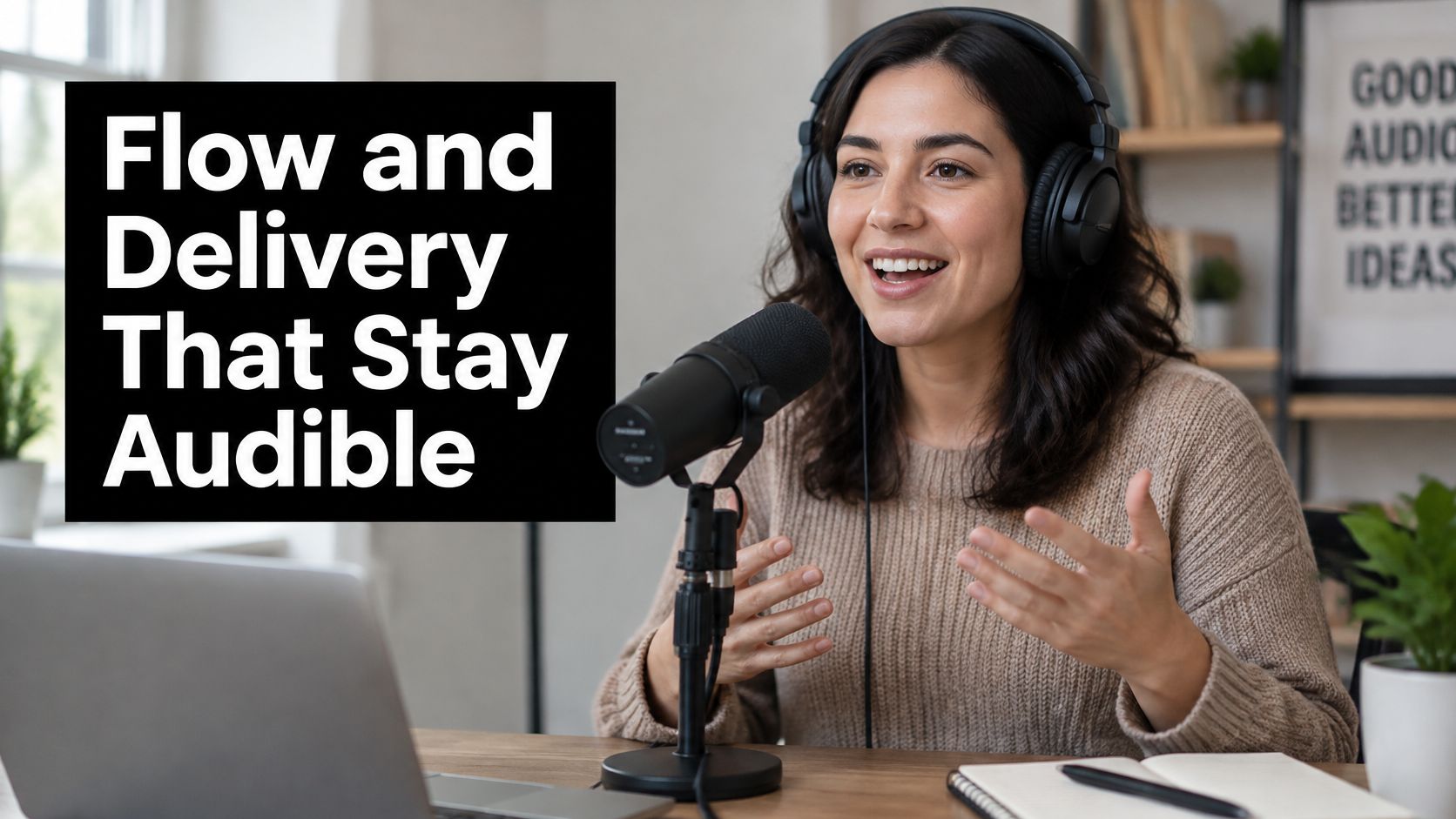 A woman speaking into a professional microphone while wearing headphones during a recording session at home.
Grime's vocal signature is quick staccato phrasing, sudden stops, internal rhyme, alliteration and switches between half-time and double-time flow, as the grime lyric writing guidance on Lyric Assistant describes. Most beginner advice stops at the recipe: pick a 140 BPM beat, write 8 to 16 bars, add internal rhymes, rehearse. What it rarely explains is how to check whether a dense line stays intelligible at speed, which is the only question that matters once you're in front of people or on a short video where nobody rewinds.
The three-speed test
Record the same bar three times: at the tempo you intend, slightly slower, and faster than comfortable. Then count how many syllables a listener can decode on first hearing. If the punchline blurs at your intended speed, cut the bar back to its stressed words and rebuild from that skeleton. The stressed words are the bar. Everything else is decoration that may or may not survive contact with a crowd.
| Delivery problem | Likely cause | Fix |
|---|---|---|
| Punchline lost on first listen | Too many syllables per bar | Cut the bar to its stressed words and rewrite it |
| Words blur at speed | Stresses fall between beats | Move stressed syllables onto the kick or snare |
| Verse feels breathless | No breath points marked | Place a pause after the setup and before the punchline |
| Flow collapses at half-time | Rhymes stacked on weak beats | Land rhymes on the 2 and 4 accents |
| Double-time sounds messy | Long subordinate clauses | Split the line into cells of two to four syllables |
Negative space is a weapon. A half-beat pause before the punchline usually hits harder than another internal rhyme, because grime arrangements leave room for the voice and most writers fill that room out of nerves.
Three things to do before your next rehearsal:
- Mark breath points before you open your mouth. A slash on the page beats a gasp mid-bar, and it stops you rewriting a good line just because you ran out of air.
- Keep double-time phrases in cells of two to four syllables. Long clauses are what turn a double-time section into noise.
- Rehearse against the beat, never in the air. A cadence that only works in your kitchen isn't a cadence yet.
Before you record a take you intend to keep, spend ten minutes on using your voice so the delivery is doing the same job as the writing.
Rhyme, Wordplay and Hooks That Land
Give me one line and I'll usually know whether it's a bar or a slogan. Take this: "Caught the 38 at seven, third seat, same window." Plain, specific, and doing three jobs at once. It names a real route and a real time, it plants a routine the listener can picture, and its hard consonants give the delivery something to bite on.
The turn comes in bar 7: "Bus is the only thing round here later than you." Same object, second meaning. The setup was literal, the reversal is figurative, and nothing had to be invented because the detail was already there.
Grime lyricism grew up around pirate radio, reload culture, MC clashes and grassroots Black working-class youth culture in London around 2002, as the Museum of Youth Culture's history of grime records. That lineage rewards reportage over generic superiority, which is why the timeline matters: Dizzee Rascal's Boy In Da Corner won the Mercury Prize in 2003 and pushed the sound to a wider audience, and Skepta's Konnichiwa won the same prize in 2016.
Rhyme beyond the line ending
End rhyme is one tool, not the whole kit. Internal rhyme, repeated vowel sounds and rhythmic consonants build momentum while keeping the sentence conversational. If you're mapping rhymes deliberately, the breakdown of rap rhyme patterns is worth a look before you start stacking them, because a stack of end rhymes in a four-bar stretch starts to sound like a nursery skip.
A hook is a repeated central phrase a listener can hold after one pass, three to six words, dropped at the end of the verse and again in the closing bars. Test it out loud on a friend and ask them to say it back. If they can't, it's a line, not a hook.
- One internal rhyme per four bars. Enough to keep the ear working, not so many that the sentence disappears.
- One concrete detail per setup. A place, a routine, a garment, a habit.
- One hook phrase per verse. Repeated, short, and returning to the opening image.
Keeping Your Verses Specific and Responsible
Grime can carry social observation as well as insults and boasts. An analysis of 90 grime, drill and related rap songs found recurring themes including community conditions, adversity, social support, policing, crime, status and escape, as Melodigging's grime genre profile summarises. Observation gives a verse substance without pulling it away from the clash.
Credible local detail comes from close observation: the bus route you know, the shop queue at 3pm, the way someone checks their phone before speaking. Borrowed street imagery you haven't lived or researched can make a line sound like costume rather than character.
Set boundaries before you write. Fictionalise names and locations when the target is a private person. Get consent before using a friend's private story, and don't make unsupported claims about an identifiable person. Dialect and slang are culturally situated, not a universal template. Borrow a feature only after you understand where it came from, not just because it makes a bar scan.
Final check before you perform: Does the line describe a behaviour, or insult a group? Could a listener mistake it for a factual claim about a real person? If either answer gives you pause, rewrite the bar.
Draft Your First 16 Bars Today
Give this next hour a shape. Minutes 0 to 15: pick one beat at 140 BPM, loop it, and count 16 bars aloud until the shape is automatic. Minutes 15 to 35: write an 8-bar setup built on one observed detail, and check that you can state the subject in two bars. Minutes 35 to 55: complete bars 9 to 16 with an escalation and a closing phrase that returns to the opening line. Minutes 55 to 60: record it once, mark the stressed syllables, and cut anything that blurs on playback.
If you stall on the draft, a generator can hand you a starting frame to argue with. DissTrack AI includes a UK Grime style alongside Drill, Emo Rap and others, each with different flows, vocabulary and attack patterns, and every generation returns multiple variations so you can pick the hardest bars, then export them as text and edit in your own voice.
Keep the first draft short enough to finish in one sitting. Before you perform it, rewrite any borrowed phrasing until the verse sounds like you and every line in it is one you could defend out loud.
You've got the bar map, the three-speed test and a 60-minute plan, so the next move is a draft rather than another evening of scrolling for beats. DissTrack AI lets you pick a UK Grime flow, feed in the details that make a target specific, and get multiple variations of structured verses back in seconds so you can keep the hardest bars and rewrite the rest in your own voice. Use it as a sparring partner for bars 7 and 8, the reversal that decides whether the whole verse lands.