
How to Write Effective Prompts for Brutal AI Diss Tracks
You type, “Write a brutal diss track about my ex,” and the machine fires back with a rhyme about pizza, bad vibes, and a heart made of stone. Nothing is technically broken. The prompt just gave the model an empty stage, so it reached for the safest props in the closet.
That's the Lyrical Translation Gap. You know the betrayal, the group-chat history, the fake confidence, the socks with sandals. The model only sees a broad request unless you translate that lived drama into instructions about target, relationship, flow, rhyme scheme, tone, and usable details. Learning how to write effective prompts means directing the performance, not begging the tool to “go harder.”
"Why Your First Prompt Flops"
A friend group wants a roast for game night. Someone types, “Make a savage rap about Jake.” The model returns clean rhymes about being slow, broke, and bad at dating. Technically, it is a rap. Nobody laughs because the same bars could target almost anyone.
Jake's actual material is more useful: he calls himself a producer but never finishes a beat, borrows chargers and forgets to return them, and once bragged about arriving early before showing up after everyone else. Those facts give the model contradictions to flip into punchlines. Without them, “savage” names an attitude, not the flow, rhyme scheme, or subject matter you want.
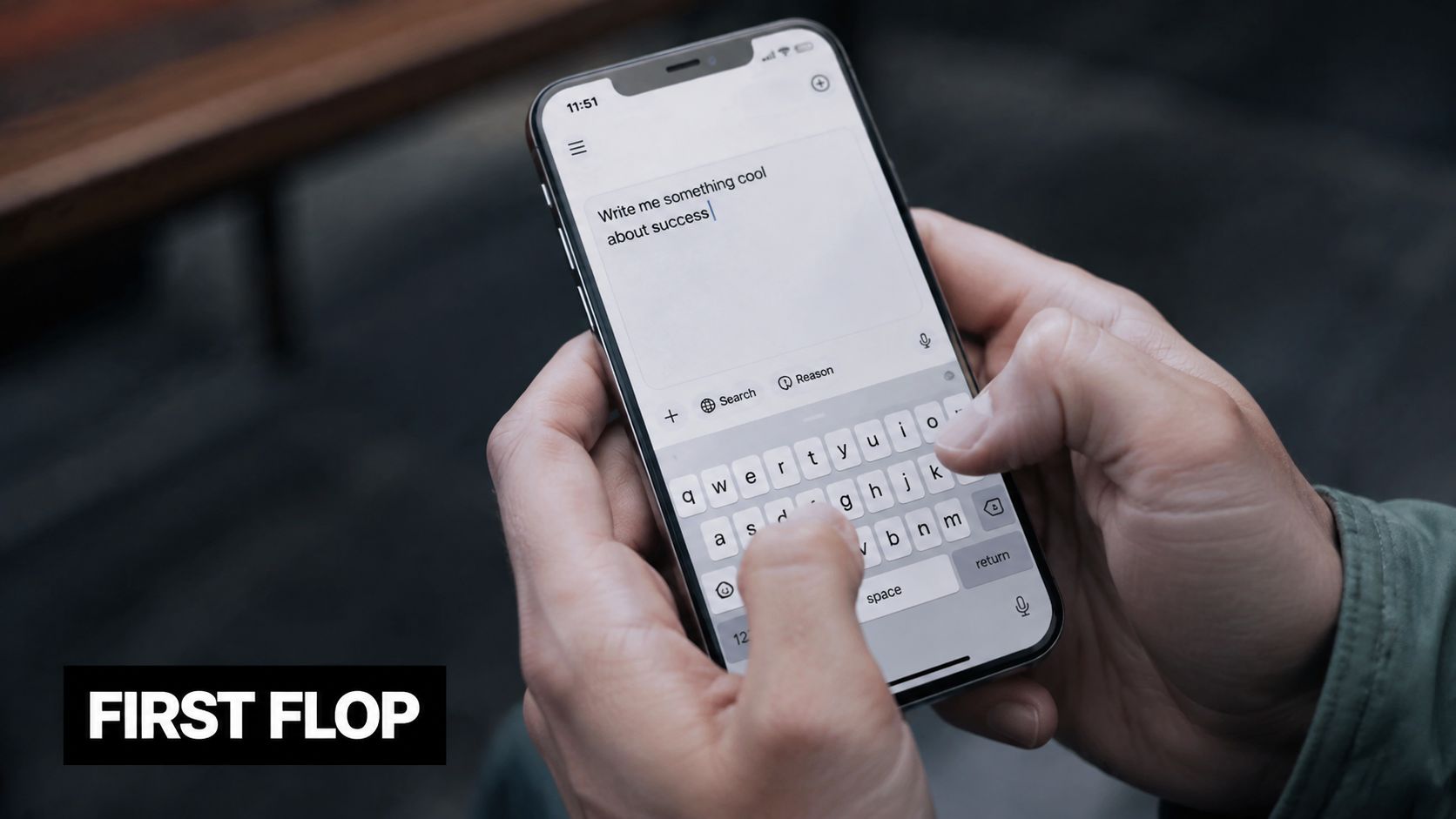 A person using a smartphone to type a creative prompt about success in an application.
A 2024 Nature Human Behaviour paper, “How to write effective prompts for large language models”, describes prompt design as a usability challenge for non-experts. The practical lesson is direct: turn lived drama into instructions the model can perform. Tell it who Jake is, what he does, how the verse should move, and which boundaries apply.
Generic language produces generic bars
Words such as “good,” “funny,” “hard,” and “viral” describe your hoped-for reaction. They do not specify what the writing should contain.
- Weak: “Make it funny.”
- Stronger: “Use playful exaggeration, two inside jokes, and a final punchline that flips his own brag against him.”
- Weak: “Make it brutal.”
- Stronger: “Keep the insults sharp but fictionalized, avoid threats, and focus on his unreliable behavior and inflated ego.”
Prompt engineering covers hard prompts, soft prompts, and optimization methods, as outlined in this survey of prompt-engineering research. The BlitzReels prompt glossary also defines practical terms for roles, constraints, context, and output formats.
Give the model a target, a history, a sound, and limits. That translation turns personal chaos into usable direction, so the output has specific details to flip, stretch, and rhyme.
"The Anatomy of a Killer Diss Prompt"
Your target has a reputation for being reliable, then misses the same deadline again. A vague prompt turns that drama into bland insults. A precise prompt translates it into performance instructions, giving the model the target, the contradiction, and the way each bar should hit.
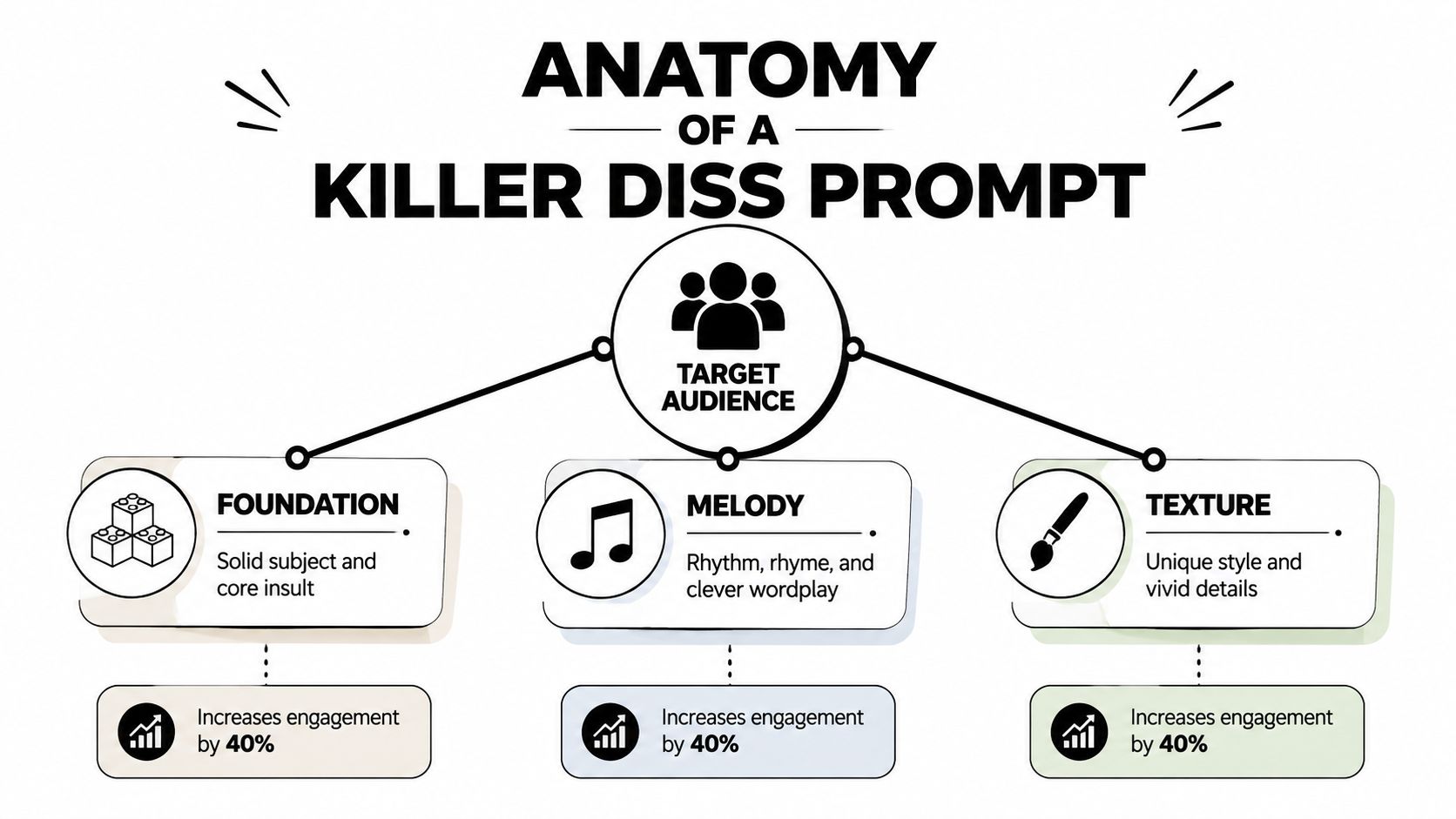 A diagram infographic explaining the key components of writing a successful diss prompt for an audience.
Foundation gives the insult a target
Start with who and why. Name the target, your relationship, the setting, and the behavior the verse should expose.
Practical rule: A model cannot personalize an insult from a name alone. Give it a habit, contradiction, failed promise, or recurring excuse.
“Roast my roommate” supplies a label. “Roast my roommate, a close friend who calls himself the cleanest person in the house but leaves cereal bowls beside the sofa” supplies a premise. The second version creates a gap between self-image and reality. That gap becomes setup, misdirection, and a punchline.
Keep the material specific without turning the prompt into a private dossier. Shared jokes, visible habits, nicknames, and harmless incidents give the model usable texture while keeping the attack playful.
Melody tells the model how to move
Style changes cadence, vocabulary, rhyme density, and imagery. Specify old-school boom bap with compact four-line setups, trap with triplet movement and restrained ad-libs, or battle rap with internal and multisyllabic rhyme. Choose a compatible combination. West Coast G-Funk, UK Drill, emo rap, and battle rap in one request can pull the output in conflicting directions.
Describe the arrangement as well as the sound:
- An opening setup exposing the target's false reputation
- Two verses, each built around a different incident
- A hook repeating the central insult
- A closing couplet that reframes the roast
For a practical example of converting a premise into musical instructions, read this guide on making a diss track from a prompt.
Texture makes the bars yours
Add specific facts from the shared story, then explain how those facts should function. A repeated excuse can become a setup, a failed promise can supply the payoff, and an absurd object can anchor a rhyme. Tell the model to reference the details naturally rather than list them. That direction produces a verse with connections instead of a checklist.
Output control finishes the brief. Set the length, section labels, perspective, rhyme preference, and boundaries. Tell the model what to avoid, such as threats, private information, or claims presented as fact. Format instructions shape how the material is delivered, so treat them as part of the creative direction, not an afterthought.
"Building Your Bar Stack"
A bar stack layers information so each instruction feeds the next. Start with the target, connect that target to a relationship, then add the incidents that give the model rhyme material. Style and structure sit on top, turning raw context into a track rather than a list of insults.
Use this order when drafting:
- Name the target and setting. “Write a playful diss for my longtime friend Jake to perform at a private game night.”
- Define the relationship. “The tone should feel competitive but affectionate, not hostile.”
- State the central contradiction. “Jake calls himself a disciplined producer, but he abandons every beat after the intro.”
- Supply concrete hooks. “He borrows chargers, arrives late, and posts motivational quotes before missing deadlines.”
- Choose the musical frame. “Use boom bap energy, internal rhyme, and conversational delivery.”
- Control the result. “Write two verses, a short hook, and a final punchline. Keep each line concise and avoid threats.”
That stack gives the AI several angles on the same character. Jake can be attacked through his self-image, his habits, and the gap between his announcements and his actions. The result has more room for setup, misdirection, and payoff.
Turn facts into usable instructions
Raw detail isn't automatically useful. “He likes music, shoes, and coffee” gives the model broad nouns. “He names every unfinished beat like it's a classic, wears spotless sneakers to messy rehearsals, and orders black coffee while adding several sweeteners” gives it contrasts and visual language.
Tell the model what role each detail should play:
- Setup: Establish the claim Jake makes about himself.
- Evidence: Show the habit that disproves it.
- Turn: Exaggerate the contradiction.
- Punchline: Land on a compact image or double meaning.
prompt guidance for writing punchlines helps sharpen the brief. Ask for a one-line diss with internal rhyme, a double meaning, or a metaphor, then request natural wording rather than ornamental vocabulary.
A reusable bar-stack template
“Write a [tone] diss track for [setting] about [target], my [relationship]. Expose [central contradiction]. Use these details: [detail one], [detail two], and [detail three]. Write in a [style] sound with [flow instruction], [rhyme instruction], and [structure]. Make the hook [hook requirement]. Avoid [unwanted elements]. End with [specific type of closer].”
That isn't a magic spell. It's a production brief. The more thoroughly you fill it in, the less the model has to invent.
"Styling Your Savage Flow"
The same insult can land like a sunny cruise, a basement cypher, or a tense battle round. Style tags work best when you translate them into sound and technique instead of dropping a genre name and walking away.
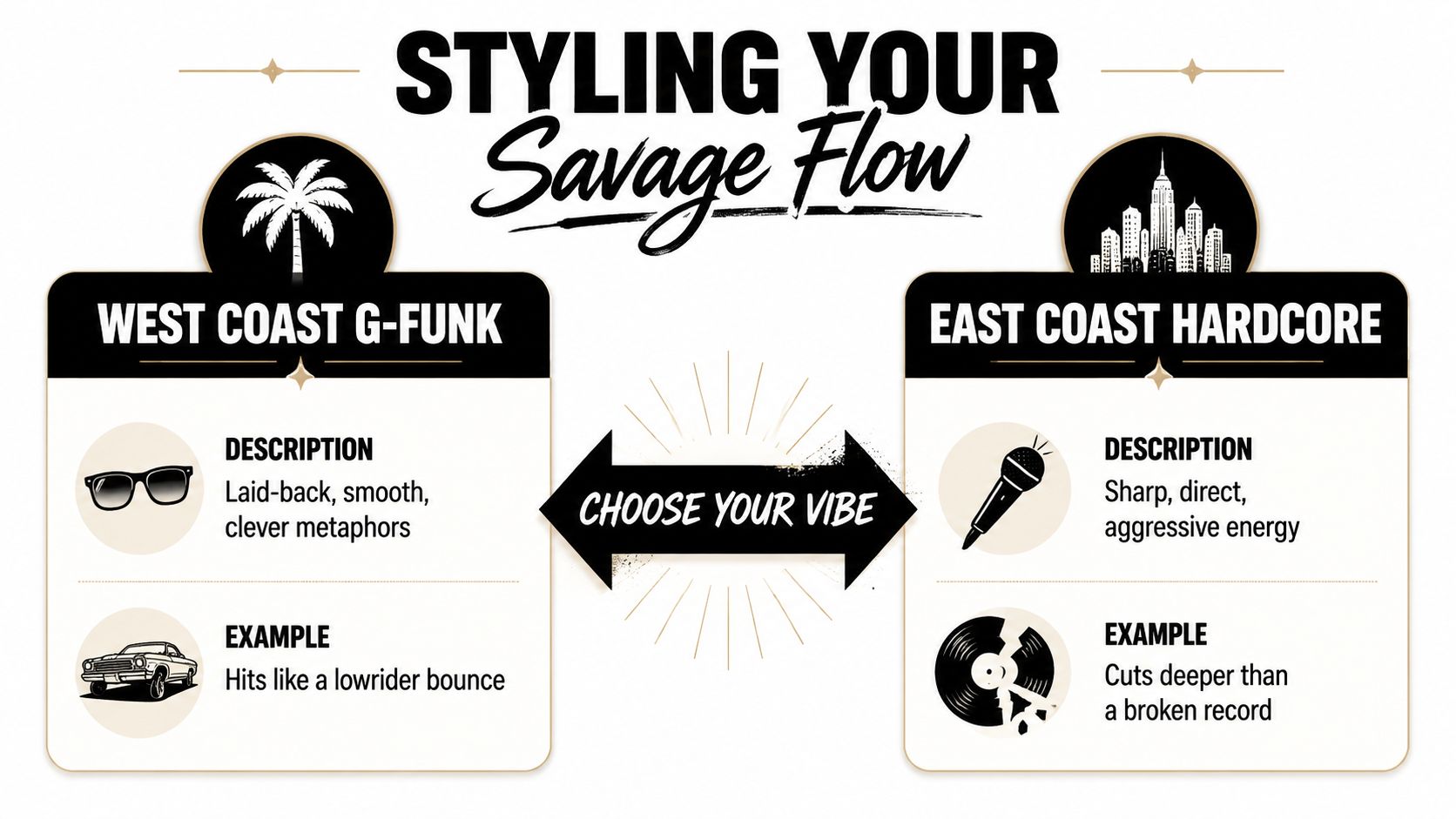 A comparison chart showing the differences between West Coast G-Funk and East Coast Hardcore music styles.
Genre names need technical detail
“West Coast” can mean several things to different users. Define it as laid-back delivery, smooth imagery, spacious phrasing, and clever metaphors if that's the intended feel. “Trap” becomes more actionable when you request short rhythmic phrases, triplet movement, selective ad-libs, and a hook built for repetition. “Battle rap” should point toward dense wordplay, internal rhyme, layered setups, and direct rebuttals.
The style request should serve the target. A playful roast may benefit from a relaxed groove and exaggerated images. A serious lyrical challenge needs tighter schemes and less filler. For a deeper look at how rhyme choices shape delivery, use this guide to rap rhyme patterns.
Compare the prompt, not just the genre
A weak style prompt says, “Make it sound like a famous rapper.” That can create imitation problems and still fails to define the mechanics you want. Describe transferable traits instead, such as clipped phrasing, internal rhyme, conversational confidence, dark imagery, or a repeated hook.
| If you want | Ask for | Avoid |
|---|---|---|
| Smooth party roast | Relaxed cadence, vivid neighborhood imagery, playful metaphors | “Make it cool” |
| Dense battle verse | Internal rhyme, multisyllabic rhyme, setups followed by reversals | “Use complex words” |
| Dark drill energy | Tense pacing, stark images, short lines, controlled aggression | Threats or literal harm |
| Emotional takedown | Reflective verses, restrained delivery, specific disappointment | Generic heartbreak clichés |
Model behavior also changes the result. A 2026 study reported different performance by model and prompt type, with ChatGPT performing better on command prompts while Gemini performed better on request prompts, as described in the model-aware prompt study. That doesn't mean one universal rule exists. Test whether “Write” or “Could you write” better suits the tool you're using.
Prompt quality improves through revision, not decoration. Add one instruction, inspect the change, and keep it only if the verse gets closer to the intended sound.
"Debugging and Refining Your Output"
Your first draft may contain a strong premise, a weak scheme, and a flow that fights the beat. Treat it like a rough recording, not a verdict. Diagnose the lyrical translation gap before adding more adjectives. Convert the life drama into a precise change: tighter cadence, denser rhyme, sharper imagery, or a clearer punchline.
When the insults sound generic
Compare these two follow-ups:
- “Make it more savage.”
- “Replace broad insults with images tied to the target's unfinished beats, late arrivals, and fake productivity posts. Keep the attack playful, and make the last word of each couplet carry the joke.”
The second tells the model what to change and where to aim. Negative constraints narrow the lane: “Don't mention money, appearance, family, or violence. Don't use nursery-rhyme couplets. Don't repeat the same insult.”
A property-focused research framework identifies 21 prompt-quality properties across six dimensions, while noting that researchers assess those properties unevenly across models and tasks, according to the prompt-quality framework. Apply that lesson during revision. “Be specific” is only a starting point. Check relevance, structure, consistency, tone, and output control as separate failure points.
When the rhyme works but the flow doesn't
Ask for a line-by-line revision with a performance constraint:
“Keep the meaning, shorten crowded lines, use conversational stress, and mark optional ad-libs in parentheses.”
For boom bap, request compact lines with internal rhyme and a clear end-rhyme anchor. For drill, request shorter phrases and sharper pauses. Mixing both approaches can create a deliberate hybrid, but asking for both without naming that goal often produces an unfocused delivery.
When extra context makes things worse
More material can bury the premise. A benchmark of 26 open-weight multimodal language models found that extra demonstrations or chain-of-thought prompting sometimes produced minimal gains or caused performance to regress, while retrieval-based examples and larger context windows offered limited improvements, as reported in the benchmark study. Test examples one at a time instead of assuming more context will strengthen the verse.
Use this edit loop:
- Generate a rough verse.
- Mark the weakest couplets and name the failure.
- Request a targeted rewrite of only those lines.
- Preserve the strongest images.
- Run a final check for tone, rhyme, and structure.
Prompt editing works like rehearsal. Adjust the instruction, hear what changed, and keep the revision only when the bars move closer to the intended performance.
"Ready-to-Use Prompt Templates"
Templates beat writer's block because they preserve the structure while leaving room for the story. Replace every bracketed field with information the model can use.
Playful friend roast
“Write a playful diss track for a private party about [name], my [relationship]. The central joke is that [contradiction]. Include [inside joke], [recurring habit], and [specific incident]. Use [style] with [flow detail] and [rhyme detail]. Write [number of sections] with a repeatable hook. Keep the roast affectionate, avoid threats and sensitive personal topics, and end with a punchline that makes the group laugh.”
Competitive battle verse
“Write a sharp battle-rap verse aimed at [fictional or consenting target]. Attack the gap between [target's claim] and [evidence]. Use dense internal rhyme, multisyllabic patterns, reversals, and double meanings. Build each couplet from setup to punchline. Keep the wording natural, avoid recycled clichés, and don't include threats, private information, or claims presented as fact without support.”
Style conversion prompt
“Rewrite this diss in [chosen style]. Preserve the central jokes about [details], but change the cadence to [flow description], the rhyme density to [rhyme description], and the imagery to [visual palette]. Keep the hook recognizable and label each section.”
Before sending, check the target, relationship, premise, details, style, structure, constraints, and revision request. If you're creating lighter meme material around the same ideas, MagicMeme's ChatGPT humor can provide another reference point for comedic framing, but your diss prompt still needs the personal hooks that make the bars feel lived-in.
Use a fictional or consenting target for entertainment, keep real-world accusations out of the lyrics, and revise for flow aloud. The model supplies options. You supply judgment, timing, and the final cut.
DissTrack AI turns your target name, relationship, inside jokes, style tags, and savagery preference into structured roast verses with variations you can edit, export, or share. Visit DissTrack AI, feed it real creative direction instead of a vague “roast them” command, and start building bars with a flow that sounds like your crew.