
8 Internal Rhyme Examples for Better Rap Bars
A rhyme doesn't need to wait for the end of a line to hit. Internal rhyme repeats matching or closely related sounds inside a line, across neighboring phrases, or across a line break, while end rhyme places the match at the ends of lines. That earlier sound creates motion before the punchline arrives, so the listener hears a pattern forming instead of waiting for a single closing sound.
Internal rhyme has deep roots outside modern rap. Reference material traces recognizable examples through Romantic-era English poetry, including Samuel Taylor Coleridge's The Rime of the Ancient Mariner, Percy Bysshe Shelley's The Cloud, and Edgar Allan Poe's The Raven. The term itself appeared later, first documented in 1900–05, even though writers had been using the technique for centuries (historical overview of internal rhyme).
The placement map in the examples below is simple. We'll mark rhymes inside one line, between adjacent lines, and inside repeating hooks, then turn each pattern into a usable exercise for bars, hooks, and personalized diss tracks. Keep the creative frame responsible. A sharp roast can target behavior, contradictions, bad habits, or playful details, but it shouldn't attack protected traits or genuine trauma.
1. Internal Rhyme in Eminem's Multi-Syllabic Wordplay
Eminem's style is a useful study in how internal rhyme can make a verse feel packed without relying only on line endings. In a dense bar, the matching sounds may appear in the middle of one line, then return near the beginning or middle of the next. That creates a chain the listener follows while the delivery keeps moving.
Consider a constructed teaching line:
Late in the station, I'm changing the cadence, then breaking the patience.
The repeated sound family appears in late, station, changing, cadence, and breaking. The matches aren't all perfect, and they don't need to be. What matters is the repeated vowel and the way the stressed syllables arrive during the flow. The end of the line can still carry a separate punchline rhyme.
This approach works especially well for an aggressive build-up. Pack the middle of the bars with related sounds, then slow down or leave space before the key insult. That contrast gives the punchline room to register instead of burying it under technique.
Map the moving chain
Write one plain line about a target's harmless contradiction:
- Behavior: They brag about preparation but always arrive late.
- Sound family: “late,” “wait,” “fake,” “change.”
- Placement: Put one match in the first half, another in the second half, and reserve the end for the punchline.
- Performance: Read it quickly once, then repeat it with a pause before the final phrase.
For a deeper writing drill, use this multisyllabic rhyme guide to build matching sound groups rather than hunting for isolated end words. The point isn't to imitate a performer's exact voice. It's to understand how several syllables can create momentum while the meaning stays clear.
The same principle appears in rap's broader evolution. The Sugarhill Gang's 1979 single “Rapper's Delight” is widely cited as an early rap milestone featuring internal rhyme, while later analysis describes internal rhyming as increasingly prominent as rhyme complexity developed in mainstream hip-hop (history and structure of internal rhyme in rap).
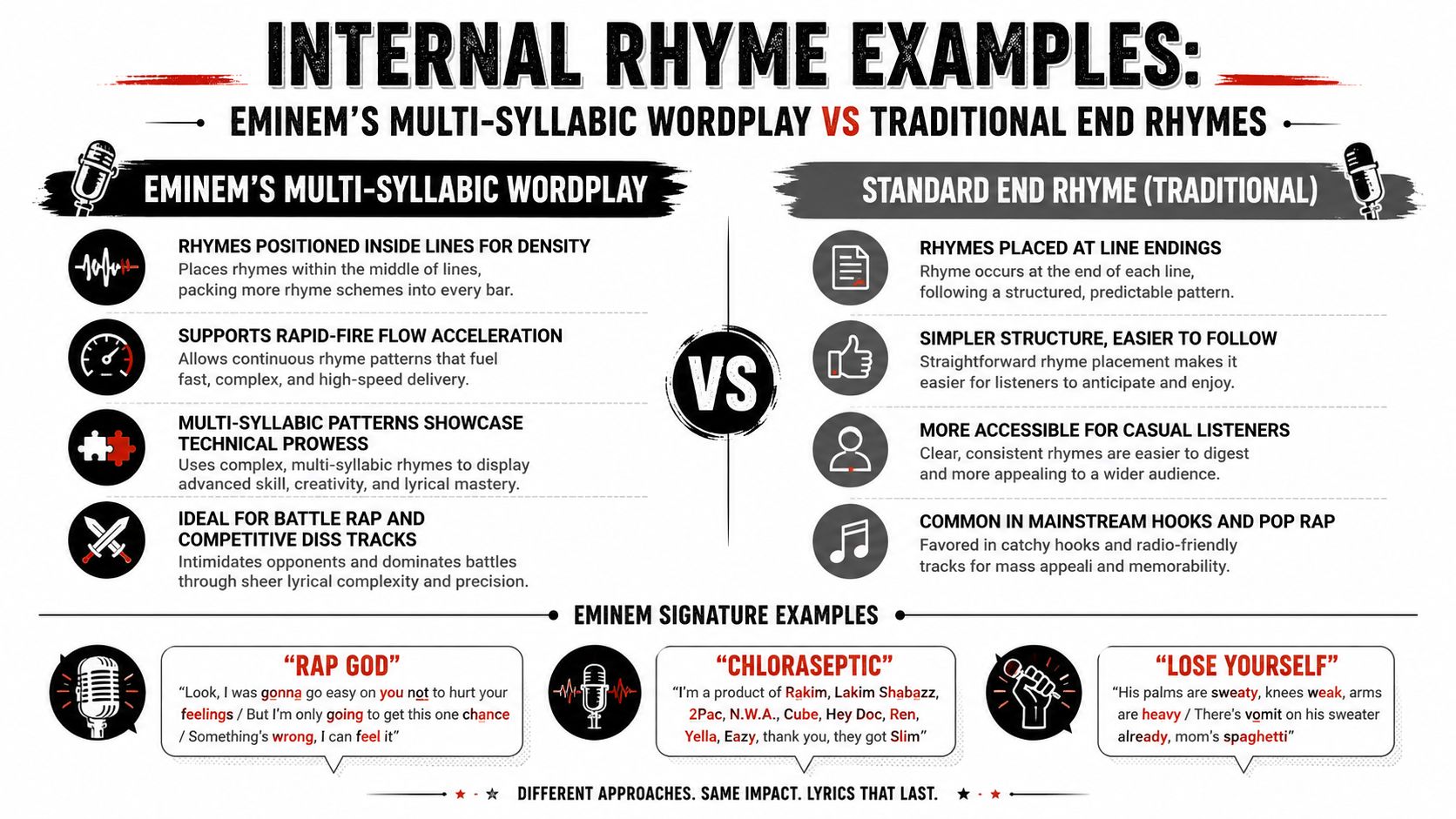 An infographic comparing Eminem's complex multi-syllabic internal rhyme technique against traditional end rhyme styles in rap music.
For DissTrack AI, ask for dense internal anchors but require a plain-language punchline at the end. Then read every generated bar aloud. If the rhyme forces unnatural word order, remove the clever match and keep the natural sentence.
2. Internal Rhyme in 2Pac's Thematic Verses
Internal rhyme can make a story's turning point sound inevitable. The pattern works inside the line, linking an action to its consequence while the verse carries an argument or emotional shift. That thematic use helps explain 2Pac's writing. The sound pattern keeps related ideas together, so the message gains rhythm without losing its human detail.
Try this original example:
You claim you came to change, but you stay in the same lane.
The internal pair is change and same, while lane extends the sound. Those echoes underline the contradiction: the target announces progress, then repeats the same behavior. The listener hears the conflict and remembers it more easily than a flat statement such as “You're inconsistent.”
Build the roast around conduct
Choose a visible action before choosing a label. A friend who cancels plans then complains about being left out provides ready roast material. A coworker who demands punctuality but arrives late offers another clear target. Shape the behavior into a sequence:
- Observation: You lecture everyone about discipline.
- Contradiction: You miss every deadline.
- Internal sound: “preach,” “reach,” “each,” or a related slant family.
- Punchline: End with the clearest consequence.
Place the matching sounds near the words that carry the accusation. Read the sentence once without performance, then tap the stressed syllables and repeat it with a pause before the final phrase. If the idea remains clear without one rhyme word, the sound has strengthened the writing. If removing that word breaks the sentence, replace it with language that preserves the conduct and the punchline.
A thematic internal rhyme earns its place by connecting sound to meaning.
 A young man with curly hair writing in a notebook while sitting in a music studio.
Apply the same map to narrative bars. Someone promises to help, disappears, and returns only when they need something. Give each stage a related echo, then let the last phrase reveal the pattern. The result creates emotional shape without requiring cruelty. Keep the details specific to the behavior, and leave real pain, medical conditions, and protected identity outside the target.
3. Internal Rhyme in Nas's Lyrical Precision
Nas shows how internal rhyme can feel exact without becoming noisy. The strongest precision-based bars usually have two systems working together. The end rhyme gives the verse its frame, while internal matches link important words inside the frame. The listener can enjoy the sound first and discover the construction on another listen.
Use this constructed example:
Cold calculation in the conversation, no hesitation when the facts get stated.
The internal sound appears in calculation, conversation, and hesitation. The words also belong to one semantic field. They describe someone who seems controlled, prepared, and difficult to catch in a contradiction. That alignment makes the rhyme feel intentional rather than stuffed into the bar.
Treat syllables as design elements
Write a plain punchline first:
You talk like an expert, but your facts never survive questions.
Now choose a two-syllable or multisyllabic sound family. For example, you might work around expert, excerpt, and check first, depending on pronunciation and delivery. Place the matching sounds near stressed syllables, then check whether the sentence still sounds like natural speech.
- First pass: Write for meaning.
- Second pass: Mark stressed syllables.
- Third pass: Add one internal match.
- Final pass: Remove any word that exists only to complete the rhyme.
The rap punchlines and metaphors guide can help you connect the sonic pattern to a clear image. A precise rhyme scheme won't rescue a vague insult. “You're bad” has little surface area for wordplay. “You sell certainty, then fold when someone checks the receipt” gives you behavior, imagery, and several possible sound paths.
Nas's approach also teaches restraint. Leave small pauses around the most important words. If every syllable receives equal force, the listener may miss the actual accusation. Precision comes from choosing what to emphasize, not from rhyming everything available.
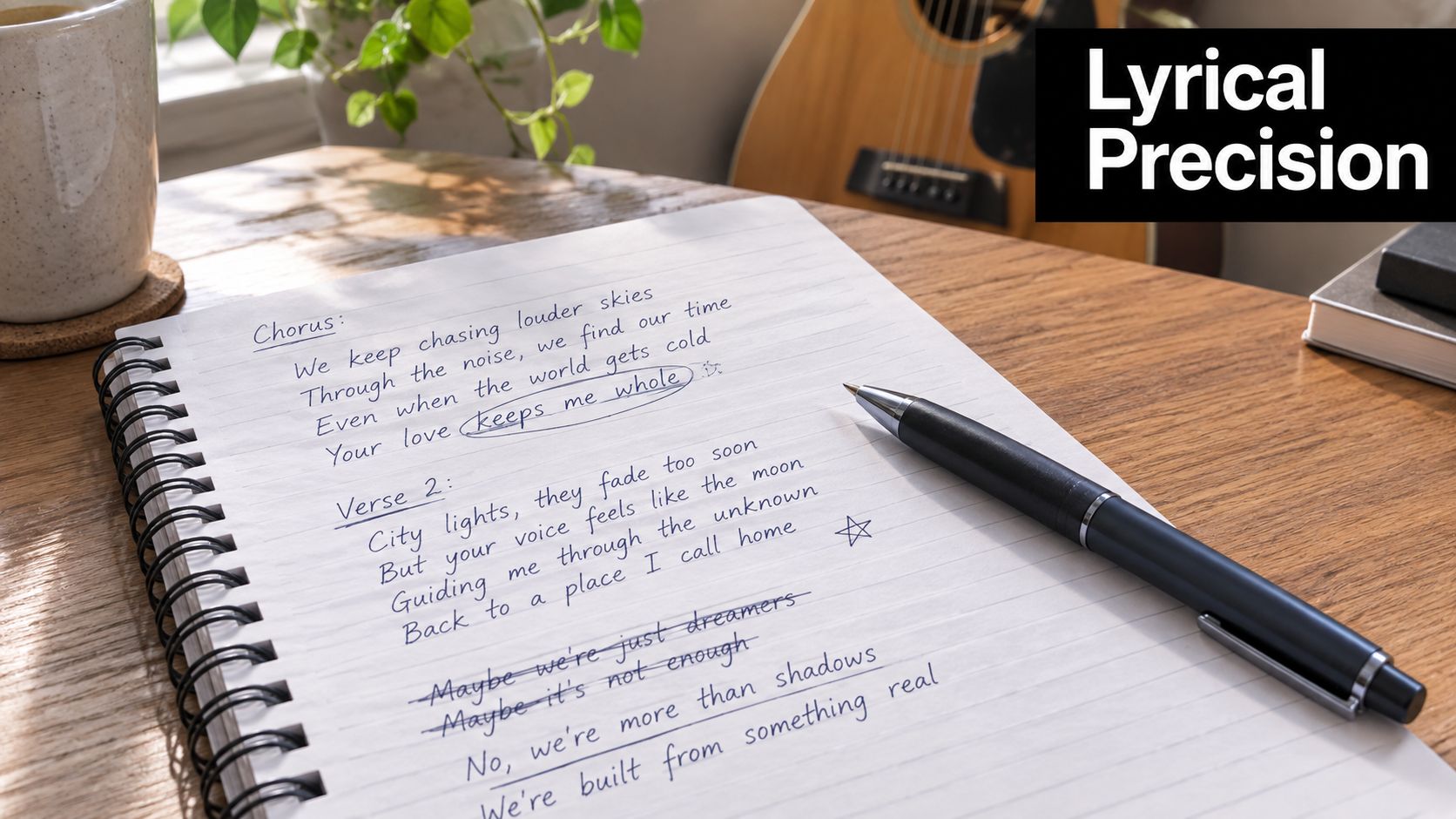 A spiral notebook open on a wooden desk showing handwritten song lyrics with a pen nearby.
4. Internal Rhyme in Pusha T's Couplet Mastery
A couplet gives internal rhyme a clear performance shape. The first line plants a sound or idea, while the second answers it by completing the rhyme, reversing the meaning, or turning setup into punchline. These internal matches bridge the lines, so the couplet feels connected before the end rhymes resolve.
Try this original pair:
You built a reputation on imitation and presentation, I checked the information and found no foundation.
The repeated sound family runs through reputation, imitation, presentation, information, and foundation. The first line sounds expansive and confident. The second narrows the claim and exposes its weakness. That shift gives the rhyme a job beyond decoration: it carries the listener from public image to concrete accusation.
Write in paired units
Start with a target's public claim. Then find evidence that undercuts it.
Line one: Repeat or exaggerate the claim.
Line two: Reveal the contradiction through a concrete image.
Let ordinary words carry the grammar and the setup while the rhyme guides the ear toward the reveal. Keep matching sounds close enough to hear, but leave space between them so the line still resembles natural speech. Read the couplet once without a beat, then clap on the stressed rhyme words. If the internal hits feel awkward, revise the sentence before changing the rhythm.
A strong couplet gives the performer a setup, a bridge, and a landing. The paired structure also helps a group perform the same piece, because each unit can stand alone and create a recognizable break after the punchline.
For a personalized roast, choose details the target recognizes without turning the joke toward a serious vulnerability. A friend who constantly announces a new project might inspire launch declarations in the first line and unfinished preparations in the second. Repeat the sound family, then make the second line reveal the behavior's pattern. Write three versions: one for a bar, one for a hook, and one for a playful diss track. Perform each aloud, keeping the final reveal slightly clearer and slower than the setup.
5. Internal Rhyme in UK Grime's Rapid-Fire Structure
Rapid delivery benefits from short, sharply articulated sound clusters that alliteration and internal rhyme work together to produce, creating verbal drum hits rather than smooth poetic flourishes. In grime, rhyme placement helps the MC turn each syllable into part of the groove, so the listener hears motion even between the main end rhymes.
Try this grime-flavored exercise:
Quick with the quips, but you slip when the pressure gets thick.
The internal chain appears in quick, quips, slip, and thick. Their repeated short vowel links the words, while the hard consonants give the bar a clipped attack. Map the sounds before performing: mark the first hit, the middle echo, and the final landing. Then write a second line with a new sound family, giving the ear a fresh burst instead of stretching one pattern too far.
Make the mouth part of the rhythm
Rapid rhyme must work in speech as well as on the page. Test every bar at three speeds:
- Clear reading: Can you pronounce every word?
- Beat reading: Do the stressed rhymes land naturally?
- Performance reading: Can you repeat the bar without swallowing consonants?
Alliteration adds texture, yet too many similar consonants can blur the line. Alternate hard and soft sounds, or leave a small gap for an ad-lib or breath. That space acts like a rest in a drum pattern, keeping the delivery controlled.
Grime grew around distinct MCing conventions, pronunciation, phrasing, and local vocabulary. A fast rap verse gains cultural specificity through those choices, so study grime records closely and adapt the energy without copying one artist's voice. For background on related UK dance styles, consult this UK garage music guide from LesFM. Use it as context while developing your own phrasing.
Write four high-energy roast bars about someone who talks over everyone, using short internal rhymes built around chat, back, and track. Place one rhyme near the opening, one in the middle, and one before the bar's final landing. Keep the behavior as the subject, leave room for ad-libs, and perform the bars at increasing speeds. Mark any consonant cluster that disappears, then replace or reposition the word.
6. Internal Rhyme in Trap Music's Repetitive Hooks
Hooks need a different kind of internal rhyme. A verse can reward close listening with intricate patterns, but a hook has to survive repetition. Short sound pairs placed inside a repeated phrase can make the line easy to remember without turning it into a tongue-twister.
Use this simple hook model:
Big talk, small walk, same story every night.
The internal pair is big and small, with talk and walk creating a stronger echo. The phrase has a conversational shape, so it can be rapped, half-sung, or repeated by a group. The hook's central contrast, loud claims versus little action, also gives the listener a clear idea to retain.
Design the repeat before the rhyme
Choose one phrase that can return unchanged. Then vary only the final thought or the response line. This keeps the internal rhyme recognizable while allowing the hook to develop.
- Core phrase: “Big talk, small walk.”
- Behavioral detail: Always promises to help, rarely appears.
- Response: “Same story every night.”
- Variation: Replace the final phrase with a specific, harmless inside joke.
Short internal pairs often work best here because the listener encounters them repeatedly. Longer patterns can still fit a trap-influenced hook, but they need open vowels and clear stress. Sing the hook as well as rapping it. If the rhyme only works at one speaking pitch, it may not carry the melody.
Leave room for the beat
A repetitive hook needs space. Don't fill every gap with another rhyme. Let the repeated phrase land, pause, and return. That empty space helps the audience participate, especially in a roast video or group setting.
For a personalized hook, describe a recognizable habit such as constantly changing profile pictures, claiming to know every song, or bringing up an old win in every conversation. Avoid sensitive subjects. The strongest joke is usually the one people can repeat without making the room uncomfortable.
7. Internal Rhyme in Boom Bap's Lyrical Density
Boom bap places a premium on words that carry information. Internal rhyme can add sophistication, but the pattern should also deepen the image or argument. A dense bar doesn't need to sound rushed. It can move through measured stresses, pauses, and layered meanings.
Try this original example:
You quote old wisdom with a bold rhythm, but miss the lesson.
The internal matches are quote, old, and bold, while wisdom and rhythm create a looser echo. The line criticizes someone who repeats impressive phrases without applying them. The sonic pattern supports the theme because the language sounds polished while the accusation exposes empty performance.
Build from an image
Boom bap writing improves when the punchline has something concrete to show. Replace a general insult with an object, scene, or action:
Plain idea: You pretend to be knowledgeable.
Image: You carry a notebook but never open it.
Sound family: “look,” “book,” “took,” or a slant variation.
Bar: You pose with the book, but never took a look at the lesson.
The rhyme links the physical image to the criticism. It also leaves room for a second layer, such as someone collecting symbols of expertise rather than doing the work.
Use internal rhyme sparingly enough that each word remains audible. Let the kick and snare create the frame, then place the rhyming syllables where your voice naturally receives emphasis. A pause before the final word can make a compact internal chain feel more deliberate.
For readers building a classic, sample-driven writing session, this guide to boom bap songs offers a relevant starting point for exploring the style. Study the relationship between the beat's space and the rapper's phrasing, then write a bar that could be understood without the beat.
 A black turntable playing a vinyl record next to a Mobb Deep album cover and speaker.
8. Internal Rhyme in Emo Rap's Emotional Vulnerability
Internal rhyme can mirror emotional movement. A scattered pattern may suit confusion, while a more regular pattern can suggest a moment of clarity. That flexibility makes internal rhyme useful in emo rap and other confessional styles, but it also demands more care. Emotional material shouldn't become an excuse to target someone's mental health, disability, trauma, or other genuine vulnerability.
Use an original, behavior-focused example:
You say you're fine, then hide online when it's time to reply.
The internal echoes in fine, hide, and online convey avoidance without diagnosing the person. The line describes an observable pattern. It can work as a playful relationship roast if the people involved understand the context, or as a reflective lyric if the writer is examining their own behavior.
Keep the emotional boundary clear
Before writing a personal roast, ask whether the target has agreed to that kind of joke. If the answer is unclear, keep the material light and specific. Don't use a real crisis, diagnosis, loss, or private disclosure as a punchline.
A safer prompt might focus on mixed signals:
- Behavior: Says they're leaving, then keeps sending messages.
- Sound family: “go,” “show,” “slow,” “know.”
- Emotional effect: Confusion, not humiliation.
- Ending: A playful image rather than a personal attack.
Emotional intensity works best when the lyric protects the person's dignity while sharpening the contradiction.
Read the bar, then perform it with the intended feeling. A vulnerable line often needs more space than a battle bar. Let one internal rhyme surface, allow the voice to crack or soften if that suits the performance, and avoid stacking sounds so tightly that the emotion disappears.
You can use an Emo Rap style direction with DissTrack AI, but edit the result carefully. Ask for inside jokes and relationship context only when the material is consensual, and set a boundary against protected traits, medical conditions, and serious trauma. The goal is a memorable creative exchange, not psychological harm.
Internal Rhyme: 8-Example Comparison
| Style | 🔄 Implementation Complexity | 💡 Resource Requirements / Tips | 📊 Expected Outcomes & Impact (⭐) | ⚡ Ideal Use Cases |
|---|---|---|---|---|
| Internal Rhyme, Eminem's Multi-Syllabic Wordplay | High, advanced internal placement and density | Train on Eminem catalog; balance with clear punchlines; test with native speakers | ⭐⭐⭐ Elite technical showcase; commands attention; premium feel | Battle rap, technical diss sections, rapid-fire showcases |
| Internal Rhyme, 2Pac's Thematic Verses | Moderate, requires contextual mapping for narrative cohesion | Map target persona; use inside-joke inputs; human editorial refinement | ⭐⭐ Strong emotional resonance and memorability; broad appeal | Personalized roasts, narrative-driven diss tracks, social sharing |
| Internal Rhyme, Nas's Lyrical Precision | Very high, syllable-level accuracy and layered schemes | Use advanced generation mode; manual refinement; clear beats | ⭐⭐⭐ Elite credibility; multi-layered meanings; rewards close listening | Competitive battle rap, purist audiences, legacy-building verses |
| Internal Rhyme, Pusha T's Couplet Mastery | Moderate, structured couplet generation and cadence matching | Generate in 4-bar couplets; preview delivery; pair with performance-ready beats | ⭐⭐ High performability and memorability; punchy delivery | Short-form content, performance-focused streams, TikTok/Reels |
| Internal Rhyme, UK Grime Rapid-Fire Structure | High, tempo/ syllable matching and accent authenticity | Use UK Grime style tag; pair with 130–140+ BPM beats; test UK pronunciation | ⭐⭐ High-energy, authentic UK flavor; strong shareability | High-energy roast videos, UK-targeted content, live MCing |
| Internal Rhyme, Trap Music Repetitive Hooks | Low–Moderate, simpler patterning but needs melodic fit | Generate 8-bar hook sections; keep 1–2 syllable pairs; optimize 15–30s clips | ⭐⭐⭐ Very high viral potential; catchy, singalong hooks | Social media virality, hook-focused roasts, non-rapper performances |
| Internal Rhyme, Boom Bap Lyrical Density | High, dense multi-scheme layering across entire verses | Use Boom Bap style tag; pair with classic beats; emphasize articulation | ⭐⭐⭐ High credibility with purists; deep replay and analysis value | Serious rappers, battle leagues, content for hip‑hop connoisseurs |
| Internal Rhyme, Emo Rap Emotional Vulnerability | Moderate, nuanced tone, ethical sensitivity required | Require consent/context; use Emo style tag; avoid exploiting mental-health topics | ⭐⭐ High emotional impact and relatability; ethically sensitive | Intimate roasts, Gen Z audiences, narrative emotional pieces |
Turn Rhyme Placement Into Your Next Bar
Internal rhyme becomes easier once you choose its job before choosing its words. Dense multisyllabic patterns suit a technical verse where momentum and syllable control matter. Thematic placement fits narrative punches because the sound can connect a claim to its contradiction. Couplets give performers clean setup and landing points. Rapid packing suits grime's percussive energy, while repetition makes internal rhyme useful in hooks.
Boom bap rewards precision, imagery, and layered meaning. Emotional styles need restraint, consent, and attention to tone. None of these approaches is automatically better. The right pattern depends on the beat, the message, and the way you want the audience to receive the line.
Start with a marking exercise. Take any plain lyric and underline the stressed syllables. Circle repeated vowel sounds inside the line, then draw a line between matching sounds across neighboring lines. This placement map shows whether your rhyme is intralinear, interlaced between bars, or linked across a line break.
Next, build one line from a two-syllable sound family. Choose a phrase such as “same game” or “cold shoulder.” Write a natural sentence first, then add one matching phrase near the middle. Keep the end of the bar available for the main punchline. Read it aloud and delete any match that makes the sentence sound like a word hunt.
Try rewriting one plain punchline in two contrasting styles:
- Technical verse: Add a multisyllabic internal chain, then leave a pause before the final accusation.
- Hook: Reduce the pattern to a short repeated pair that a group could say after one listen.
Record both versions. Listen for breath, stress, and clarity rather than counting rhymes. A technically dense line that loses its meaning needs editing. A simple line with one well-placed internal match may perform better because the audience hears the idea immediately.
For a structured writing prompt, specify the target context, rhyme placement, genre, length, delivery goal, and boundaries. For example:
“Write four battle-rap bars about a friend who promises help but cancels at the last minute. Use one internal rhyme in each bar, connect the middle sounds across the first two lines, and end each couplet with a clear behavioral punchline. Keep the tone playful, avoid protected traits and genuine trauma, and leave a short pause before each final word.”
For a hook, try:
“Write a short Trap-style roast hook about someone who makes big claims but never follows through. Use a compact internal rhyme that repeats across the hook, make it easy to rap or sing, and keep the joke focused on the behavior.”
For a grime exercise:
“Write rapid-fire bars about a person who interrupts every conversation. Use crisp internal rhymes and alliteration, keep the pronunciation clear, include space for ad-libs, and avoid personal vulnerabilities.”
DissTrack AI can help generate variations around internal and multisyllabic rhyme placements, but your editing still matters. Add the target's relationship and inside joke only with appropriate consent, choose a genre direction, then read the result aloud before sharing it. The rapper guide by Viral.new can also help you think about how delivery and short-form presentation affect a lyric's impact.
Mark the sounds. Test the breath. Protect the punchline. Then rewrite until the rhyme feels like part of the sentence instead of an ornament pasted onto it.
DissTrack AI helps you generate personalized roast lyrics with internal rhyme placements, genre style options, and editable verse variations for bars, hooks, and performance ideas. Add a playful target context and inside joke, set clear boundaries, and visit DissTrack AI to turn your next rhyme exercise into a finished creative draft.