
How to Write Lyrics of Heartbroken That Actually Hit
You're staring at a blank note on your phone, cursor blinking, and the only line that keeps showing up is the kind you've heard a hundred times before. That's the trap with heartbreak writing, the feeling is real, but the first draft starts sounding borrowed fast. If you're searching for lyrics of heartbroken that you can use in a caption, a verse, or a DM, the smarter move is to build a few sharp, editable lines of your own.
The term itself carries weight in modern pop culture. “Heartbroken” shows up as a durable emotional keyword, and one of the most visible recent mainstream uses is Diplo, Jessie Murph, and Polo G's 2023 single “Heartbroken”, released on July 21, 2023 as the fourth single from Chapter 2: Swamp Savant (Wikipedia release entry)). That matters because the word still lands in a current crossover lane, not just in old-school breakup ballads. Songfacts frames Diplo's track around the power of love to heal a broken heart (Songfacts song note), which is why the phrase can feel sad, but also recoverable.
Why Original Heartbreak Lines Beat Borrowed Lyrics
Late at night, the temptation is always the same. You open a lyrics page, copy a line that feels close enough, and then realize it's either too famous to reuse cleanly or too generic to say anything about your exact mess. That's the difference between hunting for borrowed lyric fragments and writing a line that sounds like your own face in the mirror.
A full lyrics page gives you a finished object. A short original line gives you something you can bend, trim, and post without feeling like a passenger in somebody else's song. That's especially true now that search intent around breakup writing has shifted toward quick, mobile-friendly, situation-specific snippets, the kind that fit a caption, a story, or a bar without dragging the whole record with them.
Practical rule: If the line doesn't say something only your situation could say, it's probably too broad to hit hard.
One more thing makes original lines stronger. The phrase heartbroken already carries a built-in emotional load, so your edge comes from the detail around it, the object in the room, the time of night, the exact kind of silence after the argument. That's the part people remember, not the fact that you found a sad line online.
If you care about legality as much as feel, keep one clean reference open, like this guide on whether lyrics are copyrighted, and then move back to writing your own version. The goal isn't to dodge the emotion. It's to make the emotion yours.
Naming the Emotion Before You Write a Word
Before you chase rhymes, name the actual mood. Not “sad,” because that's too wide. Pick three adjectives that fit the bruise you're writing from, then add one memory anchor and one body sensation. That tiny inventory keeps the line from drifting into generic breakup fog.
A useful pass is to separate surface sadness from the stance underneath it. Somebody can sound hurt, but the deeper note might be betrayal, relief, shame, or that cold kind of rage that shows up after the crying stops. That distinction matters because the best lyrics of heartbroken don't just say “I'm hurting,” they show what kind of hurt has teeth.
| Heartbreak Sub-Moods and Opening Line Patterns | What it feels like | Sample opening line |
|---|---|---|
| Soft grief | Missing them without wanting a fight | “Your hoodie still hangs like you never left.” |
| Quiet rage | Calm on the outside, sharp inside | “I said I was fine, but I was lying with a smile.” |
| Betrayal | Trust cracked, memory still active | “You called it love, but you moved like a warning.” |
| Relief | Hurt is real, but freedom feels louder | “I miss the habit, not the chaos.” |
| Shame | Wanting them back and hating that fact | “I folded my pride just to see if you'd pick it up.” |
Write one sentence at the top of your page that names the core feeling in plain language. Something like, “This is betrayal dressed as sadness,” or “This is relief that still aches.” That sentence becomes your filter. If a line doesn't match it, cut it.
A clean emotional label saves more drafts than fancy imagery ever will.
The point isn't to flatten the mood. It's to choose the right shade before you start painting.
Picking the Right Narrative Voice for Your Verse
The same breakup can sound tender, nasty, detached, or half-joking depending on who's talking. If the voice is muddy, the whole verse slides off the beat. If the voice is locked, even a simple line can carry attitude.
Four voices that work on heartbreak material
The wounded romantic is open-chested and exposed.
“I still check your name like it might explain itself.”
The cold survivor sounds like they already learned the lesson.
“You burned the bridge, I just stopped standing on it.”
The betrayed realist keeps score without begging.
“You don't lose me by accident, you chose that exit.”
The unbothered ex leans light, almost shrugging.
“I kept the playlist, not the problem.”
Choose the voice by asking three things. Who's listening, a close friend, a crowd, or a timeline full of strangers. Where is this living, a TikTok clip, a diss-adjacent verse, or a private text. What do you want people to feel when they finish it, sympathy, swagger, or distance. The same line can read vulnerable on TikTok, savage in a rap context, or too personal in a message thread.
The emotional stance matters more than the subject. If you're writing for performance, the betrayed realist often lands harder because it keeps tension without collapsing into whining. If you're writing for a caption, the unbothered ex usually survives better because it leaves room for the audience to project themselves onto it.
The cleanest test is simple. Read the line out loud and ask whether it sounds like somebody confessing, somebody warning, or somebody walking away. If you can't tell, rewrite it.
Hooks and Choruses That Make People Replay
A heartbreak hook works when it says the feeling before the listener has time to name it. That's why the strongest ones are short, loaded, and easy to repeat out loud. You're not writing a paragraph. You're compressing a whole breakup into a phrase people can hold onto.
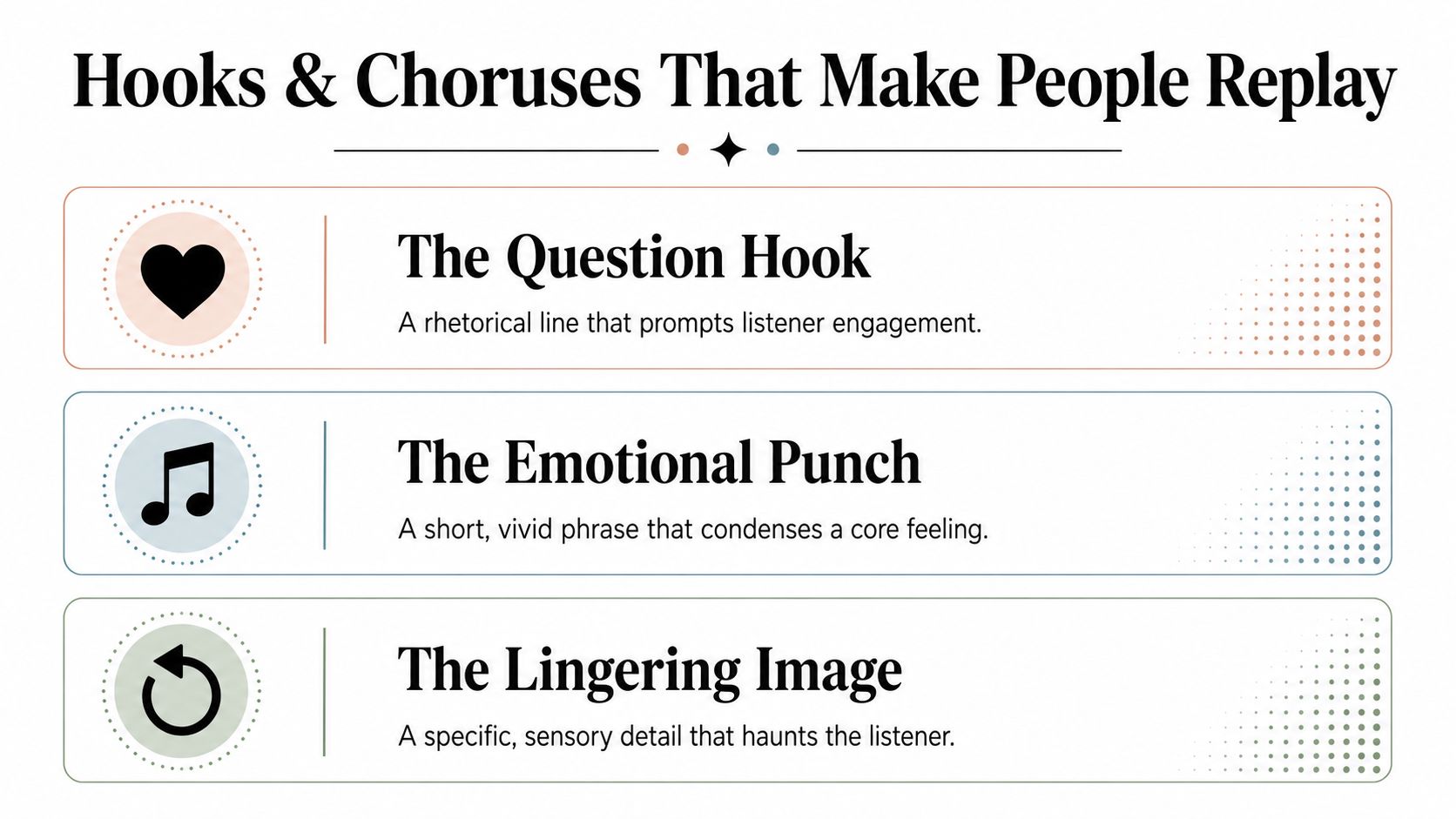 A graphic titled Hooks and Choruses That Make People Replay, listing three songwriting techniques for listeners.
Three hook shapes that keep coming back
The self-answer loop works because it turns denial into confession.
“I'm not heartbroken, I'm just losing sleep.”
“I'm not heartbroken, I'm replaying the scene.”
The specific-detail callback sticks because one concrete thing feels more real than five vague ones.
“Your black jacket still smells like that mint gum.”
“You left your lighter on my sill, now the room won't quit talking.”
The reversal flips the expected mood.
“I cried less after you left.”
“I got my heart back when the text stopped.”
Keep the hook tight. Short lines breathe better, especially in rap and melodic rap where stressed words need space to land. A hook that tries to explain the whole breakup usually sounds like a diary entry with a drum loop underneath it.
The biggest hook-killers are easy to spot. Too many ideas in one line. Imagery that could belong to any breakup. Rhyme that feels forced because the words were chosen for sound instead of meaning. If the line doesn't survive a quick hum test, it won't survive a replay.
A simple rewrite habit helps. Start with a broad line, then strip it until one detail remains. That surviving detail is usually the thing people remember.
Rhyme Flow and Breath Placement in Practice
Emotion gets the first click. Flow gets the replay. If the line stumbles off the beat, the listener feels the awkwardness before they feel the pain.
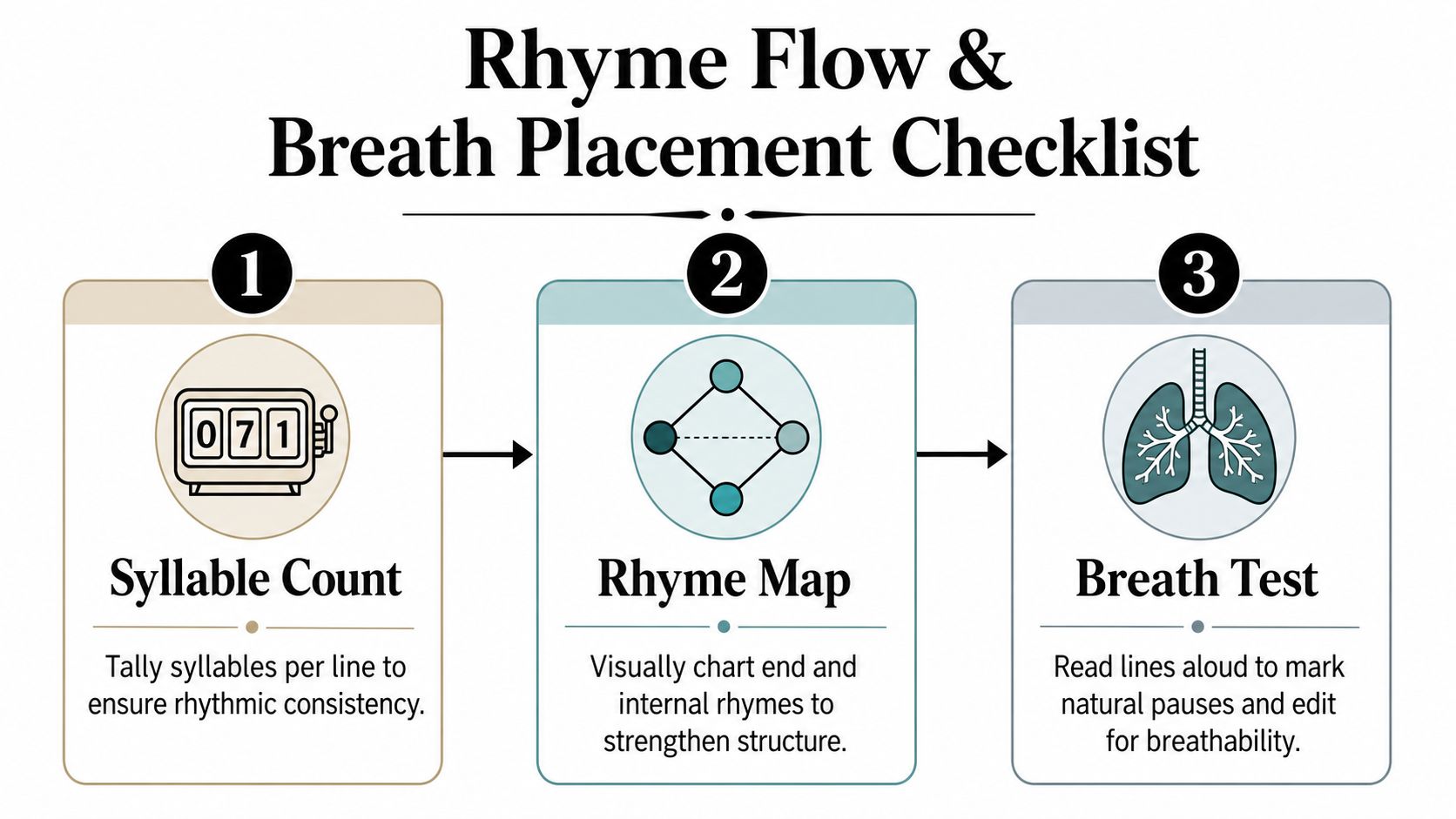 A three-step checklist graphic for improving lyrical flow, featuring syllable counting, rhyme mapping, and breath testing.
Tighten the end sound first
End rhymes don't need to be perfect, but they do need to feel related. Open vowels usually sing better than rigid consonant matches, especially when the line has to stretch across a melody. If you want a deeper dive on pattern choices, the breakdown on rap rhyme patterns is useful as a reference point.
Try this mini-verse shape:
I said I'm fine, but my voice still shakes
Your name hits hard when the silence breaks
I keep the light on, but it still feels cold
You took the soft part, left me with the fold
The first two lines lean on a clean end pattern. The last two move into a looser rhyme so the verse doesn't sound boxed in. That mix matters. Multisyllabic rhymes give you momentum, internal rhymes make the line feel woven, and slant rhymes keep things human instead of over-polished.
Test the breath before you call it done
Read the line out loud and mark where you naturally pause. If you have to gasp in the middle of a phrase, the line probably needs trimming. If the stress lands on throwaway words, rework the syntax so the important words hit the beat.
The cleanest heartbreak bars usually leave air around the hurt.
A good flow pass removes clutter, not feeling. You want the line to sound like somebody talking through pain with rhythm, not like somebody memorized a thesaurus and called it songwriting.
Generating Variations with DissTrack AI Prompts
When the draft stalls, a generator can throw you fresh angles fast, as long as you don't feed it mush. DissTrack AI lets you build custom rap-style lyric variations from a target and context, so the output starts with shape instead of a blank page. For heartbreak writing, that means you can ask for raw breakup lines, then trim them into your own voice instead of copying a canned chorus.
 Screenshot from https://aidisstrackgenerator.com
Use the prompt like this:
Target: [ex, crush, situation, or placeholder]
Style tag: Emo Rap, Trap, or Old School Boom Bap
Savagery level: low to medium for breakup material
Context: what happened, who left, what you just found out, what mood you want
A strong prompt sounds specific.
Target: ex who moved on fast. Style tag: Emo Rap. Savagery level: low. Context: I found out through a story post, and I want lines that feel cold, not cartoonish.
For inspiration on how creators structure short, punchy social clips, the Viral.new rapper playbook is a solid companion read. It's the kind of framing that helps when you're deciding whether a line should feel intimate, repostable, or performance-ready.
Keep, remix, or delete
Keep the line if the emotion is clean and the image is specific. Remix it if the rhythm is good but the wording feels generic. Delete it if it sounds like every other heartbreak bar in the feed.
The internal trick is to treat AI output like raw clay, not finished art. If a line gives you a strong last word, steal the last word and rewrite the rest. If the cadence is right but the content is off, keep the pocket and swap the nouns. For more prompt structure ideas, the guide on AI rap lyrics generation can help you shape the output before you edit.
Final Checklist and Lines You Can Steal Tonight
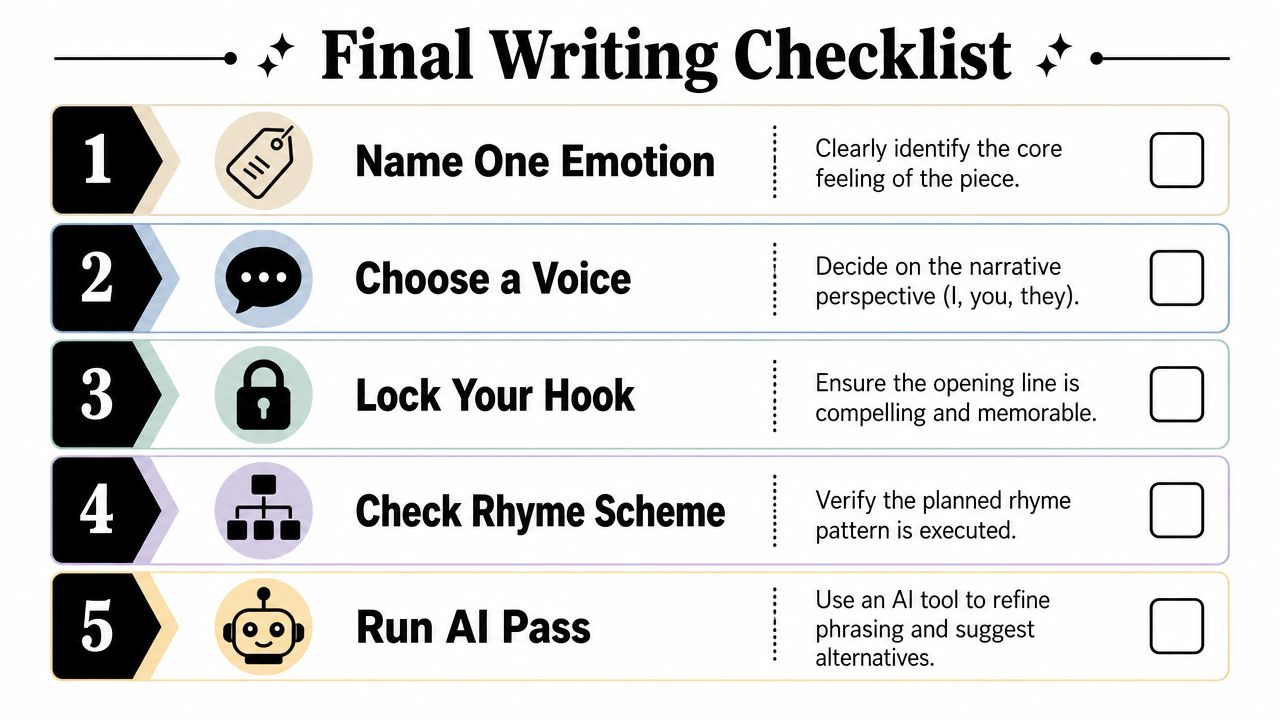 A five-step final writing checklist infographic for creative writing, featuring clear instructions and icons for writers.
Before you post, run the quick pass. Name one emotion. Choose one voice. Lock one hook. Check the rhyme scheme. Run one AI pass, then edit like you mean it. If any of those five steps feels fuzzy, the line will probably feel fuzzy too.
If you want a visual angle for the finished lyric, the AI lyric video generator guide is useful for turning short lines into something shareable without overcomplicating the post. That matters because heartbreak writing often lives in fragments now, not full songs.
Three original lines to work from:
- Soft grief, wounded romantic: “Your name still lights up my screen like it pays rent here.”
- Betrayal, betrayed realist: “You called it love, then switched sides before the chorus hit.”
- Relief, unbothered ex: “I kept the lesson, you can keep the noise.”
Keep the first draft rough. Make the second draft specific. That's the difference between a line that sounds like heartbreak and a line that sounds like your heartbreak.
DissTrack AI gives you a fast way to turn a breakup mood into raw lyric variations you can shape into your own voice. If you want to build lyrics of heartbroken without copying full songs, visit DissTrack AI and start with a target, a mood, and one honest detail you're not ready to say plain.