Personalization Best Practices for AI Diss Tracks That Hit
The streamer has queued the beat, the chat is ready, and the AI has generated eight bars in seconds. Then the first line lands: “You're bad at games, you talk too much, everybody knows your name.” The chat goes quiet because nobody heard the target in it. At a birthday party, the same problem shows up in a different costume. A roast mentions being late, loving food, and having no style, but it name-drops no nickname, no legendary disaster, no weird habit the room recognizes. It sounds like a greeting card written by an insult generator.
Personalization is the difference between rap-shaped noise and a bar people repeat later. The trick isn't dumping every fact you know into a prompt. It's choosing the detail that carries history, then shaping it with the right level of heat. That's how creators make an audience feel seen, and the same principle applies to content designed to turn viewers into buyers.
Why Personalization Makes or Breaks a Diss Track
A generic insult asks the audience to do all the work. “You're broke,” “you're slow,” and “your outfit is bad” could target anyone in the room. A personal bar gives listeners a shortcut to the story. “Jake from accounting still uses a Sidekick, but talks like he invented Wi-Fi” works because the name arrives attached to an image, a role, and a ridiculous contradiction.
Specificity creates the reaction
Shared references trigger recognition before the punchline finishes. A friend group doesn't laugh because “rage quit” is funny. They laugh because one person rage-quit FIFA after conceding a late goal, blamed the controller, and spent the rest of the night insisting the match was rigged. The reference carries the timing, the visual, and the social proof.
Streamers get the same effect from recurring chat behavior. A roast that mentions “your aim” is disposable. A roast about the moderator who bans everyone for saying “potato” after losing a speedrun becomes community property. The audience should feel that the lyric could only belong to this target.
Surface-level AI output misses the target
AI can produce clean rhyme, familiar structures, and a convincing insult cadence. It can also hide behind those strengths. If you give it only a name and the instruction “make it savage,” it tends to reach for stock material because the prompt contains no usable history.
Practical rule: A name identifies the target. A specific memory identifies the joke.
Personalization also requires restraint. Ten random facts don't create intimacy. They create a crowded verse where every line introduces a new subject and no punchline gets room to breathe. The strongest diss tracks usually build around a small number of recognizable details, repeat or escalate them, and let the audience enjoy the callback.
That's why the rest of the craft comes down to input quality, audience calibration, editing, and trust. The generator can supply options. It can't know which detail makes the room explode unless you provide the social context.
The Four Personalization Inputs That Actually Matter
A useful roast brief needs four things: the target's name, the relationship context, inside jokes, and tone. Each input answers a different creative question. The name tells the lyric who to hit. The relationship tells it what history is fair game. Inside jokes provide the ammunition. Tone controls whether the final track feels affectionate, competitive, or cruel.
| Input | Weak Usage, Generic Bar | Strong Usage, Landing Bar |
|---|---|---|
| Name | “Jake thinks he's the best in the game.” | “Jake from accounting still uses a Sidekick, but talks like he runs the game.” |
| Relationship | “My friend is always causing trouble.” | “My college roommate stole my PSN account, then asked me for the password.” |
| Inside joke | “You rage when you lose at gaming.” | “You rage-quit FIFA last summer, then blamed the Wi-Fi, the ref, and the moon.” |
| Tone | “Make it savage.” | “Make it savage but affectionate, like a sibling who knows exactly where to poke.” |
Start with the social map
“Friend” is nearly useless as creative direction. “College roommate who stole your PSN account” gives the model a relationship, a betrayal, and a comic premise. It also tells you what kind of insult feels earned. A close friend can usually handle a callback that would feel invasive coming from a stranger.
The same distinction matters for a streamer. “Subscriber” says little. “Longtime subscriber who spams the same emote whenever the streamer misses a jump” tells you where the joke lives. Use details that the intended audience can recognize without needing an explanation.
Choose inside jokes with a visible shape
The best references contain an action, object, or consequence. “He likes football” is a topic. “He threw the controller after losing by one goal and called it tactical” is a scene. Scenes turn into bars because they already contain movement and conflict.
Tone is the final control. “Playful,” “dry,” “mock-serious,” “competitive,” and “affectionate” are more useful than a single word like “savage.” If you're refining prompts for short-form content, these social video prompt tips can help you make the intended format and delivery clearer.
Layer the inputs without burying the hook
Give the generator the target, the relationship, two or three verified references, and the desired sound. Then specify a structure, such as an opening setup, a callback, and a final punchline. More information isn't automatically more personalization. Too much material forces the verse to catalogue facts instead of developing a joke.
For a practical example of turning these ingredients into a song concept, use this guide to personalizing a song. The useful test is simple: remove the name from the verse. If the lyric could still describe anyone, the brief needs sharper texture.
Tuning the Savagery Dial for the Right Audience
Savagery is a setting, and the correct level depends on who's listening, what consent exists, and whether the target can answer back. A playful line may feel warm in a family group chat, yet become humiliating when broadcast to an audience that does not know the target. Personal details sharpen a roast only when the room understands the relationship behind them.
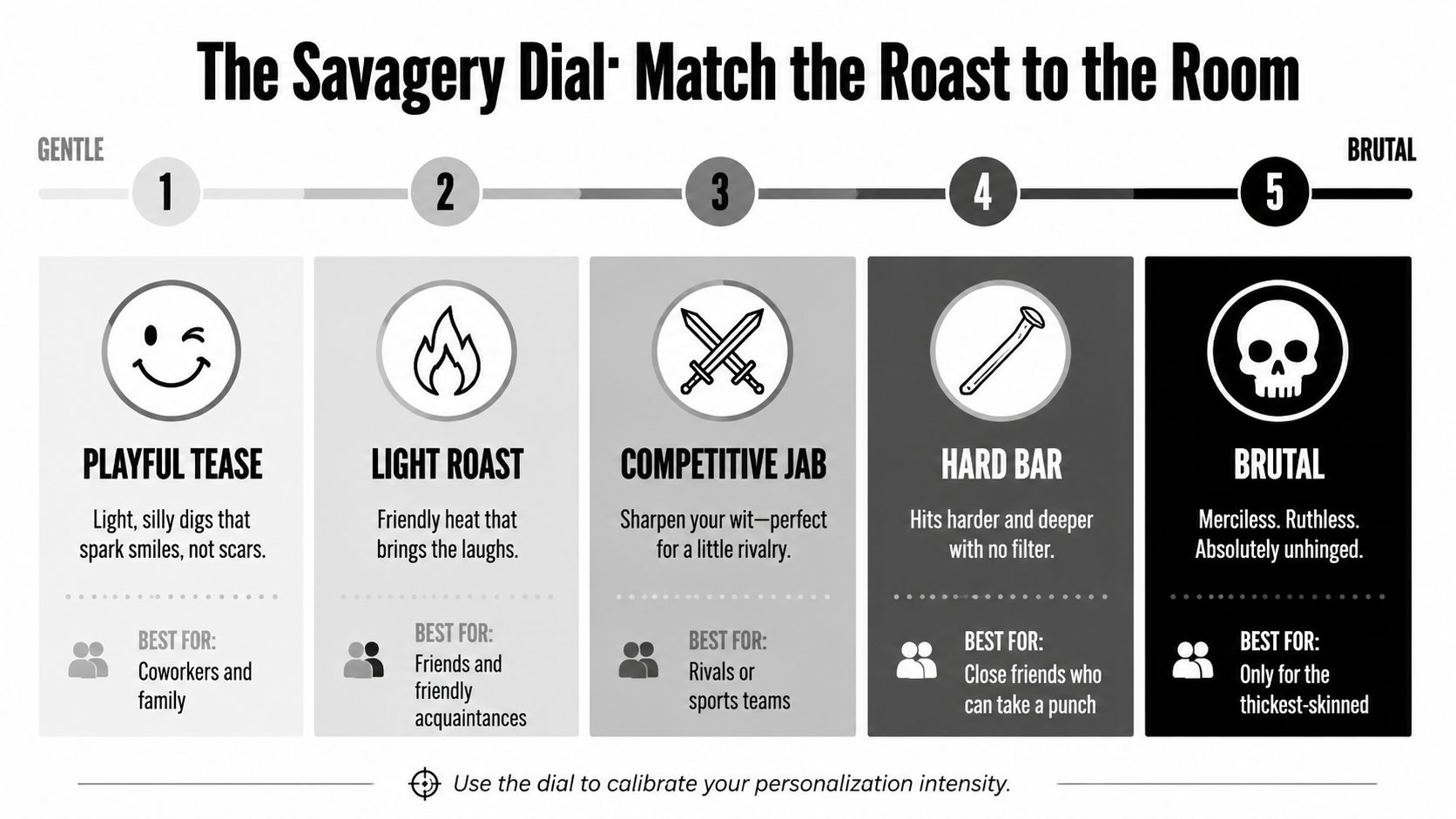 A Savagery Dial scale from 1 to 5, categorizing roasting styles from playful teases to brutal remarks.
Use five practical levels:
- Playful tease: A wink at a harmless habit, suitable for coworkers and family.
- Light roast: A clearer insult with a friendly landing, useful for birthdays and casual shoutouts.
- Competitive jab: A sharper challenge for streamer callouts, rival teams, or people who expect a response.
- Hard bar: Aggressive writing for an explicitly agreed rap battle between people who understand the rules.
- Brutal: The narrowest setting, reserved for consenting friends who directly request maximum intensity and can handle the consequences.
Match heat to the room
A stronger insult does not guarantee a better track. Too soft, and the verse lacks edge. Too harsh, and the creator spends the rest of the stream explaining that it was “just a joke.” Once the audience stops trusting the setup, even a clever punchline struggles to recover the moment.
Put the level directly into the prompt. “Light roast, no humiliation” produces a different result from “competitive jab, confident and relentless.” Add exclusions for public content, including topics that are off-limits or details that should remain private. Clear boundaries keep the model from reaching for cheap shock and force the writing toward specific, usable angles.
The target's ability to respond matters as much as the audience. A rival who agreed to trade bars can support harder language. A family member, coworker, or private person may need a gentler approach, even when the same inside joke would work among close friends.
A roast should leave the room laughing with the target, laughing at the target, or challenging the target. Decide which response you want before writing the first bar.
A Practical Workflow for Sharper AI Roasts
Good output usually comes from sequencing, not from one enormous prompt. Treat the generator like a writing partner that needs a clean brief, multiple drafts, and an editor with a functioning survival instinct.
Step 1, collect the usable material
Start with the target's name, the relationship to the audience, and two or three verified inside details. Verify the details before they enter the lyric. A false rumor can turn a joke into an accusation, while a misunderstood reference makes the writer look disconnected.
Separate facts from angles. “Stole the PSN account” is material. “Act like a criminal mastermind over a forgotten password” is an angle. The first belongs in the intake. The second belongs in the creative direction.
Step 2, sketch several angles
Ask for multiple rough versions rather than treating the first generation as sacred. Give the track a tone, savagery level, structure, and musical identity. You can request an opening setup, a middle callback, and a closing punchline, then ask each variation to approach the same detail differently.
A tool such as DissTrack AI can generate structured roast lyrics from a target's name, relationship, inside jokes, style tags, and savagery setting. Whether you use it or another writing assistant, the principle stays the same. Generate options before you start polishing.
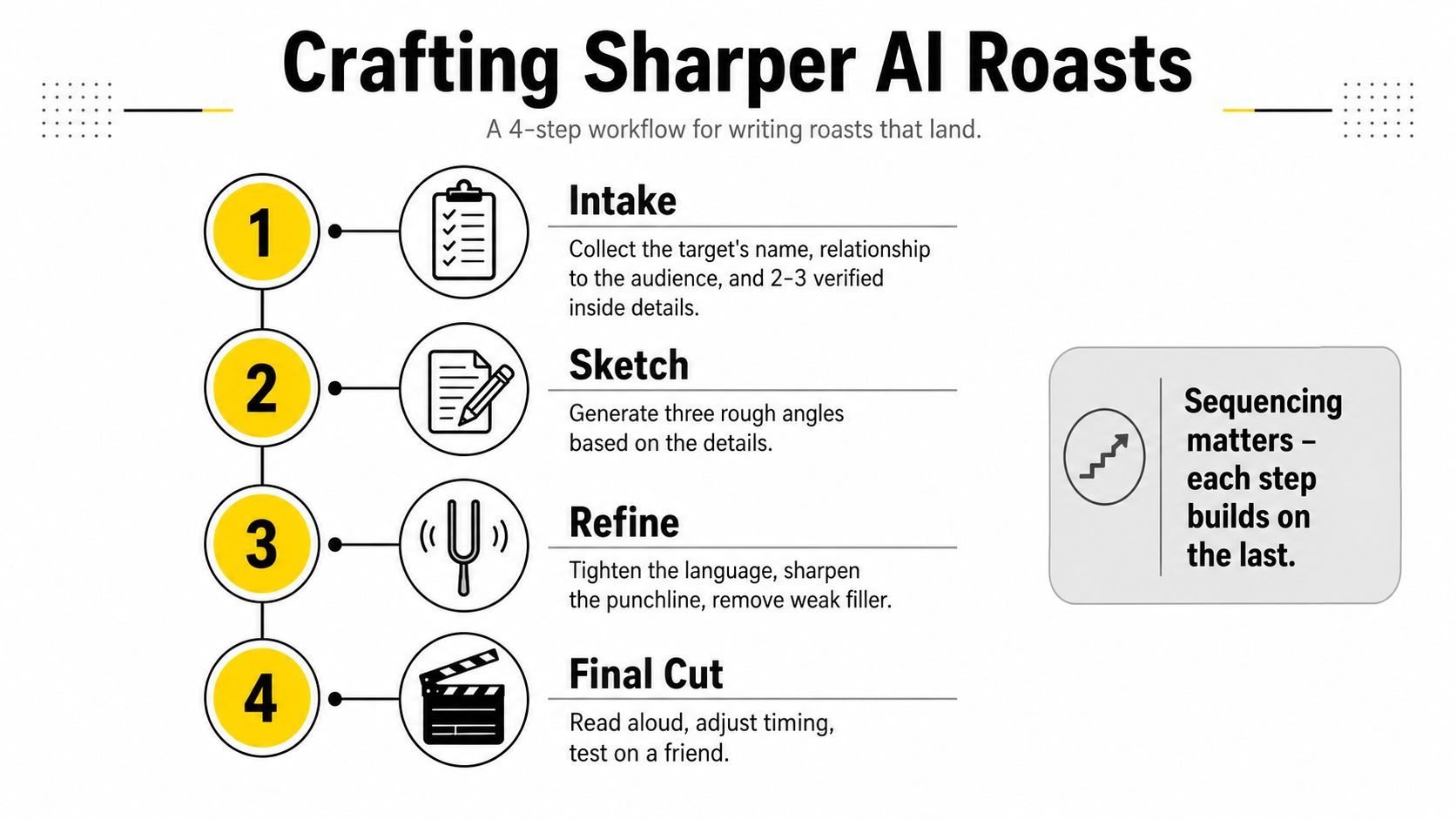 A four-step infographic illustrating a workflow for crafting effective AI-generated roasts for social settings.
Step 3, score the variations
Don't choose the version with the fanciest rhyme. Score each draft against three practical questions:
- Name specificity: Does the lyric use the target's identity as part of the joke, not as decoration?
- Callback density: Does it return to a memorable reference, or scatter unrelated facts?
- Punchline timing: Does the setup create enough space for the final hit?
A weak bar often needs a surgical edit, not a total reroll. Replace one vague line, sharpen the final word, or move the strongest detail closer to the payoff. Reroll when the voice is wrong, the references are fabricated, or the whole angle misses the relationship.
Step 4, perform the final cut
Read the verse aloud. Clumsy syllables, awkward consonants, and dead transitions reveal themselves immediately when the words leave the screen. Match it to the intended beat, then test the delivery with someone who understands the room.
For another practical route from rough premise to finished line, see how to make a diss track. The final check isn't whether the text looks clever. It's whether the target, the audience, and the beat all receive the same joke at the same moment.
Privacy and Ethics When the Bars Get Personal
More data doesn't automatically produce better personalization. It can produce a more precise breach of trust. The useful boundary is not difficult to understand: write from public behavior, shared history, and the target's own self-presentation, not from private vulnerabilities that an audience could carry into the world.
Avoid medical information, family trauma, financial hardship, private messages, protected characteristics, and unverifiable rumors. Don't involve minors in adult roast material. A bar about a public gaming habit is a creative callback. A bar exposing a private crisis is a social weapon, even if the writer calls it comedy.
Consent changes the format
A private roast among consenting friends isn't the same as a surprise drop aimed at a streamer in front of a massive audience. Public distribution increases the stakes because the target can't control who hears the line, how it gets clipped, or where it travels next.
Ask what the target agreed to, not what you hope they'll tolerate. If consent is unclear, lower the heat, use harmless references, or keep the track private. Privacy guidance recommends data minimization, explicit purpose, and deleting session-only information when it's no longer needed, because systems that retain only necessary attributes reduce exposure while preserving the intended utility. The technical principles are detailed in this privacy-enhanced personalization guidance.
Explain the joke before you collect the ammunition
People respond better when they understand why information is requested and what benefit they receive. Research on a personalized web store found that contextual explanations of privacy practices and data-sharing benefits increased willingness to disclose data, perceived privacy quality and benefit, and purchases compared with a standard global disclosure. The controlled experiment on contextual privacy explanations supports a useful creative rule: ask for the detail at the moment you can explain how it will shape the result.
Red line: If the target would reasonably fear the detail being repeated outside the original room, don't turn it into a punchline.
Ethical limits also improve the writing. Cheap attacks require little craft. When you remove private pain and lazy stereotypes, you're forced to find the contradiction, habit, rivalry, or ridiculous shared memory that makes a bar memorable.
For questions about publishing AI-assisted lyrics responsibly, review whether you can publish a song written by AI. The answer depends on the material, the rights involved, the platform, and the people represented in the track, so treat publishing as a separate decision from generation.
How Different Creators Use Personalization Differently
The same input can behave differently depending on the creator and the distribution channel. A battle rapper wants layered wordplay that rewards repeat listens. A meme page often needs one instantly legible detail that survives a screenshot.
| Creator Type | Key Inputs | Tone Range | Distribution |
|---|---|---|---|
| Battle rapper | Name flips, geographic markers, career callbacks, opponent's public persona | Competitive jab to hard bar | Live performance, recorded track, battle clips |
| Streamer | Chat history, recurring memes, moderator habits, channel-specific moments | Playful tease to competitive jab | Stream segment, short clip, community post |
| Friend group | Nicknames, shared disasters, relationship history, harmless habits | Playful tease to light roast | Birthday video, party performance, private group |
| Meme page | One signature detail, visual context, quotable hook | Light roast to competitive jab | Short-form video, image post, repostable clip |
Battle circuits reward layers
Battle rappers can spend more time on a target because listeners expect construction. A name flip may lead into a geographic reference, then resolve through a career callback. The prompt should request multisyllabic rhyme, internal connection, and escalation rather than a string of isolated insults.
The risk is overengineering. If the audience needs a footnote to understand every reference, the bar has become a puzzle instead of a hit. Keep the strongest image audible on the first pass.
Streamers trade on community memory
A streamer's personalization lives in the archive. Chat spam, recurring memes, missed plays, moderator arguments, and familiar catchphrases give the audience a shared vocabulary. The creator should specify what the community knows and what new viewers need explained, then keep the first line accessible enough to hook outsiders.
Distribution changes the writing. A long verse can work live, while a short clip needs the signature reference near the opening and a clean final line that works without the original stream context.
Friend groups need recognition more than destruction
Party crews usually want the room to feel included. A nickname, a shared disaster, or the one friend who always arrives late can carry the entire verse. Keep the savagery low and the recognition high. The joke should reward history rather than punish vulnerability.
Meme pages compress the whole brief
Short-form creators often have one visual, one detail, and one hook. A bar about a friend's famous FIFA rage quit can sit over a reaction clip, but it shouldn't introduce five unrelated memories. One unmistakable detail beats a biography delivered at double time.
Quick Wins and Common Mistakes to Avoid
You can improve a roast in minutes if you edit the right layer. Start with the detail, then the voice, then the delivery. Don't begin by hunting for a more complicated rhyme scheme.
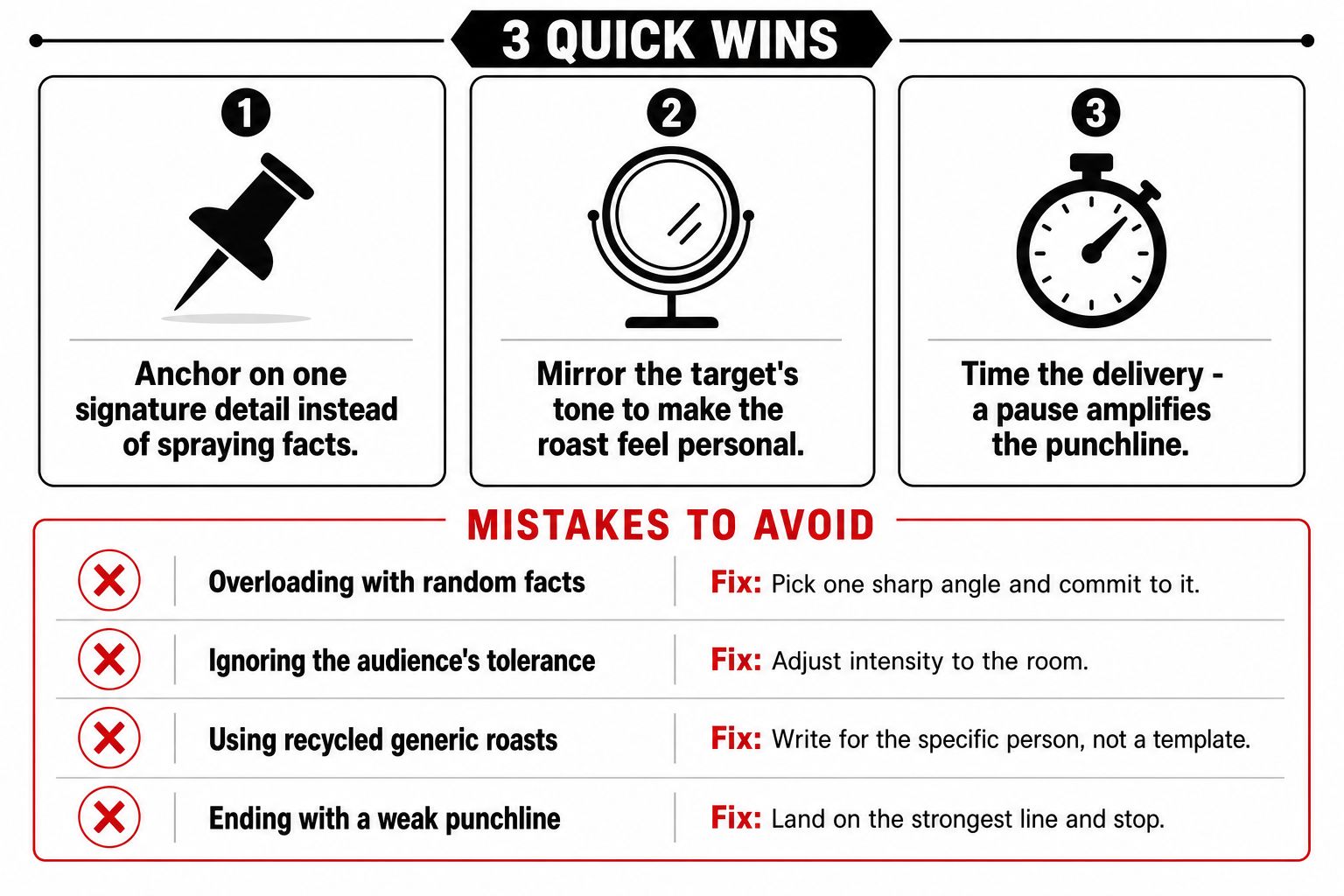 An infographic titled 3 Quick Wins for roasting, showing tips for delivery and mistakes to avoid.
Three changes with immediate payoff
- Anchor on one signature detail: Build the verse around the controller throw, the stolen account, or the repeated catchphrase instead of spraying disconnected facts.
- Mirror the target's speech pattern: If they speak in clipped phrases, use clipped phrases. If they overexplain everything, make the lyric deliberately overconfident and wordy.
- Test the opening aloud: The first line should sound natural before the beat arrives. If your mouth trips over it, the listener will trip too.
The mistakes that make AI roasts feel cheap
Overloading names turns personalization into awkward paperwork. Repeating “Jake” in every couplet doesn't make the verse intimate. Use the name once, then let the behavior carry the identity.
Using slurs or protected characteristics replaces writing with shock value. Remove the cheap angle and find a contradiction, habit, or public choice that the target can answer.
Ignoring audience tolerance makes a private joke dangerous in a public clip. Set the savagery level before generating, and reconsider the material when the distribution changes.
Publishing without a cooling-off read lets temporary anger make permanent content. Read the final draft later, ask whether the target consented to this setting, and cut any line that relies on a rumor or private wound.
Pre-publish check: consent, audience fit, savagery level, one standout line, and a delivery that works aloud.
The strongest personalization best practices are less about collecting more information and more about making better decisions. Choose a detail people recognize, shape it for the room, protect the person behind the joke, and edit until the punchline sounds inevitable.
DissTrack AI lets you enter a target's name, relationship, inside jokes, style, and savagery level, then generate structured roast verses with variations you can edit, export, or share. Visit DissTrack AI to turn one unmistakable personal detail into a sharper, room-ready diss track without settling for generic filler.