Privacy or Privacy: How Your AI Diss Lyrics Stay Safe
You know the moment. It's late, the group chat is loud, and someone has nominated a friend for a roast. You open a generator, type the name, pick a style, drop in two inside jokes and hit generate. Ninety seconds later you have four verses and one decision.
That decision has two halves, and people mash them together. Half is visibility: can anyone else open this thing? Half is processing: what happened to the name and the jokes on their way through the machine? Ask only the first question and you get privacy or privacy without ever noticing the difference between them.
Concern isn't the missing ingredient. In a 2025 U.S. News survey of 2,000 adults, 74% said they were more concerned about online privacy than five years earlier. What's missing is a map of who touches the file at each stage, and that's what follows.
Who Can See Your Diss Track at Each Stage
A diss can start as a private draft and end up as a screenshot in the group chat. At DissTrack AI, generated disses stay private: the business does not share, sell, or publicly display them, and targets are not notified. Your lyrics remain private until you choose to share or publish them.
| Stage | What Happens to Your Data | Who Can See It by Default | Your Control |
|---|---|---|---|
| Prompt entry | You enter a target's name, relationship and inside jokes | You, while entering the prompt | Keep identifying details minimal |
| Generation | The prompt is processed into verse variations | The processing system; not the target or the public | Check which details you included before generating |
| Storage in your library | Drafts and variants are saved to your account | You | Delete drafts you no longer need |
| Editing | Line and punchline changes are saved to your draft | You | Review the final version before exporting |
| Export and sharing | Files are downloaded or shared | Anyone you send them to | Share only lines you have checked |
| Publishing | You make the track public | Public audience | Consider the target's privacy before publishing |
| Deletion | Drafts are removed from your library | You can no longer see them there | Request deletion and check the provider's stated retention schedule |
The audience changes at export and publishing. A download can leave your account as soon as you send the file; a public post can be copied, quoted or screenshotted by others. Keep the punchline private, and you control its audience. Publish it, and that control narrows.
There is a difference between who can see a draft and who handles the text during generation. The table identifies the processing system as part of that stage, but does not specify whether a third-party model receives the prompt or how long each copy is retained. Check the provider's documentation for those details before entering a real name.
In 2025, 76.9% of EU internet users took steps to manage access to their personal data, according to Eurostat's report. Managing access is one step; understanding what happens after a deletion request is another. Deletion is where the documentation shows up, and it's the row everyone assumes is automatic. A guide to deleting persona memories and avatars can serve as a comparison when checking what a removal process explains.
Pick the row that matches your next action. Before generating, check the prompt. Before sharing, check the file. Before publishing, consider who else the lyrics identify.
Private by Default Does Not Mean Private Processing
A diary locked in a hotel drawer is hidden from your roommates. It isn't hidden from the cleaner, the maintenance tech who fixes the lock, or the front desk that logs who had the room. Locked away and unread are two different states.
That's the shape of the confusion in most AI tools. Visibility asks who can open the finished lyric. Processing asks who handles the text that produced it. A product can be excellent at the first and vague about the second, and the marketing copy rarely separates them.
 A hotel room drawer containing a leather journal with people entering the room in the background.
For a personalized roast, the prompt is where the sensitive material lives: a target's name, a relationship, an inside joke that twelve people know. Australia's privacy regulator asked people what they expect at exactly that point. In its community attitudes research, 80% expect personal information not to be retained by third-party AI providers longer than necessary, 76% oppose its use to train external AI systems without consent, and 74% expect disclosure when information is shared with a third-party AI provider (OAIC).
The same research complicates the fix everyone reaches for. 65% say sharing information rarely or never feels like a genuine choice, and 68% say the same about consent. A checkbox isn't trust, and a banner isn't a choice. People also know they're guessing: 67% told Pew Research Center they understood little or nothing about what companies do with their personal data, up from 59% in 2019 (Pew Research Center).
The test: ask who can read the finished lyric, then ask who can read the text that produced it. Different answers, different fixes.
Three questions do the separating, and any generator should answer them in plain language on its own site.
- Is my prompt sent to a third-party model? A vendor that routes your text through another company's API has handed the name to that company too.
- How long is each copy kept? Retention is the number that turns a private draft into a permanent record.
- What else is it used for? Training, abuse monitoring, analytics, backups and legal holds are five different uses with five different lifetimes.
If young people or family members show up in the content you generate, the bar rises further. The student and family data safeguards published by 1chat show what a stricter standard looks like when minors are anywhere near the data.
A clear answer to those three questions is worth more than a privacy badge on a landing page. Badges describe intentions. Answers describe systems.
How to Keep Identifiable Details Out of Your Prompt
A roast about someone's legendary karaoke performance does not need their full name, workplace, or the text message that started the story. Remove those details before you generate. The person being roasted may never use the tool, but their privacy is still part of the prompt.
A generator handles text while creating a verse, and copies may also exist in places such as a saved library, exports, moderation records, or backups. Keep the prompt lean, then check what you choose to save or share.
- Remove surnames, employers, and street or school names. They can identify someone without improving the joke. If the bit is about a workplace, describe the situation rather than naming the company.
- Use a nickname or alias instead of a real name. Rhymes rarely need legal names, and a short alias may scan better.
- Keep relationship labels broad. “Old college rival” gives the verse enough context. Naming an ex's employer does not.
- Describe inside jokes by situation, not by quoting messages. “The karaoke incident” gives you a writing cue without pulling other people's words into the prompt.
- Leave out health, religion, sexuality, family trauma, and details about minors. They can expose sensitive parts of someone's life without making the roast sharper.
- Check the draft for indirect identifiers. A city, job title, sports team, or distinctive car can point to one person even when their name is gone.
- Keep the cleaned prompt if you save one. Your saved version should contain only the details you intend to retain.
Four of those moves carry most of the weight.
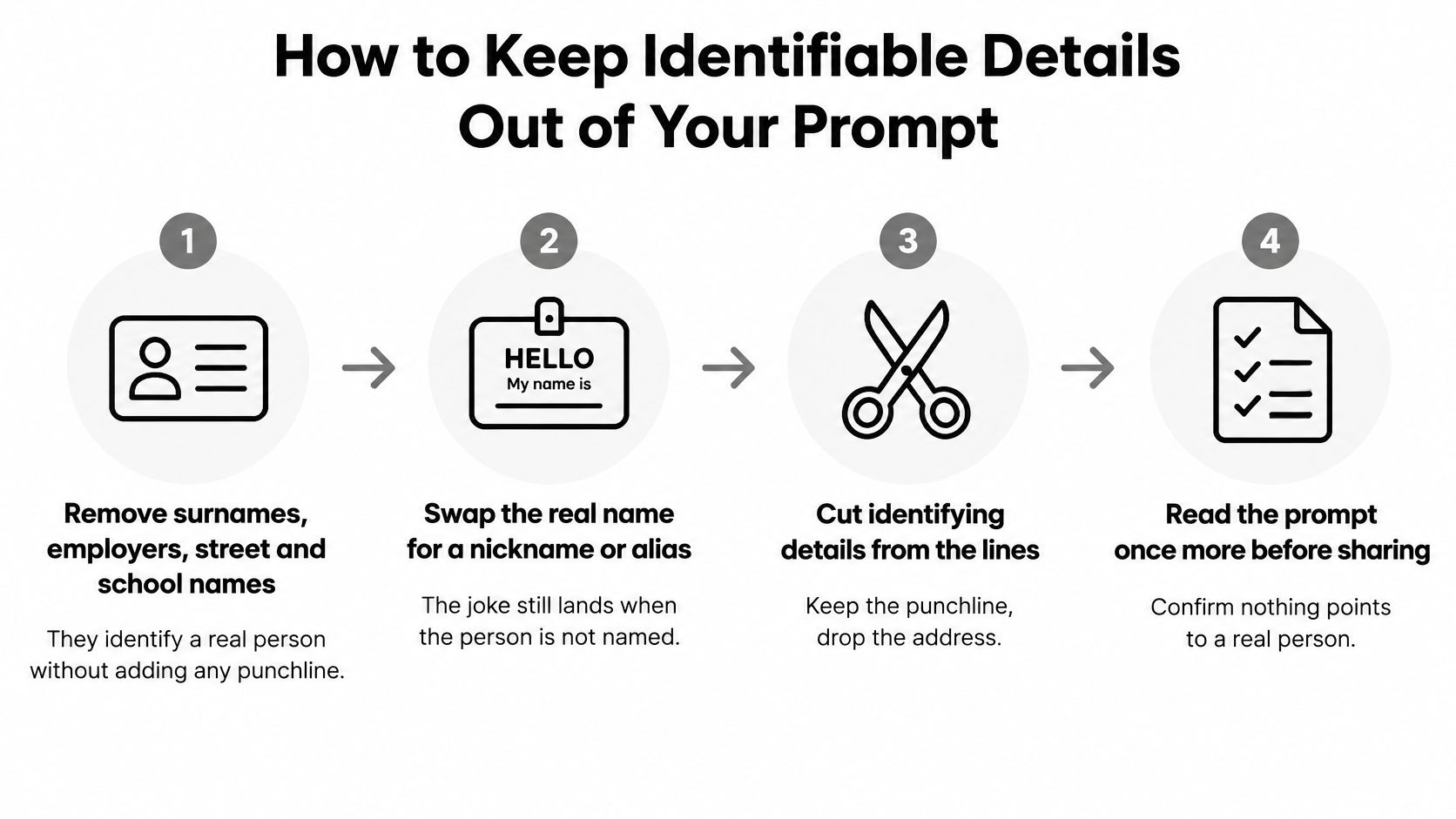 A four-step infographic illustrating how to redact personal identifying details from AI prompts for better privacy.
Minimizing identifying details and avoiding raw prompt text in logs unless it is needed for safety or debugging are sound privacy practices. Less identifying text means fewer details that could appear in a saved copy or be exposed later.
A prompt without identifiers can also make a stronger creative brief: it pushes you to describe the joke rather than the person's biography. For help shaping a rough idea into a verse, use this prompt-to-verse walkthrough.
Three Roast Scenarios and How Privacy Changes
The same prompt can be safe in one setting and harmful in another. What changes isn't the model, it's the audience and the consent behind it.
 A diverse group of friends laughing while celebrating a birthday with cake and a video call
Case One, a Birthday Roast in the Group Chat
Maya is hosting a thirtieth for a friend who has been insufferable since he started running half marathons. She generates four verses, tests them on two people, and drops the best one in the group chat the night before. Nothing is published, nothing is exported, and the lines stay on things he tells himself anyway.
The privacy move that matters most: keep the verse to material the guest would laugh at with the room. A group chat has a screenshot button, so "private draft" means private from the public, not private from the twelve people who will forward it.
If you want to see how timing and delivery change a line from cheeky to cruel, watch how a short round is built before you export yours.
Case Two, the Streamer's Short
Kwame clips a roast into a sixty-second video and posts it to a few hundred thousand followers. The privacy question shifts from who sees the draft to what goes public. His checklist: label the lyrics as AI-generated, avoid identifiable accusations, and get the target's okay before the upload rather than after the comments start.
The move that matters most here is the label plus the permission, because the audience is now strangers who don't know the inside joke is affectionate.
Case Three, the Battle Verse Aimed at a Real Rival
Tasha writes a verse aimed at an artist she has actual friction with, and this is the highest-risk version of the format. The track is designed to be published, the target never agreed to appear in it, and the whole point is provocation.
The move that matters most is framing it as clearly fictional or consensual battle play and keeping every line away from sensitive traits, family and anything that reads as an accusation of fact. Have a correction route ready before you post, because a rival who objects in public is a problem you can't delete your way out of.
Same generator, three different risk profiles. The lyric doesn't decide which one you're in. You do.
Deletion, Ownership and Training Questions to Ask
Deleting a draft removes it from your library. That isn't the same as deleting every copy. 64% of consumers across eight countries name data breaches as their top privacy concern, according to Acronis's Data Privacy Survey, and breaches get the headlines while half-finished deletion requests don't. The quieter leak is the copy nobody remembered to chase.
European data protection guidance points the same way. A deletion workflow for AI content has to cover prompt text, generated variants, cached outputs, moderation artifacts, support exports and backups, with identity verification and completion tracking (EDPS guidance on generative AI). Notice how long that list is compared to the one line in the settings menu.
Three questions to put to any provider:
- Does deletion reach backups and support exports? A draft you removed may still sit in a nightly backup or in a ticket someone emailed to support.
- Who verifies the request? Identity checks matter more than usual when the text contains a third party's name.
- Is completion tracked? You want a confirmation with a date, not a promise with an adverb.
What Ownership Does and Does Not Cover
Ownership settles a different question from deletion. You own everything the AI generates, and we don't claim any rights to your lyrics. That's a real protection and a narrow one. It doesn't give you rights over the person named in the verse, and it doesn't stop a platform from holding copies for its own operational purposes, which is exactly why the deletion path matters separately from the ownership line.
I'd want model improvement to sit behind a separate opt-in rather than a blanket clause in the terms. Consent to use a service is not consent to train on your friend's name, and the two get bundled far too often.
If you're weighing whether a generated verse can go out under your name, the guide to publishing an AI-written song covers the licensing side. And when you want to compare how vendors handle requests, Freeform Company's list of data privacy compliance tools is a reasonable starting shelf.
Check the deletion path before you need it. Nobody tests a fire exit during the fire.
Whose Privacy Counts Before You Publish
You can keep a draft private and still put someone else's details into it. The person named in the lyrics may never have opened an account, but they have a stake in what happens to their name, reputation, and private jokes.
That distinction matters at two points: while the prompt is being processed and after you publish or share the result. DissTrack AI keeps generated disses private, does not share, sell, or publicly display them, and does not notify the target. Those protections do not make every prompt detail suitable to include, or every finished lyric fair to publish.
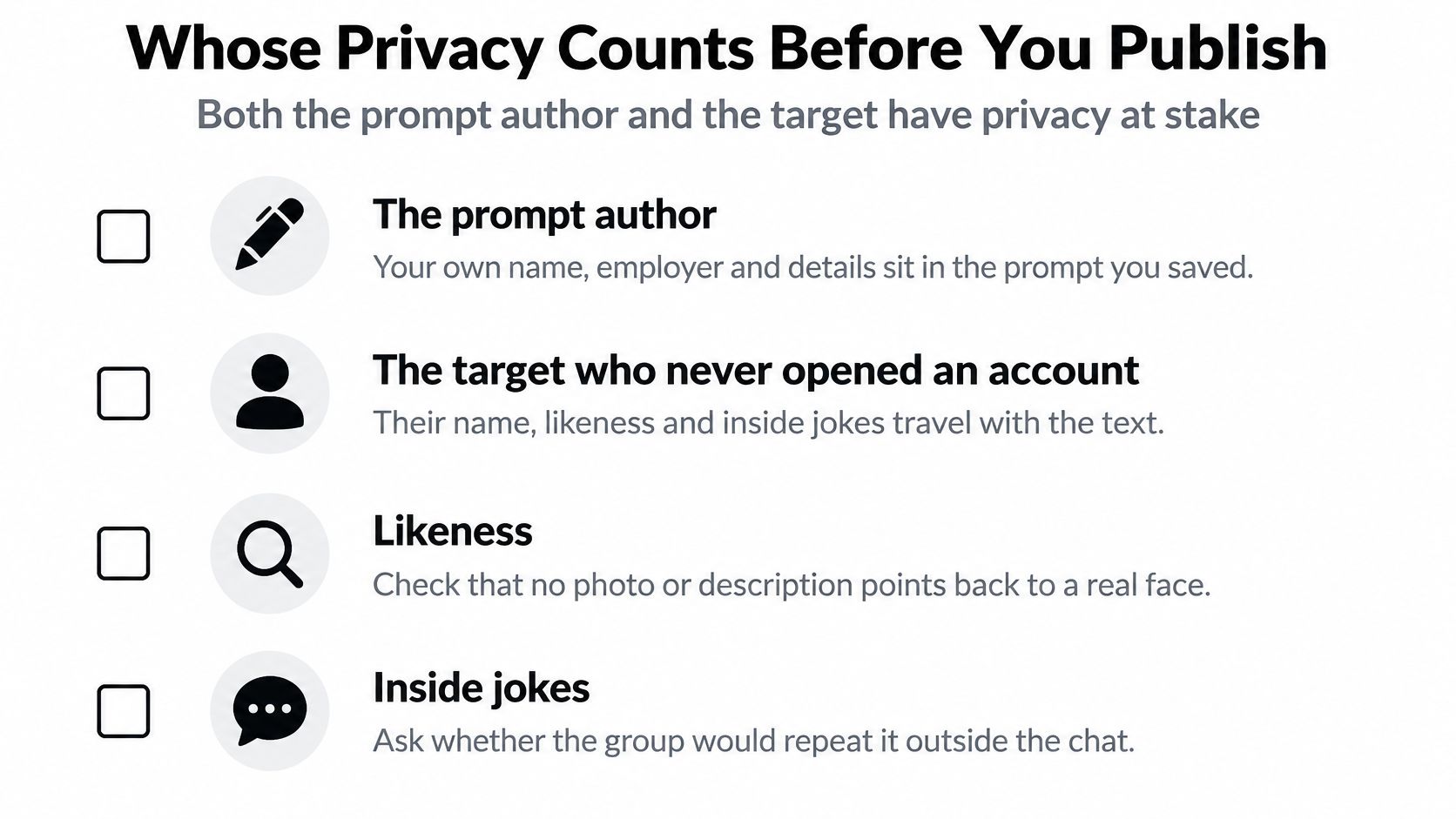 A checklist about privacy considerations for prompt authors, focusing on protecting personal details and sensitive information.
The Five-Point Go or No-Go Check
Run these checks before anything leaves your library.
- The prompt avoids details you would not want public. Remove an employer, street, school, or other identifying detail if it is not needed for the joke.
- The target has agreed, or the track is clearly fictional or consensual battle play. A guess that they will laugh is not consent.
- The lyrics avoid sensitive traits and claims presented as fact. Health, sexuality, religion, family trauma, and accusations can turn a roast into a personal attack.
- Listeners can tell the track is AI-generated. Make that clear when you share it.
- You know how to respond if the target objects. Decide how you will correct or remove a post before publishing.
If any answer is no, keep the draft private and revise the lines that failed. For a roast between friends, how to roast your best friend without crossing the line can help you focus the joke on shared humor rather than identifying details.
Practical rule: If you would be uncomfortable reading the verse aloud to the target's mother, reconsider the detail that made it uncomfortable.
The account holder controls the draft; the person named in it carries the reputational risk. Keep both people in mind before exporting or posting. DissTrack AI lets you create verses from a target's name, relationship, and inside jokes, then edit the result before sharing. You own everything the AI generates, and the business does not claim rights to your lyrics. Start with a private draft at DissTrack AI, and publish only after the five checks pass.