Rap Lyrics Generator Diss Track Guide
You've got the beat, the group chat is waiting, and the target has already talked too much. Then the screen stays blank. Every insult sounds borrowed, every rhyme feels obvious, and the one line you need refuses to show up. That's the exact moment a rap lyrics generator diss track workflow can help, provided you treat AI as a sparring partner rather than the artist who gets the final word.
Rap became a recorded, mass-distributed form of lyrical competition through a series of early milestones. Sugarhill Gang's “Rapper's Delight” reached the Billboard Hot 100 in 1979, Kurtis Blow's “The Breaks” followed in 1980, and Blondie's “Rapture” became the first No. 1 U.S. pop single to feature rap vocals, as documented in this lyrical history of hip-hop. That history matters because a diss track isn't just an insult with a beat behind it. It's structured pressure, delivered with timing, identity, and intent.
Why AI Is the Ultimate Battle Rap Sparring Partner
Blank-page panic hits battle rappers differently. You're not only searching for words. You're trying to find an angle, a rhythm, a setup, and a punchline that makes the room react. AI can break that freeze by throwing material back at you quickly, giving you something to attack, reshape, or reject.
A generator is useful for structure before polish. Ask for a verse built around a setup, escalation, reversal, and closing punch. You might receive a weak line, a serviceable rhyme, and one surprising association. That's enough. A coach doesn't judge a sparring partner by whether every exchange is perfect. The value comes from forcing you to respond.
Use output as raw material
The strongest workflow is deliberately selective:
- Start with angles: Ask for several ways to attack the target, such as fake confidence, unreliable habits, weak fashion, or a contradiction between what they claim and what they do.
- Request rhyme families: Generate related sounds and internal-rhyme possibilities before asking for finished bars.
- Build variations: Keep the same premise while changing the tone from playful to competitive.
- Read everything aloud: A line that looks clever on screen can collapse once your mouth has to deliver it on beat.
AI also helps you study mechanics. By comparing drafts, you can spot how a setup delays information, how an internal rhyme adds momentum, or how a short closing phrase creates space for an audience reaction. The tool supplies options. You supply judgment.
Coach's rule: Never defend a generated line just because it rhymes. If you wouldn't say it to someone's face, cut it.
The recorded format made this kind of lyrical contest widely distributable, while battle rap later developed its own organized infrastructure. Rap Verdict lists 22.8K total rappers, 750 leagues, 8.5K events, and 65.9K battles in its public ecosystem, according to its battle rap statistics page. That scale explains why a generator can be valuable as a practice opponent, but it also raises the standard. Generic insults disappear quickly in a culture built around memorable angles.
If you plan to publish the result as short-form video, study practical guidance such as Viral.new's TikTok growth tips, especially around presentation and audience retention. For a focused look at the broader workflow, see this guide to an AI rap lyrics generator.
Feeding the Generator With Lethal Context
A generator can only weaponize what you give it. “Roast my friend” produces a broad insult because the prompt contains no relationship, history, or scene. “Roast my teammate who claims to carry every match, ignores objectives, and still blames the controller after losing” gives the writing a targetable contradiction.
 A male programmer working late at night on a multi-monitor setup while creating rap lyrics.
Build the prompt in layers
Use this order when you're preparing a generation:
- Name the target clearly. Include a nickname or fictional label if privacy matters.
- Define your relationship. Friend, rival, teammate, sibling, creator, or fictional character changes the emotional temperature.
- State the central contradiction. The best diss often exposes a gap between the target's self-image and their behavior.
- Add shared evidence. Include a specific incident, repeated phrase, embarrassing routine, or object everyone in the group recognizes.
- Set the performance goal. Tell the generator whether the verse is for a private joke, a live battle, a short video, or a recorded song.
- Request alternatives. Ask for different angles instead of accepting one interpretation of the target.
The most useful details aren't necessarily the cruelest. A broken headset, a repeated excuse, an abandoned project, or a bizarre snack habit can create a stronger punchline than a vague attack on appearance. Specificity gives the audience a reason to remember the line, and it gives you something real to perform.
Separate facts from accusations
Keep roast material grounded in things you know are true, harmless, or clearly framed as parody. Don't feed the tool private medical information, intimate details, or allegations you can't substantiate. A joke about someone's habit is different from presenting a serious claim about their conduct as fact.
Try a prompt such as:
“Write three playful battle-rap angles about a friend who brags about being the team's best player, avoids difficult tasks, repeats the same excuse after every loss, and owns a chair held together with tape. Use internal rhymes, one recurring image, and a confident but humorous tone.”
That prompt gives the generator a character, a theme, and a visual motif. You can find more prompt inspiration in this guide to making custom AI lyrics.
Selecting Styles and Tuning the Savagery
Style should serve the beat and the persona. A smooth West Coast bounce can make a roast sound amused and effortless, while dense battle-rap writing creates pressure through layered references and rapid reversals. Choosing a tag because it sounds tough won't fix lyrics that don't fit the beat.
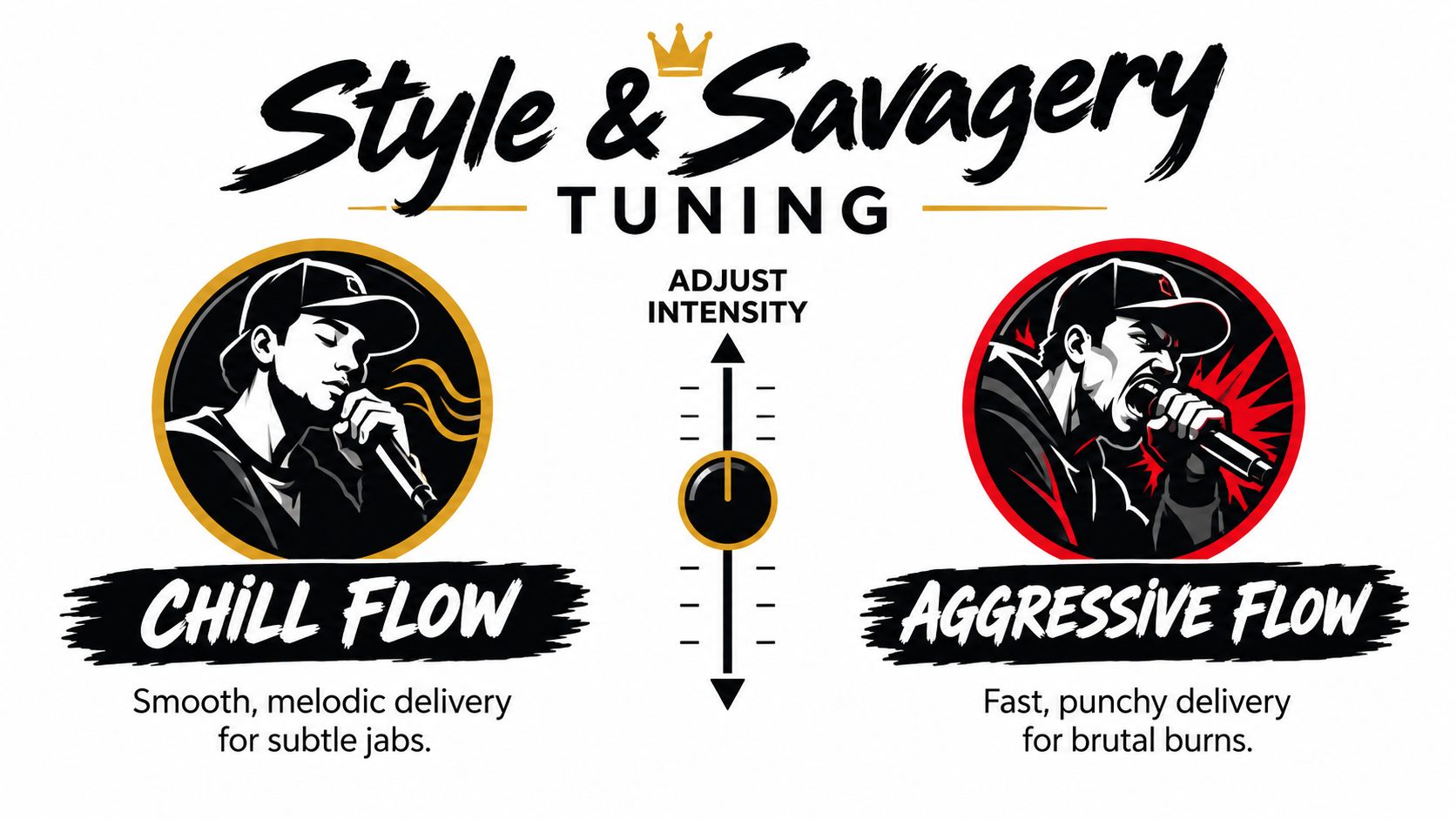 A graphic depicting Style and Savagery tuning options with choices for chill or aggressive rap flows.
Match the flow to the beat
| Style | What it emphasizes | Best use |
|---|---|---|
| West Coast | Bounce, relaxed confidence, clean pockets | A playful roast that sounds controlled |
| Old School Boom Bap | Clear cadence, punchy drums, direct setups | Bar-focused writing and live exchanges |
| Trap | Triplet movement, clipped phrases, rolling momentum | Fast, modern delivery with space for ad-libs |
| Battle Rap | Dense schemes, layered wordplay, reversals | Competitive writing where each bar must develop an angle |
| Drill | Stark rhythm, blunt aggression, hard accents | A colder, confrontational persona |
| Emo Rap | Vulnerability, melodic phrasing, emotional contrast | A roast built around disappointment or betrayal |
| UK Grime | Tight cadence, sharp pockets, compressed phrasing | High-energy delivery with regional character |
The savagery setting needs the same discipline. For a friend-group video, playful exaggeration usually lands better than total destruction. A competitive battle can handle sharper language, but aggression still needs craft. If every line screams, the listener loses the contrast that makes the decisive punch feel dangerous.
Calibrate the emotional temperature
Use three questions before generating:
- Who's listening? A private group and a public audience won't interpret the same line identically.
- What's the target relationship? Mutual joking supports a different tone from a genuine conflict.
- What should the audience feel? Amusement, shock, tension, respect, or sympathy each calls for different writing choices.
A chill flow can hide a lethal observation under a relaxed delivery. An aggressive flow can make a simple point feel larger, but it also exposes weak writing faster. Choose the beat first when possible, then ask the generator to respect its tempo, phrase length, and pauses.
Editing AI Output to Kill the Cringe Factor
Technically correct lyrics can still sound fake. AI tends to produce patterns that look impressive in a text box but feel empty in a rapper's mouth: broad claims, predictable metaphors, exaggerated confidence, and vocabulary nobody in the room uses.
The authenticity problem is structural, not cosmetic. Recent commentary on AI and rap argues that generated output often replicates patterns without the lived experience, regional cadence, or creative intent that gives battle writing its credibility, as discussed in this analysis of AI and rap flow. Human revision isn't a final polish pass. It's where the identity enters.
Run four editing passes
Pass one, delete the fog. Cut lines that could describe anyone. “You're fake,” “you're weak,” and “you talk too much” need an object, moment, or image attached to them. Replace general judgment with observable behavior.
Pass two, restore your vocabulary. Swap formal or algorithmic wording for phrases you and your scene use. Don't force slang. If you wouldn't say a word in conversation, it probably won't sound natural in performance.
Pass three, fix the breath. Mark where you inhale, where the beat leaves space, and where the final word needs emphasis. Break an overloaded line into shorter units. A clever bar that leaves you gasping won't hit with authority.
Pass four, sharpen the turn. A punchline should change the meaning of what came before it. If the line only repeats the insult, it's a statement, not a punch. Add a comparison, reveal the contradiction, or flip the target's boast against them.
Replace borrowed swagger with personal evidence
Suppose the generator writes, “You call yourself a king, but your crown is made of plastic.” The image is familiar, so it carries little identity. Your version might reference the exact prop, phrase, or setting that makes the target's performance ridiculous. The audience doesn't need a universal metaphor. They need the detail only your group would recognize.
Read the verse in three modes:
- Conversation: Does the language sound like you?
- Beat: Do stressed syllables land where the beat wants them?
- Room: Would listeners understand the angle without a long explanation?
A generator can suggest a scheme, but it can't know which memory makes your friend go silent. Keep the line that exposes a real contradiction, even if it's less ornate than the machine's rhyme.
Revision test: If removing the target's name leaves the verse unchanged, you haven't made it personal enough.
For more hands-on punchline technique, use this resource on how to write punchlines. The aim isn't to make the verse sound more like AI. It's to make the draft disappear behind your delivery.
Navigating Copyright and Roast Ethics
Generated lyrics create a practical ownership question that many tutorials skip. Current guidance generally treats fully AI-generated output, without meaningful human creative input, as weak or unavailable for copyright protection. Human-edited lyrics can offer a stronger basis for authorship when the person contributes original expression through rewriting, arrangement, selection, and creative decisions, as explained in this overview of AI-generated rap lyric ownership.
That distinction changes how you should work. Don't generate a verse, copy it unchanged, and assume you control every word. Treat the output as a draft. Rewrite key lines, reorder sections, add original images, choose among alternatives, and shape the cadence around your own performance.
Keep a creation record
Save the prompt, the generated options, your edits, and the final arrangement. A record won't automatically settle every legal question, but it shows where your human contribution entered the process. Also review the tool's terms before you publish, license, or monetize the track. Platform permission to use output isn't identical to strong copyright control over the lyrics.
Music introduces another layer. The beat, samples, vocal performance, and visual assets may each carry separate rights. Before commercial release, consult a complete music licensing guide and verify the permissions attached to every component, not just the words.
Keep the roast inside the ring
A funny diss targets behavior, habits, boasts, or clearly fictional traits. It shouldn't expose sensitive personal information, encourage harassment, or present an unverified accusation as fact. Public visibility doesn't erase the need for judgment, and a private joke can become harmful once clipped, reposted, and stripped of its original context.
Use fictional targets when you're testing a new style. For real people, ask whether the target understands the format and whether the joke can end without lasting damage. Avoid protected traits, threats, intimate details, and claims that could affect someone's reputation. The sharpest battle writing doesn't need those shortcuts.
Exporting and Deploying Your Final Verses
A finished lyric draft isn't a finished diss track. Before you export, decide whether the piece belongs in a private voice memo, a live battle, a group chat, or a public feed. Each destination changes how much context you need, how aggressive the wording should be, and which rights you must confirm.
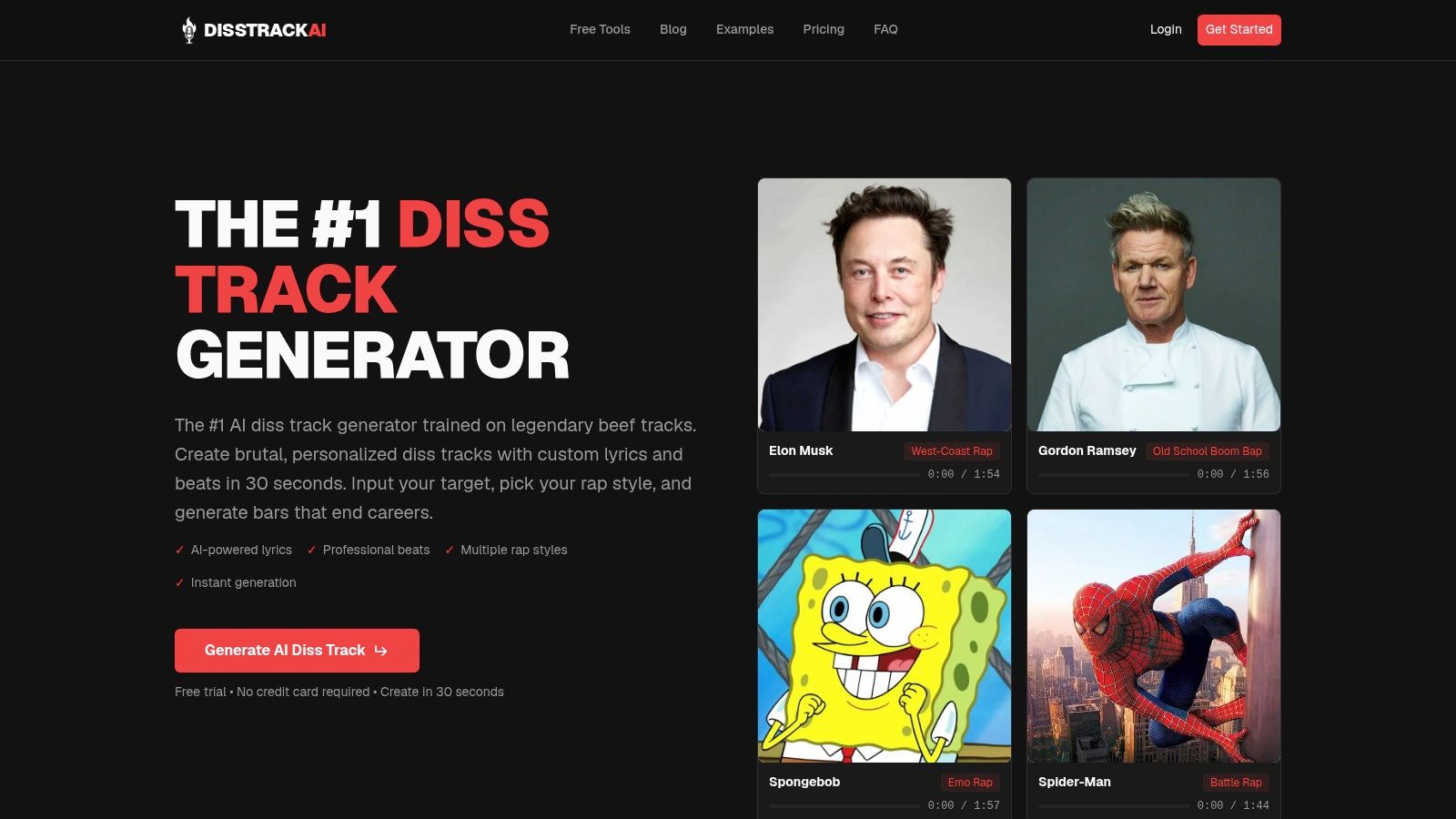 Screenshot from https://aidisstrackgenerator.com
DissTrack AI is one purpose-built option for this workflow. It lets users enter a target and roast context, select styles including West Coast, Old School Boom Bap, Trap, Battle Rap, Drill, Emo Rap, and UK Grime, then generate structured verses with variations for editing, export, or sharing. Its publisher describes private generations that remain unpublished until the user chooses to release them, with free, Pro, and Creator tiers that differ in generation limits and commercial licensing.
Use this release checklist
- Check the words: Remove accidental personal information, unsupported allegations, and lines that cross your own limits.
- Check the performance: Record a dry vocal take and listen for rushed syllables, weak endings, and missing breaths.
- Check the beat: Confirm the beat's usage rights before posting or monetizing.
- Check the arrangement: Keep the strongest opening, build toward the central angle, and end on the line people will repeat.
- Check the audience: Decide whether the target and listeners will understand the roast as performance rather than a factual accusation.
- Check the export: Save the lyric document, beat details, vocal takes, and final audio in clearly named files.
- Check the platform: Review caption language, content rules, privacy settings, and any commercial terms before uploading.
Short-form content benefits from a fast entry point, a visible reaction, and one memorable bar. A full track needs more breathing room and a clearer arc. Producers may want clean stems or editable lyrics, while a streamer may only need a compact verse that lands before the viewer scrolls.
The final quality still comes from the same division of labor. Let the generator supply options and pressure-test angles. Let your lived experience choose the details, your ear choose the rhythm, and your judgment decide whether the joke should be published at all.
DissTrack AI gives you a practical starting point for personalized roast lyrics, style-based flows, and structured verses when writer's block gets in the way. Bring it your target, relationship, and inside jokes, then edit the strongest material until it sounds like you. Visit DissTrack AI and turn a technically correct draft into a diss track with an actual point of view.