10 Rap Diss Songs That Changed Hip-Hop
The strongest rap diss songs don't win because they contain the cruelest insult. They win because they turn wordplay, research, rhythm, delivery, structure, humor, or atmosphere into competitive art that listeners can replay, quote, debate, and perform. That's why diss tracks became a recognizable hip-hop format during the Roxanne Wars in the mid-1980s, with Roxanne Shanté's 1984 “Roxanne's Revenge” widely cited as a song that helped formalize the modern template, according to this history of diss tracks.
This list doesn't rank rap diss songs by popularity alone. It organizes them by strategy, from layered insults and direct aggression to technical precision, systematic targeting, researched revelation, atmosphere, humor, metaphor, and authenticity. The point is practical as much as historical: each track offers a creative technique that artists, battle rappers, streamers, and remixers can adapt responsibly with DissTrack AI, using fictional, friendly, or consent-based targets instead of turning private information into harassment.
1. Ether by Nas
“Ether” is a lesson in how a diss can make personal knowledge feel like lyrical architecture. Nas answered Jay-Z's “Takeover” with attacks that worked on several levels at once, combining insults, cultural references, status challenges, and wordplay into a response that listeners could dissect long after the original exchange. The track's power doesn't come from one technique. It comes from stacking techniques until the target seems surrounded.
That layered construction explains why “Ether” became a reference point for later rap beefs. A strong bar can insult someone. A stronger bar also reframes their image, questions their credibility, and gives the audience a phrase they can reuse. The track's cultural afterlife shows how a diss can become more than a response, it can become a verb in hip-hop conversation.
 A creative songwriter with a beard sits at a table writing lyrics in a notebook near his guitar.
How to borrow the layered approach
Start with details that are specific but harmless, then give each detail more than one function. An inside joke can also reveal a contradiction. A style reference can also challenge credibility. A cultural comparison can also create a punchline.
Writing rule: The best layered bars reward the first listen with impact and the second with discovery.
If you're building a friendly roast, study rap punchlines and metaphors for ways to combine direct meaning with a second interpretation. DissTrack AI can help generate variations, but the strongest final version still needs human editing. Remove anything that relies on sensitive personal information, unsupported allegations, or humiliation that the target hasn't agreed to.
2. Hit ’Em Up by 2Pac
“Hit ’Em Up” chooses direct aggression and refuses to soften the delivery. During the East Coast and West Coast rivalry, 2Pac attacked The Notorious B.I.G., Bad Boy Records, and associated figures with a performance built for shock, confrontation, and instant recognition. The hook is memorable because it doesn't hide the track's purpose. The song announces its hostility immediately and keeps the pressure high.
That approach changed the expected emotional temperature of rap diss songs. “Hit ’Em Up” doesn't ask the audience to admire subtlety before understanding the threat. Its force comes from the combination of blunt language, relentless vocal energy, and a hook that functions like a rallying cry. The record became a cultural event, but its intensity also illustrates the danger of confusing dramatic performance with real-world intimidation.
Aggression needs control
A useful remix doesn't copy the track's personal hostility. It copies the clarity of intent. If a creator wants a funny battle-rap parody, the first few lines should make the premise obvious. If the target is a consenting friend, the hook should establish the playful frame rather than suggest a genuine threat.
- Use a clear premise: Decide whether the track is competitive, comic, theatrical, or fictional.
- Build a repeatable hook: Give listeners one short idea they can remember after a single play.
- Change vocal intensity deliberately: A louder performance matters more when quieter lines create contrast.
- Keep the target appropriate: Avoid threats, doxxing, protected traits, and claims presented as facts without evidence.
The broader history of greatest diss tracks shows why direct aggression remains influential, but it also makes the creative boundary clear. Performance can be fierce without becoming harassment.
3. Killshot by Eminem
“Killshot” treats a diss track like a technical examination. Eminem's response to Machine Gun Kelly emphasizes dense rhyme construction, internal rhymes, flow control, and targeted references. The record rewards listeners who care about how the bars are built, not only what the bars say.
That distinction matters. A personal attack may create immediate attention, but technical precision gives a track replay value. Listeners can return to examine rhyme placement, syllable density, transitions, and the way one insult sets up the next. Eminem's performance keeps those mechanics audible even while the lyrics remain confrontational.
Make the mechanics serve the message
Technical writing shouldn't become a speed test with no emotional direction. The rhyme scheme needs to sharpen the attack, while the delivery needs to preserve enough clarity for listeners to catch the punchlines. A complicated flow that buries the target is less effective than a simpler pattern with a clean payoff.
Try mapping a verse in three layers:
- Internal rhyme: Place linked sounds inside lines to increase momentum.
- End rhyme: Use the line endings to create expectation and resolution.
- Target detail: Attach each technical passage to a harmless, verifiable feature of the fictional or consenting target.
Production supports this process. A beat with enough space for consonants and pauses lets dense lyrics remain intelligible. You can explore diss track beats for a foundation, then test the verse at different tempos before recording. The goal isn't to sound busy. It's to make every technical choice feel like part of the attack.
4. No Vaseline by Ice-T
“No Vaseline” demonstrates the power of systematic targeting. Rather than scatter insults across a broad conflict, Ice-T organizes the track so individual members of N.W.A. receive focused attention. That structure gives the song a sense of completeness. The listener can follow the argument, identify each target, and understand how the sections fit together.
The production helps because it leaves room for the words to dominate. A diss doesn't need an overcrowded beat when the writing already carries movement. A simple hook can act as a spine, connecting several verses without competing with their details.
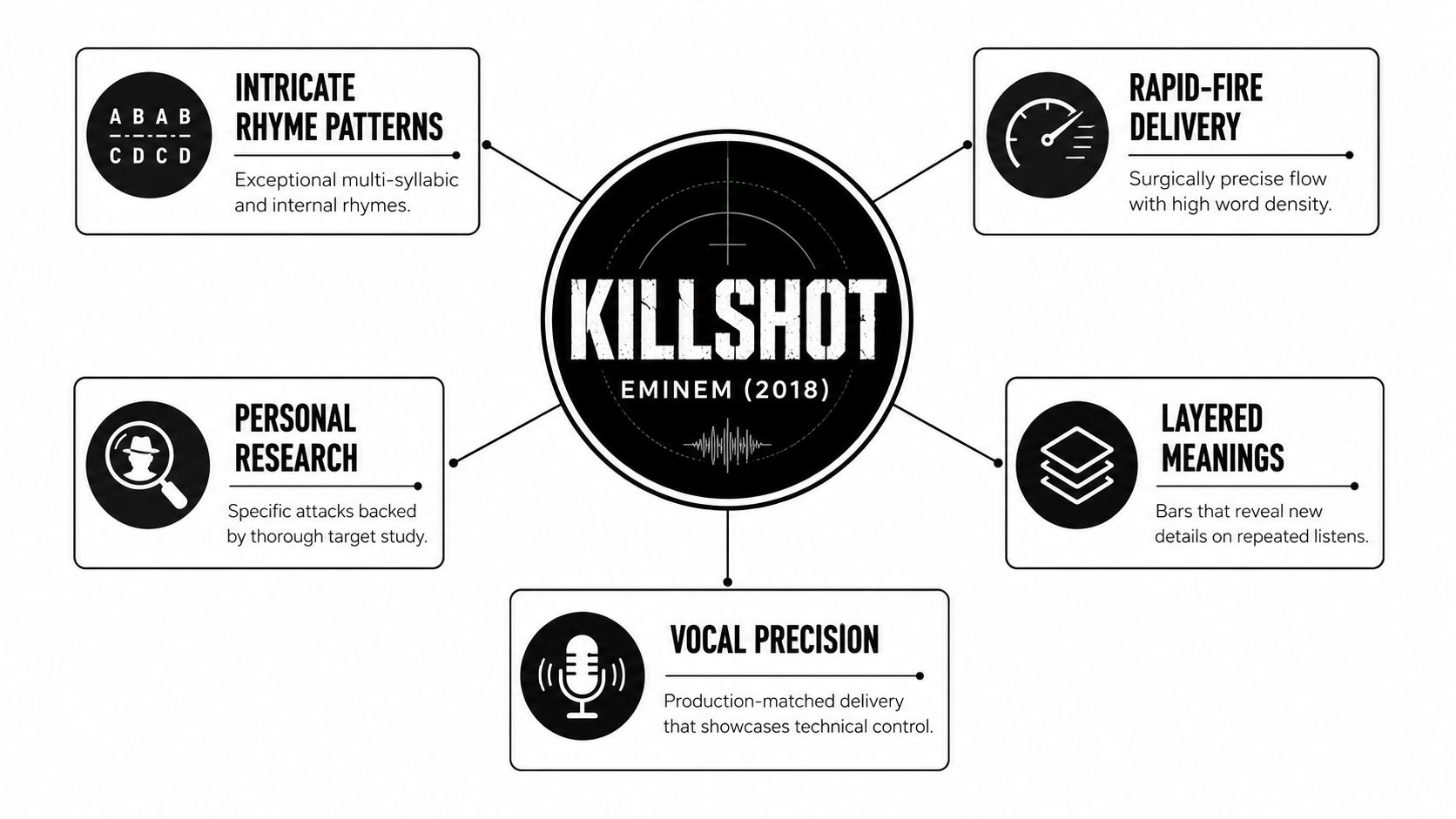 A diagram analyzing Eminem's song Killshot, highlighting technical elements like rhyme patterns, flow, and lyrical research.
Build a roast like an argument
This strategy works especially well for a group-friendly track. Suppose a creator is roasting a fictional band, a consenting friend group, or several characters in a comedy video. Each section can have a distinct function:
- Opening section: Establish the shared premise and the overall claim.
- Individual sections: Give every target a specific joke, behavior, or harmless contradiction.
- Hook: Repeat the central idea so the track doesn't feel like disconnected sketches.
- Closing section: Bring the targets back into one final image or punchline.
A structured diss feels stronger because the listener knows where the attack is going.
Don't confuse quantity with substance. Giving several people one vague insult each creates a checklist, not a song. Give every section a memorable image, a distinct rhythm, and a detail the audience can recognize without exposing private information.
5. The Story of Adidon by Pusha T
“The Story of Adidon” shows how research can become narrative power. Pusha T's response to Drake drew on industry knowledge and personal information to create a track that dominated conversation. Its impact came from the collision of revelation, timing, delivery, and a coherent artistic frame.
The lesson for creators isn't to hunt for secrets. It's to understand how preparation changes a diss. A researched track can identify contradictions between a target's public persona and their harmless, observable behavior. It can use publicly performed material, stated preferences, or details supplied with consent, then arrange those details into a story rather than dumping them into a list.
Research without crossing the line
A responsible roast needs an evidence filter before it needs a rhyme scheme. Use information that the target has willingly shared for the creative context, or material that is plainly part of the public performance being satirized. Don't include addresses, private relationships, medical details, financial information, or allegations you can't substantiate.
The track also teaches timing. A well-built response lands harder when the audience understands the conflict and the release feels purposeful. That doesn't mean rushing. Draft the narrative, check every factual implication, and ask whether the joke still works without exposing someone.
For a fictional target, research can mean building a character sheet. Give the character a job, a boast, a recurring mistake, and a recognizable habit. The song can then feel informed while remaining entirely invented. That approach preserves the strategic pleasure of “The Story of Adidon” without turning real people into targets of personal disclosure.
6. Warning by The Notorious B.I.G.
“Warning” proves that atmosphere can intimidate before the lyrics finish their first thought. The track creates tension through production, pacing, and delivery. Biggie's controlled vocal presence doesn't describe danger, it makes the listener experience uncertainty and pressure.
That's a different route from the verbal overload of “Killshot” or the direct confrontation of “Hit ’Em Up.” The beat establishes a setting, then the voice moves through it with precision. Every pause feels intentional. Every change in emphasis gives the narrative another layer of threat.
Design the room around the verse
A producer creating a roast track should ask what the audience ought to feel before deciding which sounds to add. A dark bass line, sparse percussion, filtered textures, or distant vocal layers can create suspense, but extra elements shouldn't blur the words. The best atmosphere leaves a clear lane for the performer.
- Choose a mood first: Suspense, comedy, triumph, or menace each requires a different sonic palette.
- Match delivery to the beat: A calm voice over a tense beat can feel more unsettling than constant shouting.
- Use silence as texture: Brief spaces can make a punchline or accusation feel heavier.
- Control the frame: Keep theatrical menace separate from real threats and personal intimidation.
A consenting roast can borrow the track's cinematic quality by turning a small, harmless conflict into a mock thriller. The target forgot the aux cable. The fictional villain stole the last slice. The music can make the stakes feel huge while the content stays safe and funny.
7. Rap God by Eminem
“Rap God” is a skill display disguised as competitive messaging. It isn't a conventional diss aimed at one opponent, but it asserts dominance by demonstrating range. Eminem moves through rapid delivery, dense multisyllabic rhymes, changing flows, and shifts in intensity to make technical ability itself the argument.
That strategy matters because not every competitive track needs a named enemy. Sometimes the artist is challenging the entire field, the listener's expectations, or their own previous limits. The target becomes an idea, such as complacency or weak technique, and the performance supplies the rebuttal.
Escalate without losing clarity
A skill-focused diss works best when complexity rises in stages. Begin with a rhythm the audience can follow, add internal rhyme, introduce a flow change, and reserve the most demanding passage for a moment that feels earned. Beat changes can mark those stages, but they shouldn't interrupt the song's identity.
For a remix, set one technical challenge per section:
- Verse one: Maintain a clean pocket with simple end rhymes.
- Verse two: Add internal rhyme and longer multisyllabic patterns.
- Final passage: Increase speed or switch cadence while keeping key words audible.
The performance should communicate confidence, not panic. If listeners need to read every lyric sheet to understand the point, the technique has overtaken the message. Use the showcase to support a competitive claim, then give the audience a memorable phrase they can repeat.
8. Beef Rap by MF DOOM and MF GRIMM
“Beef Rap” takes the diss format toward humor and wit. MF DOOM and MF GRIMM deliver personalized attacks with creative phrasing, technical control, and an absurdist edge. The record doesn't depend on maximum hostility. It entertains while it competes.
That balance makes humor a powerful option for friend groups, party hosts, and creators making roast videos. A funny diss invites the audience to laugh at the construction as well as the target. Unexpected metaphors, odd comparisons, and sudden punchlines can create a lighter track with strong replay value.
Let the joke outrank the insult
The safest comedic roasts attack habits, situations, fictional flaws, or agreed-upon quirks. They don't rely on identity, trauma, appearance-based cruelty, or private information. A joke about a friend's inability to choose a restaurant gives you room for exaggeration. A joke about a sensitive personal matter can damage the relationship instead of improving the performance.
Use contrast to keep the humor moving. Pair an elaborate setup with a tiny payoff. Describe an ordinary mistake as if it were a historic failure. Give the target an overconfident hook, then let the verses dismantle it.
Comedy test: If the target can laugh at the premise without needing to defend their dignity, the roast is probably aimed at the right material.
Technical skill still matters. The funniest idea loses energy if the rhyme stumbles or the delivery sounds uncertain. Write the punchline first, then build the rhyme and rhythm around it.
9. Goliath by Jeru the Damaja
“Goliath” uses metaphor as a complete framework. Its biblical image gives the diss a narrative shape, allowing the artist to position the conflict inside a larger story of scale, challenge, confidence, and reversal. The target isn't only being insulted. The target is being cast in a role.
Conceptual writing gives a track cohesion. Instead of collecting unrelated punchlines, the artist can return to the same imagery through the verses, hook, ad-libs, and production. Each reference strengthens the central idea, so the diss feels like a designed world rather than a pile of attacks.
Build a metaphor that can carry a song
Choose a framework with enough room for escalation. Sports, cooking, fantasy, courtroom drama, and science fiction can all support a roast, provided the comparison remains understandable. A target who constantly loses at video games might become a failed final boss. A fictional rival who boasts about cooking can be placed in a restaurant where every dish collapses.
The metaphor should clarify the attack, not conceal it. Include a few direct details so listeners understand what behavior or claim the imagery represents. Then let the concept shape the language around those details.
Production can reinforce the framework through bells, marching drums, arena effects, ominous textures, or playful sound design. Don't add these elements just because they sound dramatic. Each one should help the audience enter the story.
10. The Realest by 50 Cent
“The Realest” draws its competitive advantage from authenticity. The track depends on 50 Cent's established image of toughness and survival, using lived experience and persona to support its claims of dominance. Its attack feels coherent because the voice, subject matter, and production all point in the same direction.
Authenticity does not require exposing more private information. It requires a diss to sound plausible in its performer's voice. A comedian adopting a fabricated street persona creates friction. A producer claiming achievements they never earned does the same. Listeners detect contradictions between performance and identity.
Turn credibility into character
Artists can establish credibility through harmless personal details. Mention demonstrated skills, competitions entered, habits friends recognize, or a fictional backstory built for a character. These details should reinforce the tone without presenting invented achievements as facts.
Production must support that identity. Aggressive drums can frame a forceful performance, while a relaxed beat can make dry confidence more effective. Delivery should sound controlled and grounded, not exaggerated for its own sake.
The documented history of diss and battle rap includes performers earning substantial fees per event and records showing that the format can operate as serious live and digital entertainment. One Guinness World Records entry documents 510,075 tickets sold for the online Japanese rap battle Hypnosismic -Division Rap Battle- VR Battle 2nd D.R.B.. These examples show how credibility, character, and delivery can extend beyond a private lyrical exchange. They do not excuse unsupported personal claims. For remixing, preserve the original identity cues, then change the drum pattern or vocal space to test whether the character still holds without relying on volume alone.
Top 10 Rap Diss Songs Comparison
| Track | 🔄 Implementation Complexity | ⚡ Resource Requirements | ⭐ Expected Outcomes | 📊 Ideal Use Cases | 💡 Key Advantages / Tips |
|---|---|---|---|---|---|
| Ether, Nas (2001) | High, multi-layered wordplay, dense metaphors | Moderate–High, skilled lyricism + complementary production | High, timeless, quotable, culturally influential | Technical battle rap; studied templates for lyricists | Specificity and layered meanings; research target details |
| Hit 'Em Up, 2Pac (1996) | Medium, direct structure, aggressive delivery | Moderate, vocal intensity and a memorable hook | High, viral shock value and unmistakable message | Aggressive entertainment; viral roasts | Directness and memorability; hook anchors impact |
| Killshot, Eminem (2018) | Very High, rapid-fire flow, complex rhyme schemes | High, elite writing, tight production and engineering | Very High, technical acclaim; rewards repeat listens | Technical showcases; analytical breakdowns | Surgical precision in rhyme and layered meanings |
| No Vaseline, Ice‑T (1991) | Medium, organized verse-by-verse targeting | Low–Moderate, minimal production; strong writing | High, clear, comprehensive dismantling of targets | Multi-target takedowns; systematic roasts | Clarity and structure; each verse functions independently |
| The Story of Adidon, Pusha T (2018) | High, strategic narrative with factual integration | High, deep research, timing and promotional planning | Very High, credibility-driven cultural impact | Reputation exposure; insider-targeting roasts | Research-backed attacks; factual weight increases believability |
| Warning, Biggie & Puff Daddy (1994) | Medium–High, balance of menace and technique | High, atmospheric production and vocal control | High, immersive intimidation and mood-setting | Threat-focused statements; atmosphere-driven pieces | Production and delivery amplify emotional threat |
| Rap God, Eminem (2013) | Very High, progressive technical complexity, beat switches | Very High, exceptional skill, practice, and production | High, skill-based dominance; technical showcase | Competitive showcases; skill demonstrations | Demonstrate superiority through technical feats, not direct insults |
| Beef Rap, MF DOOM & MF GRIMM (1999) | High, witty wordplay and comedic timing required | Moderate, strong writing and entertaining delivery | High, entertainment value and quotability | Humorous roasts; party or streamer content | Humor + cleverness increases replay value and broad appeal |
| Goliath, Jeru the Damaja (1994) | High, extended metaphor and narrative structure | Moderate–High, concept development + supportive production | Moderate–High, artistic depth and layered appreciation | Conceptual/narrative-driven roasts; artistic statements | Metaphorical framework adds depth; balance with clarity |
| The Realest, 50 Cent (2003) | Medium, authenticity-focused, straightforward attacks | Moderate, credible persona + aggressive production | High (contextual), intimidation where realness matters | Street credibility assertions; reputation-based attacks | Authentic background lends credibility and intimidation |
Turn Inspiration Into Your Own Track
The best rap diss songs offer different tools, not one universal formula. Choose direct aggression when a fictional or consenting battle needs immediate impact. Choose technical wordplay when you want repeat listening and bar-by-bar analysis. Choose humor for a party roast or friendly video. Choose narrative metaphor when the track should feel like a complete artistic concept. Choose atmosphere when production and delivery need to create tension before the lyrics explain it.
Rap beef, diss tracks, and live battle rap aren't identical. A beef describes the broader conflict. A diss track is a recorded response or attack. Live battle rap is a performance format where timing, crowd reaction, rebuttal, and presence matter alongside writing. Treating all three as the same can hide the core question listeners ask, which is not only who was more popular, but what kind of victory the track was trying to achieve.
Commercial attention also varies by release and audience. CBC Music reported that Kendrick Lamar's “Not Like Us” reached No. 1 on the Billboard Hot 100 on April 1, 2024, and stayed at the top the following week, while “Euphoria” reached No. 3 and Drake's “Family Matters” entered at No. 7. The same CBC Music report summarized by Wikipedia said “Push Ups” had more than 75 million Spotify streams by May 13, while one-week Canadian radio airplay rose 7.5% for Drake, 9.1% for Lamar, and 400% for J. Cole after “Like That” was released. Those figures show that a diss can become an event, but virality doesn't automatically prove lyrical superiority.
Use DissTrack AI as a drafting aid, not as permission to escalate a personal conflict. A safe workflow looks like this:
- Select a style tag: Pick a broad sound such as Old School Boom Bap, Trap, Battle Rap, Drill, Emo Rap, or UK Grime.
- Supply harmless details: Use a fictional character, a consenting friend, a shared inside joke, or a public performance persona. Leave out private data and serious accusations.
- Set the tone: Choose playful, competitive, theatrical, humorous, or intense without requesting threats.
- Generate variations: Compare different hooks, rhyme densities, metaphors, and delivery ideas.
- Edit the strongest lines: Remove weak jokes, unsupported claims, personal information, and anything the target didn't agree to.
- Review before sharing: Ask whether the track still works as creative performance rather than harassment.
Diss songs have become a core part of hip-hop culture. A major playlist documenting the form contains 96 songs totaling 6 hours and 54 minutes, according to the documented history of the format, and official YouTube uploads tied to Eminem's “Killshot” and related feud tracks had collectively exceeded 800 million views by 2023, as summarized in this overview of diss tracks. Their reach can be enormous, which makes judgment more important, not less.
Audience geography adds another useful clue. Luminate reported that Kendrick Lamar's diss tracks reached a 62.2% U.S. and 37.8% ex-U.S. streaming split, compared with 50.7% U.S. and 49.3% ex-U.S. for his non-diss catalog. Drake's diss tracks reached a 60.1% U.S. share, compared with 58.9% for his typical share, according to Luminate's diss-track streaming analysis. The pattern suggests event-driven diss records can concentrate attention in major domestic markets differently from an artist's broader catalog.
Your goal isn't to recreate the most damaging moment in rap history. It's to understand why these tracks work, then choose the technique that fits your audience, your relationship with the target, and the performance you want to create. Keep the punchlines sharp, the facts supportable, the targets appropriate, and the final track entertaining enough to stand on its own.
DissTrack AI helps you turn a name, relationship, inside joke, style tag, and attitude into structured roast lyrics with multiple variations for editing and performance. Visit DissTrack AI to experiment with layered wordplay, technical flows, humor, metaphor, and battle-ready delivery while keeping your creative targets fictional, friendly, or consent-based.