
7 Rap Tongue Twisters to Sharpen Your Flow in 2026
You're three lines in. The beat sits right, the rhyme map is already in your head, and your tongue still quits. Consonants smear. The breath dies. You punch back in for take four.
That wall hits any rapper who chases tempo before diction. Train articulation the way a drummer trains paradiddles. Rap tongue twisters are the vocal gym: diction, breath control, and rhythmic precision in the same rep. The bars stay hard. The drill makes them speakable.
This list runs seven tracks across forty years of rap, from 1986 boom bap to UK grime. Each verse pairs with a drill you can run today: metronome stepping, bar-chunk memorization, or a consonant-clarity recording. Regional styles ask for different flows, not just faster ones. I recommend you run the drill clean before you touch full speed.
Practice the bar. Don't just nod along.
1. Eminem - "Rap God" (2013)
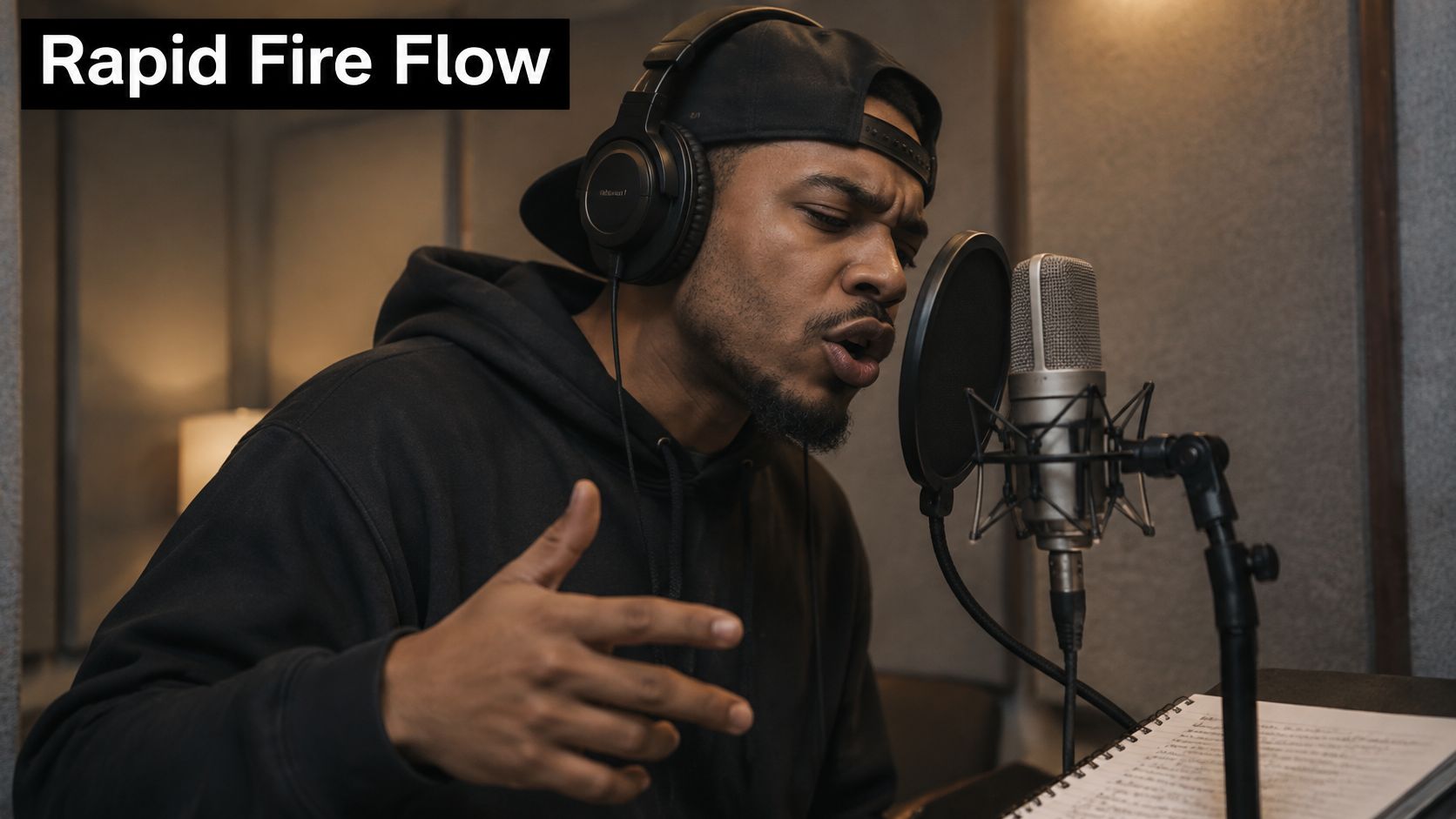 A focused rapper wearing headphones recording vocals into a professional studio microphone while reading lyrics.
Start "Rap God" at a talking pace. The 2013 verse is long, packed, and famous for how fast the syllables stack. One smeared consonant and the next internal rhyme collapses with it.
Treat the song as a diagnostic. The quoted fast stretch asks your mouth to stay clear while the words keep coming. That density exposes every weak point in your delivery: breath, diction, and the spots where your tongue skips a sound to catch the beat.
The Drill That Actually Works
Set a metronome to 70 BPM, well below the song's tempo, and speak each four-bar chunk as cleanly as you can. Clean landings at a slow tempo are what let you add speed later. Once every syllable lands at 70, bump five BPM. Repeat until you fall apart, then back off two clicks and drill there for ten minutes.
I recommend mapping multisyllabic rhymes on paper before you speed up. Highlight internal rhymes in different colors. You'll see why certain lines trip you. The rhyme density forces your tongue through three sound changes in a single breath.
Practical rule: If you can't say the bar clearly at half speed, you can't say it at all. Slow practice is where the articulation gets built.
Record the consonant-heavy lines. Listen for slurred endings, dropped T sounds, and swallowed vowels. Those are the exact spots the mic exposes. Battle MCs who reference this verse want speed that stays intelligible.
Run the full verse once a week at your current ceiling. You'll hear the difference in your regular verses within a month.
2. Twista - "Overnight Celebrity"
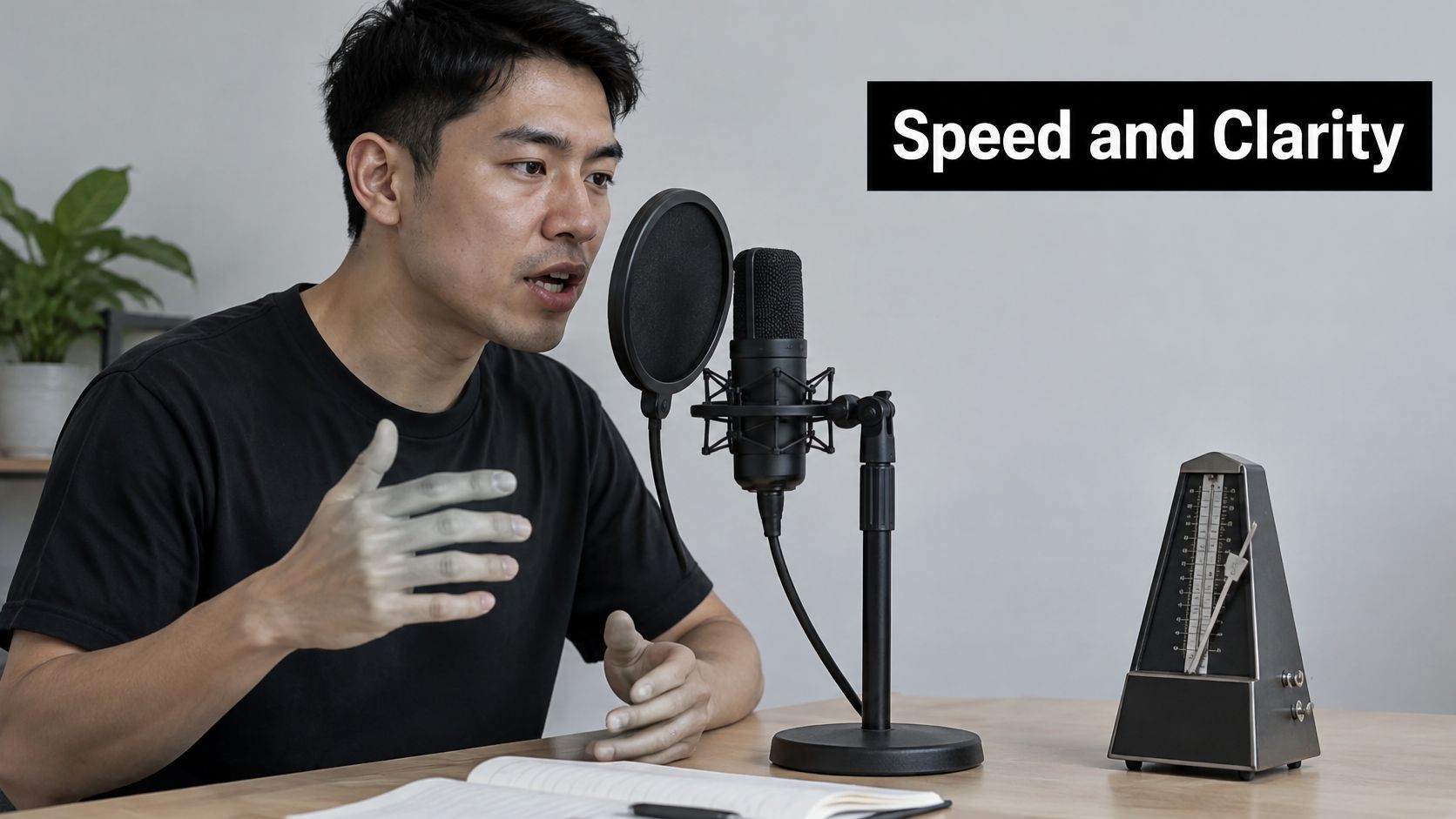 An Asian man speaking into a professional microphone with a metronome and book on his desk.
The beat drops and your mouth is already late. Twista built a career on Chicago chopper flow, packing syllables so tightly that casual listeners assume it's studio trickery. The Chicago Tribune's 1992 profile reported that Twista delivered 598 syllables in 55 seconds, roughly 10.9 syllables per second, while still repeating the word "matter" five times in one second without dropping a sound. That precision rides a locked rhythm. Speed is the last piece you add.
Rhythm Before Speed
Chasing his velocity on day one is the usual miss. The lines stay clean because the pattern is already in the body before the syllables pile up. Pick one four-bar section from "Overnight Celebrity." Clap the syllable pattern with no words, just the rhythmic skeleton. Run it until the claps feel automatic. Then speak the words at half speed, matching every clap.
Breathe only where a phrase ends. Mark those spots. Twista's lines often sit in short phrases, so you get small recovery windows even as the pace climbs. A slower hook after the sprint resets your tongue and gives the listener a place to land. Break each line into two and three-syllable chunks. Your tongue works in bursts, not one endless stream.
Speed-rap challenges name Twista constantly. The takes that hold up are the ones where every word still lands. Record one pass on your phone. If you can't transcribe your own take, it isn't chopper style yet.
3. Tech N9ne - "Speedom"
Your jaw locks halfway through a fast "Speedom" bar, and the last consonant falls off. Tech N9ne treats speed like an instrument. The track stays aggressive and syllable-heavy while the energy holds. Battle rappers use it as a technical benchmark. Stay clear while you go faster.
Burst Training for Aggressive Clarity
Start with eight-second bursts. Pick the fastest two bars, set a steady pulse under them, and hit only those bars at full aggression. Then stop. Ten bursts with ten seconds of rest beat one sloppy minute.
Aggression tightens the jaw. A tight jaw slurs consonants, and slurred consonants kill the punch this style needs.
Record every burst. Listen for the first and last syllable of each line. Stress lands there, and fatigue blurs the tongue first.
If the listener catches every third word, you didn't go fast. You went quiet.
Shift the stress inside the burst. Tech N9ne keeps fast sections interesting by moving where the accent sits. Practice the same burst three ways: stress the first syllable of each group, stress the vowels, stress the consonants. I recommend the consonant pass last, when your mouth is tired. That pass shows whether the bars still land.
For consonant-clarity recording, say the burst once clean, then again mean. Play both takes back to back. If the hard version loses /k/, /t/, or /p/, you are pushing volume instead of articulation. A short set of dirty tongue twisters before the bursts warms those endings without asking you to survive the whole verse.
- Use a pulse, not a metronome: A drum loop at half the song's tempo leaves room to feel the pocket while the syllables fly.
- Short bursts first: Keep the full fast verse on the shelf until each two-bar burst is clean.
- Check endings: Consonant endings like /k/, /t/, and /p/ vanish first. Exaggerate them in practice.
4. Busta Rhymes - "Put Your Hands Where My Eyes Could See" (1997)
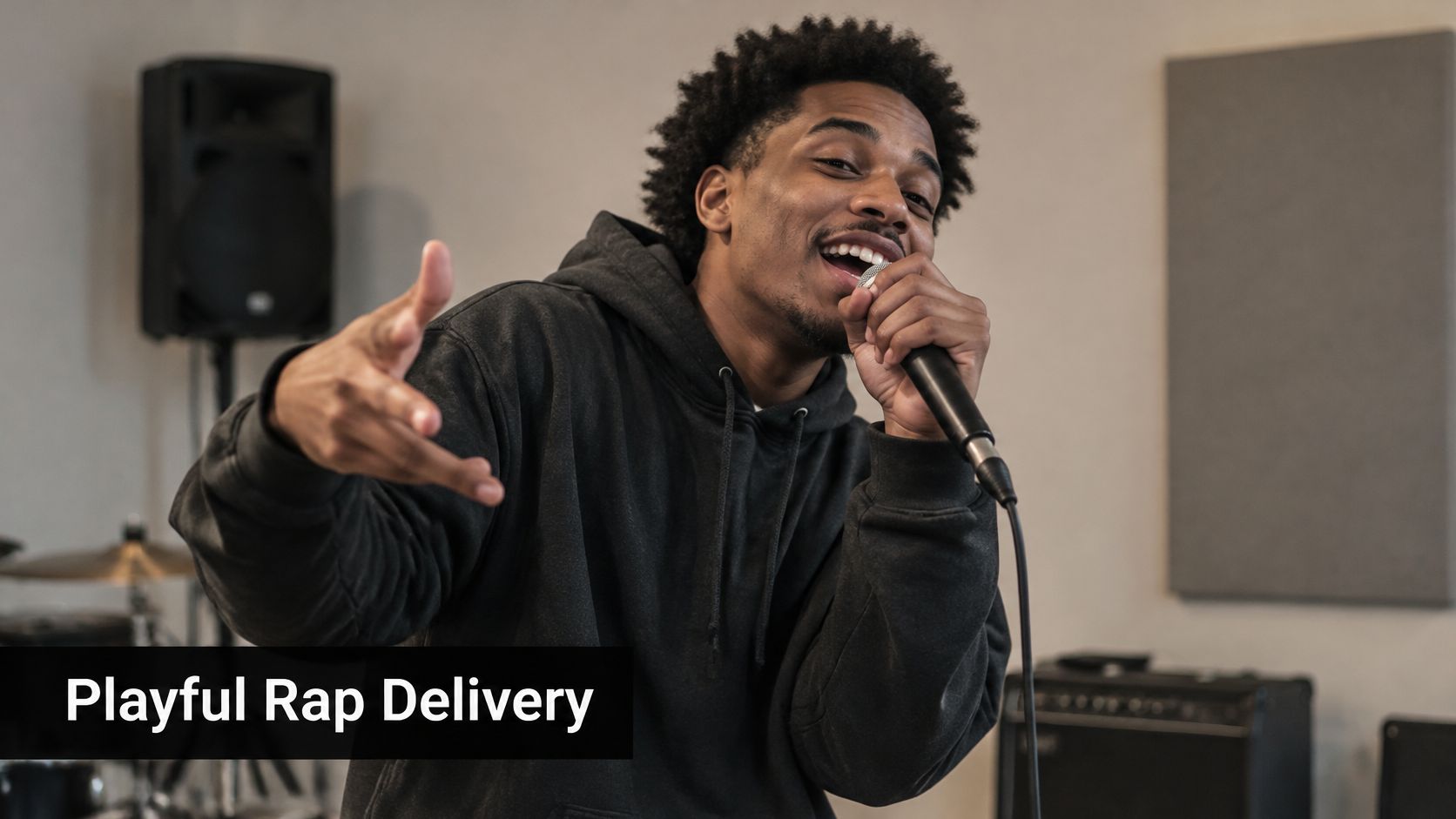 A young Black man wearing a black hoodie rapping into a microphone in a music studio.
Busta Rhymes proved that fast rap tongue twisters can be fun. His 1997 single "Put Your Hands Where My Eyes Could See" isn't just a speed showcase. It's a performance where vocal character carries the complexity. Busta's flows twist through rapid phrasing while he switches voices, energies, and rhythmic pockets. The track works because he performs the difficulty instead of surviving it.
Character Keeps Fast Verses Alive
The drill here is theatrical. Learn the verse slowly, then add an exaggerated character on top: a villain voice, a cartoon energy, a hype-man urgency. Exaggerated articulation is the bridge. When you over-pronounce every consonant and vowel for five takes, the natural performance version retains more clarity than if you'd practiced it flat.
Plan energy peaks across the verse. Busta doesn't sprint the entire time. He surges, pulls back, then surges again. Mark your verse with three levels: low simmer, mid charge, full explosion. Practice moving between them while holding the rhythm steady.
- Party energy is a technique: Short-form creators lift Busta-style verses for hype clips because the energy translates. Train that energy like a muscle.
- Overdo it in practice: Ten exaggerated takes, then one natural take. The natural take lands closer to clarity.
- Use playful phrasing: Roast and party-style content needs speed plus personality. Speed alone sounds clinical.
Run the verse in front of a friend or record a hype clip on your phone. If the performance works at 80 percent speed, the song's tempo feels easy by comparison.
5. Eminem - "Killshot" (2018)
A diss track lives or dies on how cleanly the punchlines land. "Killshot" is Eminem's rapid-fire response to Machine Gun Kelly, and every fast passage exists to deliver an insult with maximum impact. This is tongue-twister technique applied to battle rap structure. The speed serves the punchlines, not the other way around.
Punchline Clarity Before Speed
Map the verse into three parts: the setup, the rapid-fire middle, and the closing shot. Practice each part separately. For the middle section, use a metronome and step the tempo up gradually, but score yourself on whether each punchline remains distinct. A fast diss verse with muddy insults fails its only job.
- Test in short sections: Two bars at a time. If the punchline doesn't land clearly at full speed, slow those two bars down until it does.
- Keep targets playful or fictional: When you write roasts for friends or fans, structure matters more than cruelty. A setup, rapid middle, and clear closer makes any diss land.
- Record and review: Listen back for the exact word where the insult lands. If that word blurs, you lost the bar.
Battle rap creators borrow this structure constantly. The density of greatest diss tracks shows that technical speed and punchline clarity aren't opposites. They're the same skill. Run the "Killshot" verse at 60 percent speed and exaggerate the final consonant of every punchline. Then speed it up. The insults survive because you built them to.
6. Wiley - "Eskimo" (2004)
UK grime introduced a different kind of rapid delivery. Wiley's "Eskimo" is a foundational track built on fast, syncopated bars where the timing matters more than raw velocity. Grime's East London origins produced flows that dart around the beat, clipping syllables short and placing emphasis in unexpected spots. This isn't American speed rap. It's rhythmic precision at high tempo.
Syllable Timing Over Raw Speed
Practice over a grime-style beat with the BPM around 140. Feel the half-time pocket first. Wiley's flow relies on clipped phrasing, so deliberately shorten your vowel sounds and cut syllables at their edges. The urgency comes from the rhythm, not from forcing more words in.
Grime rule: If your bars rush ahead of the snare, you're doing it wrong. Speed without syncopation is just talking fast.
Work on syncopation drills separately. Clap the rhythm of two bars, leaving gaps where Wiley leaves gaps, then speak the bars into that exact pattern. Record yourself against the track and check whether each stressed syllable lands where you intended. If it drifts, you're fighting the beat instead of riding it.
- Use clipped phrasing: Short vowels, hard consonant stops, no tail sounds.
- Practice with silence: Leave deliberate gaps. Silence at 140 BPM hits as hard as syllables.
- Match the pocket: UK grime punchlines hit hardest when the timing is tight, not when the word count is high.
7. Ultramagnetic MCs - "Ego Trippin' (Part Two)" (1986)
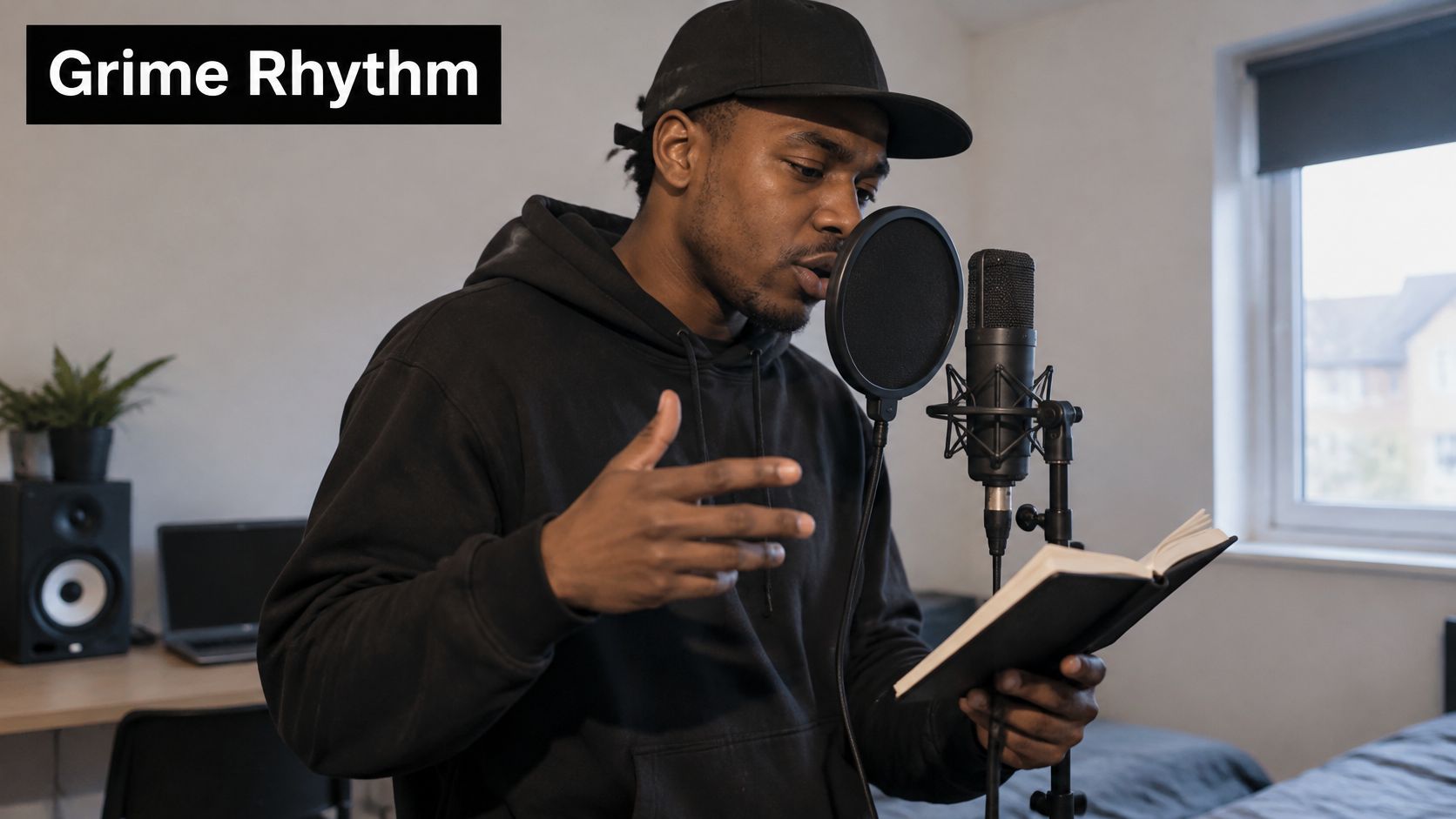 A young male rapper wearing a black hoodie and cap recording vocals in a home studio.
Before anyone measured words per second, Ultramagnetic MCs were writing rhymes so complex they became the blueprint. "Ego Trippin' (Part Two)" from 1986 helped establish that rap could be technically dense and lyrically inventive at the same time. Kool Keith's multisyllabic patterns and rapid wordplay still challenge rappers four decades later. Old school boom bap moves at a slower tempo than grime or chopper style, which means the difficulty here is articulation, not velocity.
Rhyme Density on a Slow Grid
Break the verse into rhyme groups first. Mark every multisyllabic rhyme chain on paper. The structure is the lesson. Then write your own four bars on a single theme using the same rhyme pattern. This is the hardest drill on this list because rhyme complexity forces you to retrieve words fast even when the beat is slow.
- Write before you rap: Old school rhyme density rewards preparation. Draft five versions of a four-bar exercise.
- Master at slow tempo: Complex rhymes at 85 BPM are harder to fake than fast rhymes at 140. Every sound is exposed.
- Blend eras: Take Ultramagnetic rhyme density and pair it with modern punchline delivery. The combination sounds fresh because so few rappers train both.
Run the verse at half speed with exaggerated consonants. Then run it at tempo. Modern rappers who skip this era miss the foundational skill: saying impossible rhyme patterns cleanly when there's nowhere to hide.
How the seven rap tongue twisters compare by era, style, and origin
| Item | Era | Style | Popularized By |
|---|---|---|---|
| Eminem - "Rap God" (2013) | 2010s mainstream hip hop | Battle rap / Technical rap | Eminem; Guinness World Records (record recognition) |
| Twista - "Overnight Celebrity" | Late 1990s to 2000s | Chopper / Speed rap | Twista; Chicago hip hop scene |
| Tech N9ne - "Speedom" | 2000s to 2010s | Speed rap / Battle-oriented rap | Tech N9ne; Strange Music |
| Busta Rhymes - "Put Your Hands Where My Eyes Could See" (1997) | Late 1990s | Party rap / High-energy rap | Busta Rhymes; Flipmode Squad |
| Eminem - "Killshot" (2018) | 2010s battle rap resurgence | Battle rap / Diss track | Eminem; Machine Gun Kelly (target of the track) |
| Wiley - "Eskimo" (2004) | Early 2000s UK grime | Grime | Wiley; UK grime scene |
| Ultramagnetic MCs - "Ego Trippin' (Part Two)" (1986) | Mid-1980s | Old school / Boom bap | Ultramagnetic MCs; old school hip hop community |
Turn Your Practice Into Bars That Hit
Choose one track from this list and repeat its drill for a week. Set a metronome, record each session, then listen for clipped consonants and rushed syllables. Keep the tempo steady until every word is clear. Speed comes after control.
Write a four-bar tongue twister about something you know well. Pick a personal theme, then build each line around a cluster of tricky consonants. Speak the bars slowly first. Add tempo only when the words stay sharp.
Once your diction holds, test it in a diss verse. A dictation speed test for developers measures a different task, so keep your practice focused on clear rap delivery. DissTrack AI generates custom lyrics, raps them over a beat, and mixes the track in seconds. Use the result as a draft, then adjust the phrasing until it fits your voice.
DissTrack AI structures each verse with rhyme schemes and flow patterns. Add the target's name, your relationship, and inside jokes, then choose style tags and set how savage the diss should be. Each generation takes 30 seconds and includes multiple variations, so you can compare bars and keep the lines that deliver cleanly.