How to Write Roast Battle Lyrics That Actually Land
You've got a roast line in your notes that looks lethal. The wording is clever, the insult is personal, and you can already hear the crowd exploding. Then you say it out loud, and the room gives you nothing but a cough from the back row. Your target laughs before you finish, your timing drifts, and the line that looked perfect on paper suddenly sounds like a message typed at two in the morning.
That gap separates funny insults from effective roast battle lyrics. A live audience doesn't read your notebook. They hear a setup, form an expectation, and decide in a moment whether your delivery gave them a reason to react. Strong writing matters, but structure, rhythm, clarity, and rehearsal determine whether the bar survives contact with a real room or a fast-moving clip.
Why Most Roast Lines Fail Before They Hit the Stage
A technically impressive line can fail because the audience doesn't know where it's going. You might stack three references, bury the key word at the end, and force a complicated rhyme that only makes sense after someone studies the page. By then, the moment has passed.
I've watched rappers walk into a battle with an insult they clearly loved. The line used a clever comparison, had a clean rhyme, and attacked something specific about the opponent. But the setup wandered, the punch arrived without enough emphasis, and the rapper moved on before the room understood what happened. A simpler line with a clear turn would have done more damage.
The problem usually starts before performance. Writers often chase the most outrageous insult instead of choosing the most useful angle. They confuse surprise with randomness, technical rhyme with rhythm, and personal detail with audience relevance. A crowd needs enough context to follow the attack, but not so much explanation that the punch feels announced.
Practical rule: If the audience has to reread the bar to understand why it's funny, the bar needs a cleaner route to the punch.
Paper strength versus room strength
Paper strength is about how a line looks. Room strength is about how quickly listeners understand the target, recognize the turn, and feel invited to react. Those qualities overlap, but they aren't identical.
A line can be dense and literary yet difficult to perform. Another can use ordinary language, a familiar behavior, and one sharp reversal. The second often wins because the crowd can process it in real time. Clarity gives the punchline a landing strip.
Delivery exposes weaknesses that silent reading hides:
- Long openings: The audience forgets the premise before the punch arrives.
- Weak emphasis: The key word receives the same weight as every filler word.
- Unstable rhythm: The bar sounds like prose instead of something built to ride a beat.
- Unclear target: Listeners don't know whether the joke attacks appearance, habits, ego, or a specific choice.
Modern roast lyrics can reach audiences far beyond a battle venue. Kendrick Lamar's “Not Like Us” shows how a lyrical attack can operate as a mainstream record, reaching 1 million equivalent sales in 12 days and passing 100 million Spotify streams faster than any hip-hop song previously recorded, according to the reported streaming and sales milestones. The lesson isn't that every roast needs a hit record's scale. It's that a sharp attack still needs a form people can immediately hear, repeat, and remember.
The Anatomy of a Punchline That Actually Lands
The most reliable punchlines guide the listener toward one expectation, then break it. Battle-rap guidance commonly frames the process as choosing one angle, creating a setup, and landing by disrupting what the listener thought was coming. This punchline-writing guide is useful for reinforcing that sequence, but the true test is whether your bar works when spoken at performance speed.
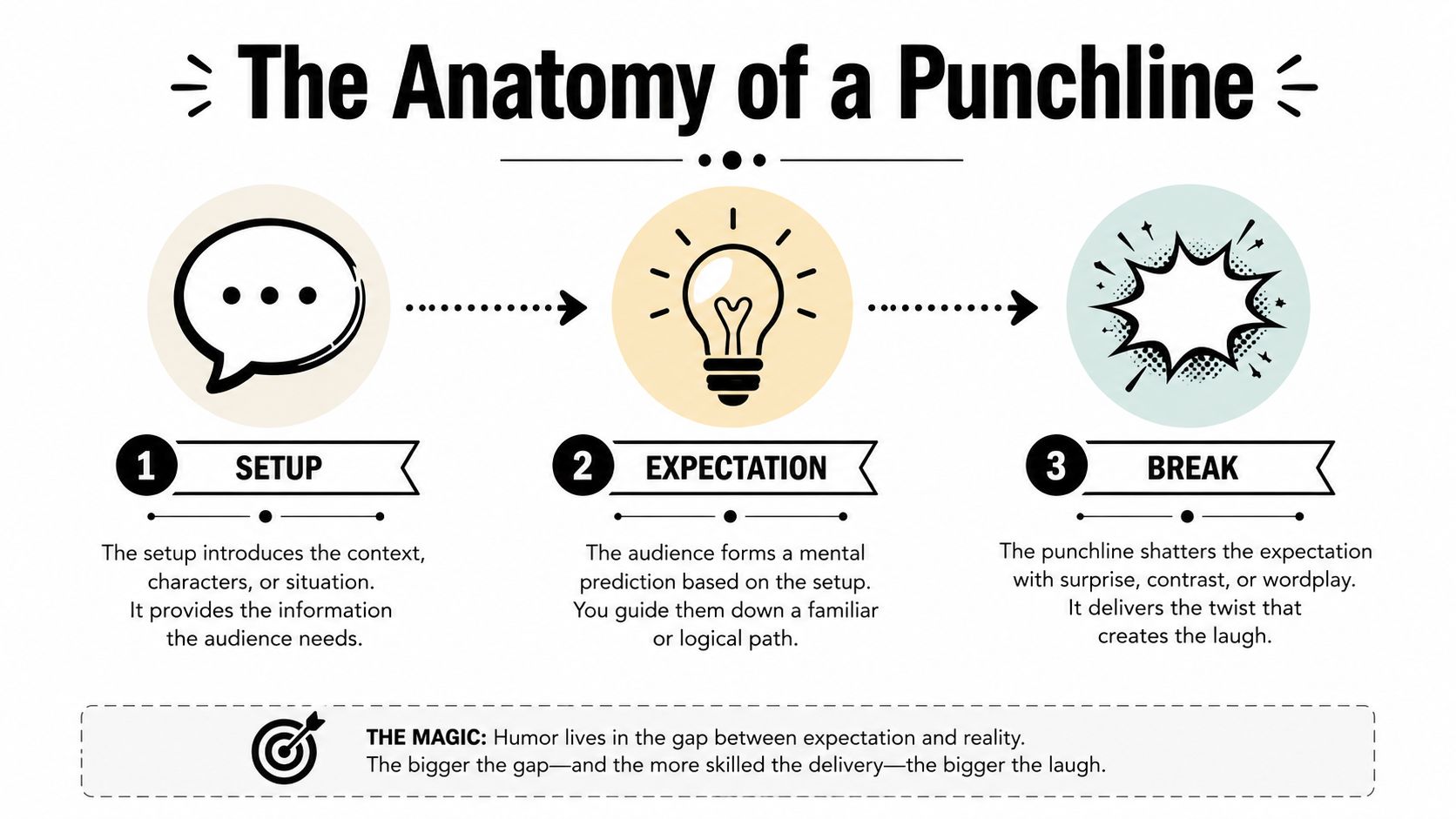 A diagram illustrating the three steps of a punchline: setup, expectation, and break, explaining comedy theory.
Choose one angle
Start with a target angle, not a pile of insults. Maybe your friend constantly arrives late, treats every minor achievement like a championship, or talks about discipline while avoiding basic responsibilities. Pick one behavior and squeeze it for meaning.
Weak approach:
“You're lazy, loud, broke, and always late.”
That line gives the audience four directions and no memorable image. A focused angle creates room for a stronger comparison:
“You call it fashion when you're late to the function, That outfit needs a warning label and public instruction.”
The example targets one idea, poor preparation disguised as confidence. The setup establishes the situation, the listener expects a normal fashion insult, and the break turns the clothing into a public hazard.
Build the expectation
Your setup should make the listener predict a familiar ending. That prediction can come from a cliché, a common phrase, a recognizable scenario, or the target's own reputation.
Suppose the target brags about being a business genius:
“You talk like a founder, all vision and charts, But your biggest investment is avoiding your part.”
The first line creates the image of entrepreneurial confidence. The second line breaks it by exposing avoidance. The rhyme supports the idea, but the contrast does the comedic work.
A multi-bar setup can work when each line adds pressure:
“You gave a speech on focus, made the room take notes, Then missed your own deadline while adjusting your quotes.
You don't need a business plan, you need someone to explain
Why every grand strategy ends with you being late.”
The danger is obvious. Extra bars only help if they build momentum or sharpen the final turn. If they repeat the same point, the crowd hears padding.
Break the prediction cleanly
The final word or phrase should carry the reversal. Don't hide it inside a crowded sentence. Leave space before it, stress it clearly, and avoid explaining why it's funny afterward.
A useful editing test is to underline the assumption and circle the break. If you can't identify both, the line probably needs a stronger contrast. You can also say the setup to someone who knows the target and ask what they expected you to say. Their prediction reveals the path your punchline must interrupt.
Rhyme Schemes and Flow Techniques That Elevate Your Bars
A basic end rhyme can make a line sound finished, but it won't automatically make the line memorable. Strong roast battle lyrics often use internal rhyme anchors, varied syllable patterns, and pauses that give the punch room to breathe. Battle-rap guidance also stresses that bars lose force when they don't rhyme or ride the beat naturally, a point covered in battle-rap lyric structure and delivery guidance.
 A focused man writing song lyrics in a notebook inside a professional music recording studio.
Consider a flat version:
“You talk about money, but you never get paid, You say you're a boss, but your plans always fade.”
The meaning is clear, but the rhythm is predictable and the images are broad. Add internal movement without sacrificing the idea:
“You talk profit, stock options, executive views, But your whole business model is excuses and dues.”
Now “profit,” “stock,” and “options” create a denser opening, while “model” and “excuses” keep the phrase moving toward the punch. The rhyme doesn't need to decorate the insult. It should help the audience anticipate the cadence while the meaning delivers the surprise.
Use rhyme as momentum, not camouflage
Internal rhymes work best when they support natural speech. Try placing related sounds before the end rhyme:
“Late to the date with a great new excuse, You don't miss an appointment, you schedule abuse.”
The repeated sounds create momentum, and the second line turns lateness into an active offense. If a rhyme forces you to use a word you wouldn't normally say, replace the rhyme. A technically neat bar that sounds unnatural will expose the writer.
For additional practice with sound patterns, lyric writing tips from House of Lyrics can help you think about phrasing, imagery, and revision beyond simple end rhymes. You can also study rhyme scheme examples for rap writing while testing which patterns remain clear when spoken quickly.
Test every bar with your mouth
Read the line once, then perform it without looking at the page. Any place where you stumble, rush, or run out of breath needs revision. Mark the word that deserves emphasis, insert a pause before the turn, and remove syllables that don't serve the image.
A good flow test uses three passes:
- Conversation pass: Say it as if you're telling a friend the joke.
- Beat pass: Speak it over the beat at a relaxed pace.
- Pressure pass: Perform it louder and faster, as you might in a battle.
If the line only works in the first pass, it isn't finished. If it works in the pressure pass without losing clarity, you've got something performable.
Choosing Your Roast Style and Tone
Style should serve the setting. A friendly roast between close friends needs recognition and playfulness, while a competitive battle can support sharper aggression. A short social clip needs an image and a punch that survives without a long explanation.
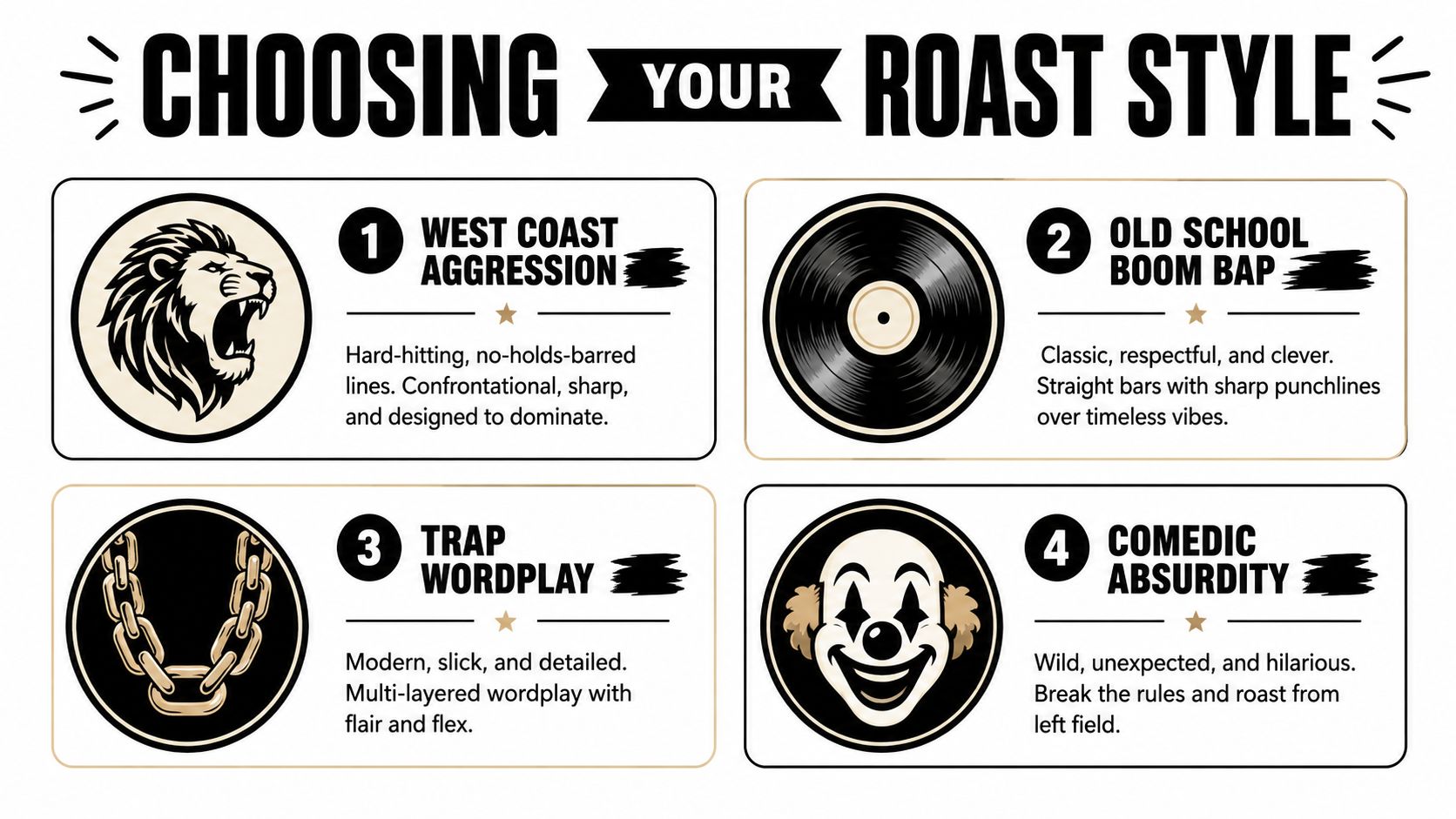 A graphic titled Choosing Your Roast Style presenting four different hip-hop inspired styles for writing roast lyrics.
Match the voice to the room
West Coast aggression favors swagger, broad confidence, and direct attacks. It works when the performer needs presence and the target can handle a forceful delivery. The trade-off is that too much aggression can flatten the joke, especially among friends.
Old School Boom Bap gives wordplay and layered rhyme more space. Choose it when the audience enjoys bars and can follow a detailed setup. It rewards craft, but dense writing can lose listeners who want a quick clip.
Trap wordplay uses bounce, repetition, and compact phrases. It fits stream content, short videos, and energetic group settings because the cadence itself creates engagement. The risk is leaning so heavily on rhythm that the insult becomes interchangeable with any other roast.
UK Grime intensity can bring clipped phrasing and confrontational energy. It suits a performer with strong rhythmic control, but imitating a style without understanding its pocket often sounds forced.
Comedic absurdity takes the target's trait somewhere ridiculous. It's often the safest choice for friends because the exaggeration signals play rather than hostility. The punch must still connect to a recognizable detail, or the absurdity becomes noise.
Set the savagery level deliberately
Ask three questions before writing:
- Is the target participating willingly?
- Will the line be heard privately, in a live room, or permanently online?
- Does the joke reveal something the target didn't choose to share?
A style tag can guide sound, but it can't decide social context. Combine an aggressive cadence with a playful subject, or use a relaxed Boom Bap pocket for a severe competitive angle. Tone is a control knob, not a costume.
The Ethics and Strategy of Smart Roasting
Boundaries don't weaken a roast. They force you to find material with more precision. The easiest targets are often immutable traits, private pain, or vulnerable circumstances. Attacking those areas may create shock, but it can also make the room uncomfortable and leave the audience remembering the cruelty instead of the writing.
The stronger strategic choice is to target behavior, choices, habits, contradictions, and public claims. If someone talks about productivity while missing every deadline, you have a repeatable angle. If they present themselves as a fashion authority while wearing combinations nobody understands, you can build images around the mismatch. Those details give you material without requiring personal harm.
Punch up through contradiction
A useful roast exposes distance between the target's self-image and observable behavior:
“You call yourself humble, then announce every favor, Your modesty needs an entrance and a personal savior.”
The line attacks performance, not identity. It gives the audience a contradiction they can recognize and lets the target laugh without feeling stripped of dignity.
Context still matters. A joke that works in a private friend group may become harassment when posted publicly, especially if the target didn't agree to participate. Public clips also lose background information, so a line that sounds playful in the room can sound hostile when separated from the exchange.
For speeches, parties, and organized events, this guide to writing a roast speech offers a useful reminder that the occasion and relationship should shape the material. Ask for consent where appropriate, avoid exposing private information, and give the target a clear route to respond.
The sharpest roast makes the target feel seen, not ambushed.
Smart roasting also protects your own performance. A cheap attack can derail the room, invite defensiveness, and make your next bar harder to hear. A specific contradiction creates laughter, recognition, and respect at the same time.
Performance Techniques That Make Your Lyrics Hit Harder
Your page is not the stage. Your mouth, breath, posture, timing, and reaction control determine whether the audience catches the bar. Rehearse every line out loud because silent reading hides awkward consonants, weak breath points, and punches that arrive without enough space.
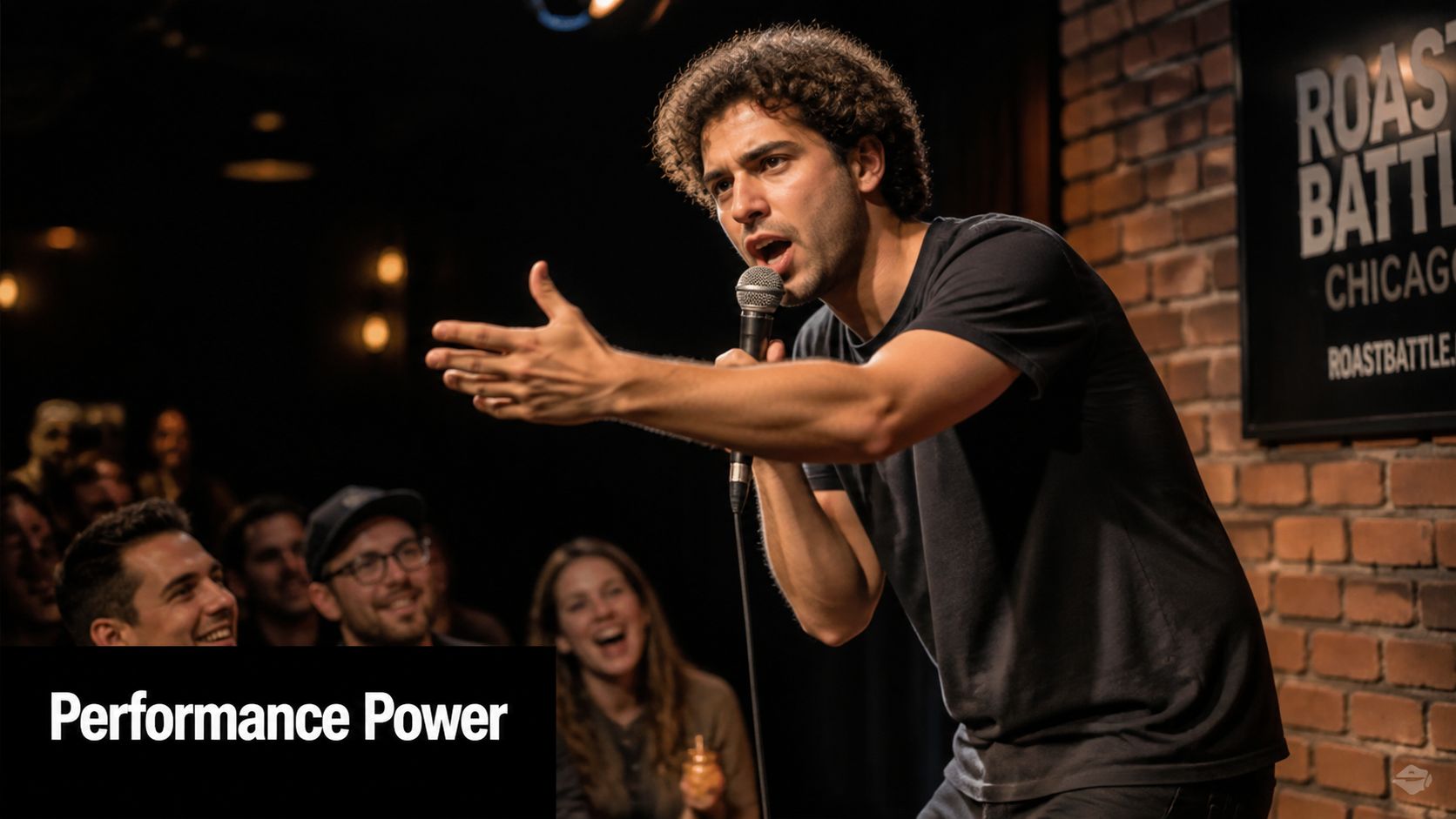 A comedian with curly hair gesturing passionately while holding a microphone on stage at a comedy club.
Start with a slow delivery. Speak the setup clearly, pause before the reversal, then hit the key word with a change in volume or tone. Don't rush to prove you memorized the line. The crowd needs a fraction of space to recognize the turn.
Record yourself on a phone and listen without reading the lyrics. If you can't identify the setup and punch while listening, the audience probably won't either. Mark any word that disappears, any rhyme that sounds forced, and any breath that makes you split the thought in the wrong place.
Rehearse reactions, not just words
Practice three versions of each punch:
- Calm version: Controlled, conversational, and easy to understand.
- Aggressive version: More volume, firmer consonants, and a stronger physical stance.
- Deadpan version: Minimal movement, with the punch delivered as if it's obvious.
The best version depends on the material. A ridiculous comparison may land harder with a straight face. A direct attack may need eye contact and stillness rather than frantic gestures.
For creators making clips, pacing becomes part of the edit. Leave clean openings and endings, avoid talking over the punch, and make the central phrase understandable without the audience knowing the full backstory. The craft overlaps with compelling content creation, because a strong short-form moment still needs a clear premise, escalation, and payoff.
Watch the performance below with attention to pauses, emphasis, and how the performer holds the room after a punch.
Don't fill every silence. A laugh, reaction, or visible surprise is part of the exchange. If the room responds, let the moment breathe. If it doesn't, move on confidently instead of explaining the joke or repeating the line.
Ready-to-Use Examples and AI-Assisted Prompts
A usable roast bar needs a target detail, one angle, a clear setup, and a performable break. Try this compact example:
“You call that a grind, posting quotes before noon, Your work ethic's a screensaver waiting for a room.”
The first line establishes the target's self-image. The second replaces “hard worker” with an inactive image, and the sounds in “grind,” “quotes,” and “screensaver” give the delivery movement.
For an AI-assisted workflow, provide:
- Target: Name or nickname, plus the relationship.
- Details: Habits, harmless inside jokes, public claims, and recurring behaviors.
- Style: Boom Bap, Trap, UK Grime, absurdist, or another clear direction.
- Structure: Two-bar punches, a short verse, or a setup-heavy roast.
- Boundaries: Topics to avoid and the desired level of aggression.
Use generated lyrics as raw material, not a finished performance. Keep the specific images, delete generic insults, simplify any tangled setup, and read every surviving bar aloud. Resources such as tools for rap hooks and punchlines can support idea generation, but your editing and delivery give the material a voice.
DissTrack AI is one option for creating personalized roast lyrics from a target's name, relationship, inside jokes, style tags, and chosen savagery level. It generates structured variations that you can revise, export, or share, with generations remaining private until you choose to publish.
DissTrack AI helps you turn personal details and inside jokes into structured roast lyrics, with style and savagery controls suited to battles, clips, parties, and creative projects. Visit DissTrack AI, generate a few angles, then edit and rehearse the one that sounds dangerous out loud, not just impressive on the page.