
How to Use a Roast Lyrics Generator Like a Pro
You've got a friend's roast coming up, a streamer segment to fill, or a video that needs a sharper ending. The generator hands you a complete verse. It rhymes, it looks confident, and then you say it aloud and discover the punchline needs an explanation. Don't scrap the whole thing. Treat it like a rough studio take: keep the promising material, cut the filler, and make it sound like something you'd say.
Why Generated Roasts Need a Human Finishing Pass
A roast lyrics generator can produce a verse without knowing which detail makes your friend laugh and which one makes the room uncomfortable. That distinction matters more than whether it successfully rhymes king with thing.
Consider a fictional draft about a gamer who spends ages arranging their character's outfit. The generator calls them a fake champion, a weak opponent, and a bargain-bin boss. Those lines identify an opponent, but they miss the actual joke: this person treats the lobby like a fashion appointment.
 A young woman looking concerned while working on her laptop at a desk with a lamp.
Separate Writing Competence From Comic Impact
Judge a draft on distinct questions:
- Coverage: Did it use the details you supplied accurately?
- Sound: Can you deliver the lines without mangling your pronunciation?
- Surprise: Does the punchline reveal an unexpected comparison?
- Relationship fit: Would this target recognize affectionate teasing rather than hostility?
That distinction reflects the form's roots. A scholarly history of battle rap traces influential competitive performances and response records, including Kool Moe Dee versus Busy Bee Starski and Roxanne Shanté's response writing. Direct targeting, rebuttal, status competition, and performance-centered wordplay come from that competitive tradition, not from adding insults to a song.
Practical rule: Keep the line that reveals something recognizable about the target, not merely the line that sounds most aggressive.
For a creator, the finishing pass also means asking what happens on camera. A useful adjacent planning resource is Wideo's video creation for car dealerships, particularly if you're developing a playful dealership segment rather than an audio-only roast. Treat the visual plan and lyric draft as separate decisions: what viewers see should support the joke, not explain a punchline that never worked.
Your editing job is to turn fluent text into an intentional performance.
Build a Personalization Brief Before You Generate
“Roast my friend brutally” isn't much of a creative brief. It leaves the generator to invent both the personality and the offense.
Start with observable, harmless behavior. A friend who brings a spreadsheet to board-game night offers a clearer comic angle than a friend described as annoying. You can exaggerate the spreadsheet habit without inventing a damaging story.
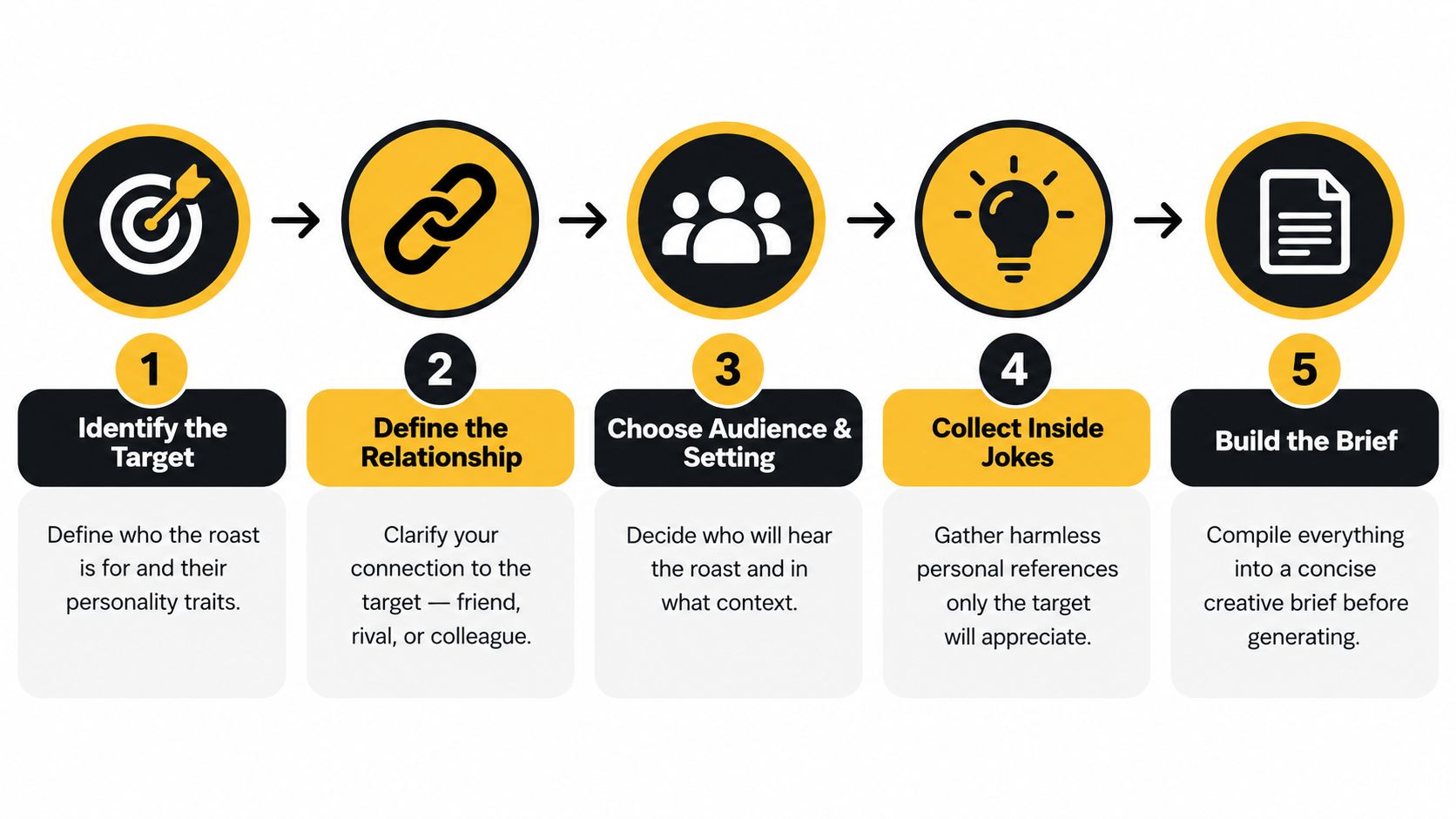 A five-step process infographic illustrating how to create a personalized roast for a friend or colleague.
Define the Assignment Before the Attitude
Build the brief around these decisions:
- Target and relationship: Use a nickname or fictional identity, then explain whether you're friends, collaborators, or consenting performers.
- Audience and setting: Distinguish a private birthday party from a public livestream. State what the audience already knows.
- Comic material: Supply habits, recurring phrases, harmless bragging, and shared references.
- Desired reaction: Ask for affectionate recognition, theatrical disbelief, or competitive swagger rather than maximum brutality alone.
- Boundaries: Identify excluded subjects before generation, not after an uncomfortable line appears.
For a friend-group roast, the spreadsheet can remain an inside joke. For a streamer segment, establish the behavior visibly before the verse. For a short creator video, choose a detail viewers can understand without knowing anybody involved.
Keep addresses, medical information, financial troubles, private messages, and unverifiable allegations out of the input. Personalization doesn't require private information.
Give the Generator an Editable Assignment
Use a prompt like this:
Write several alternative roast verses about my consenting friend, using the nickname Captain Checklist. The audience is our board-game group. Focus on their habit of making spreadsheets for casual games. Use conversational boom bap, playful medium intensity, and clearly separated lines. Build toward a closing punchline. Don't invent personal facts or mention appearance, health, relationships, or private information. Leave room for my own edits.
If you're pairing lyrics with footage, Veo3 AI's prompt engineering tips for video are a relevant companion resource for the visual brief. Keep the lyric and video instructions aligned on audience, setting, and tone, while making each understandable on its own.
Choose a Rap Style That Fits the Roast
Choose the style you can perform, not the label that sounds toughest. A relaxed speaker trying to force a breathless delivery can bury a good joke under the effort of getting the words out.
Treat genre labels as creative directions, then specify the behavior you want: roomy pauses, clipped phrasing, melodic repetition, conversational emphasis, or dense internal rhymes. The following are useful starting instructions, not rigid definitions of entire genres.
Rap Style Selection Guide
| Style Tag | Rhythmic Character | Best Scenario | Editing Focus |
|---|---|---|---|
| Old School Boom Bap | Request steady phrasing and room around line endings | Friend-group roast or spoken performance | Remove filler before the punch |
| Trap | Request short phrases, repeated motifs, and ad-lib space | Creator clip with a memorable refrain | Make repetition earn its place |
| Drill | Request clipped delivery and tightly controlled emphasis | A theatrical competitive segment | Keep aggression lyrical, not threatening |
| UK Grime | Request brisk cadence and compact statements | A performer comfortable with rapid delivery | Simplify crowded consonants |
| Battle Rap | Request setup, rebuttal, and deliberate pauses | A consenting live roast exchange | Make each claim support the punchline |
| Emo Rap | Request melodic phrasing and self-aware exaggeration | A mock-dramatic streamer monologue | Keep the joke clear beneath the emotion |
| West Coast | Request a relaxed pocket and conversational swagger | A laid-back party performance | Preserve natural speech and unhurried timing |
Test the Same Detail in Different Voices
Take the fictional friend who spends forever choosing a gaming outfit. A laid-back approach might be:
You dress for the lobby like the lobby's an event.
A battle challenge could sharpen the contrast:
You've got a victory outfit. Try earning the occasion.
For a theatrical streamer monologue:
We interrupt this match for another wardrobe emergency.
A tightly edited social clip might need only:
Best dressed. Still loading.
These are original sketch lines, not finished verses. Their purpose is to expose different comic approaches before you commit to a full structure.
Don't add slang you wouldn't say in conversation. If you need to rehearse sounding like somebody else, change the wording rather than doubling down on the preset. You can borrow a rhythmic approach without borrowing a performer's identity.
Test the candidate over the intended backing track, if you have one. A useful style choice lets you emphasize the funny word naturally, with enough space afterward for listeners to react.
Tune Savagery Without Losing the Punchline
Turning up the intensity can produce louder language without a better joke. If every line calls the target pathetic, fake, or useless, you've changed the temperature but not improved the writing.
Attack a comic behavior, not the person's worth. That gives you something concrete to exaggerate, reverse, or compare.
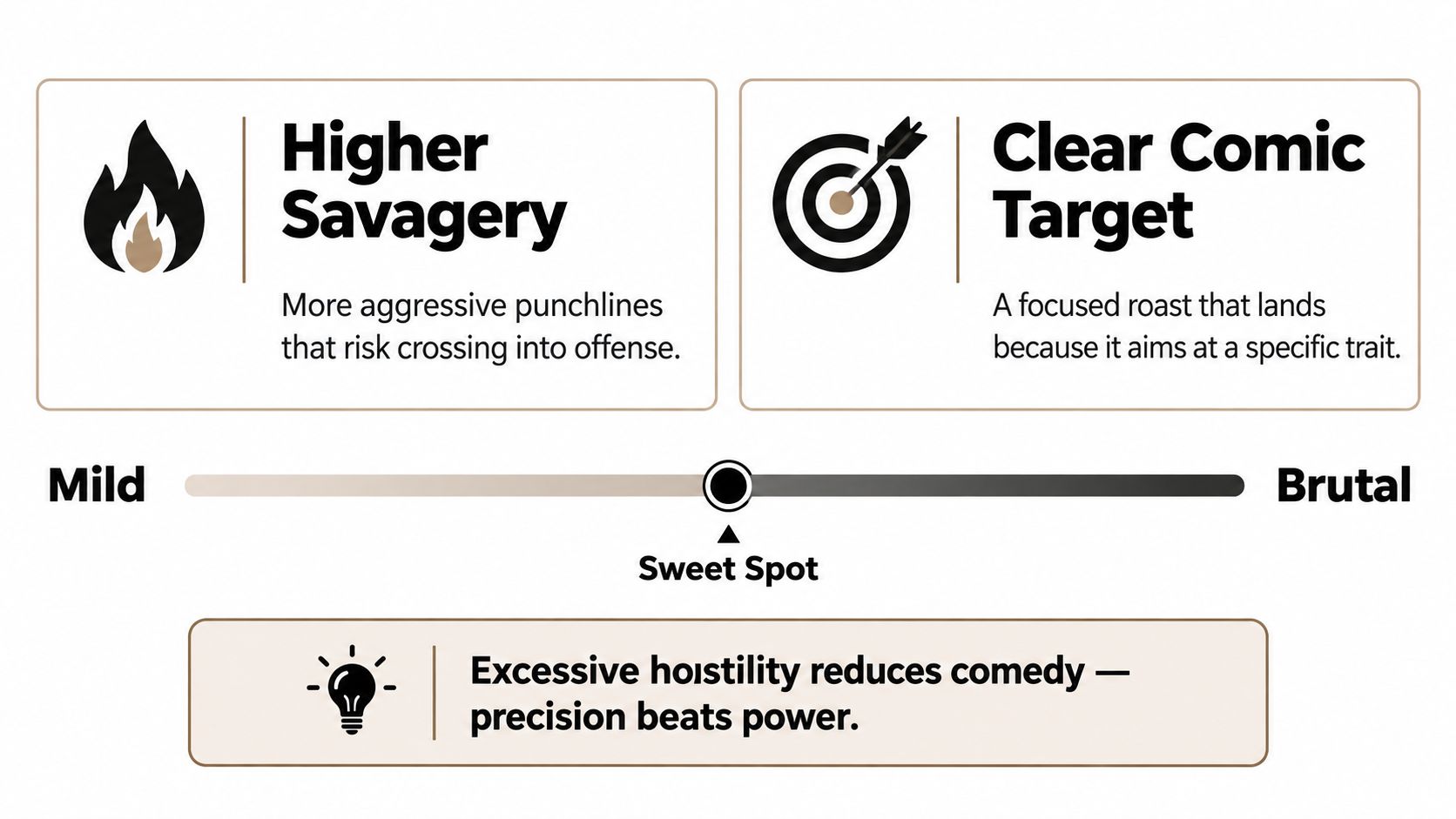 A diagram comparing comedic savagery and target precision on a scale ranging from mild to brutal.
Replace the Insult With an Angle
Suppose a rough draft says:
You're useless at games, nobody wants you around.
That's hostility without much craftsmanship. Using the outfit example, a more targeted rewrite is:
Your outfit gets applause before your gameplay gets a chance.
The second line still teases, but it creates a scene. You can deliver it with amused disbelief instead of contempt.
Generate alternatives at different intensities, then compare detail coverage, freshness, and punchline impact separately from rhyme and rhythm. For an affectionate target, the guide to roasting your best friend is a useful companion when deciding how much bite suits the relationship.
Use Context Modes Rather Than a Cruelty Ladder
- Party-safe: Keep the subject familiar, affectionate, and easy for the target to laugh about.
- Stage-safe: Allow more theatrical competition within boundaries the participants have agreed to.
- Publish-safe: Remove identifying details that aren't necessary and assess how strangers could interpret the excerpt.
Publish-safe isn't the most aggressive setting. It's the version that needs the most scrutiny because viewers may never see the surrounding exchange.
A sharp roast gives the audience a recognizable contradiction. A cruel roast asks the audience to enjoy somebody's discomfort.
Reject unsupported allegations, protected-class attacks, credible threats, doxxing, sexual humiliation, and sensitive personal disclosures. Don't rescue an unsafe line with a playful delivery note. Rewrite the subject of the joke.
Finally, listen again after the initial novelty wears off. Keep the line whose comparison still feels clever, not the one whose only surprise was how mean it sounded.
Refine Lyrics for Rhyme Flow and Fresh Punchlines
A tidy rhyme scheme isn't proof that a verse works. You can match every ending and still sound like you're reading a greeting card through clenched teeth.
Use a content pass followed by a sound pass. First preserve the intended joke and requested details. Then revise pronunciation, stresses, rhyme placement, and breath space without losing that meaning.
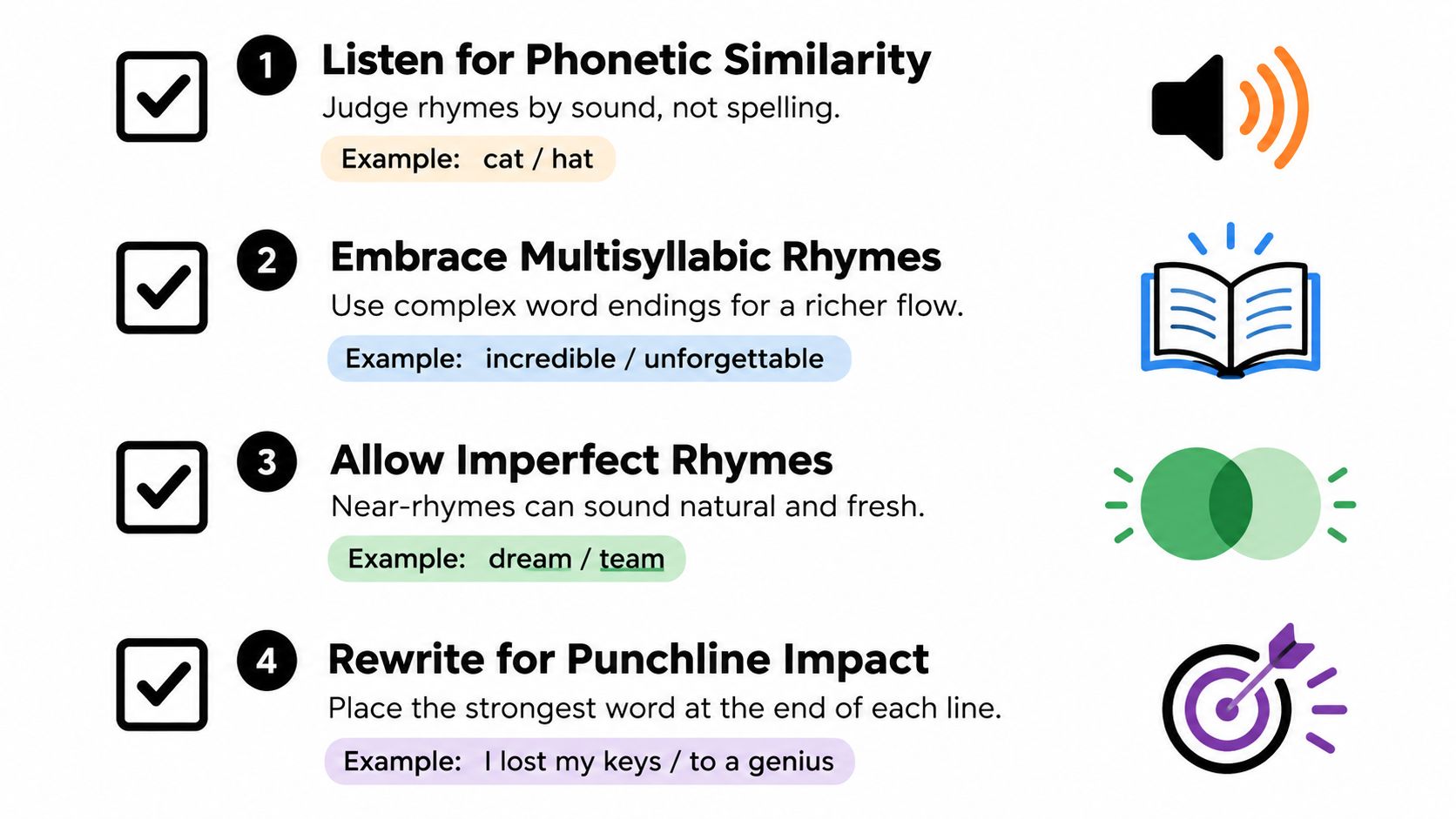 A list of four tips for creating better song lyrics, illustrated with simple icons and examples.
Listen Instead of Matching Letters
Judge rhyme by phonetic similarity, including stressed vowels and surrounding sounds, rather than spelling. Multisyllabic and imperfect rhymes can give you alternatives when exact matches force unnatural phrasing. Research on phoneme-aware rhyme enhancement for generated rap supports treating rhyme revision as a dedicated stage rather than relying entirely on initial generation.
For a fuller structural reference, use the rhyme scheme generator guide, then test the pattern against your chosen delivery.
Here's an intentionally stiff original draft:
You choose your boots before the fight, You make your jacket very bright.
You change your hat beside the door, Your teammates wait a little more.
The paired endings work, but very bright and beside the door exist mainly to complete the pattern. A looser revision gives the performer a better angle:
You call it battle prep. We call it getting dressed.
The squad's already queued.
You're checking if the jacket matches.
Your toughest opponent? The preview menu.
The revision isn't a rhyme-density victory. It's a comic rewrite ready for another sound pass, with a stronger ending and deliberate space around the setup.
Use Metrics as Warning Lights
For systematic evaluation, track:
- Rhyme density: Rhymed syllables divided by total syllables.
- Rhyme accuracy: The proportion of lines whose final word rhymes with another line ending.
- Distinct unigram and bigram rates: Vocabulary and word-pair variety, useful for spotting repetition.
- Syllable variation: Abrupt line-length changes that may need a pause, pickup, or rewrite.
Don't flatten every line into identical length. Explain the variation through delivery, or cut it. Remove repeated templates, replace abstract boasting with concrete images, and put the strongest reveal where listeners can hear it clearly.
Automatic scores assess patterns, not laughter. Keep the version that sounds natural and preserves the joke, even when a mechanically denser alternative looks more impressive.
Share Perform and Credit the Final Roast
Format the final lyric for a mouth, not a document. Break lines where you'll breathe, mark a pause before the reveal, and spell unfamiliar names phonetically in your performance copy.
Record a rehearsal and listen without watching yourself. If you rush the setup or swallow the final word, shorten the line before trying to perform it harder. The guide to using your voice can help you approach delivery as a separate creative task.
Adapt the Lyric to the Release
A short clip needs a clear premise and a decisive ending. A livestream needs an introduction that makes the target's participation understandable. A party performance can rely more on shared context, while a full track needs enough development to justify its length.
For example, turn the fictional wardrobe roast into a creator segment by showing your own character-selection screen, establishing the outfit joke, and performing the closing lines. Don't display private chat messages or another person's account details to prove the setup.
Keep a Release Record
- Consent and context: Confirm that a real-person target agrees to the intended audience, not merely a private rehearsal.
- Originality: Search distinctive phrases that sound suspiciously familiar and rewrite borrowed-sounding material.
- Rights: Check the generator's current terms, beat license, and platform rules before monetizing.
- Authorship records: Save prompts, drafts, and meaningful human revisions. Do not assume those records guarantee copyright protection.
- Disclosure: Describe AI assistance and avoid copying a living artist's recognizable voice or identity.
Audience expectations deserve attention. A Deezer–Ipsos survey reported by Reuters found that 73% supported disclosure when AI-generated tracks are recommended. That finding concerns music recommendations, not a universal labeling rule for every roast clip, but it's a good reason not to hide the process.
Commercial permission, exclusive ownership, and copyright eligibility aren't interchangeable. Get qualified advice when a consequential release depends on those distinctions.
Use a Final Roast Quality Check
Judge the release version against the original brief, not against the relief of finally finishing. Keep an unchanged baseline draft so you can tell whether each revision improved the performance or merely made it longer.
A useful evaluation approach separates semantic coverage, rhyme and rhythm, novelty, and human-rated punchline impact. Rap-generation research comparing Transformer and LSTM approaches also cautions against equating fluent generated text with expert-level lyric quality.
Run the Readiness Check
- Personalization: Are the important supplied details present without invented biography?
- Comedy: Does the strongest joke survive another listen without explanation?
- Flow: Can you deliver the verse naturally at the intended pace?
- Voice: Does the wording fit both you and the audience?
- Safety: Have you removed accusations, private information, and prohibited attacks?
- Release: Are consent, permissions, disclosure, and the final format settled?
Ask a trusted listener to describe the joke back to you. If they repeat an insult but miss the intended observation, revise the setup rather than adding another aggressive line.
Request the Right Final Revision
Use a context-specific editing prompt instead of asking the generator to “make it better”:
- Friendship roast: “Preserve the affectionate tone and shared reference. Replace anything that sounds like genuine resentment.”
- Streamer content: “Make the premise understandable without private context. Leave a reaction pause after the strongest reveal.”
- Party joke: “Simplify wording for live delivery and remove references guests won't recognize.”
- Creator script: “Keep the central visual idea, tighten the opening, and finish on the most quotable original line.”
Retain the strongest candidate and document what you changed. You don't need to keep polishing a joke that already works, but you should know why you chose it.
Specificity carries a roast, rhythm makes it land, and judgment keeps it fun.
For a starting draft, DissTrack AI offers personalized roast lyrics with style choices and adjustable savagery. Bring a harmless inside joke and a clear audience brief, then use the generated material to build a verse you've edited, rehearsed, and made your own.