
Trap Rap Lyrics How to Write Authentic Heat That Hits
You've got the beat. The 808 rattles the desk, the hi-hats flicker like sparks, and the hook in your head feels undeniable. Then you press record, deliver the verse, and the room goes quiet for the wrong reason. The words sound borrowed. The slang doesn't belong to you. Every bar reaches for a trap cliché and misses the pocket.
That problem isn't solved by stuffing more street vocabulary into your notebook. Authentic trap rap lyrics come from a believable voice, a controlled rhythm, specific details, and emotional tension. The flex can sit beside fear. The victory can carry receipts from the struggle. The threat can reveal insecurity without turning into theater.
Trap crystallized as a recognizable mainstream hip-hop lane in the early 2000s. T.I.’s 2003 album Trap Muzik became a commercial milestone, selling over 2.1 million copies, while Young Jeezy's 2005 Let's Get It: Thug Motivation 101 debuted at No. 2 on the U.S. Billboard 200 with 172,000 first-week sales, according to the history of trap music. The sound traveled, but its strongest writing still feels local, personal, and lived-in.
Why Most Trap Rap Lyrics Sound Fake Before the Hook Hits
The bedroom-studio failure usually starts before the microphone turns on. A new writer hears a dark beat, opens a rhyme app, and searches for “trap words.” The result might include chains, foreign cars, money, shooters, and a mysterious enemy nobody can identify. On paper, it looks like the genre. In a vocal take, it sounds like someone wearing a costume.
Listeners hear the mismatch immediately. They notice when your confidence belongs to the rapper you studied instead of the person standing at the mic. They notice when you use slang you'd never say to a friend. They notice when every line claims dominance but none of the details explain what you wanted, lost, feared, or survived.
Practical rule: Don't borrow somebody else's biography. Borrow the discipline, not the costume.
Trap began with a specific Southern street idiom, then became a global rap template. Its commercial breakthrough helped establish a durable formula built around rags-to-riches narratives, regional slang, and hard-edged realism, as documented in the Wikipedia overview of trap music. That formula works because the emotional engine is clear. Someone is under pressure, wants out, and refuses to look powerless while climbing.
Authenticity lives in the contradiction
A believable trap voice doesn't need to announce that it's vulnerable. It can show vulnerability through a decision, an image, or a detail. “I'm stressed” is a label. “Phone on silent, still checking every minute” gives the feeling somewhere to live.
Your persona can say:
- “I don't trust applause, I remember who went missing.”
- “Made it out the hallway, still sleep with one eye open.”
- “She says I'm distant, I call it keeping focus.”
- “I wear the win loud, but the loss stays private.”
Those lines don't depend on pretending to sell drugs or threaten strangers. They create tension between ambition and exhaustion, pride and shame, romance and suspicion. That tension gives trap lyrics a human pulse.
A study of Black Sherif's lyrics identified recurring uses of pronouns, Ghanaian Student Pidgin, and metaphor to frame struggle, pain, survival, and self-confidence. The analysis supports a broader reading of trap as an identity language, especially outside the United States, rather than a narrow catalog of flexes and street scenes. You can read that discussion in the academic analysis of Black Sherif's lyrics.
Train your ear before you chase cleverness
Play your draft beside the beat and ask three uncomfortable questions:
- Would I say this without the music?
- Does the voice match the life behind the words?
- Is the line memorable because it's specific, or only because it rhymes?
If the answer feels weak, strip the bar down. Replace the generic object with the specific one. Replace “they switched up” with what the person did. Replace “I'm the hardest” with the behavior that proves it.
The system ahead treats the song like a record, not a pile of captions. You'll lock the cadence to the drums, build rhyme that survives repetition, choose themes with real pressure behind them, and arrange the hook so the listener remembers it after one pass.
Locking Your Flow to the Beat and Nailing Triplet Swing
Trap flow starts with the beat's breathing pattern. The beat's 808, hi-hats, snare, and half-time space decide how many syllables can land before your vocal starts wrestling the drums. Trap commonly sits around a 130 to 150 BPM range in practical beat selection, but the counted tempo isn't the whole feel. A beat can move quickly on the grid while the snare creates a slower, wider pocket.
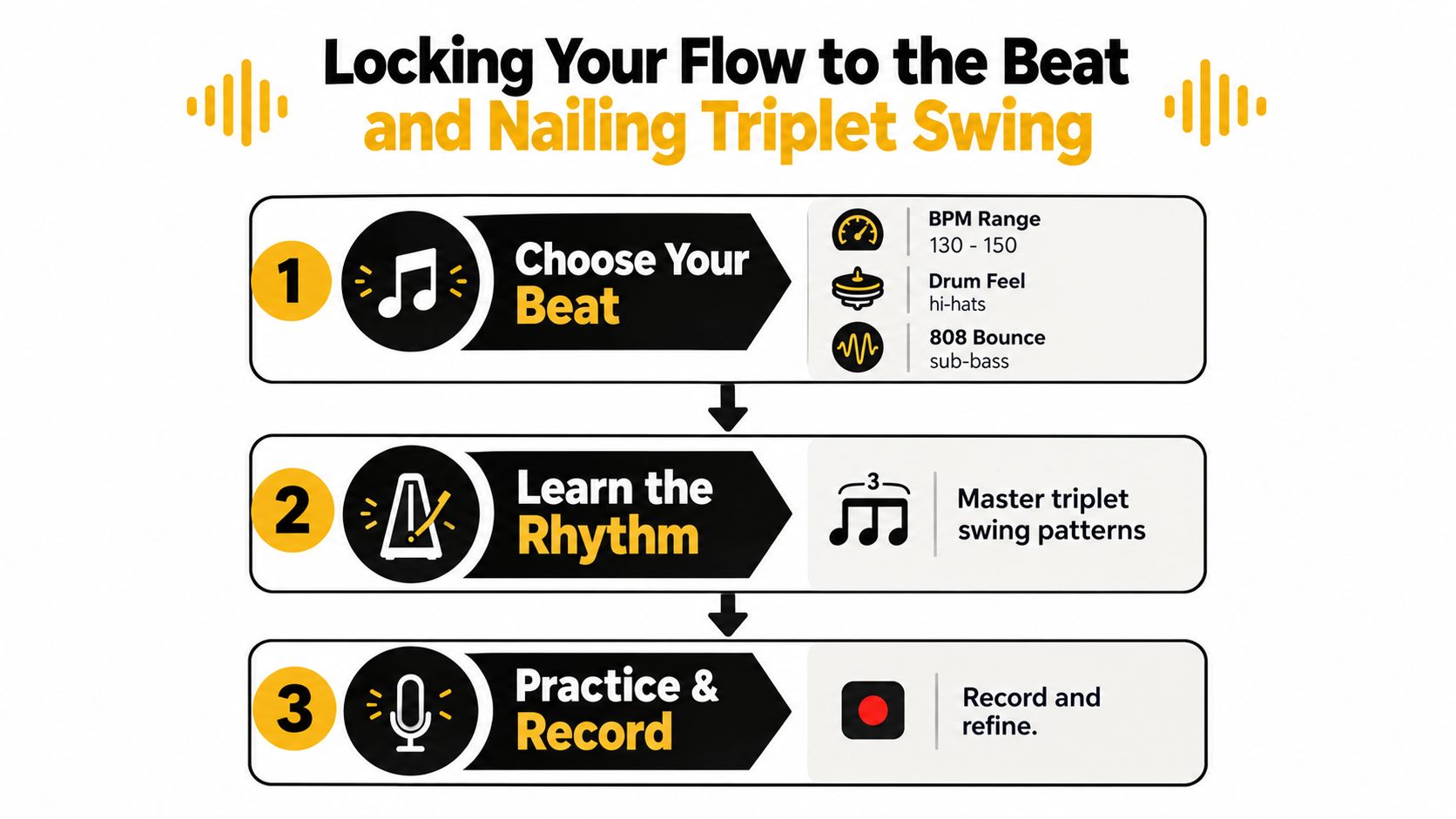 A three-step infographic on how to lock your flow to the beat for trap rap.
Choose the pocket before writing bars
Loop the beat and ignore the melody for a moment. Clap with the snare. Tap your finger through the hi-hats. Listen for where the 808 changes pitch or leaves a gap. Those gaps are not empty space you must fill. They're places where your voice can sound expensive.
Test three deliveries over the same loop:
- Straight sixteenths: Count “one e and a, two e and a” and place one syllable on each subdivision. This gives you a tight, machine-like run.
- Triplets: Count “one-trip-let, two-trip-let” and fit three syllables into each beat. This creates the rolling signature associated with modern trap cadence.
- Swung triplets: Keep the three-part shape but delay the middle or final syllable slightly. The result feels less robotic and gives the groove a lurching bounce.
Don't force triplets across every bar. A full verse with one cadence quickly becomes wallpaper. Run a dense triplet phrase, leave a gap, then return with a shorter line that lets the 808 answer.
Use a syllable map instead of guessing
Speak a plain sentence over the beat, such as:
“I kept the door closed, now they ask who I became.”
Mark the stressed words: kept, door, closed, ask, became. Those are potential landing points. Now change the sentence while preserving the stress pattern:
“I kept my name clean, now they ask what I became.”
The rhythm survives because the important accents remain in similar places. That's the trick. New writers count every syllable but ignore the stress. Experienced writers count both.
Try this five-minute drill:
- Loop four bars.
- Clap only on the snare.
- Hum a rhythm using one vowel.
- Replace the hum with nonsense syllables.
- Keep the same pattern and insert real words.
- Record three versions, one sparse, one straight, and one triplet-heavy.
The nonsense stage matters. It separates cadence from vocabulary. If the rhythm works before the words arrive, your lyrics have somewhere solid to sit.
Let hi-hat rolls change your density
Hi-hat rolls create moments of acceleration. You can answer them with a compact burst, but you don't have to mirror every note. A short phrase before a roll often sounds stronger than a syllable-for-syllable imitation because the drums already provide motion.
Before drafting, you can also build or adjust the beat with a focused workflow such as this guide to making a backing track for rap. Keep the vocal's job clear. The beat supplies movement, while your delivery supplies attitude and meaning.
Record a take while standing, then listen without watching the waveform. If you run out of breath, remove filler words before you add more breaths. If the verse sounds crowded, cut syllables at the end of the line and give the 808 room to finish its sentence.
Here's a useful test. Mute the beat for a moment and play the vocal alone. If the rhythm collapses completely, you may be leaning on the drums instead of controlling the pocket. If the vocal still carries a recognizable bounce, you're locked in.
Rhyme Tricks That Make Trap Rap Lyrics Stick
Trap doesn't require a new rhyme at every turn. Its hooks often depend on repetition, vowel color, and phrases that feel natural enough to chant. The mistake is confusing simplicity with laziness. A repeated end rhyme can work when the internal movement keeps changing.
Compare these two sketches:
Flat:
I'm on the road, I'm getting paid
I'm with the crew, they're getting made
Stronger:
Late-night motion, I'm awake when the city fades
Same old pressure, new location, still I switch the lane
The second version doesn't only rhyme “fades” and “lane.” It creates internal echoes through motion, location, and the repeated long “a” sound. The rhyme feels woven into the sentence rather than glued to its final word.
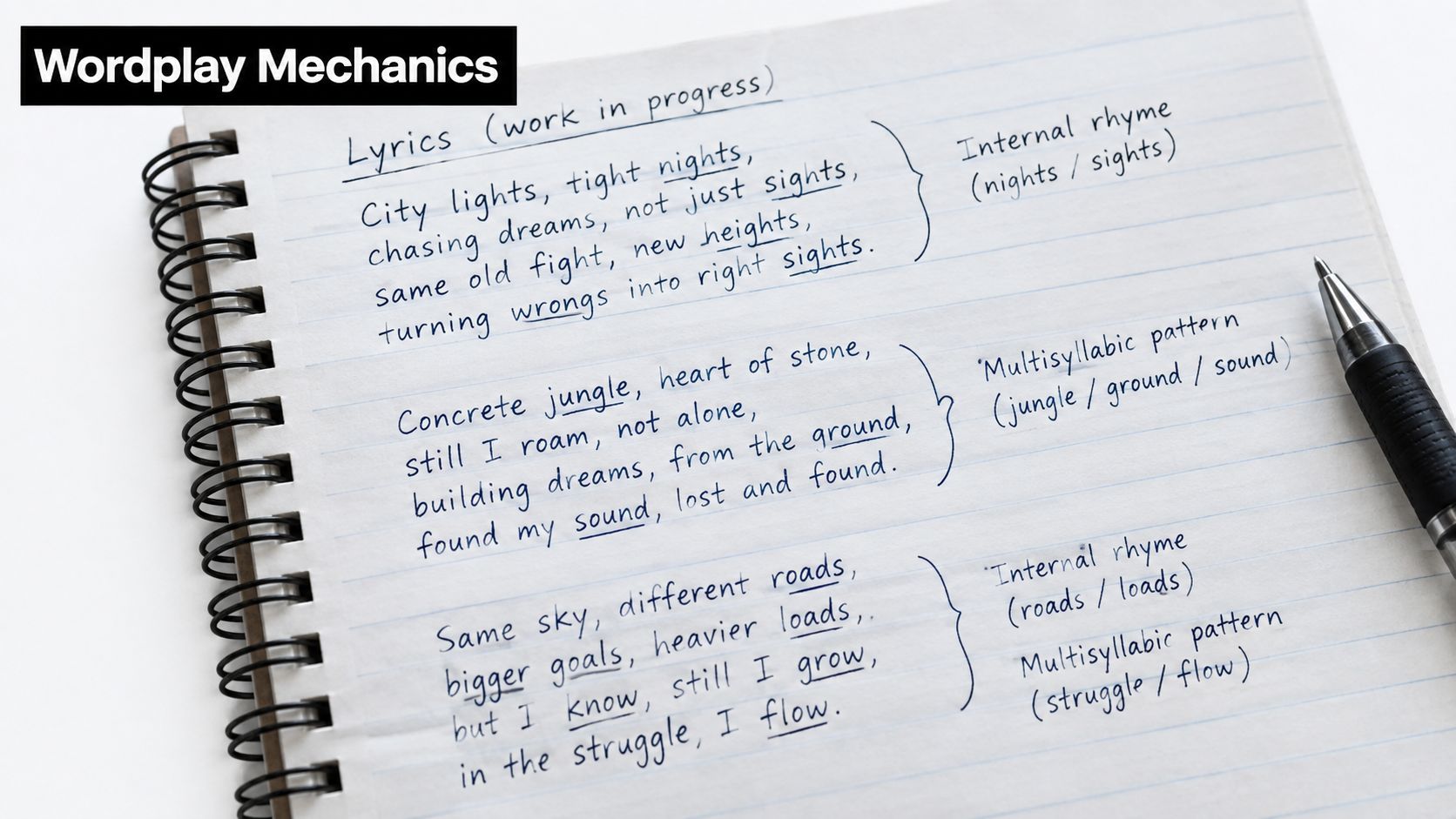 A spiral notebook displaying handwritten rap lyrics and explanations of literary techniques like internal rhymes and multisyllabic patterns.
Build rhyme families, not isolated pairs
Start with a central sound, then collect words by sound rather than spelling. If your anchor is “pressure,” you might explore:
- pressure, lecture, texture
- measure, pleasure, treasure
- lesser, dresser, extra
- enter, center, temper
Not every match is exact. That's useful. Slant rhyme lets you keep a conversational tone instead of contorting the line to hit a perfect dictionary match.
A multisyllabic chain extends the sound across two or more syllables:
“Never let it get me”
“Heavy on the envy”
The phrase doesn't need identical spelling. The repeated vowel movement does the work. Add an internal rhyme before the main landing point:
“Heavy on the envy, but I never let it get me.”
Now the line has a small echo in the middle and a larger echo at the end. That helps a slow hook feel active without cramming it.
Repetition needs a reason
Write a hook phrase three times, then change one element each time. Keep the first version plain, make the second more specific, and let the third reveal the emotional cost.
“I'm outside, I'm outside, I'm outside.”
“I'm outside, where the cold wind knows my name.”
“I'm outside, won the race, still afraid of the change.”
The repetition becomes a frame. The changing detail gives it progression.
Use rap rhyme patterns as a study aid when you want to inspect how end rhymes, internals, and slant matches interact. Don't treat a pattern as a cage. Trap delivery needs room for clipped words, stretched vowels, and phrases that sound spoken.
Edit the rhyme without killing the voice
Read each line aloud at recording speed. Circle any word you'd never use in conversation. Then check the rhyme chain:
| Check | Keep it when | Cut or replace it when |
|---|---|---|
| Sound | The vowel match is audible | The spelling matches but the sound doesn't |
| Meaning | The word adds image or pressure | It exists only to complete the rhyme |
| Cadence | The phrase rolls naturally | The rhyme forces awkward stress |
| Memory | The listener can repeat it | The line disappears after one pass |
A clever rhyme that sounds written is weaker than a plain phrase delivered with conviction. Trap rewards lines that can survive the first listen, the chant, and the ad-libbed performance.
What to Actually Rap About Without Sounding Like a Cliché
Classic trap themes still work because they carry conflict. Hustle means movement under pressure. Flex means proof that the pressure produced something. Survival means the win didn't erase the danger. The cliché appears when the writer names the category without giving it a personal shape.
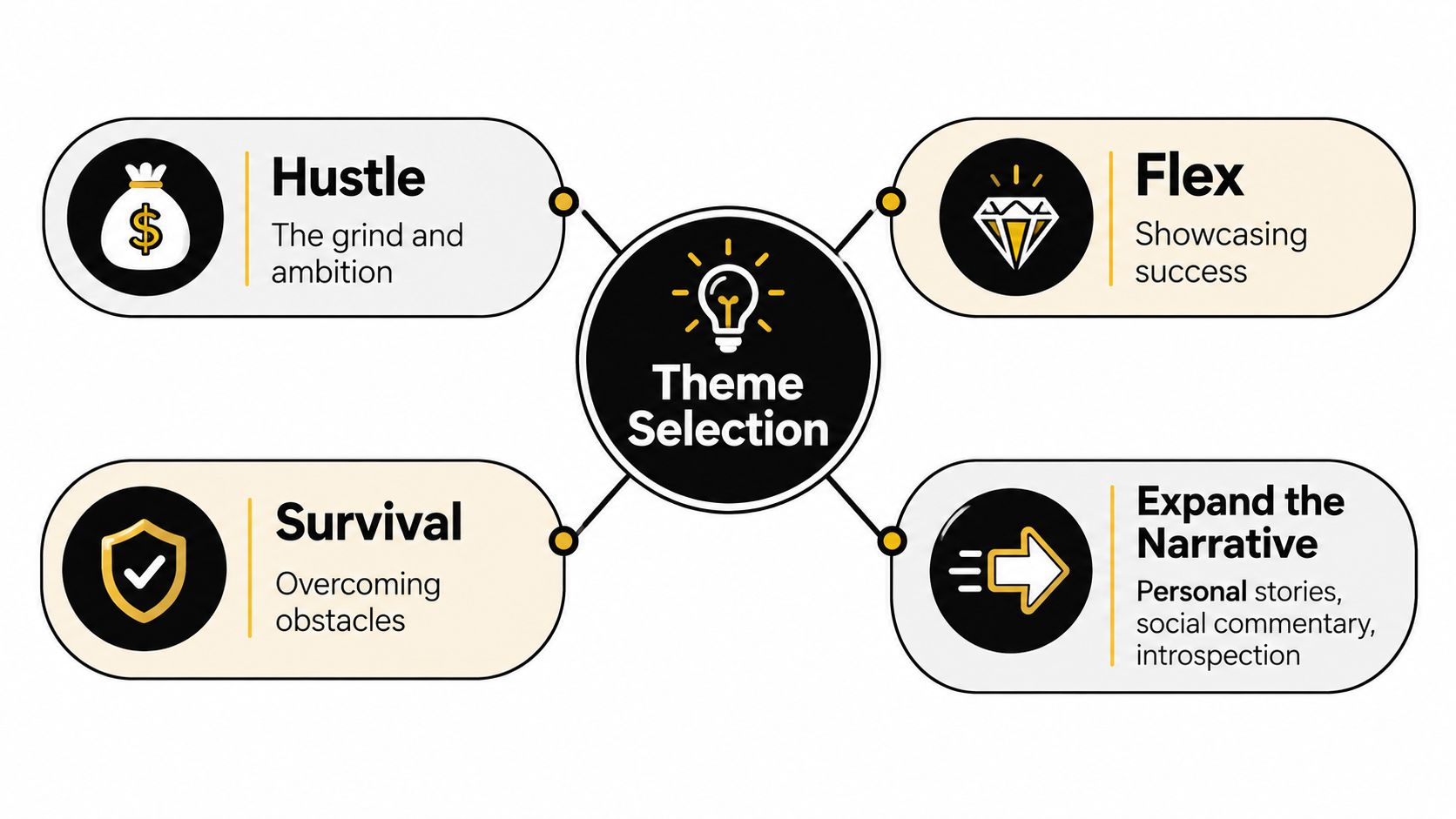 A diagram outlining theme selection categories including Hustle, Flex, Survival, and Expand the Narrative for song lyrics.
Turn familiar pillars into lived scenes
Hustle doesn't have to mean illegal activity. It can mean late shifts, rejected applications, studio sessions nobody funded, or building a business while your friends assume you're wasting time. Flexing can show discipline instead of jewelry. Survival can describe protecting your peace, supporting family, or refusing to return to an old version of yourself.
Use a detail ladder:
- Broad idea: I'm working hard.
- Concrete action: I answer client messages after the last train.
- Personal cost: My mother thinks I'm avoiding sleep.
- Contradiction: I wanted freedom, now responsibility follows me everywhere.
That final step creates a song. The listener already understands ambition. They want the price.
Black Sherif's lyric writing is useful here because the academic analysis highlights pronouns, Ghanaian Student Pidgin, and metaphor as ways to frame struggle, pain, survival, and self-confidence. The lesson isn't to copy his vocabulary. It's to let your own speech patterns, region, and relationships carry the emotional truth.
Use regional language with a purpose
Slang should identify the speaker, not decorate the beat. Keep words you'd use naturally with people who know you. If a local phrase has a double meaning in your community, build the line around that meaning. If you only learned it from another artist, leave it alone.
Pronouns can also shift the emotional camera:
- I makes the verse confessional.
- We turns survival into a shared statement.
- They creates pressure, judgment, or opposition.
- You can address a rival, lover, younger self, or audience.
Metaphor expands the world without pretending your life is somebody else's. “My past is a locked room” says more than another generic reference to enemies. “I made a ladder out of every no” turns rejection into an object the listener can see.
For artist-specific listening, explore Gunna's work on OohYeah and pay attention to how melodic phrasing, luxury imagery, and emotional distance can coexist. Study the choices, then translate the underlying technique into your own setting.
Handle romance and aggression with care
Trap lyrics often place affection beside suspicion. That contrast can be compelling, but lazy writing turns every woman into a prop and every disagreement into a threat. You can write desire, jealousy, betrayal, or bravado without reducing another person to an object.
Ask who has agency in the scene. Give the love interest a decision, a boundary, or a perspective. If the narrator behaves badly, make the lyric aware of the damage instead of presenting cruelty as automatic proof of power.
Quantitative research on Italian rap and trap lyrics from 1993 to 2025 found that about one third of the corpus contained misogynistic expressions, with the pattern broadly stable over time. The same analysis reported that positive love songs could contain more derogatory language than negative ones, a contradiction discussed in this analysis of Italian rap and trap lyrics. That finding gives writers a sharp question to ask: is the romance revealing intimacy, or is it smuggling in contempt under a softer melody?
Building Verses Hooks and Ad Libs That Hit Like a Record
A finished trap song needs architecture. Strong lines can still lose if the hook arrives late, the verse has no escalation, or the ad-libs fill every gap. Treat the arrangement like a conversation between lead vocal, drums, and silence.
A dependable starting shape is:
- Hook: 8 bars, one central phrase, one emotional promise.
- Verse: 16 bars, more detail and movement.
- Hook: Return with extra layers or a changed final line.
- Second verse or bridge: Add a new angle rather than repeating the first verse's argument.
For a deeper structural breakdown, use this guide to structure a rap song. The exact bar count can change, but the listener should understand what the song wants them to remember.
Write the hook as a pressure point
Begin with a phrase that can survive repetition:
“Still outside, still outside.”
“No sleep, new keys.”
“They know the name now.”
Then attach a question or contradiction:
“Still outside, still outside, but I don't feel free.”
“No sleep, new keys, every room got history.”
“They know the name now, still won't say they missed me.”
The hook's first pass should be easy to catch. Its later lines should reward attention. Leave one bar with fewer words so the beat can answer the statement.
Give every verse block a job
Think in four-bar movements rather than sixteen identical lines:
- Bars 1 to 4, establish the scene. Name the place, time, or immediate pressure.
- Bars 5 to 8, show the response. Explain what the narrator does, not just what they feel.
- Bars 9 to 12, introduce the cost. Let success create a new problem.
- Bars 13 to 16, land the turn. End with the line that changes how the listener reads the verse.
A fill-in template can help:
I came from [specific place], where [specific pressure]
They wanted [what they demanded], I gave [your choice]
Now I got [visible result], but [private cost]
Tell them [final claim], then let the beat drop
That template only works if you replace every bracket with something you can defend. Generic nouns make generic records.
Place ad-libs like punctuation
Ad-libs should underline a moment, not compete with it. Use a short response after a punchline, a breath before a new thought, or a texture at the end of a repeated phrase.
- “Yeah” can confirm a statement.
- “Huh” can create hesitation or challenge.
- “Grrt” can punctuate aggression when the beat leaves space.
- A whispered double can make a confident line feel haunted.
- Silence can be the strongest ad-lib after a heavy reveal.
Record the lead vocal first. Mark the words that deserve support. Then add doubles only to key phrases, not every line. Stack the hook wider than the verse, drop the layers before a verse begins, and let one ad-lib answer from the side of the stereo field rather than shouting over the center vocal.
A rough arrangement often looks like this:
Hook: full lead, selective double, two response ad-libs
Verse opening: dry lead, no clutter
Verse middle: one background phrase at the turn
Verse ending: double the final claim, then leave a beat open
Hook return: restore the layers, change the final ad-lib
The record feels bigger because the energy moves. More vocal tracks don't automatically create more impact. Contrast does.
Generate and Polish Your Next Hit With DissTrack AI
Writer's block usually isn't a shortage of words. It's a shortage of angles. You know the target, the beat, and the mood, but every opening line sounds like a placeholder. An AI workflow can produce raw options quickly, then you can apply the human judgment that makes a diss feel personal instead of mass-produced.
DissTrack AI can generate personalized roast lyrics from inputs such as a target's name, relationship, and inside jokes. It supports style tags including Trap, Drill, Battle Rap, Emo Rap, UK Grime, West Coast, and Old School Boom Bap, along with a savagery setting. The system produces structured verse variations that users can edit, export, or share, and its product description says generations remain private until the user chooses to publish.
Use prompts that give the model real ammunition
A weak prompt says:
“Write a savage trap diss.”
That produces broad insults. A useful prompt supplies the conflict:
“Write an 8-bar trap diss aimed at a former collaborator who takes credit for my hooks. Use the inside joke about the broken headphones, keep the insults clever rather than threatening, make the hook chantable, and end with a line about receipts.”
Generate several directions, not one sacred draft. Keep the version with the strongest premise, steal the cleanest punchline from another, and rewrite anything that doesn't sound like your mouth.
Polish in the human pass
Check every generated line against four filters:
- Voice: Would you say it?
- Specificity: Does it reveal something only this target would recognize?
- Flow: Can you perform it without squeezing or swallowing syllables?
- Restraint: Is the insult sharp because it's precise, not because it's merely cruel?
Cut inflated wording. Replace vague insults with behavior. Add your own pauses, local phrasing, and emotional reaction. The software can give you a pile of clay. It can't decide which memory makes the diss sting.
Then run the result through the same record test as any other trap lyric. Find the pocket. Mark the internal echoes. Make the hook repeatable. Give the final bar a turn. AI speeds up the first draft, but your edit creates the identity.
The complete workflow is simple: choose a beat with room, lock your cadence, build a sound-based rhyme bank, write from contradiction, arrange the hook and verse for contrast, then record before perfectionism talks you out of the take. A polished idea sitting in your notes is still silent.
DissTrack AI gives you personalized roast lyrics, trap-style variations, structured verses, and editable punchlines from your target details and inside jokes. Try the workflow on your next beat, then visit DissTrack AI and turn the first draft into something you would record.