
Trap Rap Lyrics Generator: How to Write Bars That Hit
You've generated a verse that looks sharp on the page, then pressed play on the beat and watched every line arrive late. The 808 drops, the hi-hats start sprinting, and your carefully worded bars suddenly feel too long, too smooth, or completely disconnected from the bounce.
That problem usually isn't a lack of vocabulary. It's a cadence problem. A useful trap rap lyrics generator needs more direction than a topic and a mood. You have to control syllable density, bar length, rhyme placement, and the moment the hook lands. The generator can supply raw material, but your prompt must tell it how that material is supposed to move.
Why Trap Bars Need a Different Approach
A writer can spend forty minutes refreshing the same prompt and still receive technically correct verses that collapse. The lines may rhyme, the grammar may work, and the imagery may sound suitably aggressive. Yet when the 808 slides underneath them, every bar crowds the snare.
Trap emerged in the early 1990s in the Southern United States, with lyrical references appearing as early as 1991 and its modern sound taking shape around 1999. The style later moved into the mainstream during the 2010s, carrying a highly recognizable vocabulary and rhythmic identity with it, as documented in the history of trap music. Early writing focused on street slang, hustling, and the trap environment. Later trap standardized traits such as triplet flows, heavy 808 drums, rapid hi-hats, and repeated rhythmic pockets.
That history matters because a generator isn't working from a blank musical canvas. It's imitating a codified form. A general rap tool often produces symmetrical couplets, loose bar lengths, and long sentences that read well but don't leave room for an 808-driven pause.
Practical rule: Judge a trap lyric with the beat playing, not with your eyes alone.
Cadence comes before cleverness
Start by treating each line as a performance unit. Ask where the stressed syllables land, where the rapper can breathe, and whether the final word arrives close enough to the snare to feel intentional. A clever internal rhyme doesn't rescue a line that needs four extra syllables.
A strong trap prompt therefore describes the musical container first. Instead of asking for “dark, emotional rap lyrics about ambition,” specify a compact verse, a defined hook position, short punchy lines, and a chosen substyle. The target isn't readable text. It's a sequence of bars that can survive a loop.
The genre rewards controlled repetition
Trap hooks often depend on a phrase returning with slight variations. Generators tend to over-explain, especially when a prompt asks for many themes at once. Remove the explanation and force a repeatable phrase, a clear end rhyme, and a deliberate gap before the next bar.
Trap's commercial expansion created a large, active catalog. One catalog-based overview tracks 6,672 trap-related releases, including 3,736 releases in the 2020s, 799 in 2023, 181 in the 2000s, and 3 in the 1990s. Those figures appear in the Age of Trap overview, and they help explain why audiences expect a trap rap lyrics generator to understand more than generic rhyme. Users are listening for the pocket.
Setting Up Your Inputs for Maximum Impact
Prompts don't carry equal weight. A target, a substyle, and a controlled intensity instruction usually shape the result more effectively than a paragraph of mood adjectives.
Rank inputs by what they force the model to do
First, name the target or subject. A concrete target gives every bar an anchor. “My rival” invites vague flexing. A named person, team, product, or fictional character pushes the generator toward details, contrasts, and usable angles. Add a relationship or specific conflict if it matters, but don't bury the target inside a long backstory.
Second, choose the substyle. “Trap” is broad. “Wavy melodic trap” encourages open vowels and longer notes. “Dark drill-influenced trap” points toward clipped phrases and a colder delivery. “Party bounce” should produce simpler, more repeatable language. The tag changes sentence length as much as it changes word choice.
Third, set the savagery dial. Use a numeric scale in your own workflow, but define what the endpoints mean. A low setting can request subliminal jabs and playful teasing. A high setting can request direct battle-rap aggression while still requiring original wording and avoiding threats.
Fourth, specify the form. Ask for a hook, a verse, or both. State the number of bars you want, where the hook should appear, and whether ad-libs should sit on separate lines.
Cut low-leverage prompt clutter
Mood words help only when they support a musical decision. “Gritty,” “cinematic,” “raw,” and “emotional” can point in different directions unless you connect them to delivery. Try “gritty, clipped delivery, short lines” instead of stacking several atmospheric adjectives.
A minimum viable input can look like this:
- Target: a specific name or subject
- Substyle: one trap lane
- Intensity: a defined savagery level
- Structure: hook or verse, bar count, hook position
- Cadence: short lines, triplet pocket, melodic sustain, or another clear instruction
The strongest prompt often contains one clear theme plus a few actionable constraints. Independent comparison guidance on AI lyric tools also highlights the value of focused prompts and clarifying questions, rather than overloading the generator with unsupported detail, in this 2026 comparison of AI lyrics generators.
Copy-Paste Prompt Templates That Actually Spit
Templates work because they remove the blank-page problem without removing your control. Keep the brackets, replace the fields, and change one variable at a time when the output misses.
Hook for wavy melodic trap
Write a four-bar hook for [TARGET OR THEME] in wavy melodic trap.
Use one memorable end phrase that repeats on bars 2 and 4.
Keep each bar short enough to leave space for an 808 slide.
Use open vowel sounds, simple imagery, and one call-and-response ad-lib.
Do not explain the story. Make the hook easy to repeat.
This template creates a repeatable center rather than a mini-verse. If the result sounds bland, change the image, not the entire prompt. Ask for one concrete object, location, or phrase connected to the target.
Punchline verse for dark drill-influenced trap
Write a 16-bar diss verse aimed at [TARGET NAME].
Style: dark drill-influenced trap, clipped delivery, tight internal rhymes.
Use specific imagery from [DETAIL 1] and [DETAIL 2].
Build tension through bars 1-11.
Deliver the main punchline on bar 12, then use bars 13-16 as short aftermath punches.
Avoid threats, generic flexes, filler adverbs, and repeated ideas.
Keep the bar lengths close enough to perform over one loop.
The delayed punchline gives the verse a shape. Without that instruction, generators often spend their strongest line immediately, then pad the remaining bars.
Full verse for gritty Atlanta-style trap
Write a 16-bar verse in gritty Atlanta-style trap about [THEME].
Use heavy 808 space, triplet pockets, short phrases, and concrete Southern imagery.
Place a two-bar refrain after bar 8.
Use end rhymes in alternating four-bar groups, with occasional internal rhymes.
Keep the language direct and performance-ready.
Label every bar and mark ad-libs separately.
The substyle tag changes the output's vocabulary, sentence length, and rhythmic feel. Don't treat it as decoration. If you want a different result, swap only that tag first.
For broader prompt-writing fundamentals, the guide on how to write effective AI prompts is useful because it reinforces the same principle, clear instructions work better when they define the intended result and constraints instead of piling on vague descriptors.
Editing AI Bars Until They Sound Like You
The first output is raw clay. The recognizable voice usually appears during editing, when you remove the language the generator uses to sound impressive and replace it with words you'd say.
Take a generic AI line:
“I'm on top of the game, watching all of them fade.”
It reads cleanly, but “on top of the game” carries no personal image. Start with the same four-step sequence every time:
- Count syllables. Decide how much room the beat gives the line.
- Find the flat bar. Mark the line that could belong to anyone.
- Swap one word for crunch. Replace an abstract phrase with an object, place, sound, or action.
- Test it aloud on the 808. Keep the version that lands naturally, not the one that looks most polished.
A tighter revision might become:
“Bent rim, phone dead, still I'm up in the frame.”
The line uses a more concrete image and creates sharper vowel movement around “dead” and “frame.” You don't need to rewrite every word. One image can turn a generic flex into a bar with a visual center.
Remove the thesaurus effect
Now take a triple-stacked simile:
“I move like a phantom, a shark, and a storm in the night.”
The line tries to prove intensity through accumulation. The result feels written rather than delivered. Cut the doubled concepts and keep two short punches:
“Move in the dark. Bite when the lights flash.”
The revision is less ornate, but it gives the rapper two clean attacks. Staccato phrasing creates room, especially when the track already carries a busy hat pattern.
Keep the place names, slang, and verbal habits you already use. Cut filler adverbs, doubled adjectives, generic declarations, and phrases that sound borrowed from a motivational caption. A practical resource such as this guide to writing punchlines can help you evaluate whether the final word delivers a turn or merely completes a rhyme.
Editing also matters for visual identity. If you're building a broader creator presence, the same preference for specific language and recognizable phrasing applies to projects such as branded merch for internet teams. The lyric should sound like a person with a point of view, not a machine combining aggressive nouns.
Research on rap lyric generation supports separating fluency, coherence, and style matching rather than judging output through surface similarity alone. The evaluation approach described in this rap lyric generation study uses human judgments for readability and target-style fit, which matches the practical test: can you perform it, and does it sound like the intended lane?
Short Prompts Beat Long Prompts Every Time
Long prompts feel thorough, but they often give the generator too many soft targets. Compare a descriptive paragraph asking for dark, melodic Atlanta trap with loss, ambition, street pressure, cinematic imagery, emotional contrast, layered metaphors, and a dramatic hook against a compact structural instruction:
Atlanta trap, 80 BPM, 16 bars, hook on bar 4
The long request may produce language such as:
“Through the shadows of my pain, I rise above the pressure, chasing dreams through the city while my heart remembers every loss.”
The sentence has atmosphere, but it's crowded and generic. The short prompt is more likely to produce a shape such as:
“Rain on the glass, still the bass don't fold
Lost some names, now the chain stay cold”
The second excerpt isn't finished just because it's shorter. It has a clearer pocket, a defined length target, and a stronger chance of leaving space for the beat.
Same beat, different output
| Prompt Type | Input Length | Output Coherence | Rhyme Density | Edit Time Needed |
|---|---|---|---|---|
| Long descriptive prompt | Long paragraph | Often diluted by competing instructions | Inconsistent | More trimming and restructuring |
| Short constraint prompt | Nine words | Clear structural commitment | Easier to control | Less restructuring, more word-level edits |
The table compares workflow behavior, not a measured performance study. The mechanism is straightforward: a compact prompt forces the model to commit to a template, while a long paragraph distributes attention across mood, story, imagery, and delivery.
Use the short version first. Add only the constraint that fixes the current failure. If the bars are too long, add a syllable instruction. If the hook disappears, specify its bar. If the language is too soft, adjust the substyle or savagery level.
Prompt discipline: If the instruction fits inside a short social post, the structure is more likely to fit on the beat.
Matching Bar Length and Rhyme Density to the Beat
Trap writing becomes easier when you stop describing flow as a feeling and start measuring what you can. The three useful controls are bar length, rhyme density, and hook placement.
Bar length is the number of syllables you ask the rapper to deliver before the next rhythmic reset. The planning range often used for trap is 12 to 14 syllables, but that range is a starting point, not a law. A hi-hat-heavy section may need shorter, punchier phrases. A half-time pocket can support longer lines with more air between stressed words.
Rhyme density describes how many lines in a four-bar group share a noticeable rhyme relationship. Tight end rhymes create a locked pattern, while internal rhymes add movement without forcing every line to end identically. A generator should balance rhyme with meaning. Research on rap lyric generation has examined vowel-phoneme similarity, both intra-line and end-of-line rhyme, and flow irregularity based on line-length variance, as described in this technical rap lyrics paper. That framework is useful because rhyme density alone can produce repetition or awkward semantics.
Hook placement gives the listener a return point. You might place a short refrain after a verse opening, at the end of a four-bar block, or around the midpoint of a longer verse. The correct location depends on your arrangement, so tell the generator where the hook belongs instead of hoping it infers the structure.
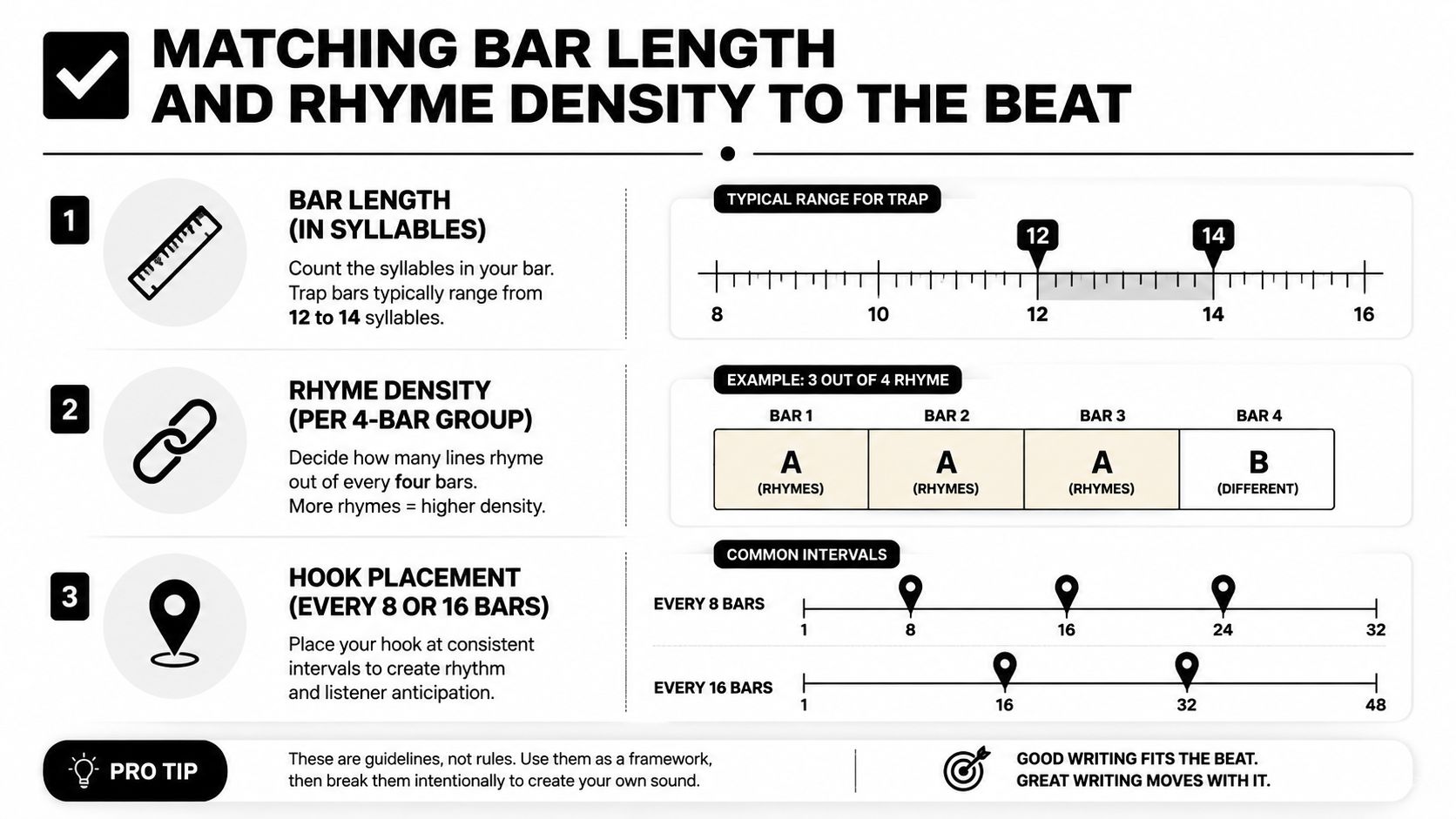 An educational infographic explaining how to structure trap rap lyrics with syllable counts, rhyme density, and hook placement.
A beat-first checklist
- Count syllables: Read each line aloud and mark the stressed syllables.
- Mark rhyme pairs: Highlight end rhymes and underline useful internal echoes.
- Circle the hook: Identify the exact line or refrain that returns.
- Check the snare: Play the beat and note whether the key word lands with the snare.
- Trim the spillover: Remove words that force you to rush the final phrase.
A faster banger with busy hats usually favors compact bars and more frequent rhyme movement. A slower, lazier pocket can tolerate longer phrases, provided the stressed words still land cleanly. For producers who need to shape the backing around the writing, this guide to making a backing track provides a useful companion workflow.
Publishing Your Diss Track Without Legal Drama
A finished lyric isn't the end of the job. Before you publish, separate the creative question from the rights and platform questions. A diss can be original and still create problems if it uses someone else's recording, implies unsupported factual claims, copies recognizable wording, or relies on a beat whose license doesn't cover your release.
Run the originality check first
Read the lyric without the beat and flag any line that sounds unusually familiar. Search distinctive phrases, run a plagiarism check, and review the text for paraphrased slogans or recognizable quotes. An AI-detection read-through isn't proof of authorship, but it can expose stiff phrasing that needs rewriting in your own voice.
Check the target carefully. A direct name is clearer than an implied reference, but it can also create greater exposure depending on the content and jurisdiction. Avoid presenting invented allegations as facts, and consider whether a line attacks a person's identity rather than their public behavior or artistic work.
Clear the audio and document the credits
Review the beat license before distribution. Interpolations, lifted vocal tags, uncleared samples, and drum-kit restrictions can affect what you're allowed to upload. Keep producer names, split agreements, and license receipts in one folder.
Use the credit fields consistently across BeatStars, DistroKid, YouTube descriptions, and other platforms. List the producer, identify contributors, and record whether AI assisted with drafting or arrangement according to the platform and collaborator expectations. Keep your original prompts, generated drafts, edits, and final session files. They create a useful provenance trail.
The publishing order should be practical:
- Finalize the master and publishing split.
- Register the required release identifiers.
- Upload through the distributor with accurate metadata.
- Promote the finished track after the rights information is in place.
Platform systems can create separate headaches. YouTube may flag audio through Content ID. TikTok may classify an upload differently from a standard music release. SoundCloud can process takedown complaints, while Spotify metadata can raise questions around synthetic vocals. Review each service's current rules before release.
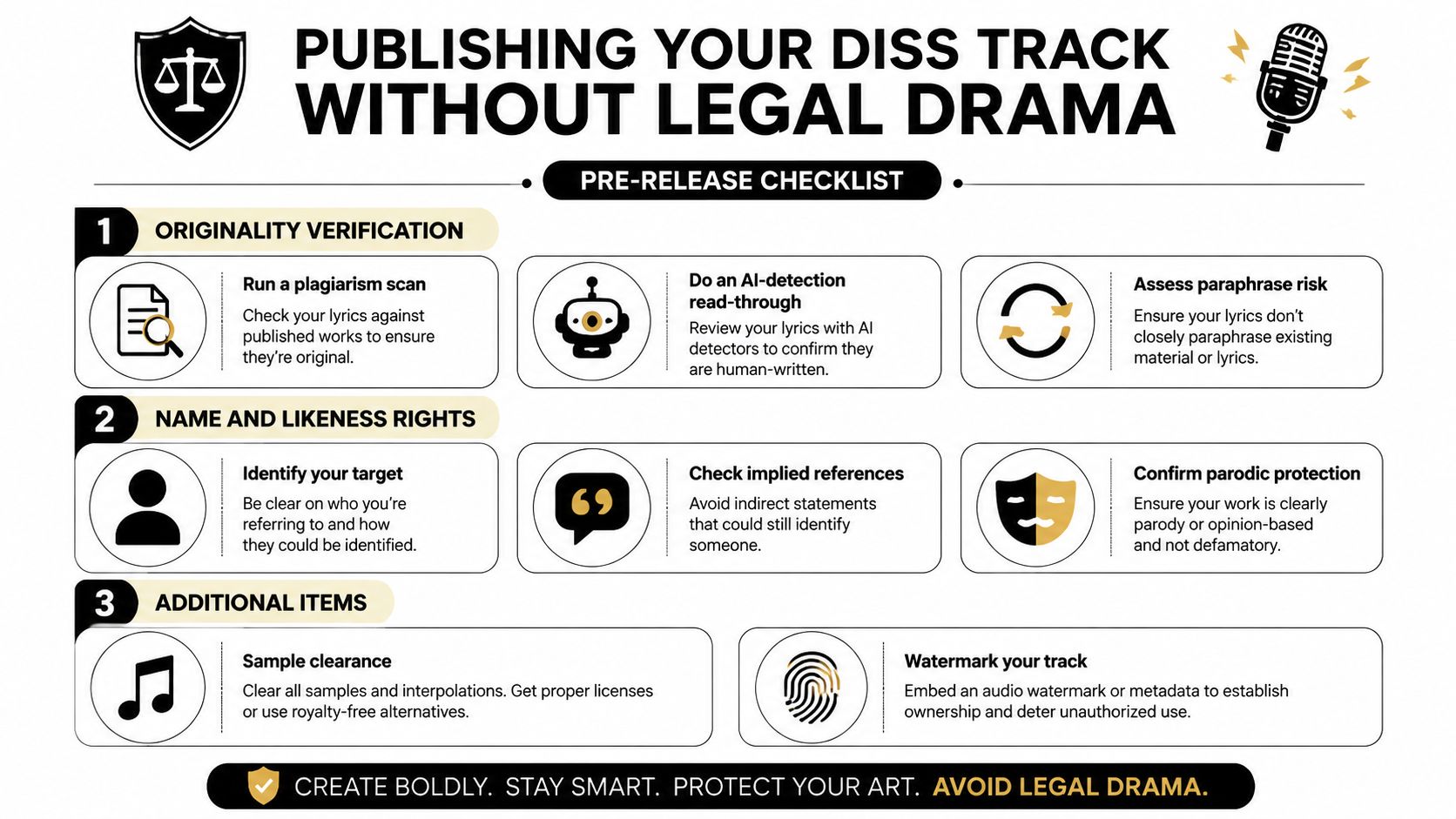 A checklist infographic titled Publishing Your Diss Track Without Legal Drama, outlining steps for musicians to avoid lawsuits.
Screenshot this final check
- Verify originality: Remove literal diss-target quotes and copied phrasing.
- Swap risky references: Replace unnecessary brand names and identifiable third-party material.
- Confirm the beat license: Check the permitted use, distribution, and commercial terms.
- Add an original-work statement: Record your contribution and disclose AI assistance where appropriate.
- Save your provenance: Keep prompts, drafts, edit logs, licenses, and final exports together.
For questions about AI-assisted releases and ownership, review whether you can publish a song written by AI. For a commercial release, consult a publishing attorney who can assess your specific lyrics, recording, target, and licenses.
DissTrack AI lets you enter a target, relationship, inside jokes, and a trap style, then generate structured diss verses with adjustable savagery and multiple variations for editing. Use DissTrack AI to create a starting draft, force it into your beat's syllable and hook structure, and turn the usable bars into a track that sounds like you.