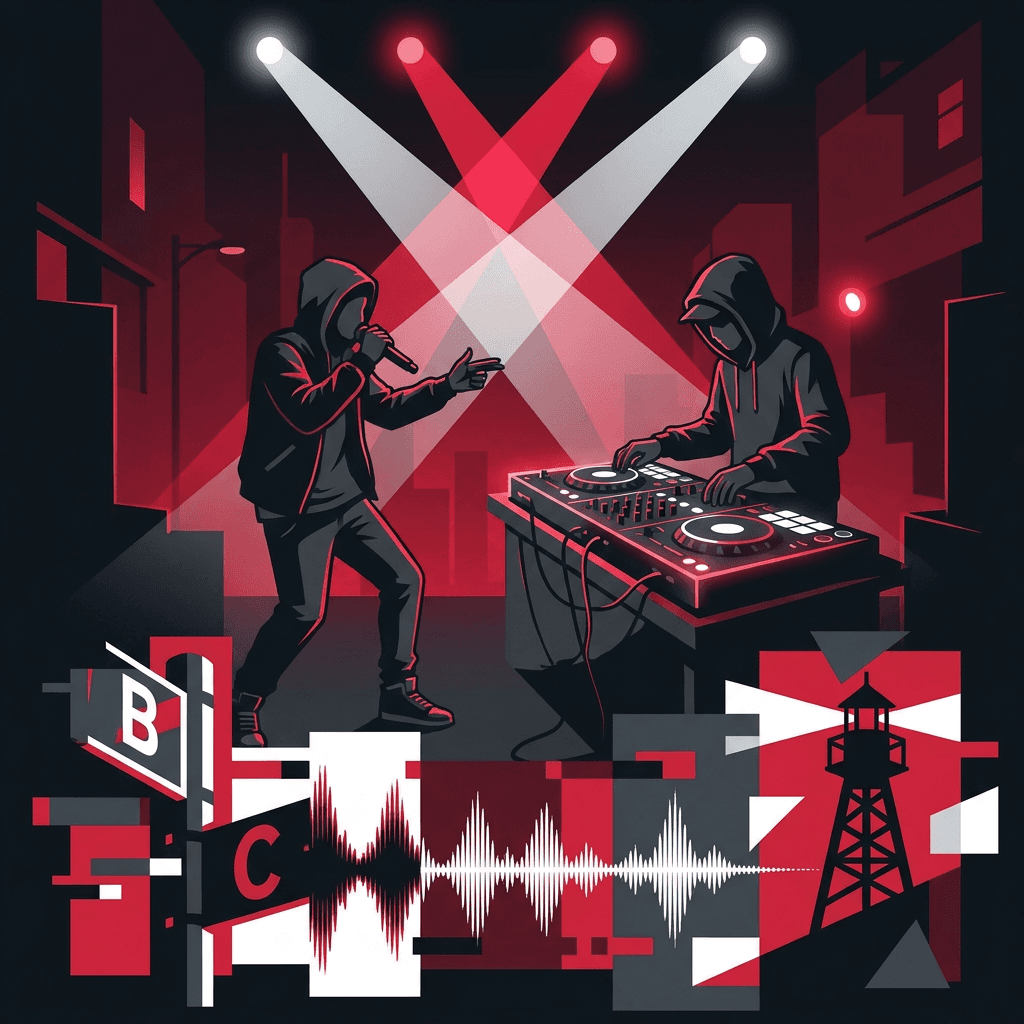
What Is UK Grime? Origins, Sound, and Key Artists
UK grime is a fast, electronic British rap form born in early-2000s East London tower blocks, built around pirate-radio MCs, 140 BPM beats, and crew-based clashes. It emerged around 2001, then reached a national audience when Dizzee Rascal won the Mercury Prize in 2003 and Lethal Bizzle's “Pow! (Forward)” entered the UK Top 20 in 2004.
I remember hearing grime through a thin bedroom wall before I properly understood what it was. The beat sounded like an alarm trapped inside a video game, the MCs sounded ready to argue with the whole street, and the DJ kept stopping the tune just when the room got loudest. That combination of speed, tension, humour, and live pressure is the quickest route into understanding what UK grime is.
The Sound That Came Out of the Tower Blocks
Late at night in East London, a kettle might be boiling in a cramped flat while a teenager hunches over an Atari, tapping out a melody that sounds less like a piano and more like a warning signal. Somewhere nearby, a pirate-radio transmission cuts through a stacked stereo. The signal crackles, the bass rattles the windows, and an MC grabs the microphone as if the next eight bars are a small public trial.
That setting matters. UK grime emerged in East London in the early 2000s, shaped by UK garage, dancehall, hip-hop, and pirate-radio culture. BBC coverage places its earliest foundations around 2001, with the sound spreading through illegal pirate stations before it gained wider recognition in BBC's programme history of grime. London's tower-block communities weren't just scenery behind the music. They supplied the cramped rooms, local rivalries, cheap equipment, shared bedrooms, and broadcast networks that gave grime its first shape.
A useful working definition is simple: grime is fast electronic British rap designed for pressure, movement, and live MC performance. Its classic beat framework runs at 140 BPM, often using stark synth sounds, stripped-back drums, heavy sub-bass, and short repeating patterns. The beat leaves space because the MC is expected to occupy it with rhythm, personality, threats, jokes, boasts, and sudden changes of flow.
Why the location changed the sound
American hip-hop often reached listeners through polished albums, radio programming, and label-backed promotion. Grime grew through a more improvised route. Pirate stations acted like open workshops, where crews could test lines in real time and hear which phrases made the room erupt.
That infrastructure encouraged a raw, collective style. A grime track could feel less like a finished pop object and more like a door opening onto a live set. The listener wasn't only hearing a beat and a verse. They were hearing a local network at work.
Practical rule: If the instrumental feels slightly unfinished but the MC sounds completely awake, you're probably close to grime's central idea.
The rest of grime's story follows three connected threads: the sound, the performance craft, and the transformation from a pirate-radio subculture into an established British genre. Its history is local, but its method of turning limited resources into intense performance has travelled widely.
What Grime Actually Sounds Like
Grime reveals itself through tension: a fast pulse, spare sound choices, and an MC who treats every gap as usable space. The beat works like a bare stage, with few props and nowhere to hide. Each sound has a job, leaving the performer to supply the movement and drama.
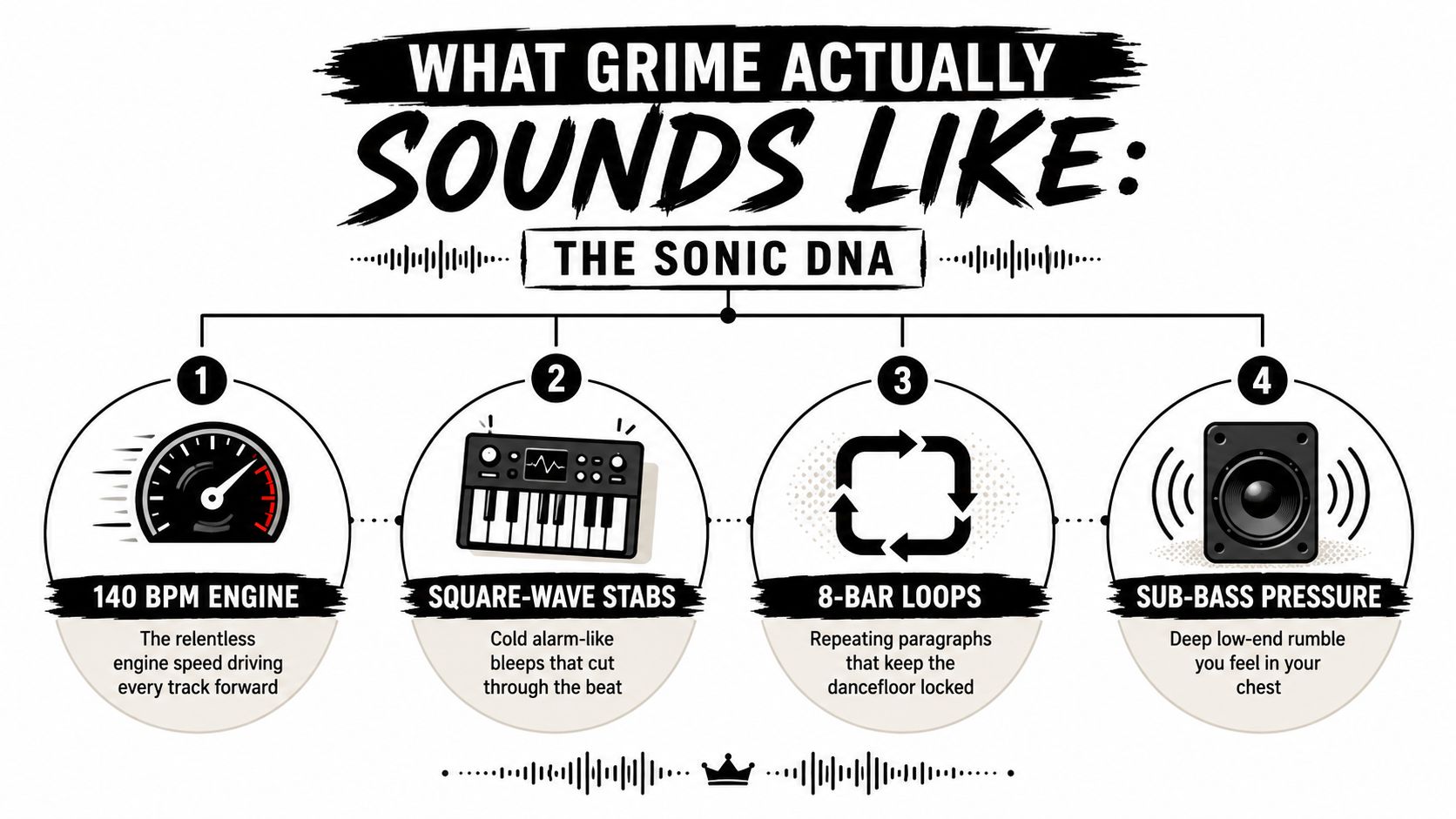 An infographic detailing the four key sonic elements that define the sound of UK Grime music.
The engine and the empty space
140 BPM is the familiar speed associated with classic grime. It drives forward with relentless urgency, quicker than the relaxed feel many listeners associate with hip-hop, yet shaped differently from jungle's rolling rush.
The drums often borrow energy from UK garage and related dance music, then leave deliberate gaps. Those spaces are part of the design. An MC can snap into the rhythm, pause before a punchline, or switch from clipped delivery to a longer burst.
Square-wave synth stabs provide the cold, digital edge. Their tone can recall a smoke alarm, an old arcade machine, and a siren arguing over one note. Producers usually deploy them in short, sharp phrases instead of lush melodies.
Loops, riddims, and rimming
An 8-bar loop is a short musical paragraph that repeats. Its return anchors the listener while the MC changes the meaning above it. Pop often builds toward a large chorus with layers of instruments. A grime riddim keeps its architecture exposed, so the performance remains the main event.
You may also hear “rimming”, a scene term for a raw beat re-cut or version of an existing track. The term describes reshaping the riddim for a new performance angle, not decorating the track. That distinction matters because grime's backing can function like a shared platform, ready for different MCs to test their voices.
For anyone exploring this approach, a guide to making rap beats offers a starting point for working with loops, drums, and space.
The final ingredient is the voice. A grime MC uses the beat like a set of steps, jumping across gaps, placing syllables against the snare, stretching vowels over the bass, and turning repetition into a weapon. If the beat feels slightly unfinished but the MC sounds completely awake, you're probably close to grime's central idea.
How Grime Was Born in Early-2000s London
Grime grew from a cultural shift in London's underground. Late-1990s jungle, UK garage, dancehall, hip-hop, and pirate radio had already supplied the ingredients. Producers and MCs then made the rhythms harsher, more skeletal, and better suited to direct lyrical competition. Garage had centred on the dancefloor and sung vocals. Grime pushed the MC forward, giving the voice a more confrontational role while the backing became more severe.
Pirate radio as a live laboratory
Stations such as Rinse FM turned broadcasting into practice under pressure. A radio set required MCs to respond quickly, hold attention, share the microphone, and stand out beside other voices. DJs could reload a beat when a line connected, turning a strong bar into a shared event rather than a private recording.
Crews gave this system structure. Roll Deep, More Fire around Lethal Bizzle, and later Boy Better Know brought together artists, producers, DJs, and local listeners. A bedroom, block, or small studio could become a recording space, while the transmission carried its energy beyond the immediate neighbourhood. Pirate radio worked like a public workshop: rough ideas were tested in real time, and the crowd's reaction helped shape what came next.
Dizzee Rascal's Boy in da Corner became a major legitimacy moment when it won the Mercury Prize in 2003, as documented in the chronology of grime music. The award showed institutions that this local, rough-edged sound could support ambitious album-making. Grime kept its underground identity, yet the national music industry could no longer treat it as a passing noise from one corner of London.
From local pressure to chart recognition
The following year, Lethal Bizzle's “Pow! (Forward)” reached the UK Top 20 in 2004, giving grime further visibility beyond pirate radio and specialist audiences. BBC coverage identifies the early 2000s as the genre's formative period, while reference histories connect its spread from London to other British cities.
Those developments explain grime's rapid rise. Artists first built a working culture through radio sets, crews, recordings, and live pressure. Awards and chart attention followed, translating that culture for institutions and listeners who had not experienced it firsthand.
That history also explains why grime is more than a relic of the 2000s. Its pirate-radio habits remain useful in diss tracks and live sets, including the mini-resurgence visible across 2025-2026. The setting may be a stage or screen rather than a tower-block transmission, but the core format still depends on presence, response, and an MC proving control of the moment.
The Generations of Grime MCs
Grime's story follows a family tree rather than a frozen playlist. Each generation inherits the demand for sharp timing and presence, then adapts it to new rooms, cameras, and audiences.
| Generation / Era | Key MCs | Main Platform | Lyrical Focus | Signature Track |
|---|---|---|---|---|
| First wave | Dizzee Rascal, Wiley, Kano, Skepta | Pirate radio, crew sets, pirate CDs | Estate life, rivalry, identity, technical skill | “Pow!” |
| Second wave | Ghetts, Chip, Stormzy, JME | Mixtapes, freestyle videos, streaming platforms | Ambition, visibility, self-definition, social pressure | “That's Not Me” |
| Current and continuing wave | Established veterans, newer MCs, emerging female artists | Live sets, video platforms, streaming, social media | Lineage, reinvention, clashes, crossover identity | Varies by artist and set |
The first template
Dizzee Rascal and Wiley helped give grime its early vocabulary. Their work tied the sound to pirate radio, Roll Deep, and the exploratory production style associated with eski beats. Kano added technical control and narrative detail, while Skepta built a direct, commanding presence that could fill a radio room or a major stage.
Early grime often stayed close to its source: raw 140 BPM beats, tight loops, and verses designed to prove that an MC could control the moment. A huge chorus was optional. One sharply timed phrase could become the hook, much like a bright marker on a crowded map.
Expansion without losing the core
Ghetts and Chip showed how grime could carry personal ambition and industry commentary while retaining its competitive edge. Stormzy emerged as freestyle videos, streaming, and online discovery allowed an MC to reach far beyond a local radio audience.
The platform changed the presentation. A radio set depended on crew chemistry. A video freestyle put the camera close to the performer. A chart single usually needed a clearer structure, yet strong artists kept the feeling that a person, not just a polished recording, was driving the track.
Generational change now shows grime's institutional maturity. Wiley and Dizzee Rascal are two decades into their careers. Stormzy headlines major stages, while artists such as Novelist carry a newer wave. The scene also continues to produce emerging female artists and performers who move between grime, rap, and wider crossover spaces.
That movement is part of the genre's current life. The 2025 to 2026 mini-resurgence in diss tracks and grime sets, noted in this history of UK grime, brings the old pirate-radio logic back into live performance. The setting may be a stage or screen instead of a tower-block transmission, but the test remains familiar: presence, response, and an MC proving control of the moment.
How MCing, Freestyles, and Clashes Work
An MC in grime is a performer who rides a beat with rhythm, timing, and bars. They may perform written material, improvise, or move between both approaches during a set. The job isn't to rap over a beat. It's to make the room feel that the beat has become a contest.
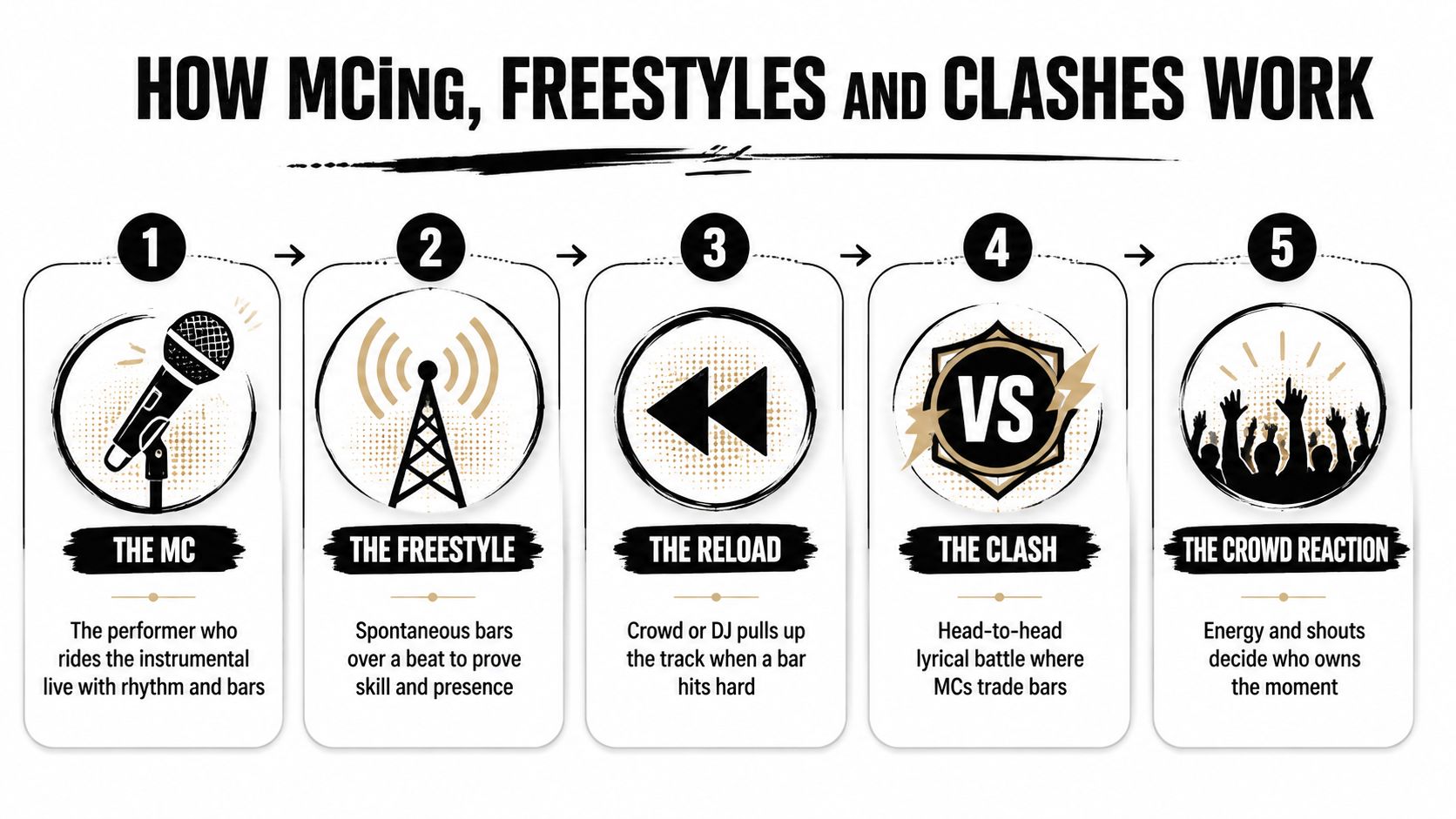 An infographic titled How MCing, Freestyles and Clashes Work, illustrating five steps in grime culture.
Bars and the shape of a verse
A bar is a unit of musical time used to organise lyrics. Grime performers often work in groups of four, eight, or sixteen bars because those lengths fit naturally with repeating musical phrases.
An 8-bar loop gives the MC a compact stage. The opening bars can establish an idea, the middle can tighten the rhythm, and the final bar can deliver a punchline or memorable turn. That structure resembles verbal boxing with a beat instead of gloves. The MC circles, feints, attacks, and resets when the loop begins again.
A freestyle can mean improvised bars created in the moment, though the word is also used more loosely for a prepared verse performed in a freestyle setting. Context matters. A radio freestyle often tests spontaneity and presence, while a recorded single may use carefully written lyrics, edits, and multiple takes.
Reloads and clashes
A reload happens when the DJ or crowd pulls the track back because a line has landed hard. The interruption creates tension, then gives the MC another chance to repeat or extend the moment. It's similar to a crowd demanding an encore, except the encore can happen inside the verse.
A clash puts MCs or crews head to head. They trade bars, often over the same beat, and attack each other's skill, reputation, style, or claims. The crowd reacts through noise, movement, and approval, so the winner isn't determined only by written quality. Timing and delivery can change the verdict.
For beginners who want to practise this kind of spontaneous writing, this guide to freestyling rap breaks the craft into manageable exercises. Start with a simple beat, choose a subject, and focus on staying in rhythm before chasing complicated wordplay.
A strong grime MC doesn't fill every gap. They know which gaps make the next bar hit harder.
Grime's Place in British Culture Today
Grime became more than a sound. It gave British youth culture a visual language of tracksuits, trainers, dark colours, estate stairwells, radio rooms, and crews gathered around one microphone. Boy Better Know helped turn affiliation into identity, while grime-linked fashion connected music with everyday streetwear rather than a fixed uniform.
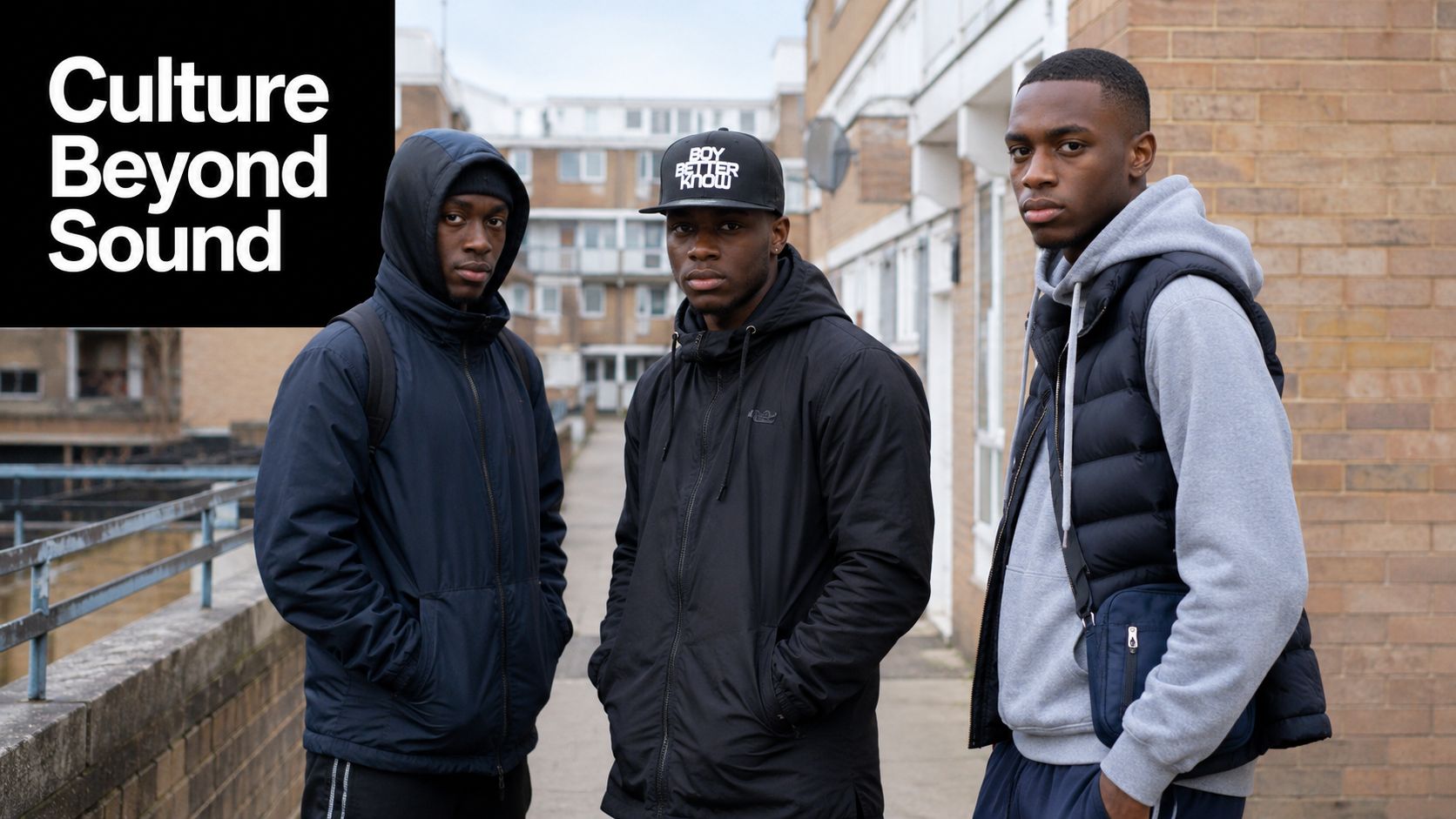 Three young Black men standing together in an urban residential environment wearing casual streetwear clothing and hoods.
The culture also changed how audiences found performers. Link Up TV, SBTV, GRM Daily, and YouTube freestyle sessions gave unknown MCs access to listeners who might never have heard them on traditional radio. A camera, a microphone, and a distinctive verse could build recognition before a major label became involved.
Grime's vocabulary entered wider British speech, though slang changes once it travels beyond its original setting. Listeners borrowed expressions, flows, and attitudes, sometimes with the local context and sometimes only with the surface. That gap often appears when neighbourhood culture becomes nationally visible.
Influence without simple replacement
UK drill, road rap, and Afroswing followed different musical and social routes, but grime helped establish an audience for distinctly British rap formats. Later styles are not automatically grime. Grime's wider contribution was proving that local accents, rhythms, and performance codes could command major attention.
Its influence remains visible in the importance of filmed performance. A freestyle video can matter as much as an audio release because viewers watch how an MC occupies space, responds to the beat, and handles pressure.
The 2025 to 2026 mini-resurgence brings that performance culture back into focus through fresh grime diss tracks and revived sets on platforms such as Link Up TV. Grime is being used again as a live format, with the exchange between MC, DJ, and crowd carrying the energy. It therefore belongs to the present, not only to memories of the 2000s.
For listeners comparing grime's competitive energy with a neighbouring style, a drill rap lyrics generator can show how different prompts create different lyrical textures. The genres may share audiences and attitudes, but their rhythms, delivery, and performance traditions remain distinct.
Common Misconceptions About UK Grime
Grime is easy to mislabel because its beats are stark and its clashes can sound hostile. Listen more closely, and the genre opens into a wider culture of invention, humour, local identity, and performance.
Grime is just gang rap
Grime may describe street pressure, rivalry, or danger, yet its subject matter is far broader. JME's writing often turns toward humour, self-awareness, technology, and the craft of being an MC. Stormzy has also made space for faith, family, ambition, and personal vulnerability. Those examples show why aggressive delivery does not automatically make a song gang rap.
The distinction becomes clearer during a clash. A clash is a competitive performance, closer to verbal sport than a criminal exchange. MCs test timing, originality, confidence, and crowd response. The language may be sharp, but the contest is judged through technique and presence.
Grime died after its first peak
Grime moved away from the centre of popular conversation, but that is different from disappearing. Older artists still perform, newer artists borrow and reshape its structures, and radio sets continue to give the format room to breathe.
The 2025 to 2026 mini-resurgence makes that continuity visible through fresh diss tracks and revived live sets. Recent activity does not recreate one fixed golden age. It shows that grime still works when an MC, DJ, and crowd share the same moment, with reloads, reactions, and pressure carrying as much weight as the recording itself.
Grime is the same as UK hip-hop
Both belong to British rap, but their usual foundations differ. Grime's familiar 140 BPM framework, electronic austerity, pirate-radio history, and MC-led sets give it a distinctive identity. UK hip-hop can use a wider range of tempos, warmer samples, and arrangements built around albums, hooks, or producers.
| Feature | UK Grime | UK Hip-Hop |
|---|---|---|
| Common rhythmic feel | Fast, electronic, often built around 140 BPM | Broader range, often slower or sample-led |
| Core performance | MC sets, clashes, reloads, crew chemistry | Verses, hooks, albums, cyphers, producer-led arrangements |
| Historical route | Pirate radio, UK garage, dancehall, local crews | Hip-hop traditions, sampling, DJ culture, independent scenes |
| Instrumental character | Sparse, tense, synthetic, bass-heavy | Can be soulful, dusty, jazzy, polished, or experimental |
| Best entry point | Live set or clash recording | Album, single, cypher, or producer showcase |
Grime is too niche for casual listeners
You do not need to memorise every crew before pressing play. A short set can reveal the appeal: the beat moves quickly, the MC has limited space, and a strong line can change the room's energy at once. Grime rewards curiosity, but the first listen requires no university course.
Where to Start Listening to Grime
Start with the mood you want, not a fixed history lesson. Grime has several entry points: stark atmosphere, memorable hooks, intricate bars, or the pressure of a live clash. Each route reveals a different part of the genre.
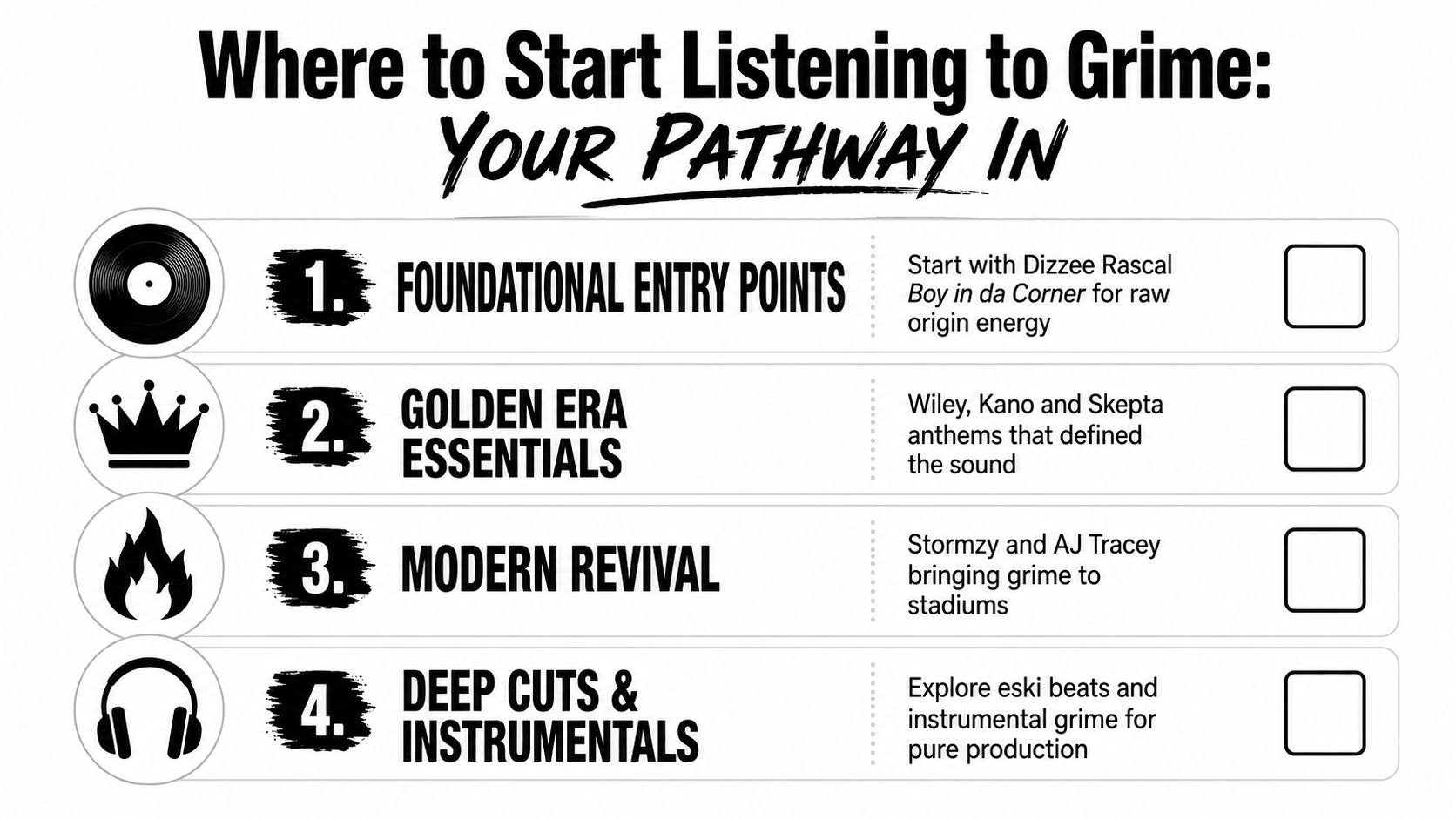 A four-step checklist titled Where to Start Listening to Grime displaying music categories and artist recommendations.
If you want the origin energy
Begin with Dizzee Rascal's Boy in da Corner. Its anxious electronics, local detail, rhythmic invention, and uneasy atmosphere make it a strong album-length introduction to early grime. Follow it with Wiley's Treddin' on Thin Ice, then search for Roll Deep radio sets or old eski-beat performances.
Dizzee's album also won the Mercury Prize in 2003, marking grime's movement from pirate-radio culture into wider British musical institutions. Listen for the tension in the production, then notice how the vocal seems to push against the beat.
If you want instant impact
Try Lethal Bizzle's “Pow! (Forward)” and Skepta's “That's Not Me.” Both show how grime can be direct, chantable, and physically energetic while keeping the MC at the centre. Search for Skepta, JME, or Boy Better Know radio sets to hear crew chemistry rather than a polished single.
Link Up TV and related freestyle channels offer a visual route. The performer's posture, timing, facial expression, and reaction to the room explain why grime is more than a beat with words placed over it.
If you want deeper modern work
Move to Ghetts, JME, and Skepta's Konnichiwa. These artists approach maturity, scale, humour, and self-awareness differently. Pair the albums with freestyle videos. A carefully sequenced project and an exposed live performance reveal different kinds of control.
Streaming playlists labelled Grime Classics and Rinse FM archives are useful maps, though they are not complete histories. Follow the voices that make you stop and rewind.
If you want the current live feeling
Explore recent Skepta and Chip diss exchanges, then look for newly uploaded grime sets and clash footage connected with the current revival. The point is not to declare every new round a classic. Listen for the urgency created when two MCs must answer each other, especially as the 2025 and 2026 mini-resurgence brings diss tracks and live sets back into focus.
Add a newer female voice with Lady Fury's grime releases and live appearances. Her work gives the listening path a different perspective on MC presence and shows that the format is not sealed inside its early-2000s history.
Try this first-week route:
- Day one: Dizzee Rascal, Boy in da Corner.
- Day two: Wiley and an eski-beat set.
- Day three: Lethal Bizzle's “Pow! (Forward)”.
- Day four: Skepta's “That's Not Me”.
- Day five: Ghetts or JME.
- Day six: Lady Fury, then a recent female-led grime set.
- Day seven: A recent clash or live grime set.
The order matters less than active listening. Hear the spaces between bass hits. Notice where the MC leaves silence, where the DJ reloads, and how a simple loop becomes a stage.
If you want to practise that competitive energy, DissTrack AI lets you generate personalised roast lyrics with a UK Grime style option, then edit the verses for your own voice, friends, videos, or performances. Use the result as a starting point for a playful grime-inspired clash.