7 UK Rap Battle Examples That Changed the Game
The UK rap-battle scene didn't grow from punchlines alone. It developed through formats that turned confrontation into repeatable performance: grime clashes over beats, filmed league rounds, live tournaments, and verses built to travel beyond the room. That history offers a useful surprise for anyone writing a battle verse today. The format can shape the bar as much as the opponent does.
The strongest moments combine timing, character, crowd chemistry, structure, and the patience to make a listener wait for the next line. A callback can reward close attention; a sharp ending can give a crowd something to react to; a local reference can make a verse feel lived-in. But a reference that means nothing to anyone outside the room can also lose its force.
These seven examples focus on distinct performance approaches and the craft each one can teach. Some are anchored in documented UK battle culture; others are practical writing models for freestyle, storytelling, and short-form performance. The aim isn't to rank artists by fame or views. It's to identify what makes a moment work, then turn that observation into a repeatable tactic for a cypher, a recorded track, or a video.
1. Grime MC Battles and Lord of the Mics
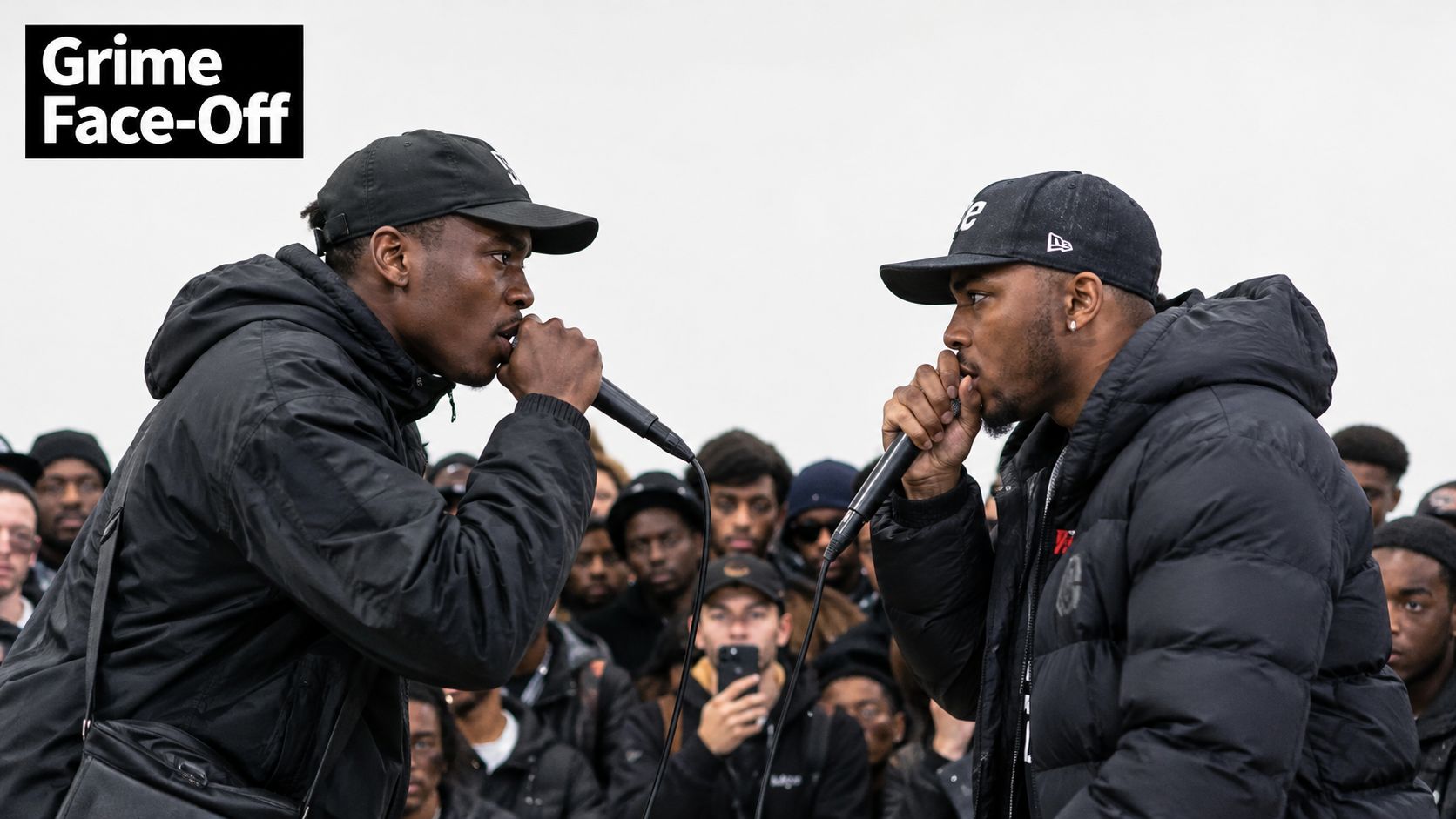 Two black men in black hoodies and caps facing each other in a heated rap battle.
A grime clash has a different pulse from a verse written for a silent page. The MC has to make words land against a backing track, with timing and delivery doing as much work as the rhyme. Lord of the Mics turned that kind of direct confrontation into a repeatable media format, connecting underground music culture, filmed performance, and artist development.
The series began in 2004, when producer and MC Jammer launched it from a basement in east London. Its early clashes included Wiley against a teenage Kano, and later installments brought in artists such as Skepta, Bashy, and Birmingham MC Devilman. The format's particular strength was its combination of music and confrontation: each MC had to ride the beat while making the opponent, and the audience, feel the pressure. (The Fader's account of Lord of the Mics)
Make the response feel immediate
That context explains why a good grime-battle bar often sounds like an answer, not a prepared speech. A callback to an opponent's earlier line can create that feeling even in a written round: it tells the audience you heard the attack and have turned it around. Place the sharpest word at the end of the bar, then leave enough space for the reaction instead of stepping on it with the next line.
Performance rule: Write a few different angles, but keep the transitions flexible. If the other MC changes the subject, a responsive bar can feel more alive than a perfect verse that ignores the moment.
For a structured starting point, explore this guide to writing a battle rap song. Draft the rhyme first, then test whether the punchline still lands when you say it over a beat. A grime influence isn't just a sound tag. It's a demand for rhythmic control, directness, and lines that survive performance.
Here's a Lord of the Mics battle clip.
2. Don't Flop and the Online Battle League
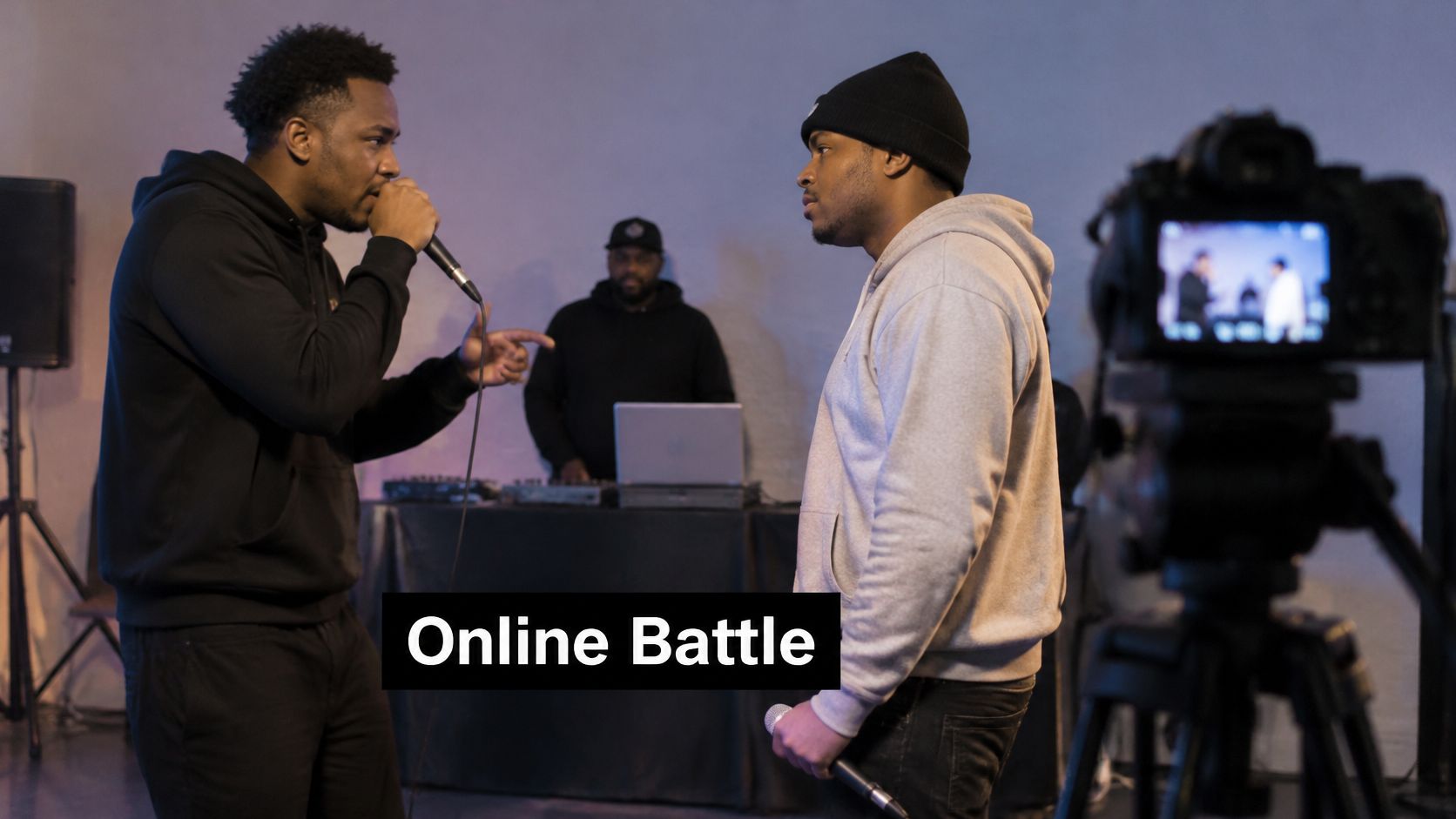 Two rappers facing off during a rap battle performance in a studio setting with a camera
Don't Flop shows what happens when a battle is made to live beyond the venue. The league helped make UK battle rap a searchable video experience, where viewers could revisit a round, quote a line, and follow a rivalry after the performers had left the stage. The writing consequence is significant: a battle verse has to work both as a live exchange and as a piece of recorded content.
The league's rise also shows how a repeatable format can build audience attention. Reporting from 2016 cited more than 100 million cumulative YouTube views, approximately 360,000 online subscribers, and more than 1,000 tickets sold for its seventh-birthday event. Those are historical figures, not current totals, but they demonstrate how filmed battles could reach far beyond the people in the room. The Shotty Horroh versus Arsonal battle was reported at nearly 8 million views, bringing the format to audiences beyond its specialist scene. (Rife Magazine's report on battle rap)
Write for the replay
A replayable line needs enough context to make sense when a viewer encounters it out of order. Build toward one clear setup and payoff, rather than relying on a string of references that only the people at the event understand. If you're creating a roast series, give each instalment a distinct angle so the next release adds to the story instead of repeating the same insult.
A clip can also reveal weaknesses a live crowd hides. A line that depends on a long explanation may lose viewers before its payoff; a clean image or compact wordplay can travel without flattening the whole verse. Keep the attack within agreed boundaries, especially when personal material is involved.
To study how punchlines can be built and varied, use these battle rap line examples as a creative reference. Then say your own lines aloud, cut a short excerpt, and ask whether a new listener can follow the setup without extra explanation.
3. The Freestyle Booth as a Pressure Test
A freestyle is a different test from a prepared battle round. The writer can't polish every phrase in advance, so the performance depends on listening, choosing an angle quickly, and making the delivery sound deliberate. A BBC Radio 1Xtra freestyle format such as Fire in the Booth can be used as a practical model for that pressure: the central skill is turning a prompt into a coherent run of bars without losing the beat.
For a real rehearsal, pick a topic that has enough detail to generate images. An inside joke, a familiar habit, or a harmless public quirk gives you more to work with than a generic insult. Then choose a simple rhyme pattern and keep the ideas connected. The point isn't to force a clever line into every beat. It's to make the listener feel that each bar follows naturally from the last.
Practise the pivot, not just the rhyme
Try a three-step exercise: name the subject, describe a specific behaviour, then flip that behaviour into a punchline. If you stumble, don't stop the performance. Reframe the next line around a new detail, and use the recovery as part of your delivery. Battle audiences notice composure; a minor slip doesn't have to become the moment they remember.
Record the practice and listen for flat endings. A line may look clever on a page but still lack a strong final word, a clear image, or a satisfying rhythm when spoken aloud. Adjust the language until the rhyme feels natural in your voice.
A generated variation can offer another route into a line, but it can't replace the timing you build by practising out loud. Treat a draft as a prompt, not a performance. Keep the best idea, discard the filler, and make the finished bar sound like something you would say.
4. Short-Form Freestyle Challenges
A recurring freestyle challenge is a useful model for anyone trying to make a high-energy rap clip. Lady Leshurr's Queen's Speech is a familiar example named in discussions of UK rap, but a specific performance claim isn't needed to draw the practical lesson: a recognisable format gives the audience a reason to understand the next video quickly. The challenge is to deliver speed and wordplay without letting articulation disappear.
Start with a small, repeatable premise. Each new verse might respond to a fresh prompt, turn a familiar phrase inside out, or build a chain of linked images. The audience should be able to recognise the format while still hearing a new idea. That balance is more useful than treating every clip as an unrelated attempt to go viral.
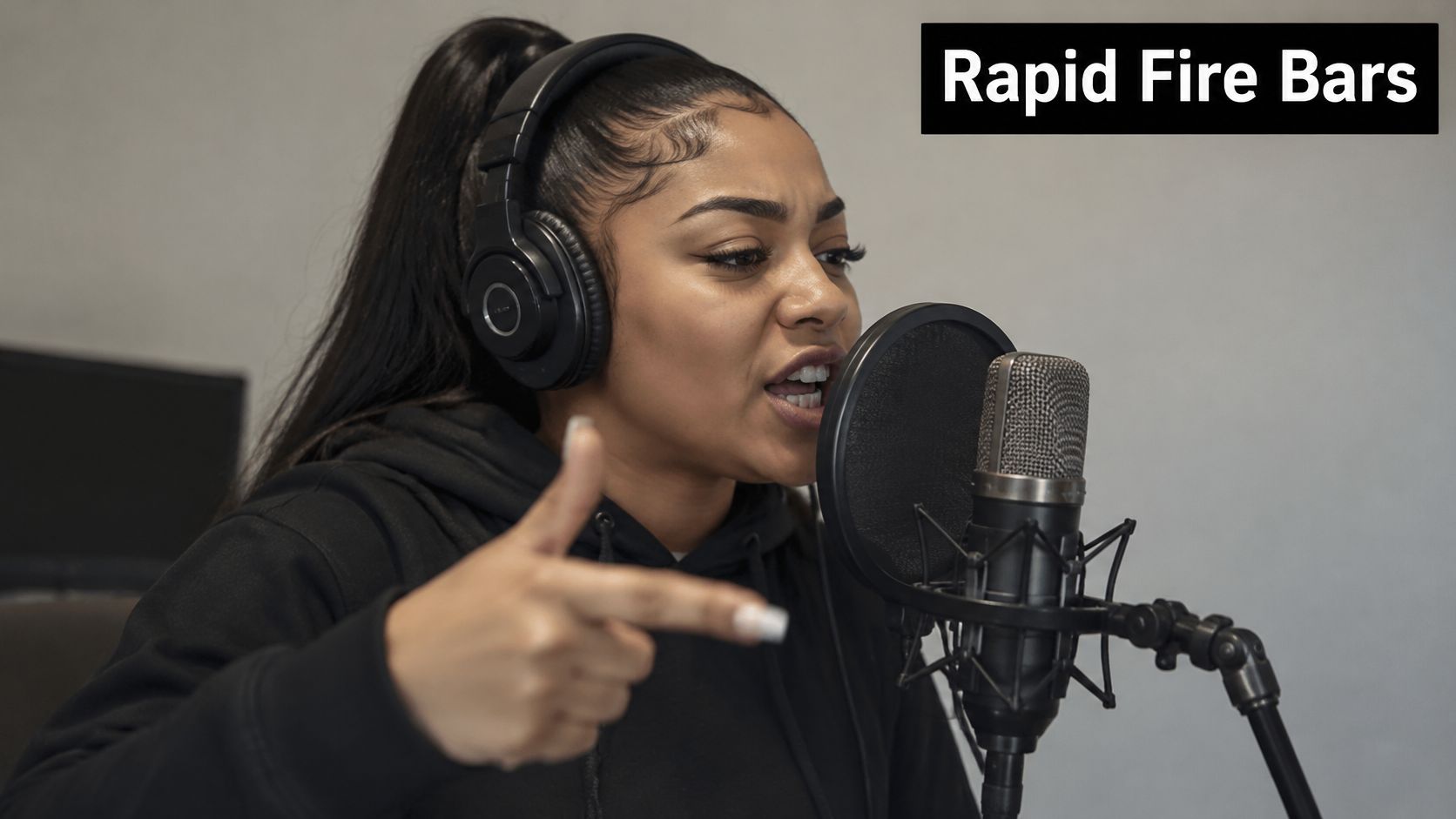 A young female rapper performs with passion while wearing headphones in front of a studio microphone.
Make clarity part of the flex
Tongue-twisting writing only works when the listener can hear the words. Practise a difficult phrase slowly, then bring up the pace while keeping consonants clean. If the line becomes muddy, remove a syllable or change the word order. Precision can sound more impressive than raw speed because the listener gets to enjoy the wordplay instead of guessing what was said.
Before posting a clip, listen once without watching the screen. Does the verse still make sense? Is the payoff audible on the first listen? Those checks can help a creator keep a short performance lively without relying on visual edits to rescue unclear writing.
A recurring challenge can also vary its tone. One instalment might lean comic; another might sound more competitive. That variation gives the performer room to show personality without making every line more hostile than the last.
5. Minimal Beats and Early Grime Tension
Wiley's “Eskimo” and early grime diss culture are useful reference points for one broad writing technique: restraint can make confrontation feel sharper. In a battle verse, that means you don't need to crowd every beat with syllables. A short line, delivered with conviction, can leave the listener room to register the insult before the next one arrives.
Consider a simple performance scenario. The opponent makes a boast about being untouchable; rather than answering with a long paragraph of accusations, you challenge the boast with one clear image, then pause. The pause turns the next line into a reveal. The strength is not in pretending that one phrase settles the contest. It's in giving the audience a clean moment to react.
Let space carry part of the bar
Repetition can help a phrase stick, but only if the repeated words build tension or change meaning. Repeat a short hook, then add a small twist on the last pass. That gives a crowd something familiar to catch and a reason to listen for the variation.
Minimal backing can also expose weak writing. Without busy production to mask a crowded bar, the performer has to make the rhythm, emphasis, and word choice work together. Try the verse without a beat first. If the line has no natural stress or the punchline needs extra explanation, revise it before adding the beat.
The repeatable tactic is simple: write fewer ideas, make each one clearer, and use silence intentionally. A battle isn't a race to fill every gap. The performer who controls a pause can sound more confident than the performer who rushes to the next rhyme.
6. Storytelling That Makes a Diss Specific
Dizzee Rascal's Boy in da Corner offers a useful writing lens for battle verses: personal detail can make a line vivid in a way that a stock insult can't. That's a craft lesson, not permission to expose someone's private life. A specific, observable habit or harmless inside joke gives the audience something concrete to picture; a broad claim such as “you're fake” gives them little to hold on to.
A writer can borrow the storytelling method without turning a battle into a biography. Set the scene in one detail, show the behaviour, then reveal why it undercuts the opponent's image. For instance, a verse might contrast someone's loud online confidence with their careful hesitation in a friendly game. The joke lands through the contrast, not through an attack on identity or vulnerability.
Choose details with care
The best personal angle is usually both recognisable and safe to share. Keep the material to public behaviour, performance choices, fashion, ego, or a relationship-specific joke that everyone involved has agreed is fair game. Avoid private or sensitive details that could cause real harm. A battle can feel personal without making a person's private life the target.
That approach also helps the verse travel. Listeners can understand a clear contrast even if they don't know the performers, while the person who does know the inside joke gets an extra layer. If you're developing your writing from the beginning, this guide to writing your first song can help you think about turning an idea into a structured piece.
Specificity is not the same as cruelty. The more carefully you choose the detail, the less you need to rely on generic abuse to make the verse memorable.
7. Grime-to-Mainstream Energy and the Chantable Hook
Skepta's “Shutdown” is a useful reference for thinking about battle energy that can work beyond a specialist crowd. The practical lesson is to make the central phrase easy to catch, then let the verse add character and detail around it. A chantable hook can invite the audience into the performance; the lines that follow give them a reason to stay.
A real-world test is to say the hook once to someone who hasn't heard the rest of the track. Can they repeat it back? Does it carry a clear attitude without a long explanation? If the answer is yes, the phrase may work in a crowd, a caption, or a short clip. If it needs several lines of setup, keep it as a verse bar rather than forcing it into the hook.
 A male rapper in a black beanie and windbreaker performing with a microphone against white background.
Aim the aggression at choices
A crowd-ready diss doesn't need a personal attack on someone's identity. Focus on what the opponent does, the persona they present, or the gap between their claims and their public behaviour. That keeps the line pointed while leaving room for wit. It also makes it easier to deliver with confidence instead of leaning on a slur for impact.
Short hooks benefit from repeated testing. Try a few versions aloud, then listen for which one feels natural to chant. A phrase that looks clever in writing can become awkward when a group has to say it together. For more examples of how memorable diss writing works, browse these greatest diss tracks and pay attention to how the strongest phrases are shaped for recall, not just shock.
UK Rap Battles: 7-Example Comparison
| Example | 🔄 Complexity to Create or Perform | ⚡ Resource Requirements | 📊 Expected Outcome | 💡 Ideal Use Case | ⭐ Key Advantage |
|---|---|---|---|---|---|
| Grime MC Battles (Lord of the Mics) | High: requires prepared verses and live delivery | MCs, grime beat, venue, audience, cameras | Immediate crowd response and competitive exchanges | Live, one-on-one battle rap | Structured format rewards quick callbacks and punchlines |
| Don't Flop (UK Online Battle League) | Medium–high: requires multi-round writing and performance | Competitors, recording setup, editing, online platform | Shareable battles and ongoing audience engagement | Serialized online battles and rivalry content | Recurring matchups help build audience loyalty |
| Fire in the Booth (BBC Radio 1Xtra) | High: requires freestyle skill under pressure | Performer, studio, host, recording equipment | A showcase of improvisation, flow, and wordplay | Freestyle practice and artist exposure | Demonstrates lyrical ability in a live studio setting |
| Lady Leshurr's Queen's Speech Series | High: requires fast, precise delivery and complex rhymes | Performer, microphone, video production, repeatable concept | Memorable, highly shareable short-form videos | Recurring rap challenges and social clips | Repeatable format highlights technical skill |
| Wiley's “Eskimo” and Early Grime Diss Culture | Medium: requires concise writing and a fitting production style | Minimal grime beat, vocals, recording setup | Punchy, high-energy track rooted in grime culture | Studying early grime sound and competitive bars | Minimal production keeps focus on lyrics and delivery |
| Dizzee Rascal's “Boy in da Corner” and Lyrical Storytelling | High: requires detailed writing and longer-form development | Songwriting time, production, recording setup | Vivid, personal storytelling with lasting influence | Developing specific, narrative-driven verses | Shows how personal detail can make lyrics more authentic |
| Skepta's “Shutdown” and Grime-to-Mainstream Battle Energy | Medium: requires a strong hook and confident delivery | Minimal production, vocals, recording setup | Crowd-ready track with broad appeal | Writing chantable, high-energy verses and hooks | Makes confrontational energy accessible and memorable |
Turn Battle Lessons Into Your Next Performance
The strongest UK battle performances combine a memorable phrase, precise delivery, useful callbacks, and details that make the opponent feel specific rather than interchangeable. Those elements don't have to arrive in the same order. A grime clash may turn on timing against a beat; a recorded round may depend on a line that still makes sense when clipped; a storytelling verse may win attention through one sharply observed detail.
Pick one technique from each example and rehearse it with a time limit. Write a callback to a line you've heard, practise leaving space after a punchline, and test a short hook with someone who hasn't seen the rest of the verse. Then record the performance and listen for the details that disappear when you're moving at full pace. If the audience can't hear the setup, the payoff can't do its job.
Keep the attack theatrical and the material within agreed boundaries. A battle can be cutting without relying on gendered abuse, threats, or private information. Focusing on skill, ego, public behaviour, style, or a harmless inside joke gives you more ways to be funny and more room to make the writing personal. That distinction matters especially when a performance moves from a local crowd to a wider online audience.
DissTrack AI can help generate draft verses and variations from a target, relationship, and inside jokes, with style options that include UK Grime and Battle Rap. Use the output as raw material: keep the lines that fit your voice, rewrite anything that sounds generic, and practise the final version out loud. The performance is still yours to shape, and the audience will hear the difference.
Need fresh bars or a new angle for a friendly roast, battle round, or short-form clip? DissTrack AI can generate personalized diss-track drafts with UK Grime and Battle Rap style options for you to edit and perform. Try a prompt based on a harmless inside joke, then make the strongest lines your own.