
Commercial License Requirements for AI Diss Tracks
You've got a savage hook, a beat that hits, and a roast video ready to upload. Then the brand asks whether everything is cleared for commercial use, and your answer suddenly sounds less battle-ready: you bought access to the generator, but you haven't checked the beat, the voice, or the client's rights.
Commercial license requirements are a clearance chain, not a checkout receipt. Before you monetize an AI diss track, you need permission for the tool's output, clearance for outside material, evidence of your own contribution, and approval under the destination's rules. The punchlines can be reckless. The paperwork shouldn't be.
Commercial License Requirements by Use Case
Your upload is ready, but the permissions folder is empty. Find your release below before pressing publish.
Commercial requirements by monetized use case
| Use case | Commercial plan needed | Music clearance needed | Human-edit proof |
|---|---|---|---|
| Monetized video with AI lyrics only | Yes, a plan permitting commercial use | Only if a beat or recording from elsewhere is added | Recommended: version history of edits |
| Video with AI instrumental and vocals | Yes, covering those audio outputs | Sync and public-performance permissions may apply; verify the supplied audio rights | Recommended: log of arrangement and vocal choices |
| Sponsored post or brand deal | Yes, plus an agreed written brand warranty | Check all music; clear outside material separately | Strongly recommended: edit log shared with the brand |
| Client campaign or agency delivery | Yes, with appropriate sublicense or client-use rights | Audit every component and clear outside music | Strongly recommended: rights audit on file |
| Streaming or download release | Yes, with distribution rights | Composition, master, and mechanical rights may apply | Strongly recommended: record of human contribution |
| Live performance or event playback | Yes, plus venue authorization | A public-performance licence may apply | Recommended: generation records kept |
Read commercial plan as a plan whose terms authorize your intended business use, not necessarily a paid subscription. A free tier can include commercial permission; a paid tier can still impose restrictions.
The music column asks a separate question: who authorized every audible element? If you wrote and recorded everything yourself, there may be no outside music owner to contact. That doesn't eliminate the need to check performance licensing, distribution terms, or rights in supplied AI audio.
Read the table as a release checklist
Keep the human-edit evidence even when nobody requests it at upload. It helps you describe what you contributed without claiming that every generated word is exclusively yours.
Budget for clearance before scheduling distribution. When comparing the cost of multi-platform scheduling tools from Mallary.ai, keep publishing software in a separate budget line from music permissions. Buying a convenient posting workflow doesn't clear the material you post.
Practical rule: A publishing tool moves the file. A licence authorizes a defined use of its contents.
This table is a planning map, not legal advice. Countries, contracts, venues, and distribution services can impose different requirements, so match your release to a row and resolve every applicable layer before publishing. An uncleared sample can hold up the whole asset, even if the lyrics are ready for the main stage.
Why a Commercial Plan Is Not Copyright Ownership
A commercial plan grants the permissions stated in its contract, not automatic copyright ownership. Paying doesn't create authorship, even when you drop the generated roast straight into a monetized video.
Think of the plan as a studio rental agreement and copyright as the deed to what you built inside. The analogy isn't exact, but it separates access and permission from legal protection for creative expression.
The U.S. Copyright Office's January 2025 announcement explains that AI output can receive protection only where a human determines sufficient expressive elements, assessed case by case; prompts alone don't necessarily establish authorship. Human selection, arrangement, and other creative contributions may be protected while the generated material itself remains unprotected.
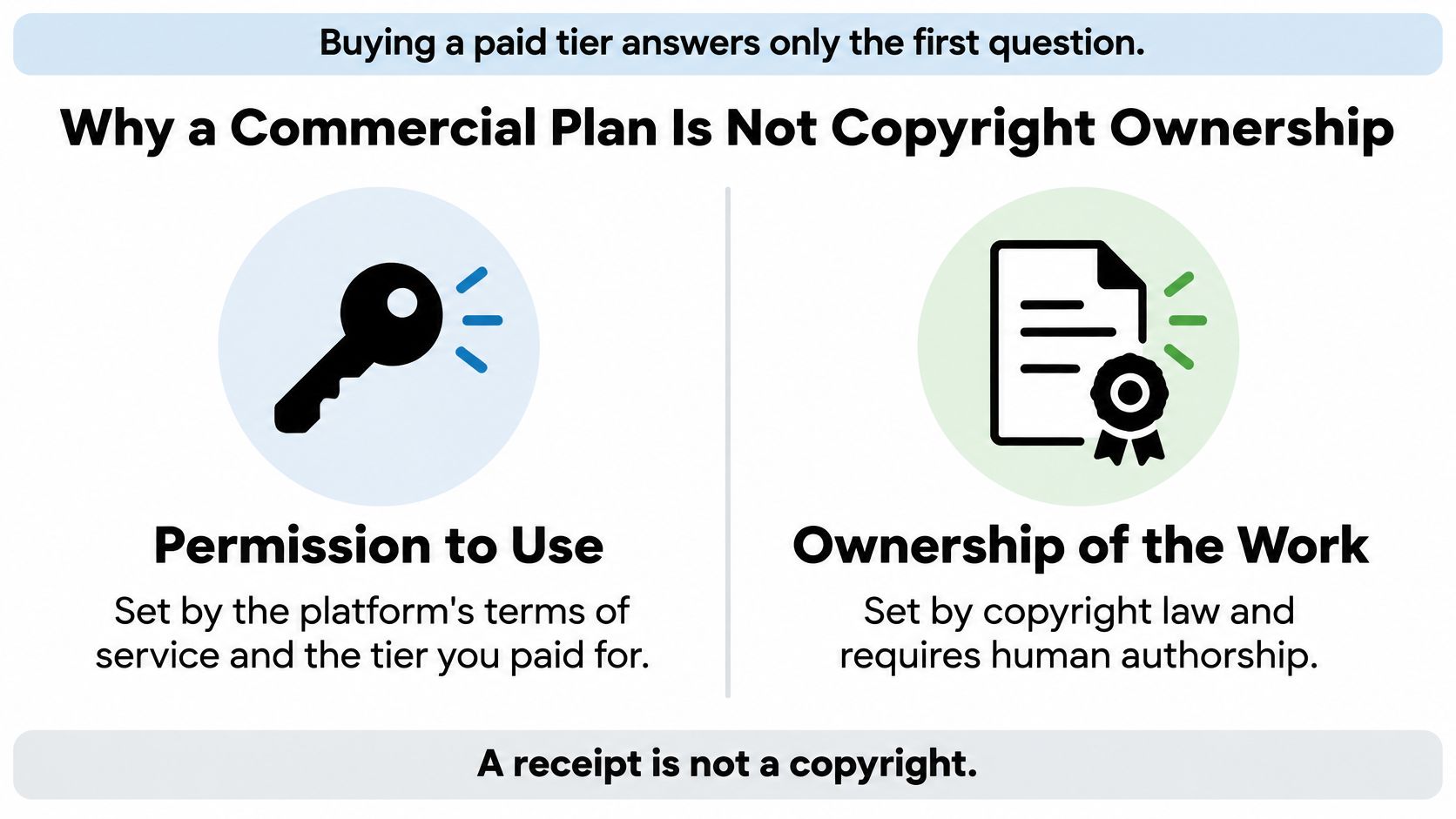 An infographic titled Why a Commercial Plan Is Not Copyright Ownership illustrating permission versus actual copyright ownership.
Separate the promises before signing
A platform might authorize you to edit, release, and monetize output without promising that nobody else can receive similar wording. Don't turn that permission into a client promise of exclusive ownership unless you can support the promise.
For a broader contract-reading foundation, LA Law Group, APLC's guide to practical business law for entrepreneurs is a useful companion. For the music-specific distinction, consult our explanation of AI music copyright.
The commercial trade-off is straightforward: fast generation can help you reach a usable draft, but substantial original writing gives you more human-created expression to identify. Neither a polished export nor a premium receipt substitutes for that contribution.
Before relying on a licence, get clear written answers to these questions:
- Editing: Can I revise, rearrange, and combine the output with my own work?
- Commercial publication: Can I publish and monetize it in the intended media and territories?
- Client delivery: Can I sublicense it, or otherwise authorize the client's intended use?
Music Rights Your Lyric License Cannot Cover
UK businesses generally need a licence to play recorded music publicly, and the GOV.UK music-licensing guide identifies additional licensing needs for uses including streaming, downloads, webcasts, podcasts, and physical copies. A lyric licence doesn't automatically authorize those uses of somebody else's music.
The U.S. Copyright Office's music-marketplace study estimated musical-work revenue at approximately 52% from performance, 23% from mechanical uses, 20% from synchronization, and 5% from other uses, and reported that negotiated synchronization licences generally split royalties approximately equally between musical-work and sound-recording owners. Those are findings about the music marketplace, not a price list or guaranteed split for your release.
Music rights triggered by each release format
| Right | Triggered when | Who typically clears it |
|---|---|---|
| Composition, including lyrics and melody | Protected lyrics or melody are reproduced, performed, or recorded | Creator or release team obtains permission from the songwriter, publisher, or relevant licensor |
| Sound recording, or master | An existing recorded beat, vocal, or other protected recording is used | Creator or release team obtains permission from the recording owner |
| Synchronization | A musical work is paired with video | Producer clears the composition; use of an existing recording also requires master permission |
| Mechanical | A musical work is reproduced for an audio release, download, or physical product | Release team, distributor, publisher, or collecting society through the applicable route |
| Public performance | Music is played publicly, broadcast, or made available through relevant online uses | Venue, broadcaster, service, or organizer obtains the applicable permissions |
Check the deliverable, not just the label
A service's terms should identify whether commercial permission covers lyrics, backing tracks, vocals, sound effects, or a finished audiovisual export. Don't assume a lyric-generation licence extends to every component available elsewhere in the workflow.
Say you generate original roast lyrics, record your own vocal, and lay it over a producer's beat. Your vocal performance doesn't authorize the backing track, and buying the beat doesn't necessarily authorize a sponsored video. Read the beat licence for advertising, audiovisual use, distribution, and any restrictions on client use.
This video provides additional context for the music-rights discussion.
A track can be original in its lyrics and still contain uncleared audio.
Use a practical final-file test: every sound you didn't create or already license goes on a separate clearance list. Identify the owner, the permission required, and the document that proves you have it.
Input Mistakes That Void Your Clearance
Building a paid campaign around an unauthorized voice imitation or borrowed recording can force you to replace the performance, rebuild the edit, and renegotiate delivery. A generator subscription isn't a permission slip from the person or rights owner involved.
Not every mistake automatically voids a licence. Some leave material outside its scope, others create separate claims, and some make your rights harder to prove. Treat the following as stop signs before release.
Input and plan mistakes that void clearance
| Mistake | Risk | Fix |
|---|---|---|
| Pasting copyrighted lyrics into prompts | Infringement exposure outside the tool licence | Write original reference notes instead |
| Uploading a real person's voice or likeness without permission | Publicity, privacy, and other permission issues | Use your own voice or an appropriately licensed performer |
| Using a reference track as the prompt base | Protected expression may carry into the output | Describe the style in your own words |
| Deleting drafts and version history | Loss of evidence of human contribution | Archive the trail before each release |
| Assuming a lapsed plan still covers old releases | Disputes over continued use of archived content | Check whether relevant permissions survive cancellation |
| Treating one generation as cleared for every remix | New elements or uses remain unchecked | Run the rights check for each version |
Fix the source before polishing the export
For copyrighted lyrics, replacing names and rhyme endings isn't a reliable clearance strategy. Write your own premise, subject matter, cadence notes, and punchlines rather than feeding protected wording into the workflow.
For voices, obtain permission that matches the intended use, including advertising where applicable. A performer's approval of a recording session shouldn't be stretched into permission for unrelated synthetic performances.
Reference tracks create a different trap: describing a musical approach is not the same as supplying an existing recording. Ask for sparse drums, a tense bass line, or conversational delivery instead of requesting reproduction of a specific passage.
Keep account decisions out of the danger zone
Before cancelling an account, save the terms governing your output and identify any continuing conditions. Don't rely on your memory of a pricing badge.
Archive drafts before cleaning your project folder, and treat a remix as a new clearance event when it introduces another beat, sample, performer, or destination. Skipping these checks can turn a simple re-export into a rights dispute with no useful evidence attached.
How to Document Human Authorship Before Publishing
A receipt proves account access or payment, not which creative decisions you made. The U.S. Copyright Office's copyrightability report explains that sufficient human determination of expressive elements is necessary for protection and that prompts alone are unlikely to meet that threshold.
Your job isn't to make the folder look impressive. It's to make the creative process understandable.
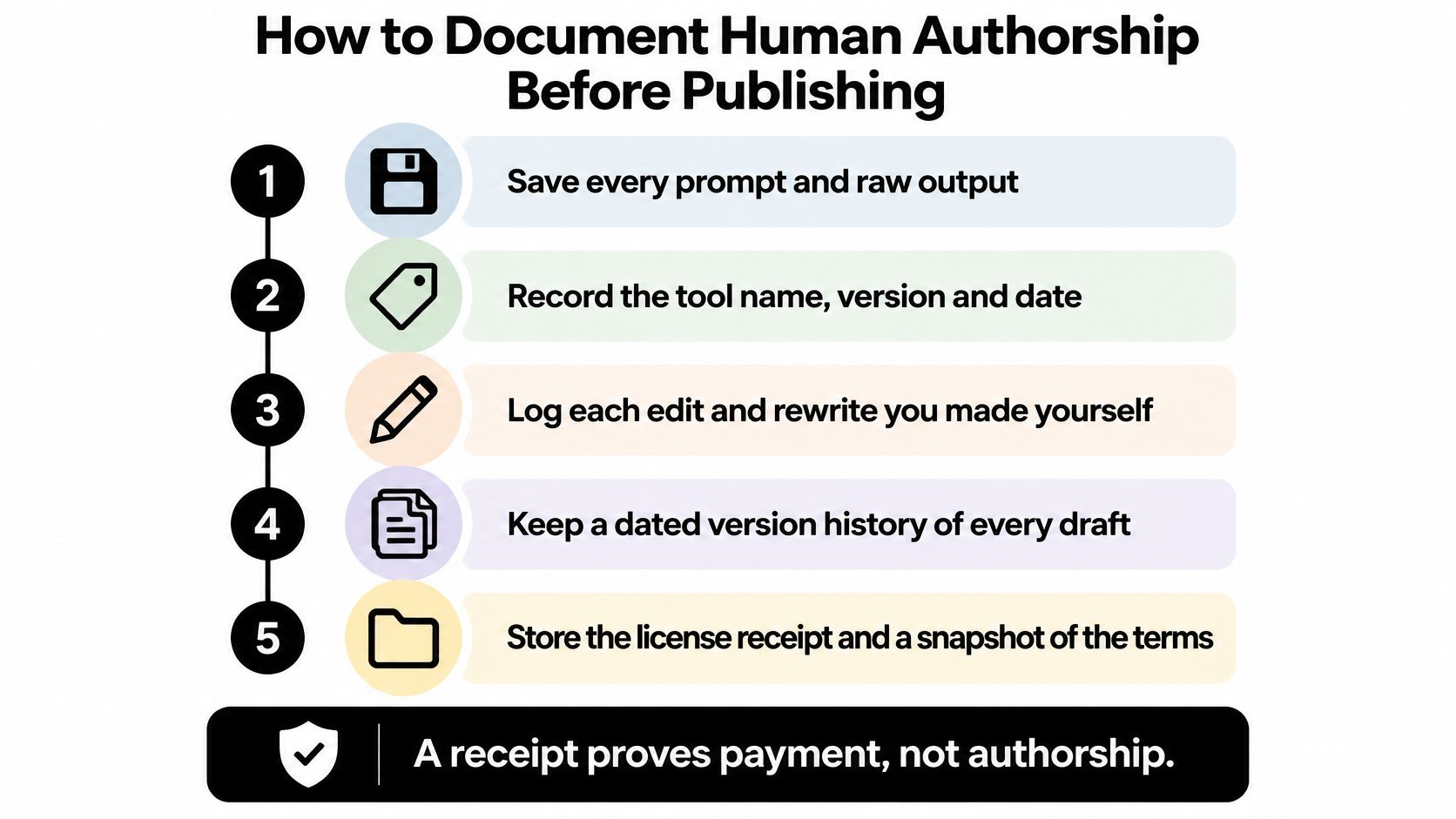 A checklist infographic detailing five essential steps for authors to document AI human creation process before publication.
Build a traceable creative record
-
Save prompts and untouched output. Export the starting material with dates, the tool name, and any available version information. The common slip is saving only the finished lyric sheet, which hides the difference between machine output and your work.
-
Mark your actual writing. Use tracked changes in Microsoft Word, Google Docs version history, or a clearly annotated lyric sheet to identify rewritten punchlines, new lines, cuts, and reordering. Correcting punctuation alone won't demonstrate the same expressive contribution as rewriting the verse.
-
Record arrangement decisions. Note where the hook lands, which lines you selected, how verses connect, and how you placed them against the beat. Save a short explanation rather than an unexplained list of timestamps.
-
Log performance and production. Identify who performed, when recording occurred, and which takes or production changes you selected. Keep session files and performer permissions together, while distinguishing performance evidence from evidence that you wrote the words.
-
Keep a coherent version history. Store drafts, marked-up lyrics, session notes, and exports in a project folder with consistent filenames. Scattered screenshots are harder to interpret than a dated sequence showing how the track developed.
-
Attach a concise contribution summary. Describe what the tool supplied and what each human contributor wrote, arranged, performed, or produced. Don't claim the whole output as human-written when your records show otherwise.
A worked example without the victory fiction
Consider a hypothetical creator answering a distributor's authorship question. Their folder contains dated prompts, an untouched generated draft, marked-up lyrics showing rewritten punchlines, an arrangement note placing the hook after bar eight, and a contribution summary attached to the export.
That creator can assemble a meaningful response from existing records rather than reconstructing the process from memory. A creator holding only a plan receipt can establish access to the service, but not explain who supplied the expressive wording.
Evidence standard: Someone outside the session should be able to distinguish the generated starting point from your creative contribution.
Keep the licence receipt and a snapshot of the applicable terms beside the creative record, not instead of it. Neither elaborate documentation nor extensive editing guarantees copyright protection, but accurate records let you make narrower, better-supported claims.
For client delivery, provide the summary and relevant permissions without dumping private prompts or unnecessary personal information into the handoff. Preserve the complete archive in case a more detailed review becomes necessary.
Platform and Client Rules That Apply After Generation
The track leaves the generator, and a different set of decision-makers takes over. YouTube, TikTok, distributors, advertisers, and clients can apply their own acceptance and monetization rules; Stability AI's commercial-use explainer distinguishes tool permission from destination-platform requirements and flags separate issues involving uploaded material, voices, and likenesses.
A clean licence folder doesn't guarantee catalog acceptance. A platform's acceptance doesn't prove you cleared the underlying rights, either.
Keep the destination review alongside the release session.
 A woman working on her laptop in a cozy home office setting with a podcasting microphone.
Ask each destination the right questions
- Disclosure: Does this service or client require disclosure of AI-assisted lyrics, generated audio, or synthetic performances?
- Acceptance: Does it accept this category of AI-assisted content, and what evidence does it request?
- Monetization: Does it restrict advertising, revenue sharing, sponsored use, or distribution of generated audio?
Save the relevant policy text and your submission answers. Don't copy a disclosure from another creator whose workflow differs from yours.
Adapt wording such as: This track uses AI-assisted lyric drafting. The final lyrics were edited and arranged by the creator, who also performed the vocal. Delete any statement that isn't true, and add generated-audio details when relevant.
Make client promises match the file
A starting clause for legal review could read:
Client-use clause: The creator grants only the rights identified in the attached rights schedule. The schedule identifies AI-assisted components, third-party material, permitted media and territories, and any outstanding approvals. Uses outside that scope require further clearance.
Avoid an unrestricted ownership warranty when you're delivering a mixture of original writing, generated text, and licensed audio. The client needs a usable rights schedule, not a heroic promise you can't defend.
For a third-party beat in video, route composition permission to the songwriter or publisher and recording permission to the master owner. Our guide to synchronization rights explains that audiovisual layer.
For public or online play, determine whether the venue, organizer, broadcaster, or service holds the necessary licences. Don't assume joining a rights organization clears someone else's song.
Finish the audit by checking prompts, uploads, generated lyrics, human edits, vocals, and final distribution against the intended campaign. International distribution requires particular attention to territory, local rights, and whether your permissions cover the actual audience and media.
Confirm Your License Before You Publish
Treat approval as a release decision, not an account-status check. You need to know what you're publishing, where it will appear, and which documents support that use.
At DissTrack AI, our Free and Creator plans include basic voice styles, standard audio quality, priority support, and a commercial license. We also offer a free trial with no credit card required. Those plan features don't replace clearance for outside material or your destination's rules.
Assemble the release packet
-
Match the use case. Identify whether this is a monetized video, sponsored post, client delivery, audio release, or public playback. List every intended destination rather than describing the project as social content.
-
Read the grant. Confirm permission to edit, publish, monetize, and authorize client use where needed. Check cancellation provisions and retain the terms applicable to generation and release, including any transition rules.
-
Reconcile the final audio. Compare the actual export with your clearance list. A last-minute beat swap needs its own permission check, even if the previous version was approved.
-
Save the evidence before uploading. Archive the authorship record and licence documents alongside the final file. Label the approved export so nobody accidentally publishes an uncleared alternate version.
The practical packet contains a use-case and destination sheet, applicable platform terms, third-party permissions schedule, and human-contribution record. If no third-party material appears, record that conclusion and the basis for it rather than leaving an unexplained blank.
Use current written terms, but don't assume today's page automatically governs older generations or releases. Check effective dates and any provisions addressing earlier output.
Your next action is concrete: match the release to a row, collect the release documents, resolve any missing permission, and only then authorize publication. The upload button isn't going anywhere.
Where to Clear Third-Party Music
Start with the final export, not the folder of assets you originally intended to use. Listen through and identify every outside beat, sample, backing track, vocal, and sound effect that remains audible.
For each item, record both the underlying musical work and the recording, where applicable. The producer who sent the file may not control every element inside it.
Route each request to the actual owner
- Composition permission: Contact the songwriter, publisher, or authorized administrator. Describe the use and request synchronization permission for video, or the applicable mechanical permission for audio reproduction.
- Recording permission: Contact the master owner for authorization to use the specific recording. A sample can require attention to both the recording and its underlying composition.
- Public playback and online use: Identify who must obtain the relevant licence. In the UK, investigate PRS for Music and PPL routes; in the US, organizations such as ASCAP and BMI administer musical-work performance rights. Registration or membership alone doesn't authorize every intended use.
- Licensed sound effects: Read the supplier's terms for commercial distribution, client delivery, and any restrictions on standalone redistribution.
Send a request that names the asset, intended media, territories, duration, monetization, advertising use, and planned edits. Vague requests produce vague permissions, which are poor company when a brand asks for proof.
Our commercial music licensing guide can help you organize the request and delivery paperwork. Don't treat a lack of response as approval or assume that permission for a download also covers an advertisement.
File each executed licence with the release, noting its date, territory, media, attribution obligations, and restrictions. If you can't identify the owner or obtain the necessary grant, replace the asset with music you can document. A different beat is cheaper to manage than an unresolved rights problem.
DissTrack AI helps you draft personalized roast lyrics that you can refine into your own performance. Visit DissTrack AI to build your next verse, then save your edits and complete the release permissions before you monetize it.