
What Is Drill Rap Music? Origins, Beats, and Global Scenes
You're halfway through a playlist when the beat changes. The melody turns cold, the bass seems to bend underneath the kick, and the rapper's voice stays almost unnervingly calm. You may recognize the mood before you know the name. What is drill rap music? It's rap built around pressure, restraint, and place, a sound that began in Chicago and later changed shape in London, Brooklyn, and scenes far beyond the United States.
The easiest way to understand it is to follow its movement. Drill carries a recognizable musical skeleton, but each city adds its own accent, slang, rhythm, and social meaning. The result isn't one fixed formula. It's a traveling sound with a strong memory and a restless future.
What Makes Drill Feel Like the Streets Speaking
In a Chicago basement, the track can begin with a thin minor-key loop, a kick, and an 808 that bends under the beat. The producer leaves air between each hit. The rapper enters without a rush, clipping the words and keeping the voice steady, while the room's low ceiling seems to press down on every bar.
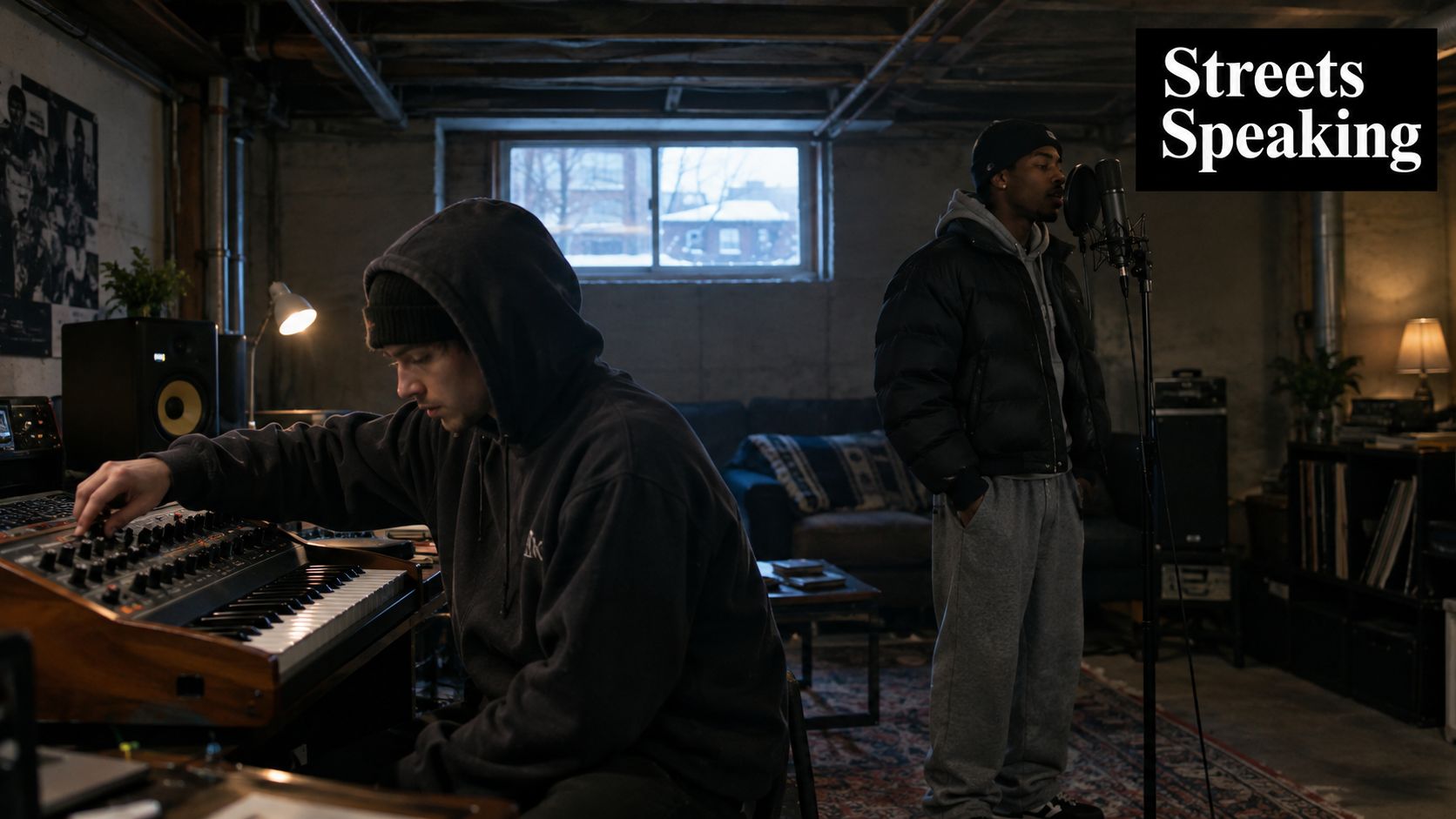 Two young men in a dimly lit basement studio recording music with a synthesizer and microphone.
Drill rap is a street-rooted rap subgenre that turns neighborhood tension, loyalty, fear, ambition, and survival into rhythm. Its force comes from restraint. A sparse arrangement gives the bass room to lurch, the drums room to snap, and each syllable room to sound deliberate. Silence becomes part of the pressure.
The blueprint travels, then changes. Chicago's stark spaces and watchful delivery can reappear in London with tighter flows and a different club pulse, or in Brooklyn with local cadences and a new accent. The sound keeps its dark skeleton while each scene supplies its own streets, slang, and social meaning.
The central feeling: drill sounds controlled on the surface and volatile underneath.
Lyrics often draw on hyperlocal conflict and street realism. Academic discussion also treats them as stylized performance rather than automatic documentary evidence. Drill therefore speaks through environment, imagination, identity, and audience. Its menace matters, but the music also carries pride, frustration, ambition, and the pressure of being heard.
The result is a form that can feel intensely local and still travel widely. Its recurring bass slides and empty spaces provide the recognizable DNA. Cities reshape that DNA in real time.
How Drill Took Chicago Before Taking Over the World
A basement session on Chicago's South Side could begin with a spare beat, a microphone, and a rapper naming the pressure of a particular block. In the early 2010s, those recordings moved through neighborhood studios, mixtapes, and street-level circulation, forming a sound tied to local rivalries and daily uncertainty (Drill music history). The records felt immediate rather than polished for export. Producers used limited musical materials, while rappers delivered each line with a controlled, heavy presence.
Chief Keef's 2012 breakout single “I Don't Like” carried that local sound into the U.S. mainstream. Listeners far beyond Chicago could now hear a style shaped by South Side streets, basement sessions, and conflicts they had never witnessed.
A sound amplified by conflict
Drill's visibility arrived with scrutiny. News reports often centered on violence, police attention, and arguments over whether lyrics could intensify disputes. That framing brought more attention while encouraging outsiders to read performance as direct evidence of criminal activity, rather than as a stylized form shaped by place, identity, and audience.
The internet widened the route from one scene to another. A Chicago beat could reach a producer overseas, then return as a local version instead of a carbon copy. London artists kept the low-end weight and stark delivery but rebuilt the rhythm around their speech patterns and production habits. New York artists followed a related path, joining drill's cold atmosphere to an established U.S. rap tradition.
By 2021, BBC reported that drill had spread from Chicago to at least 10 major cities worldwide, including London, New York, Paris, Amsterdam, Lisbon, Stockholm, Sydney, Dublin, Seoul, and Kumasi (BBC's global drill feature). The same BBC coverage reported that Chartmetric found London overtook Chicago in 2020 as drill's biggest Spotify market by average monthly listeners for the top 100 drill artists.
The change was cultural as much as commercial. Chicago supplied the first widely recognized blueprint, while London and Brooklyn reshaped its rhythm, accent, and local meaning. Drill crossed borders because its core was recognizable, yet open to mutation.
The Sonic Blueprint Behind the Dark Minimal Beats
A kick cuts through the room, then leaves a pocket of silence. Beneath it, an 808 bends between notes while hi-hats chatter in clipped bursts. Drill builds its pressure from that conversation between impact and empty space, not from a crowded arrangement.
The commonly cited tempo sits around 60 to 70 BPM, giving the beat a measured, marching pulse (LibreTexts' drill music reading). Urgency comes from the gaps, the sudden drum accents, and the bass movement. The track can feel tense while leaving the rapper room to speak.
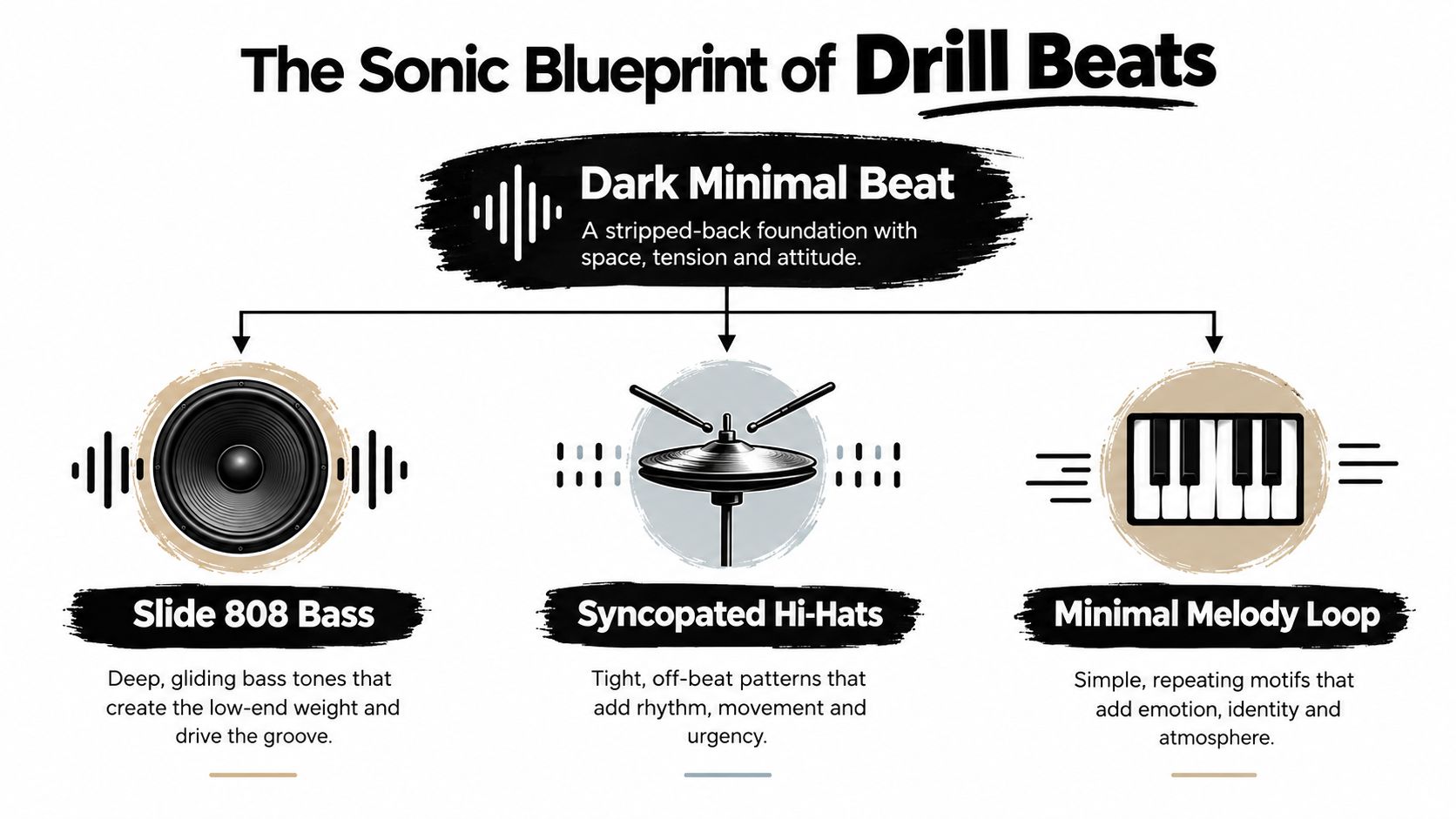 A diagram illustrating the core musical elements of drill beats: slide 808 bass, syncopated hi-hats, and minimal melody loops.
Three layers carry the pressure
| Layer | What you hear | Why it matters |
|---|---|---|
| Slide 808 bass | A sub-bass note glides between pitches instead of staying fixed | It adds instability and physical weight |
| Rolling hi-hats | Fast, syncopated bursts interrupt the main pulse | They create nervous motion without filling the mix |
| Minimal melody loop | A short minor-key motif repeats with limited variation | It keeps the mood bleak, focused, and memorable |
Producers often join these parts to simple repeating motifs. Rappers then fit flat or monotone cadences into the pattern, sometimes with Auto-Tune (Music Production Wiki's drill production guide). Pauses, clipped phrases, and controlled pitch make the voice feel embedded in the beat's machinery rather than placed above it.
That restraint changes the listener's focus. A dense melody can soften the setting, while sparse backing leaves each word exposed. One bass slide can imply instability without adding an instrument, and a hi-hat roll can surround a calm delivery with restless motion.
Watch the embedded breakdown for a visual sense of how these parts interact:
GarageBand producers can use GarageBand Flex Time tricks to test timing changes and adjust small rhythmic details without losing the pocket. For arrangement ideas, compare these choices with a practical guide on how to make rap beats. Together, the bass, drums, and controlled vocal space form a blueprint that travels well, even as Chicago, London, and Brooklyn reshape its accent.
Chicago vs UK vs Brooklyn Drill Scenes Compared
A Chicago block party can turn sparse 808s and clipped verses into a neighborhood report. In London, the same low-end pressure slips through tighter drum patterns, while a Brooklyn crowd hears that British tension pushed through an American rap delivery. The blueprint travels, then each city changes its accent.
Chicago drill supplies the historical root. Its early identity grew from South Side realities, local references, stark production, and direct storytelling. The vocal approach often sounds conversational yet guarded, with details delivered through a lived neighborhood vocabulary. The beat leaves room for those details to sit in plain view.
UK drill reshaped that foundation in London. Producers built more intricate drum programming, sliding bass movement, and grooves that keep shifting beneath the rapper. British slang, local geography, and clipped cadences sit inside the rhythm, so the flow can feel like a maze of interlocking turns rather than a straight march.
Brooklyn drill links the American and British branches. Its delivery keeps the force of U.S. rap, while hard, agile percussion draws from UK drill. Melodic instincts appear more openly in some tracks, but heavy bass and sharply placed drums preserve the pressure.
| Scene | Shared DNA | Local signature |
|---|---|---|
| Chicago | Sparse melodies, heavy 808s, restrained delivery | South Side storytelling and raw neighborhood specificity |
| UK | Dark atmosphere, bass slides, rhythmic tension | Complex drum patterns, London vocabulary, and tightly packed cadences |
| Brooklyn | Hard percussion, low-end weight, direct flows | A U.S. bridge between melodic rap instincts and UK-inspired production |
The scenes are chapters in one moving sound. Chicago establishes the root, London re-engineers the rhythm, and Brooklyn sends the form back across the Atlantic with a different accent.
The useful comparison asks what each city does with the same dark, minimal pulse. Chicago places it beside firsthand neighborhood detail. London makes the rhythm twist and snap. Brooklyn joins that percussion to American melodic and vocal instincts, proving that drill's identity can travel without staying unchanged.
How Drill Changes Across the World and Why It Matters
A Paris crowd may catch the bass slide first, then hear the rapper bend it around French phrasing. In Melbourne, the cadence settles differently against the drums. Lagos artists can pull local rhythmic instincts and language into the flow, while a Tbilisi track may make the Chicago starting point feel far away. The blueprint travels, then changes accent at every stop.
Coverage identifies recognizable drill variants in France, Melbourne, Lagos, and Tbilisi, and describes UK drill as a template-setting force (SongBrain's global drill overview). Those scenes show why drill cannot be reduced to an American or British subgenre. Chicago supplied a foundation, London reshaped its movement, Brooklyn connected those approaches, and other cities continue to mutate the form.
Language determines how many syllables fit comfortably in a bar. Local slang decides whether a line sounds threatening, funny, intimate, or forced. Regional drum traditions can make the groove feel straight, swung, hurried, or open. A melody may also carry the memory of a city's own musical traditions.
Why global drill doesn't sound identical
A producer can copy sliding bass and sparse melody, yet the track still needs a local voice. Digital platforms spread references quickly, but imitation alone rarely gives a scene its identity. Artists translate the form through familiar streets, accents, social references, and emotional pressure.
A useful listening guide follows the mechanics beneath the surface:
- Cadence: Where does the rapper pause, stretch a word, or fall behind the beat?
- Local texture: Which streets, phrases, accents, and social references make the record specific?
- Arrangement: How much space sits between the vocal, bass, hats, and melody?
- Adaptation: What changes make the style belong to that market?
Drill works as a conversation between a shared blueprint and local invention. Its international life shows a framework in motion, with each city answering the last one in its own voice. That exchange matters because it keeps the genre connected to place, even as the sound crosses oceans.
The Controversy Around Drill Lyrics and Performance
At a Chicago block party, a rapper can turn a neighborhood feud into a sharp hook, then deliver it with a grin that makes the line feel half threat, half theater. In a London club, the same kind of performance may arrive through clipped syllables, stark visuals, and local references that outsiders cannot fully read. Drill often makes that boundary difficult to see. Listeners may hear a constructed persona, while investigators, prosecutors, politicians, or media outlets may treat the words as evidence of real conduct.
The debate has stayed especially visible in the UK, where drill lyrics have continued to appear in courtroom disputes and political arguments about whether lyrics should be admissible as evidence (The Guardian's drill coverage). Civil-liberty and academic perspectives frame the dispute around artistic expression, context, and whether drill receives more suspicious treatment than other rap styles.
Performance isn't a police report
A verse about violence can draw from lived tension, fictional positioning, rivalry, bravado, or a deliberate attempt to build a dangerous character. The same bar may carry several of those purposes at once. Calling it stylized performance rather than straightforward documentary evidence keeps attention on voice, genre conventions, and the gap between a lyric and a verified event.
That framing does not make every lyric harmless or erase the pain behind real events. It does require careful interpretation. A chorus can provoke without serving as a confession. A video can use estate blocks, street signs, colors, or hand gestures without giving a complete account of everyone shown. Reading every line as plain fact removes the craft that makes rap performance work.
Context matters: A lyric's meaning depends on voice, genre conventions, audience, imagery, timing, and the relationship between the artist and the listener.
Platform moderation adds pressure. Social-video feeds reward immediacy, repetition, and visual confrontation, while the same services may remove or restrict material that appears threatening. Drill artists therefore build connection through recognizable detail while facing suspicion that their authenticity proves criminal intent.
For writers, the dispute offers a practical lesson. Study how a bar creates a character, how a pause can turn menace into irony, and how a local detail makes a scene feel lived-in. Questions about ownership and protection require a separate legal lens, and this guide to whether lyrics are copyrighted provides context without treating artistic performance as legal fact.
Practical Tips for Writing and Producing Drill-Style Tracks
A drill beat can feel tense before the rapper says a word. Start with a slow-to-mid tempo in the genre's established range, then build a dark minor-key motif that repeats like a signal. One haunted piano phrase or cold synth figure often gives the track more identity than a crowded arrangement.
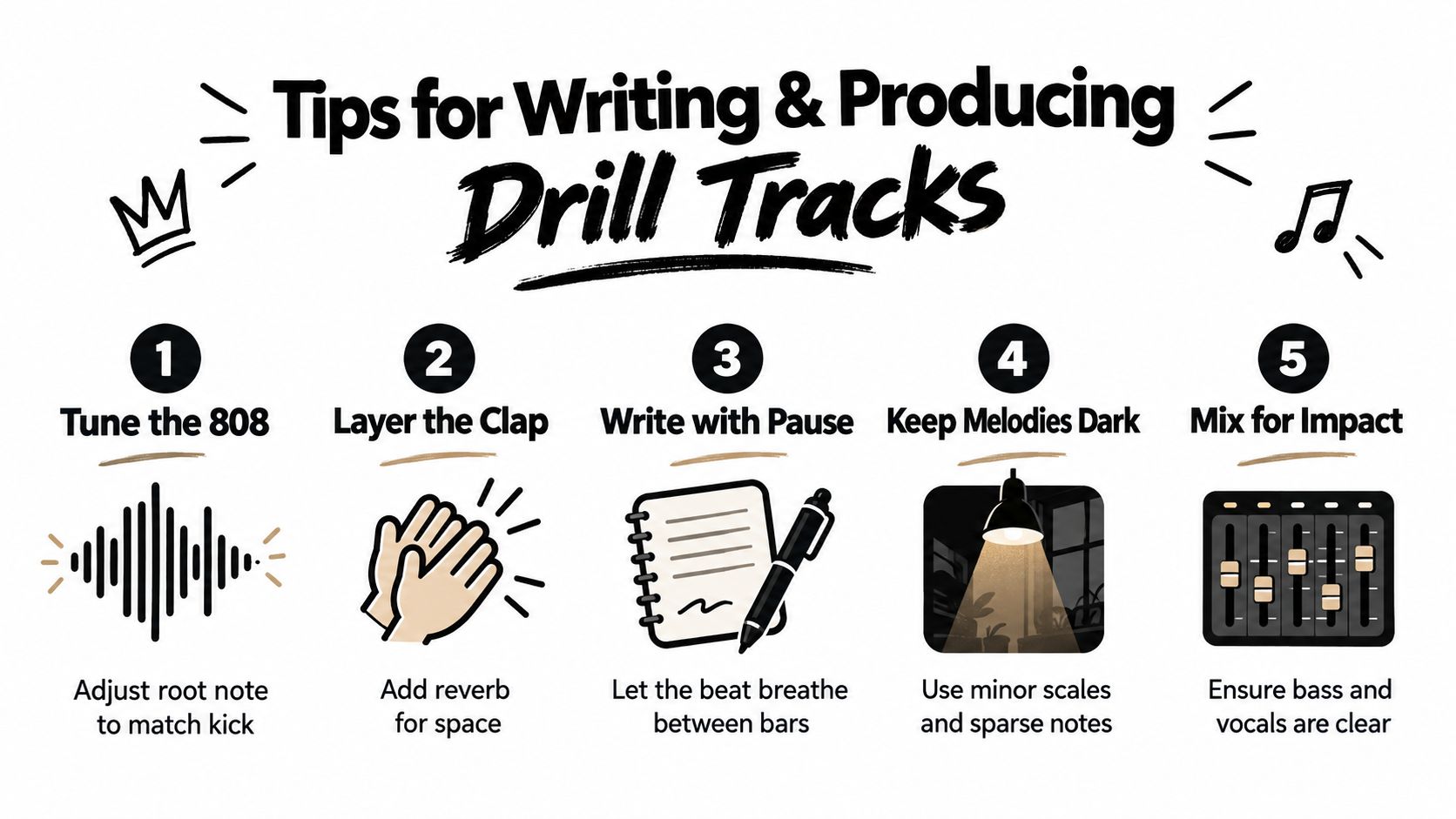 A five-step guide on how to produce and write drill music tracks shown in an infographic.
Build the instrumental in layers
-
Tune the 808 first. Match its root note to the key and shape each slide deliberately. A glide should feel like a turn in the story, not a random effect.
-
Give the drums room. Place the kick and clap with purpose, then add rolling hi-hats in short bursts. Constant activity across every subdivision removes the tension created by space.
-
Write around pauses. Draft a bar, remove a phrase, and listen to the silence. A gap before the final word can make the delivery feel heavier than another crowded line.
-
Keep the melody narrow. Use minor scales, sparse notes, and a repeating motif. Let the melody establish the atmosphere while the bass and vocal control the track's movement.
-
Mix for impact. Keep the sub-bass powerful but readable, and leave enough separation for an intelligible vocal. Darkness in the mix should not bury the words.
Write locally, perform calmly
A stairwell, bus route, shopfront, estate, block party, or late-night studio gives a verse somewhere to stand. Choose one setting, then build internal rhymes and compact punchlines around what the character sees, wants, fears, or refuses to reveal.
The same blueprint changes with its city. Chicago phrasing can sit heavily against the beat, UK delivery can sharpen the clipped rhythm, and Brooklyn voices can connect the form to another American rap current. Study those regional choices without borrowing another city's slang as decoration. Write from your own vocabulary and let local speech shape the cadence.
A deadpan voice can carry humor, grief, arrogance, or warning. The words before and after each pause decide which meaning reaches the listener.
For structured prompts and drill-oriented writing experiments, the drill rap lyrics generator can offer raw material to edit by hand. Replace generic lines with details only you can supply, then test the verse against the beat's silences, bass movement, and changing regional feel.
Why Drill Still Dominates Modern Rap Culture
A Chicago block party can turn a sparse loop into a crowd response: the 808 slides, hats twitch, and the rapper's measured voice cuts through street noise. In London, that same pressure moved into clubs, where clipped flows and darker rhythms reshaped the room. Brooklyn connected the blueprint to another American rap current.
Drill lasts because its parts travel well. Sparse melody, sliding bass, restless hats, and controlled vocals remain recognizable even when local references and language change. Producers can carry that framework across cities, while rappers use the open space to make cadence and perspective central.
Its reach extends beyond artists who call themselves drill rappers. Contemporary rap borrows the bass movement, clipped delivery, bleak loops, and confrontational pacing, then rebuilds them inside other subgenres. The form survives through mutation, not repetition.
Listen for the mutation
When a drill-inspired track starts, follow four details:
- The low end: Does the 808 stay grounded or slide between notes?
- The silence: Which gaps make the vocal feel more threatening?
- The accent: How do local speech patterns reshape the cadence?
- The point of view: Is the rapper reporting, performing, exaggerating, mourning, or provoking?
Chicago established a powerful vocabulary. London reworked the rhythmic grammar. Brooklyn tied those ideas to another American rap current, while scenes elsewhere translate the structure into their own musical languages.
So, what is drill rap music? It is controlled pressure made from minimal parts and given meaning by place. The beat leaves room, and artists fill it with identity, whether they are describing a block, a housing estate, or a city night.
DissTrack AI lets you generate personalized roast lyrics with selectable styles including Drill and UK Grime, then edit the verses, punchlines, and tone for your own performance or content. Visit DissTrack AI to experiment with drill-inspired cadence without waiting for the first line to arrive.