
What Is Natural Language Processing and How It Works
Natural language processing is the branch of AI that lets computers read, understand, and produce human language. It matters because every time you ask a phone for directions, finish a sentence with autocomplete, or get a chatbot reply that sounds oddly human, NLP is doing the heavy lifting.
You're probably already using it without thinking about it. A message gets filtered as spam, a customer-support bot answers a question, or a search engine guesses what you meant instead of what you typed. That everyday usefulness is why what is natural language processing has become such a common question, and why the answer is more practical than academic.
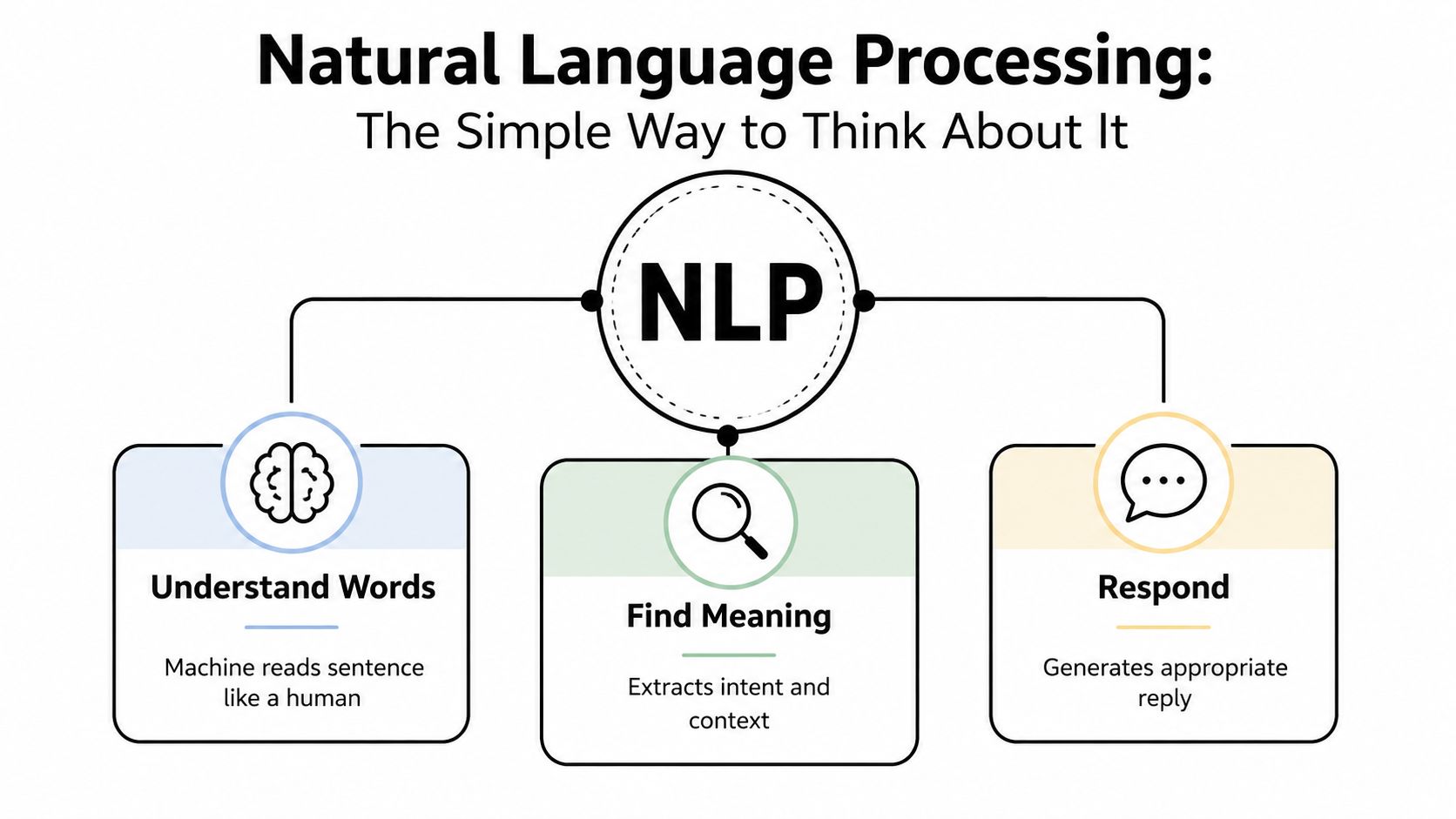 A simple infographic explaining Natural Language Processing, featuring its three core functions: understanding, finding meaning, and responding.
Think of NLP as a translator between two very different worlds. Humans write sloppily, casually, and full of context. Computers prefer tidy labels, numbers, and structure, so NLP turns messy language into something a machine can work with, then turns the result back into a response people can use. IBM describes NLP as a subfield of computer science and AI that uses machine learning to help computers understand and communicate with human language, while ISO frames it as enabling systems to analyze, interpret, and generate language in meaningful ways (IBM NLP overview).
If you want a broader map of the AI field, a useful companion is six key AI models overview, which helps separate language systems from other model types. That context makes NLP easier to place, because not every AI tool is trying to read or write text.
The Simple Way to Think About Natural Language Processing
The easiest mental model is this, NLP helps a machine do three things with language, understand it, find meaning in it, and respond to it. That's why it powers voice assistants, search boxes, translation tools, and chatbots. When you speak into your phone and it turns your sentence into an action, the system is not “reading” the way a person reads, but it is carrying out a workflow built to approximate that ability.
A helpful analogy is a very fast assistant with three jobs. First, it hears or reads the words. Second, it decides what those words probably mean in context. Third, it produces the next step, maybe a label, a translation, a summary, or a reply. That's the basic shape of NLP across almost every product category, from support automation to content generation.
Practical rule: if a product handles text or speech in a way that depends on meaning, not just matching keywords, NLP is probably involved.
That's also why NLP is different from adjacent AI fields. Speech recognition turns sound into text, but NLP interprets the text. Computer vision handles images and video, while NLP handles language. The overlap matters, because many modern apps combine them, but the core job of NLP is still language processing. In practical terms, it helps software move from raw words to structured intent.
The market side of the story shows how far the field has moved. MarketsandMarkets estimates the global NLP market at USD 69.13 billion in 2026, up from USD 52.06 billion in 2025, and projects USD 216.89 billion by 2031 at a 25.7% CAGR (MarketsandMarkets NLP market). Those numbers don't tell you how NLP works, but they do show that it's no longer a niche research topic. It's a core layer in modern software.
How NLP Grew From Rules to Language Models
A rule-based parser could handle a tidy sentence on a good day. The same system often fell apart when a sentence was slangy, emotional, or just phrased in an unexpected way. Early NLP began with hand-built grammar logic, token handling, and pattern matching, and those methods only worked inside narrow boundaries. IBM's overview of the field points to the 1950s and 1960s shift from rule-based language processing toward statistical and corpus-based methods, including tokenization and frequency analysis, which later became core preprocessing steps in NLP pipelines (IBM NLP overview).
That shift changed the whole mindset. Researchers stopped asking, “What are the rules of language?” and started asking, “What patterns repeat across lots of text?” It was a huge change in engineering philosophy. A rules-only system expects humans to anticipate every exception, while a statistical system learns from examples and handles variation much better.
The old rule-based era also explains why early chat systems felt brittle. They could sound smart in demos, but once a conversation moved outside a narrow script, the illusion collapsed. Modern language models are stronger because they absorb large text patterns and infer likely responses from context rather than from a tiny set of handwritten rules.
Language became useful for computers when engineers stopped trying to describe every sentence and started teaching systems to spot recurring patterns.
That transition paved the way for today's pipeline, where machine learning, deep learning, and transformers dominate. AWS describes modern NLP as a pipeline that converts unstructured text or speech into structured representations, then applies machine learning to tasks like classification, extraction, translation, summarization, and generation (AWS NLP overview). In plain English, NLP moved from grammar books to data-driven systems, and that is why today's tools can handle search, translation, and conversation in ways older software never could.
The Core NLP Pipeline You Can Picture in Your Head
A good way to understand NLP is to follow one sentence through the machinery. Suppose the input is, “I love this weird little app.” The system doesn't start with meaning. It starts by breaking the sentence into pieces it can handle. That's important, because computers need clean units before they can infer anything useful.
From text to numbers
The first cleanup step is tokenization, which splits the sentence into words or subword units. Then systems may remove very common words, reduce words to their root forms, and tag parts of speech. In a classic pipeline, those steps help separate signal from noise before the model gets to work. The point isn't to make language pretty, it's to make it computationally useful.
After that comes the next move, turning words into embeddings. DeepLearning.AI explains that models learn relationships between words, phrases, and sentence context from training data, and that this numerical representation is what makes tasks like sentiment analysis, semantic search, and information extraction possible (DeepLearning.AI NLP resources). The exact math stays under the hood, but the intuition is simple, similar words end up close together in vector space, and that proximity lets the model generalize.
How order and attention matter
Once language is numerical, the model has to decide what matters. Sequence models like RNNs and LSTMs were built to pay attention to word order, while transformers introduced attention mechanisms that let the system weigh relevant parts of the sentence more flexibly. For a phrase like “not good,” that distinction matters a lot, because the word not changes the entire meaning of good.
Useful shortcut: tokenization breaks the sentence apart, embeddings turn the pieces into numbers, and the model learns which numbers belong together.
Here's a compact view of the classic pipeline.
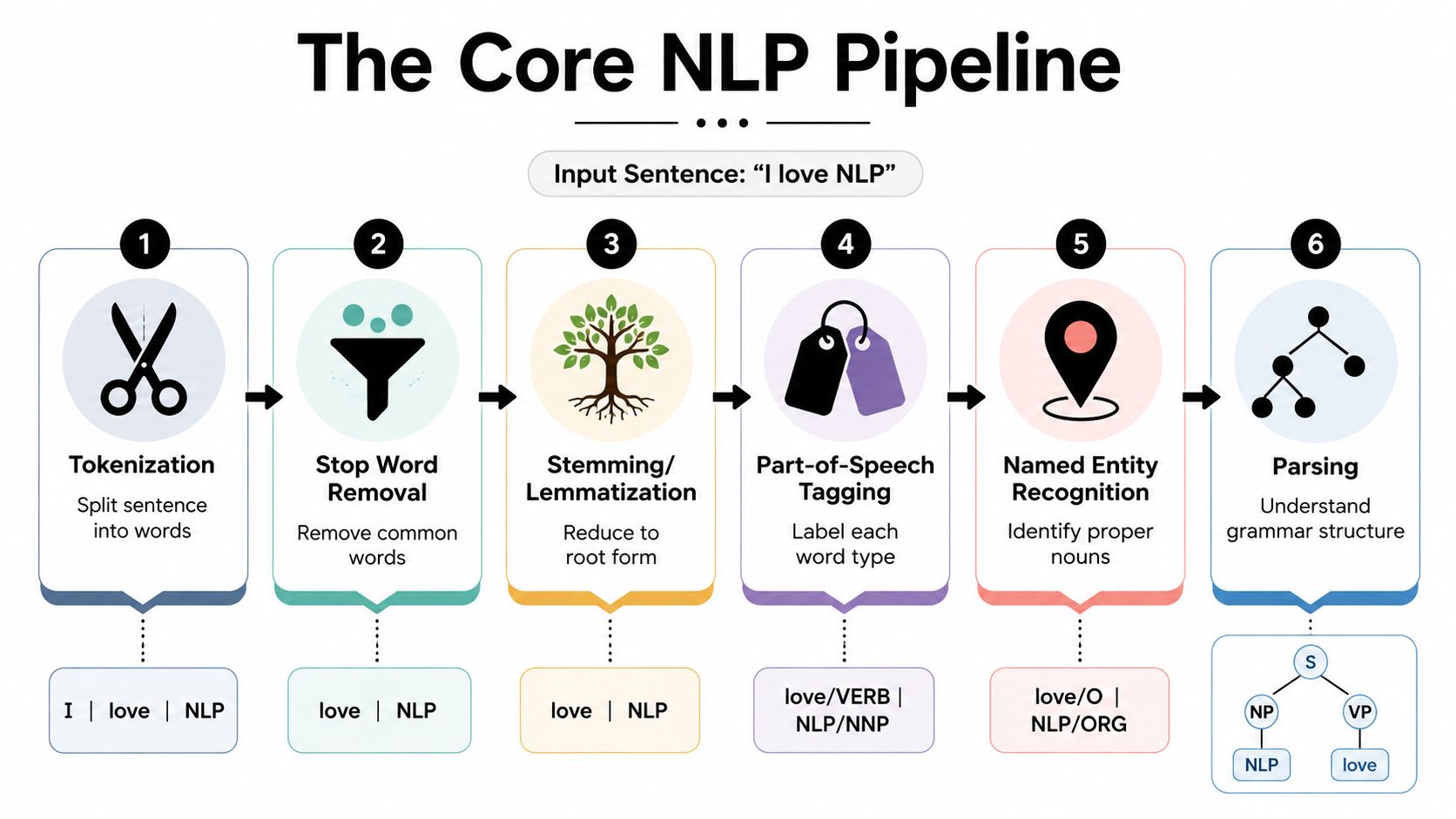 A diagram illustrating the six core steps of a natural language processing pipeline for the sentence I love NLP.
| Step | What it does | Why it matters |
|---|---|---|
| Tokenization | Splits text into units | Gives the model pieces to analyze |
| Cleaning | Removes noise like filler words | Reduces clutter |
| Normalization | Groups word variants | Helps the model recognize related forms |
| Tagging | Labels word roles | Clarifies grammar and structure |
| Representation | Converts words to vectors | Makes meaning machine-readable |
| Prediction | Produces output | Creates a label, summary, or response |
If you want a playful use case that shows these layers in a creative setting, take a look at how to generate lyrics from audio, where language processing and generation get used in a more musical workflow. It's a nice reminder that NLP isn't just about search bars and support bots.
The Tasks NLP Solves Every Day
A useful way to picture NLP is as a set of jobs that text can be sent through, the same way a kitchen line sends ingredients to different stations. One system checks the tone, another pulls out names, another rewrites the wording, and another creates fresh text from a prompt. Each job answers a different question, which is why a single polished product can hide several NLP tasks underneath.
What each task is really doing
Classification asks, “What kind of text is this?” Sentiment analysis, spam detection, and topic labeling all fit here. A customer review tool might flag a message as positive or negative, while an email client decides whether a message looks suspicious.
Sequence labeling asks, “Which words need special attention?” Named entity recognition and part-of-speech tagging live here. These systems help identify people, places, organizations, dates, and grammatical roles, which is why they show up so often in search and document tools.
Transformation asks, “How can this text be reworked?” Translation, summarization, and paraphrasing are the usual examples. A writing assistant that shortens a long paragraph is doing a transformation job, not generation in the narrow sense.
Generation asks, “What should come next?” Chatbots, content assistants, and code helpers all generate new language based on context. The model uses what came before to continue the thought in a way that fits the prompt.
A useful real-world example is how some email tools suggest replies. They are not only predicting words, they are classifying intent, summarizing context, and generating a suitable response in one flow. Product teams often chain several NLP tasks together so the user never sees the machinery underneath.
| NLP Task | What It Does | Example Product |
|---|---|---|
| Sentiment analysis | Detects tone or opinion | Review moderation tools |
| Named entity recognition | Finds names, places, dates | Search and document systems |
| Translation | Converts text between languages | Google Translate |
| Summarization | Condenses longer text | News and note tools |
| Text generation | Produces new text | Chatbots and writing assistants |
For teams thinking in more global terms, Unfloppable global growth tips is a useful reference point because it shows how language tools often sit inside broader localization workflows. That broader lens matters, since NLP is rarely a one-task product.
Inside DissTrack AI and How NLP Powers a Roast Generator
DissTrack AI is a good example because it makes the invisible pipeline easy to picture. A user enters a target's name, relationship, and a few personal details, then picks a style like West Coast, Old School Boom Bap, Trap, or UK Grime. Under the hood, the system has to turn that free-form prompt into something a language model can shape into a punchy verse.
The first pass is tokenization. The system breaks the prompt into pieces, so a model can separate the target's identity from the style request and the flavor text. That sounds basic, but it's the difference between “Jake, my college roommate” and one long blob of text with no structure. Once tokenized, those inputs can be turned into embeddings, which help the model connect the user's prompt with the patterns it learned from battle-rap style text.
 Screenshot from https://aidisstrackgenerator.com
Why style and tone feel controllable
The style tags act like conditioning signals. If the user chooses a grime-oriented setting, the model is nudged toward vocabulary, rhythm, and phrasing that fit that lane. If the savagery slider changes, the tone shifts without rebuilding the whole system from scratch, because the model is being guided at generation time rather than retrained every time someone wants a meaner punchline.
That's where generation gets fun. The model doesn't just spit out random lines. It has to keep a persona in mind, maintain some rhythmic structure, and assemble internal rhymes and punchlines that match the requested tone. That's a classic NLP challenge, because the system needs context, style control, and coherent output all at once.
If you're interested in how language tools are packaged for creators, workflow for AI explainer scripts offers a useful parallel, since it shows how structured prompts can guide a model toward a specific content format. DissTrack AI uses the same broad idea, but for roast lyrics instead of explainers.
For users who want a rap-voice angle, there's also the AI rap voice guide, which sits naturally beside lyric generation. Together, they show how NLP can be used to shape both the words and the performance style of a creative output.
Honest Limits and Ethical Questions NLP Still Faces
A language model can sound confident in one sentence and get the next one wrong. That is why NLP can look impressive in a demo and then fail when the input is messy, sarcastic, or full of context the model never saw during training. It may produce fluent text, but fluency alone does not make the result reliable.
The language gap remains one of the clearest limits. A recent policy and review piece notes that major large language models still perform worse in non-English settings, mainly because labeled and unlabeled data are scarce or low quality, and because low-resource language work still leaves many conversational and multimodal tasks underexplored (Stanford HAI language gap review). In practical terms, a system can handle English well and still stumble when the dialect, language family, or cultural context changes.
Reliability is more than accuracy
A model can score well on a benchmark and still miss what a real person meant. Work on social-good NLP points to repeated problems in evaluation, cultural sensitivity, and human-centered performance, since common metrics often overlook empathy, pragmatics, and context. A low-resource NLP paper on evaluation and uncertainty argues that forcing one fixed answer can erase annotator uncertainty, dialect variation, and cultural subjectivity (arXiv paper on evaluation and uncertainty). Language is often ambiguous on purpose, so treating every sentence as if it has only one valid interpretation can create a false sense of certainty.
The ethical questions become sharper once personal data enters the workflow. A tool like DissTrack AI can be playful, but it still processes names, relationships, and inside jokes, and those details can be sensitive if they leave the intended audience. The risk includes privacy leakage, harassment, impersonation, and unwanted exposure, not just a vague concern about data use.
Fluent output is not the same thing as trustworthy output.
Consent and authorship raise another layer of concern. If a language model learns from artist catalogs or public lyrics, the legal and ethical picture can get complicated quickly, especially when the output resembles a living creator's style. Readers who are asking can I publish a song written by AI are really asking a broader question about ownership, permission, and where inspiration ends and imitation begins. Responsible NLP use means treating the model as a useful but fallible system, not as an authority on truth, culture, or authorship.
How to Keep Learning NLP Without Burning Out
Start small, because NLP gets much easier once you've seen the same ideas in multiple forms. If you're curious, watch demos of tokenization, embeddings, and text classification before you dive into code. If you're hands-on, build a tiny sentiment classifier or a toy lyric generator in Python, then inspect where it fails. If you want a deeper path, read classic NLP chapters, then compare them with modern transformer tutorials so the history feels concrete instead of abstract.
A practical starter project is a miniature rap-verse generator trained on a tiny, carefully chosen text set. Keep the goal modest, maybe just generating two or four lines that sound consistent in style. That mirrors the DissTrack AI idea without demanding production-level scale.
- Curious reader path: watch a few interactive NLP demos, then try text classification examples in a browser notebook.
- Hands-on tinkerer path: use Hugging Face models or spaCy to tag entities, classify sentiment, or generate short text.
- Future practitioner path: study one textbook, one survey, and one real pipeline write-up, then revisit them after you've built something.
A good checklist is simple. You understand tokenization when you can explain why text gets split. You understand embeddings when you can explain why similar words live near each other. You understand generation when you can explain why the same prompt can produce different outputs depending on style, context, and decoding settings.
If you want to see these ideas turned into something you can play with, visit DissTrack AI and try generating a custom roast from a name, a few details, and a style tag. It's a fast way to see tokenization, embeddings, and generation working together in one product. If this article made NLP feel less mysterious, that's the same kind of clarity DissTrack AI brings to creative language generation.